Home Blog Page 493

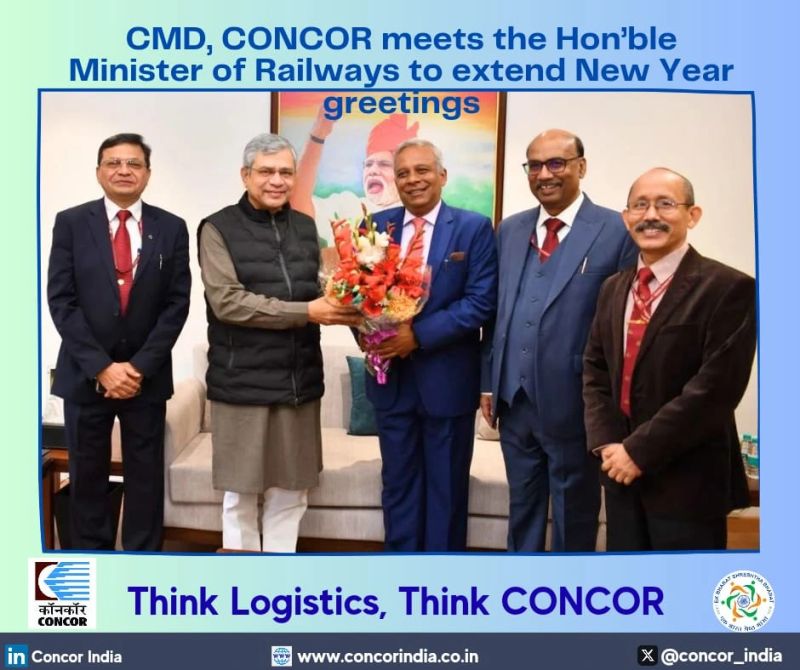
CMD, CONCOR calls on Hon’ble Minister of Railways; extends New Year Greetings

NEW DELHI : Shri Sanjay Swarup, Chairman & Managing Director, Container Corporation of India Ltd. (CONCOR), along with the Directors of the company, met Shri Ashwini Vaishnaw ji, Hon’ble Minister of Railways, to extend warm New Year greetings and convey best wishes for the year ahead.

During the interaction, the Hon’ble Minister appreciated CONCOR’s pivotal role in strengthening India’s logistics ecosystem and enhancing multimodal freight movement across the country. He conveyed his best wishes to the organization for scaling new heights and achieving its ambitious growth and performance targets in the coming year.

The meeting provided an opportunity to discuss CONCOR’s ongoing initiatives aimed at improving operational efficiency, expanding terminal infrastructure, promoting rail-led logistics, and delivering seamless end-to-end logistics solutions to customers. The Hon’ble Minister reiterated the Ministry of Railways’ continued support and guidance in enabling CONCOR to align with the national vision of building a resilient, efficient, and sustainable logistics network.

CONCOR expressed its gratitude to the Ministry of Railways for its steadfast support and strategic direction. The company reaffirmed its commitment to supporting India’s economic growth by enhancing supply chain efficiency, facilitating EXIM and domestic trade, and contributing to the Government’s initiatives such as Gati Shakti, PM Gati Shakti National Master Plan, and the vision of a strong, integrated logistics ecosystem.

Strengthening regional Connectivity: New Glottis Service launched at Kattupalli Port

Adani Ports and Special Economic Zone Ltd. (APSEZ) is pleased to announce the launch of a new fortnightly Glottis service at Kattupalli Port, further strengthening regional connectivity with key Asian markets.

The introduction of this service marks an important step in enhancing trade efficiency by offering faster transit times, improved schedule reliability, and expanded market access for exporters and importers. Designed to support growing cargo demand, the Glottis service will provide seamless connectivity across strategic Asian trade corridors.

More than just a new shipping route, the Glottis service reflects Adani Ports’ continued commitment to enabling smoother, quicker, and more dependable global trade. By expanding its service network, Kattupalli Port aims to simplify supply chains, reduce logistics costs, and foster stronger trade partnerships across the region.

Kattupalli Port remains focused on delivering efficient, customer-centric logistics solutions, supporting India’s trade growth while creating new opportunities for businesses and communities alike.

DPA invites RFQ for development of berth No. 15 & 16 at Kandla

GANDHIDHAM : Deendayal Port Authority (DPA), Kandla has invited Request for Qualification (RFQ) for the “Development, Operation and Maintenance of Berth No. 15 & 16 for handling Multipurpose Cargo (Clean Cargo) and Containers at Kandla Port on DBFOT basis under PPP mode.”

The proposed project aims to significantly augment cargo handling capacity, improve operational efficiency, and promote private sector participation in port-led infrastructure development. The development of Berths 15 and 16 is expected to strengthen Kandla Port’s capability to handle growing volumes of multipurpose and containerized cargo, in line with evolving trade requirements.

Planned under the Public–Private Partnership (PPP) framework on a Design, Build, Finance, Operate and Transfer (DBFOT) basis, the project reflects Deendayal Port Authority’s commitment to leveraging private expertise and investment for modernising port infrastructure.

This initiative marks an important step towards enhancing port competitiveness, improving turnaround times, and supporting India’s expanding maritime trade. It also aligns with the Government of India’s broader vision of developing world-class ports and fostering sustainable growth in the maritime sector.

Deendayal Port Authority continues to play a pivotal role in strengthening India’s logistics ecosystem and advancing the nation’s maritime growth story through strategic infrastructure development and policy-driven reforms.

India plans exporter performance index, rules out export subsidies: DGFT

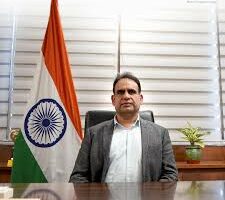
NEW DELHI: India is working on creating an index to evaluate exporters performance based on their Importer Exporter Codes (IECs), tracking performance over a five-year period, Director General of Foreign Trade (DGFT) Mr. Ajay Bhadoo said on Wednesday, as the government sharpens its focus on data-driven export promotion and market diversification.

“Trying to create an index for exporters to evaluate IECs how they’ve fared over 5 years,” Mr. Bhadoo said, adding that the data could be compiled over the next year to support the “acceleration of new market for diversification, bring more exporters.”

Mr. Bhadoo reiterated that India has moved away from export subsidies under its New Trade Policy, aligning its trade framework with global rules. “Not subsidizing exports, FoB subsidy done away with under New Trade Policy,” he said.

Instead, the government is relying on duty remission mechanisms that ensure exports are not burdened with domestic taxes. “Remission is fine to not export taxes on duty foregone basis,” Mr. Bhadoo said, noting that reforms of Special Economic Zones are ongoing. “SEZ reforms underway,” he added.

On trade frictions, Mr. Bhadoo said some policy measures should not be seen as direct responses to external actions. “AS 11 inventory under sport promotion mission not per se in response to US tariffs,” he said. He also acknowledged structural limits in responding to higher global tariffs. “Tariff for over 50% cannot be countered,” Mr. Bhadoo added.

The export promotion mission, according to him, is aimed at addressing deep-rooted challenges faced by exporters. “Export promotion mission trying to resolve long-term Disability that exporters were facing,” he said.

Mr. Bhadoo said the government continues to work on a broad set of policy tools to support exporters, including “other inventories, FTAs, Policy initiatives, preferential market access,” as well as reimbursements through the Remission of Duties and Taxes on Exported Products (RoDTEP) scheme. “Reimbursement via RoDTEP, Advance authorisation scheme is continuing,” he said.

He added that the proposed exporter index could become a key instrument for policy calibration once sufficient data is available.

Source: ANI

DGFT’s strategic policy overhaul and digital integration reshape India’s trade landscape in 2025

NEW DELHI: The Directorate General of Foreign Trade (DGFT) has concluded 2025 with a series of strategic policy updates and digital reforms aimed at strengthening India’s trade facilitation ecosystem.

According to a DGFT press release, the year was marked by the institutionalisation of formal consultations and the expansion of digital platforms to enhance the ease of doing business for Indian exporters.

Throughout the year, the department focused on aligning the Foreign Trade Policy 2023 with evolving domestic and global requirements, ensuring a streamlined process for the issuance of authorisations and the rationalisation of trade measures.

Policy transparency remained a central pillar of the year’s achievements as DGFT amended the Foreign Trade Policy to introduce Paras 1.07A and 1.07B. These amendments institutionalised formal consultations for future policy changes, ensuring greater stakeholder engagement.

Additionally, the department issued several notifications to align India’s Import and Export Policy Schedules with updates to the Customs Tariff and Finance Acts of 2024 and 2025. This regulatory coherence was supported by the restoration and alignment of RoDTEP benefits for Advance Authorisation holders, Special Economic Zones, and Export Orientated Units.

Significant sectoral updates were introduced to stabilise domestic markets and support specific industries. The DGFT launched the Diamond Imprest Authorisation to assist the gem and jewellery sector and extended the “free” import policy for key pulses. Regulatory adjustments were also made regarding synthetic knitted fabrics, urea, platinum, and sensitive food commodities.

Furthermore, the export of wheat to Nepal and broken rice to Senegal was permitted, alongside the facilitation of essential supplies to the Maldives under neighbourhood commitments. In a move to support quality compliance, the export obligation period for Advance Authorisations containing inputs under Quality Control Orders was brought on par with regular authorisations, removing the previous 180-day restriction.

The year 2025 also saw the expansion of the “Source from India” directory on the Trade Connect ePlatform, which now includes exporters with a minimum turnover of USD 100,000 in any of the past three financial years.

To further streamline testing and certification, the pilot phase of “Bharat Aayat Niryat Lab Setu” was launched. This unified digital platform integrates accredited testing and inspection agencies, providing exporters with centralised access to lab services. The system aims to reduce dwell time and improve transparency through real-time visibility of laboratory operations.

Digital reforms continued to build upon the IT system revamp initiated in 2020. Key measures included the online redemption facility for EPCG licences and the introduction of a digital facility for exporters to correct unutilised duty-free import authorisations.

The DGFT also addressed strategic security by updating the SCOMET list, reflecting international best practices and proposals from the Wassenaar Arrangement. These combined efforts across policy and technology have focused on end-to-end automation and improved service delivery to simplify cross-border trade operations for the Indian business community.

Source: ANI

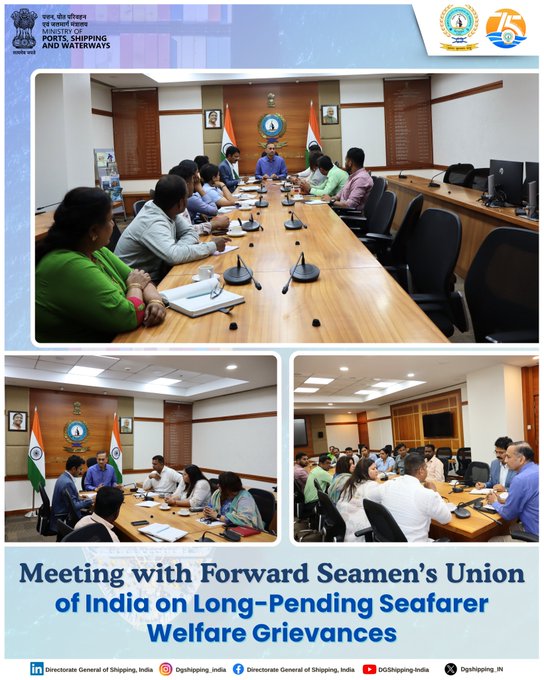
DG Shipping holds meeting with Forward Seamen’s Union to address long-pending seafarer grievances

MUMBAI : The Directorate General of Shipping (DG Shipping) held a meeting with representatives of the Forward Seamen’s Union of India (FSUI) to deliberate on long-standing grievances affecting Indian seafarers and their families.

During the meeting, the Union raised several critical issues impacting seafarer welfare, including compensation to families of deceased seafarers, non-payment of wages, gratuity and other statutory dues, and concerns related to missing seafarer cases and support mechanisms for affected families.

Other key matters discussed included compliance with tribunal awards and contractual obligations, opening of Articles of Agreement for catering crew, and issues concerning RPSL compliance and overseas recruitment practices.

The Directorate General of Shipping reaffirmed its firm commitment to safeguarding the rights, welfare and dignity of Indian seafarers. All representations made during the meeting have been formally taken on record and will be examined in coordination with the concerned stakeholders for appropriate action, in accordance with existing rules and regulations.

DG Shipping reiterated that seafarer welfare remains a top priority, and assured continued engagement with stakeholders to ensure fair treatment, timely redressal of grievances, and strengthened protections for India’s maritime workforce.

Credit Guarantee Scheme for Exporters (CGSE) made operational through Jan Samarth Portal w.e.f. 1 December 2025

Applications amounting to over ₹8,500 crores and sanctions of over ₹3,100 crores received within first month

Scheme benefits MSME and non-MSME exporters by supporting liquidity, market diversification and employment

Government to provide 100% guarantee for additional loan facility under the scheme

NEW DELHI: Exports being a critical pillar of the Indian economy, account for nearly 21% of GDP and robust  foreign exchange inflows. With over 45 million people being directly and indirectly employed under the export oriented industries, the MSMEs contribute nearly 45% of total exports. Such a sustained export growth has been instrumental in supporting India’s current account balance and macroeconomic stability.

The Credit Guarantee Scheme for Exporters (CGSE) being implemented by the Department of Financial Services, has been made operational since 01.12.2025 enabling banks and financial institutions (Member Lending Institutions – MLIs) to extend additional financial assistance to Indian exporters during a period of uncertain headwinds. Further, the measure shall diversify export markets and enhance their global competitiveness. The objective of this proactive intervention is to provide a credit guarantee for exporters and MSMEs which will facilitate additional credit for them. This will thereby provide liquidity, ensure business continuity and create  opportunities to expand into new markets.

The scheme envisages additional collateral-free credit support of upto ₹20,000 crore to direct and indirect exporter MSMEs through eligible MLIs. As on 31.12.2025, 1,788 applications amounting to Rs 8,599 crores have been received, of which, a total of 716 applications have been sanctioned amounting to ₹3,141 crore which reflects a strong confidence among our exporters and MSMEs.

With a working capital loan amount equivalent upto 20% of their existing export credit / working capital limits, the scheme will facilitate exporters and MSMEs to develop capabilities and enhance their global competitiveness as well as take steps towards diversification into new and emerging markets. By facilitating the liquidity of these entities, the scheme expects to ensure continuity of business operations and sustain employment.

CGSE scheme is open till 31.03.2026 or until guarantees of value upto ₹ 20,000 crores are issued. The scheme is being implemented by Department of Financial Services (DFS) through National Credit Guarantee Trustee Company Limited (NCGTC).

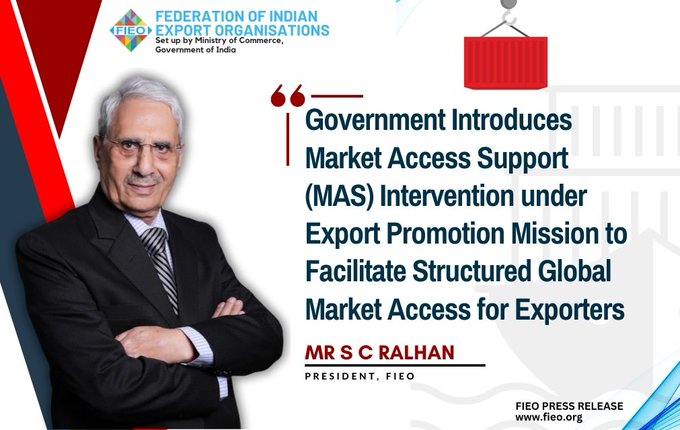
Government Introduces Market Access Support (MAS) Intervention under Export Promotion Mission to Facilitate Structured Global Market Access for Exporters: FIEO President

NEW DELHI: The Federation of Indian Export Organisations (FIEO) has welcomed the launch of the Market Access Support (MAS) Intervention under the Export Promotion Mission (EPM) by the Government of India, describing it as a timely and strategic step to strengthen India’s global export footprint, especially for MSMEs, first-time exporters and firms from priority sectors.

Commenting on the initiative, Mr S C Ralhan, President, FIEO, said that the Market Access Support Intervention marks a paradigm shift in India’s export promotion strategy. By focusing on predictable, well-planned and outcome-driven market access activities, the Government has addressed a long-standing need of exporters, particularly MSMEs, who often face constraints in accessing overseas markets.

The MAS Intervention, approved by the Union Cabinet on November 12, 2025, is being implemented under the NIRYAT DISHA sub-scheme of the Export Promotion Mission. The Mission is jointly implemented by the Department of Commerce, Ministry of MSME and Ministry of Finance, in close coordination with Indian Missions abroad, Export Promotion Councils, Commodity Boards and industry associations.

Under MAS, the Government will provide structured financial and institutional support for Buyer-Seller Meets (BSMs), international trade fairs and exhibitions, Mega Reverse Buyer-Seller Meets (RBSMs) organised in India, and trade delegations to priority and emerging markets. The intervention aims to improve buyer connect and enhance India’s presence in global markets through outcome-oriented market access initiatives.

Mr Ralhan added, “The provision of a three-to-five-year advance calendar of international events will significantly improve planning certainty for exporters and trade bodies. Mandating a minimum 35 per cent participation of MSMEs and prioritising new geographies, will go a long way in broad-basing India’s export growth and promoting diversification.”

The MAS framework also rationalises event-level financial support ceilings and cost-sharing ratios, with preferential support for priority sectors and markets. Small exporters with export turnover of up to ₹75 lakh in the preceding year will receive partial airfare support, encouraging participation of new and small exporters in global events.

Highlighting the digital enablement of the scheme, Mr Ralhan stated, that the end-to-end digitisation of processes through the trade.gov.in portal will ensure transparency, ease of access and faster approvals. Mandatory online feedback, lead tracking and outcome measurement tools will help align market access interventions with real business results.

FIEO also welcomed the proposed introduction of Proof-of-Concept and Product Demonstration support, particularly for technology-intensive and sunrise sectors, and the phased rollout of advanced digital tools for market intelligence and exporter follow-up. “MAS has the potential to become a cornerstone of India’s export ecosystem by creating stronger buyer engagement, data-driven policy feedback and deeper integration of Indian exporters into global value chains,” Mr Ralhan said.

FIEO reaffirmed its commitment to working closely with the Government and all stakeholders to ensure effective implementation of the MAS Intervention and to maximise its benefits for the exporting community.

NICDC Logistics Data Services Limited completes 10 Years of Operations in Logistics Data and Digital Systems

NEW DELHI: “As NICDC Logistics Data Services Limited (NLDSL) enters its next decade, the organization will remain focused towards the broader national vision of Viksit Bharat 2047, by strengthening digital foundations aimed at enhancing infrastructure, connectivity, and overall supply-chain efficiency”, stated Chairman, NLDSL and Chief Executive Officer & Managing Director, National Industrial Corridor Development Corporation (NICDC), Shri Rajat Kumar Saini, at the Foundation Day event of NLDSL.

Over the past decade, NLDSL has been engaged in the development and operation of digital public infrastructure platforms aimed at facilitating data exchange across logistics value chains. These initiatives support transparency, efficiency and data-led decision-making in the logistics sector and are aligned with NICDC’s mandate of enabling industrial and economic infrastructure, particularly in the context of growing trade, manufacturing and multimodal transport activity.

NLDSL has deployed standards-based technology platforms for use by government agencies and industry participants. Key platforms include the Logistics Data Bank (LDB) and the Unified Logistics Interface Platform (ULIP), which support container tracking, application programming interface (API)-based data exchange, analytics and end-to-end visibility across ports, terminals, rail, road and other logistics nodes.

The Logistics Data Bank functions as a single-window container logistics visualisation system, providing tracking through container numbers. The platform currently covers 100 per cent of India’s EXIM container volume and is operational across all container-handling port terminals in the country. Since its inception in 2016, LDB has tracked over 91 million EXIM containers.

The Unified Logistics Interface Platform, developed under the National Logistics Policy, enables secure and standardised API-based data exchange between government systems and industry participants. ULIP has integrated 44 systems across 11 Ministries, provides access to 136 APIs covering over 2,000 data fields, and has recorded more than 225 crore API transactions.

NLDSL has also developed and supported digital solutions such as Track Your Transport, Transport Management System and Koyla Shakti – India’s Smart Coal Analytics Dashboard, which are used for monitoring and managing logistics and supply chain operations by government

About NLDSL

The company was established on December 30, 2015, with the primary objective of harnessing Information and Communication Technology (ICT) to enhance efficiency in the Indian logistics sector. NICDC Logistics Data Services Limited (NLDSL) is the logistics digital and data arm of National Industrial Corridor Development Corporation (NICDC), functioning under the guidance and support of National Industrial Corridor Development and Implementation Trust (NICDIT), which represents the Government of India’s institutional framework for driving technology-enabled reforms in logistics and industrial infrastructure. It is a joint venture between the Government of India represented by National Industrial Corridor Development and Implementation Trust (NICDIT) and Japanese IT major NEC Corporation

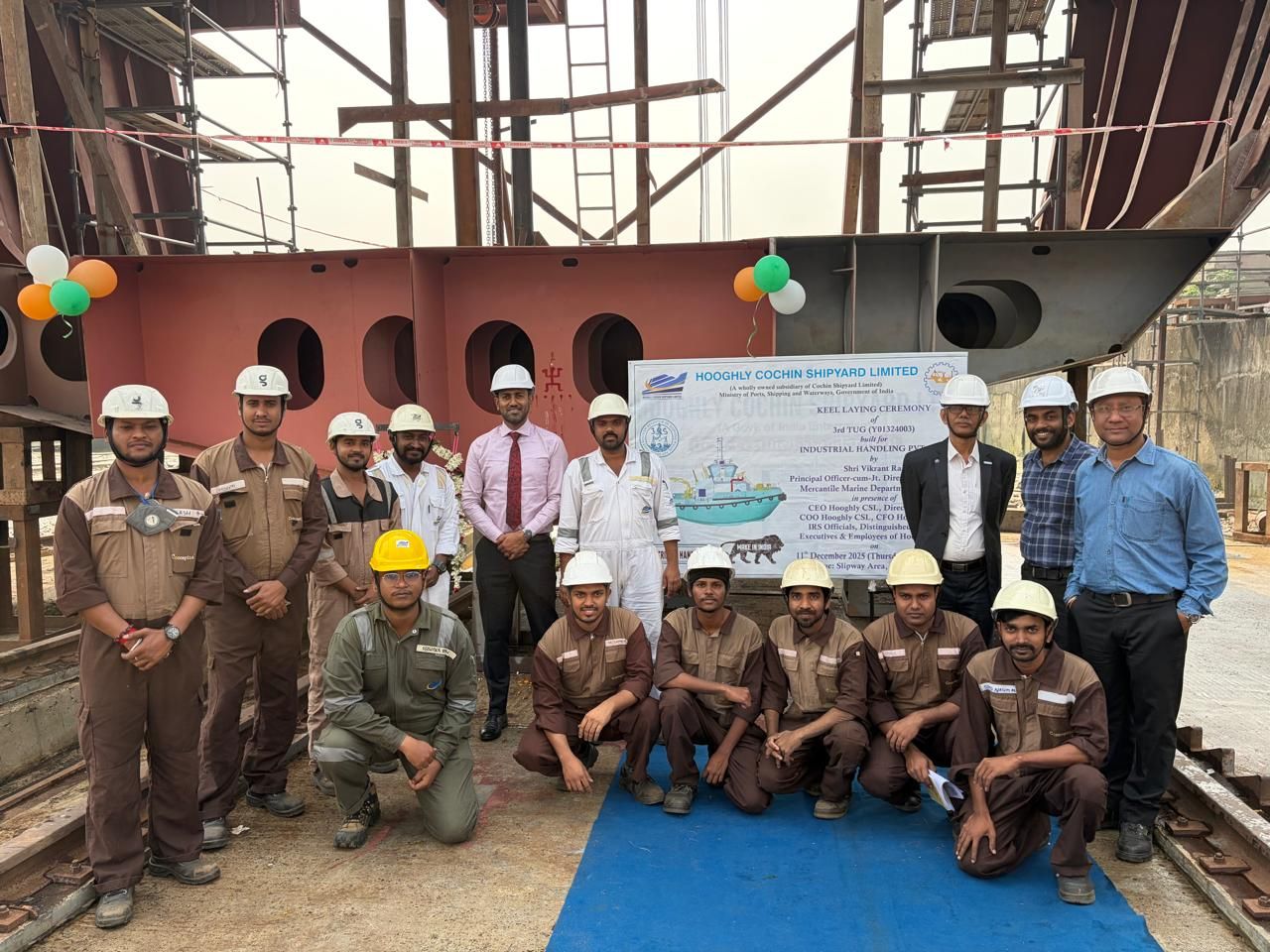
IRS Kolkata team attends Keel Laying Ceremony at Hooghly Cochin Shipyard

KOLKATA : The Kolkata team of the Indian Register of Shipping (IRS) attended the keel laying ceremony of two key vessels—a 40-tonne Bollard Pull (BP) tug for Industrial Handling Pvt. Ltd. and an 80-passenger river cruise vessel—at Hooghly Cochin Shipyard Ltd. (HooghlyCSL).

1767165586074 IRS Kolkata team attends Keel Laying Ceremony at Hooghly Cochin Shipyard

Both vessels are being constructed under the classification and survey of the Indian Register of Shipping, reaffirming IRS’s commitment to upholding high standards of safety, quality, and technical compliance in India’s growing inland and coastal maritime sector.

The 40T BP tug is designed to support industrial and port operations, offering enhanced manoeuvrability, towing capability, and operational reliability for demanding handling requirements. The 80-passenger river cruise vessel is aimed at strengthening inland waterway tourism, with a focus on passenger safety, comfort, and efficient riverine operations.

The keel laying ceremony marks a significant milestone in the construction lifecycle of both vessels and reflects the collaborative efforts of the shipowner, shipyard, and classification society. IRS’s presence at the event underscores its active role in supporting indigenous shipbuilding under the Make in India and Atmanirbhar Bharat initiatives.

Hooghly Cochin Shipyard Ltd. continues to play a vital role in the development of inland and coastal vessels, contributing to capacity building, employment generation, and sustainable maritime growth in the region.