Home Blog Page 500

Baltic Index logs Best Year since 2016

LONDON: The Baltic Exchange’s Dry Bulk Sea Freight index, which tracks rates for vessels transporting dry bulk commodities, inched lower on Wednesday, but logged its best year since 2016.

The Baltic report will not be published until January 2, 2026 due to post-Christmas and New Year holidays.

The main index which factors in rates for capesize, panamax and supramax shipping vessels, lost 12 points, or 0.6%, to 1,877 points. However, it rose 88.3% for the year.

“Trade patterns are shifting and there’s an increased performance in terms of ton mileages compared to the past so that means a lot of inefficiency in bulk shipping, which raises demand,” said Rico Luman, Transport and Shipping economist at ING Research.

“Demand from China, not only for manufacturing raw material, but also for energy carriers like coal, was actually better than expected previously,” Luman added.

The capesize index fell 18 points, or about 0.5%, to 3,319 points, its lowest in over a month. The contract logged a 189.4% gain for the year.

Average daily earnings for capesize vessels, which typically transport 150,000-ton cargoes such as iron ore and coal, decreased by $153 to $27,523.

Dalian iron ore futures finished higher on Wednesday after a session of directionless trading, as China’s plans to stabilise its property sector outweighed pressure from a decline in global crude steel output.

The panamax inde posted its first gain in nearly a month, rising by 1 point, or 0.1%, to 1,267 points. The contract marked its best annual gain since 2021.

Average daily earnings for panamax vessels, which usually carry 60,000 to 70,000 tons of coal or grain, increased by $14 to $11,405.

Among smaller vessels, the supramax index lost 18 points to 1,144 points. It rose about 23.9% for the year.

Source: Reuter

India – New Zealand FTA : One of India’s fastest-concluded FTAs

NEW DELHI : India has steadily expanded its global trade partnerships to strengthen economic growth, create jobs, and enhance its global standing. After signing six Free Trade Agreements in the last five years, the latest being with Oman this month, India and New Zealand have just concluded negotiations for a forward-looking FTA, marking a historic milestone in bilateral economic relations. The Agreement delivers unprecedented duty-free access for Indian exports to New Zealand while safeguarding India’s sensitive sectors, strengthening economic resilience, and promoting inclusive growth aligned with India’s national priorities.

India and New Zealand announced negotiations for a Free Trade Agreement (FTA) In March 2025. Following several rounds of negotiations, the India-New Zealand FTA was concluded in December 2025, becoming one of India’s fastest-concluded FTAs. This FTA enhances market access and tariff preferences for Indian exports to New Zealand, while serving as a gateway to the wider Oceania and Pacific Island markets. The agreement opens opportunities for India to emerge as a key supplier of skilled workforce, alongside prospects for future cooperation in areas such as AYUSH and services such as Yoga Instructors, Indian Chefs, and Music Teachers, and services under sector of interests like IT, Engineering, Healthcare, Education, and Construction.

Overall, the agreement establishes establishes a predictable, transparent framework that expands market access, enhances trade in services, creates mobility pathways, encourages long-term investment, and builds agriculture productivity.

India – New Zealand: Bilateral Trade Ties

India’s partnership with New Zealand is shaped by both economic realities and strong people-to-people ties. Currently, New Zealand is India’s second-largest trading partner in Oceania.

At USD 49,380, New Zealand is among the higher-income economies in Oceania. In 2024, New Zealand’s imports stood at USD 47 billion, while exports were USD 42 billion. New Zealand invests nearly 8% of its GDP annually overseas, with total overseas investment valued at USD 422.6 billion as of March 2025.

Around 300,000 persons of Indian origin and NRIs live in New Zealand, making up nearly 5% of its population. This diaspora acts as a cultural and economic bridge, supporting stronger bilateral ties and demand for Indian goods and services.

This FTA builds on the socio-economic foundation aimed at creating new opportunities.

Merchandise Trade: Grew from USD 873 million in 2023–24 to USD 1.3 billion in 2024–25, registering a 49% growth.
Merchandise Exports to New Zealand: Rose to USD 711 million in 2024–25, showing a positive trend of 32%.
Services Trade: India’s services exports to New Zealand grew by 13% in 2024, reaching USD 634 million. Major sectors include travel, IT, and business services.
India and New Zealand merchandise bilateral trade increased from USD 855 Million in 2015-2016 to USD 1298 Million in 2024-2025. The exports increased by 130% whereas imports only increased by 7.21% in 10 years. In 2024-25, the exports from India to New Zealand was higher than imports from New Zealand, maintaining positive trade balance with the country.

Salient Features of the FTA

The FTA eliminates duty on 100% of Indian Exports
A USD 20 billion investment commitment over 15 years strengthens long-term economic and strategic cooperation.
Through Agricultural Productivity Partnership, the FTA collaborates with farmers to boost productivity and integrate them in the global value chains.
The FTA boosts MSMEs and Jobs through Zero-duty access for labour-intensive sectors including textiles, apparel, leather, footwear, gems & jewellery, engineering goods and processed foods.
India has offered market access in 70.03% of the tariff lines while keeping 29.97 % tariff lines in exclusion. Immediate Elimination (EIF) on 30%, Rest is phased.
Certain products are kept in exclusion such as Dairy (milk, cream, whey, yoghurt, cheese etc.), animal products (other than sheep meat), vegetable products (onions, chana, peas, corn, almonds etc.), sugar, artificial honey, Animal, vegetable or microbial fats and oils, Arms and Ammunition, Gems and Jewellery, Copper and Articles (Cathodes, Cartridges, Rods, Bars, Coils etc.), Aluminium and articles thereof (Ingots, billets, wire bars) among others.
30.00% of tariff lines will have immediate duty elimination, covering wood, wool, sheep meat, leather-raw hides etc
35.60% of tariffs are subject to phased elimination over 3, 5, 7, and 10 years,including petroleum oil, malt extract, vegetable oils, and selected electrical and mechanical machinery, peptones etc.
4.37% of products face tariff reductions, such as wine, pharmaceutical drugs, polymers, aluminium, iron and steel articles etc
0.06% fall under tariff rate quotas, including honey, apples, kiwi fruit, and albumins including milk albumin.

Enhanced Market Access for Indian Goods

Gains to India from FTA

New Zealand’s market access offer covers immediate elimination of duties (zero duty) on 100% of tariff lines of New Zealand (8,284 tariff lines), from Entry into Force.
New Zealand maintained tariffs around 10% in around 450 lines of key Indian exports in products including textile/apparel products, leather and headgear, ceramics, carpets, ⁠automobiles and auto components. Additionally, the average applied tariff at 2.2% in 2025 will become zero from EIF.
The offer extends gains to several products and sectors
o Labour intensive sectors like textiles and clothing, leather and footwear;

Emerging and advanced engineering sectors like transport/auto, pharmaceuticals, plastic & rubber, electrical & electronic machinery, mechanical machinery, chemicals and;
o Agri Products like fruits and vegetables, coffee, spices, cereals, processed foods

Gains from import to support domestic industries: wooden logs, coking coal, waste and scrap of ferrous, non-ferrous metals
Gains for Agriculture, Technology Cooperation, and Farmer Income Growth

New Zealand have agreed on focused Action Plans for kiwifruit, apples, and honey to improve productivity, quality, and sectoral capabilities of these fruits growers in India
The cooperation includes the establishment of Centres of Excellence, improved planting material, capacity building for growers, technical support for orchard management, post-harvest practices, supply chains and food safety.
Projects for premium apple cultivators and sustainable beekeeping practices will enhance production and quality standards.
This is Paired with Market access for the selected agricultural products (Apples, Kiwifruit, Manuka Honey) from New Zealand in India.
This access will be managed through a Tariff Rate Quota (TRQ) system with Minimum Import Price and seasonal imports, ensuring consumer choice while protecting domestic farmers.
All TRQs are linked to Agri-technology Action Plans and monitored by a Joint Agriculture Productivity Council, balancing market access with protection of sensitive domestic agricultural sectors.

Enhanced Opportunities Beyond Goods

Services

Best-Ever Offer by New Zealand: Commitment across 118 services sectors, with Most-Favoured Nation (MFN) treatment in 139 sectors.
Health & Traditional Medicine Annex: For the first time, New Zealand has signed an annex to facilitate trade in Ayurveda, yoga, and other traditional medicine services with India. This landmark provision promotes the global recognition of India’s AYUSH systems,supports medical value travel, encourages collaboration in wellness services, and reinforces India’s position as a global hub for health, wellness, and traditional medicine services. It gives centre stage to India’s AYUSH disciplines (Ayurveda, Yoga & Naturopathy, Unani, Sowa-Rigpa, Siddha, and Homeopathy) alongside Maori Health practices
Mobility & Education

Student Mobility: New Zealand signed Annex on Student Mobility and Post Study Work Visa for the first time with any country. Indian students can work up to 20 hours per week while studying, even if there are policy changes in future, with extended post-study work visas (STEM Bachelor: 3 yrs; Master’s: up to 3 yrs; Doctorate: up to 4 yrs).
Professional Pathways: A quota of 5,000 visas for skilled Indians for stay upto 3 years in the sectors of interest to India which include Indian iconic occupations (AYUSH practitioners, Yoga Instructors, Indian Chefs, and Music Teachers) and Other sectors of interest – IT, Engineering, Healthcare, Education, and Construction
Working Holiday Visa: 1,000 young Indians annually can avail multiple entry in New Zealand for a period of 12 months.
These provisions create unprecedented opportunities for Indian youth and professionals to gain global exposure.
Investment and Economic Co-operation

FDI Commitment: New Zealand will invest USD 20 billion in India over 15 years, strengthening long-term economic ties.

Organic Primary Products: Mutual recognition of organic certification to be agreed between the two sides.

MSME Cooperation: Institutional linkages to help small businesses access trade-related information and global markets.

Technical Assistance: Cooperation has been agreed in AYUSH, audio visual industries, tourism, sports and traditional knowledge systems. The FTA promotes India’s AYUSH systems internationally, encourages medical value travel, and positions India as a global wellness hub.

Cultural & Traditional Knowledge

Dedicated cooperation in Ayush and Indian traditional knowledge has been agreed.
Engagement with New Zealand’s indigenous Maori communities to promote cultural exchange and mutual respect. This strengthens India’s soft power and global recognition of its heritage.
Regulatory & Institutional Provisions

Pharmaceuticals & Medical Devices: Annexes for expedited regulatory pathways and recognition of inspections from trusted regulators (US, EU, UK, Canada).
Intellectual Property Rights: Binding commitment by New Zealand to amend its laws within 18 months to provide EU-level protection for India’s Geographical Indications (GIs).
Customs & Trade Facilitation: Advance rulings, electronic documentation, and faster clearance times (within 48 hours, 24 hours for perishables).
Rules of Origin (ROO): Robust framework to prevent circumvention and ensure integrity of preferential access.

India’s Global Trade Networks

Free Trade Agreements are designed to open new opportunities for Indian businesses, farmers, students, and professionals, while also strengthening India’s role in global value chains. It is an agreement between two or more countries where the countries agree on certain obligations that affect trade in goods and services, and protections for investors and intellectual property rights, among other topics.

India’s FTA with other countries enhances competitiveness by reducing or eliminating tariffs and by improving market access for goods and services. They strengthen intellectual property protection, enable participation in standards setting and government procurement, and ensure fair treatment for investors. Overall, FTAs create a more predictable and level playing field for businesses operating across borders.

With the continued expansion of its global economic footprint, India has increasingly emerged as a preferred partner for enhanced trade and economic cooperation.

India -Oman Comprehensive Economic Partnership Agreement (CEPA), 2025
India -UK Comprehensive Economic and Trade Agreement (CETA), 2025
India-EFTA Trade & Economic Partnership Agreement (TEPA) with Switzerland, Norway, Iceland, and Liechtenstein, 2024
India- United Arab Emirates Comprehensive Economic Partnership Agreement (CEPA), 2022
India- Australia Economic Cooperation and Trade Agreement (ECTA), 2022
India – Mauritius Comprehensive Economic Cooperation and Partnership (CECPA), 2021
Conclusion

The India–New Zealand Free Trade Agreement reflects a defining moment in India’s trade diplomacy, opening new avenues for comprehensive economic cooperation. By securing improved market access for Indian goods, expanding opportunities in services and mobility, and deepening collaboration in agriculture, investment and emerging sectors, the Agreement delivers tangible and wide-ranging benefits across the economy.

From farmers and MSMEs to students and skilled professionals, the gains from this Agreement are expected to be broad-based, reinforcing India’s position as a trusted, forward-looking global partner and advancing the vision of a globally integrated Viksit Bharat 2047.


SMP Kolkata to float tender for Agro Processing Zone in two months

KOLOKATA : Syama Prasad Mookerjee Port (SMP), Kolkata, is planning to float a tender within the next two months for the development of an agro processing zone on port-owned land, as part of its broader land monetisation and port-led industrialisation strategy.

The port authority, formerly known as Kolkata Port Trust, has identified significant land parcels for industrial development. Under its land monetisation plan, SMP Kolkata has around 100 acres of land available across the city and adjoining areas, which it aims to leverage to attract industry and generate additional revenue streams.

Speaking on the initiative, Samrat Rahi, Deputy Chairperson, Syama Prasad Mookerjee Port, Kolkata, said that preparations for the agro processing zone are at an advanced stage and the tendering process will be initiated shortly. He added that the port has also received expressions of interest for setting up a toy manufacturing zone.

The proposed development aligns with the Centre’s focus on port-led development and multimodal logistics integration. By facilitating value-added activities such as agro and tea processing near port facilities, SMP Kolkata aims to strengthen cargo generation, improve logistics efficiency, and create employment opportunities in the region. The upcoming tender for the agro processing zone is expected to be a key step in advancing these objectives.

Indian Register of Shipping records strong, diversified performance in 2025

MUMBAI : The Indian Register of Shipping (IRS) reported a robust and diversified performance in 2025, reaffirming its position as a trusted technical partner to governments, shipowners, and shipyards at a time of rapid transformation in the global maritime industry.

In the merchant marine segment, IRS significantly expanded its international engagement and footprint. During the year, the society successfully completed its first newbuilding project for Penguin Shipyard in Singapore and delivered its first vessel for a Korean owner built at a Korean yard through IRS Korea. Confidence from leading global operators was reflected in vessels from CMA CGM and Maersk being classed with IRS in 2025. Strengthening its Middle East presence, IRS also inaugurated a new office in Saudi Arabia. Since January 2025, a total of 115 vessels of varied sizes and applications have been delivered under IRS class in India and overseas.

IRS continued to play a vital role in India’s defence maritime programmes as the Indian Navy progressed with fleet modernisation. A landmark achievement during the year was the completion of single classing for the Navy’s Fleet Support Ships—an unprecedented milestone for the country. The society also contributed to the delivery and commissioning of key naval platforms, including Anti-Submarine Warfare Corvettes, Survey Vessel Large, and Diving Support Vessels. In another notable first, IRS supervised the refit of submarine INS Sindhukirti, marking the first occasion an Indian classification society has overseen the refit of an EKM-class submarine.

Digital transformation remained a strategic priority for IRS in 2025. The society advanced the deployment of virtual twin technology for life-cycle assessment and 3D classification, while also developing predictive analytics and remote-ready solutions. IRS actively participated in international discussions on future propulsion technologies, including nuclear energy for commercial shipping, and took part in a specialist roundtable at London International Shipping Week focused on deep-sea decarbonisation and emerging safety frameworks.

Beyond seagoing shipping, IRS deepened its engagement in inland waterways through a collaborative feasibility study with Rhenus Logistics India. The society also reinforced best practices in ship recycling by hosting a seminar on safe and sustainable recycling at Bhavnagar.

Commenting on the performance, Arun Sharma, Executive Chairman of IRS, said that the organisation’s achievements in 2025 reflect growing confidence and trust across both defence and commercial sectors. He noted that as regulations, technologies, and fuel strategies continue to evolve, IRS is strengthening its capabilities and research partnerships to deliver future-ready technical assurance.

Looking ahead to 2026, IRS anticipates sustained growth in demand for advanced technical services across defence and commercial shipping, increased naval project activity, wider adoption of digital classification tools, and growing interest in alternative fuels such as hydrogen, biofuels, and methanol.

Despite tariffs, India’s exports to US on uptrend since Sept, tariff-hit sectors not worst performers

NEW DELHI : Despite tariffs remaining in place, India’s exports to the United States have shown a pickup since September, while sectors that were expected to be hit harder by tariffs have not underperformed as sharply as those considered relatively insulated, according to a data-based report by DSP Mutual Fund.
The data shows that India’s exports to the US declined from USD 8.8 billion in May 2025 to a low of USD 5.4 billion in September 2025. Since then, exports have recovered to USD 6.3 billion in October and further to USD 7.0 billion in November.
However, the report noted that the data window is short, and it would be premature to call this a trend, but the improvement complicates the narrative that tariffs alone are driving the slowdown.
It stated, “exports to the U.S. have shown a pickup since September… it does complicate the straightforward narrative that tariffs alone are driving the slowdown.”
Sector-wise data highlights that the impact of tariffs has not been neatly contained. Pharmaceuticals, which were exempted from tariffs, saw exports fall of 16.5 per cent between May and October 2025. Mobile phone exports declined sharply by 35.5 per cent during the same period.

Among sectors where the same tariff applied globally, iron and steel exports fell 18.4 per cent, while ferrous and non-ferrous metals declined 24.6 per cent.
In segments facing higher tariffs, textiles (excluding readymade garments) recorded an 18.5 per cent fall, and gems and jewellery exports dropped 27.3 per cent.
According to DSP Mutual Fund, sectors expected to bear the brunt of tariffs have not necessarily been the worst performers, suggesting that export weakness has been broader and not limited only to tariff-sensitive segments.
It stated, “Sectors that were expected to be hit harder by tariffs have not underperformed as sharply as those that were supposedly insulated.”
The report added that more data will be required to assess whether the recent recovery in exports to the US is sustainable.

Source : ANI

Adani Energy Solutions doubles project pipeline, expands green transmission & smart metering infra

MUMBAI : Adani Energy Solutions Ltd. (AESL) expanded its green energy infrastructure and transmission network this year, positioning itself as a key player in India’s shift toward renewable power. According to a press release from Adani Energy Solutions, the company’s project pipeline doubled from Rs 30,000 crore to Rs 60,000 crore during the year.
AESL also increased its transmission lines to 26,705 circuit kilometers and raised its transformation capacity to 97,236 mega volt ampere to support the country’s growing renewable energy needs.
The company secured its largest private renewable energy transmission corridor, the Rs 25,000 crore Bhadla-Fatehpur High Voltage Direct Current project. This system is designed to move 6,000 MW of renewable power from Rajasthan. The company currently holds a 28 per cent market share in the national transmission sector, including both commissioned and under-construction projects.

In addition to building power lines, the firm is digitizing how people use electricity through smart meters. It has already installed 74 lakh meters and aims to reach over 1 crore by March 2026. These meters help manage electricity demand and provide real-time information, which is helpful for a grid that relies heavily on sun and wind power.
The company is currently installing between 25,000 and 27,000 meters every day as part of its larger goal to capture a significant portion of India’s smart metering market.
The company’s distribution arm, Adani Electricity Mumbai Ltd., maintained its position as a top-rated utility while reducing technical losses to 4.36 per cent. It currently sources about 45 per cent of its power from renewable sources and plans to increase this to 70 per cent by 2030. Beyond Mumbai, the company is looking to expand its distribution services to other regions like Navi Mumbai, Mundra, and Greater Noida.
New low-carbon cooling solutions are also being developed to reduce the energy used by large buildings. A district cooling system is under construction in Mundra that uses 30 per cent less energy than traditional methods.
The firm is also helping large industries, such as textile and cement factories, switch to cleaner power supplies. These efforts are part of a broader commitment to sustainable operations, which includes keeping its sites free of single-use plastics and ensuring no waste is sent to landfills.

Source : ANI

TCI Adds 1.5 Lakh Sq. Ft. Cold Chain Capacity at Taj Nagar, Gurugram

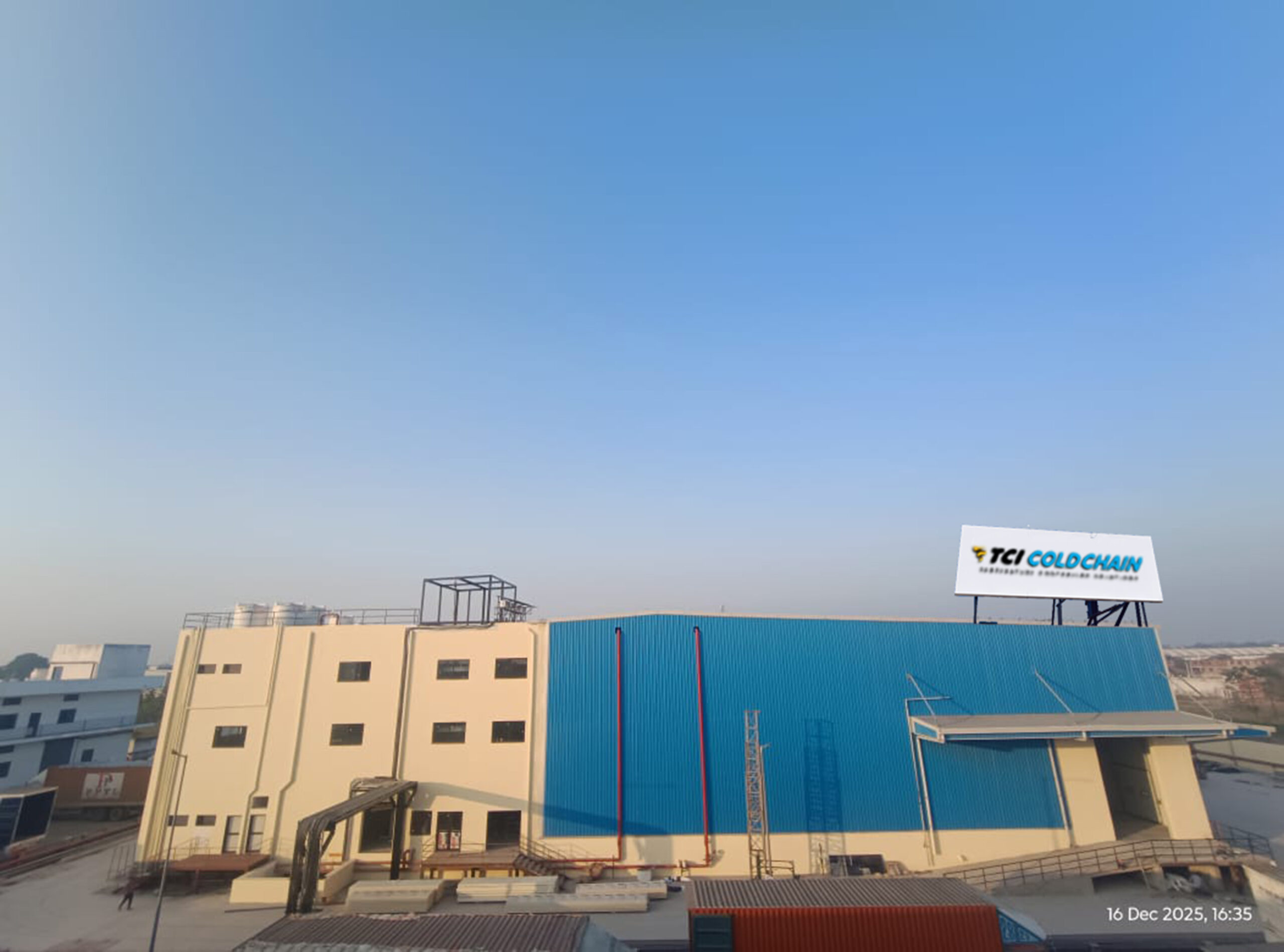
GURUGRAM: As demand for reliable, scalable temperature-controlled logistics continues to rise across the National Capital Region, Transport Corporation of India Ltd. (TCI) – one of India’s leading integrated supply chain and multimodal logistics solution providers – has expanded its cold chain warehousing presence in Gurugram with the addition of a 1.5 lakh sq. ft. facility at Taj Nagar. With over 16 million sq. ft. of warehousing space managed nationwide, TCI continues to reinforce its integrated logistics network to support high-growth industries and compliance-driven supply chain requirements.

This facility will be operated by TCI Cold Chain Solutions Ltd., a JV Company Between TCI & Mitsui & Co., Japan. The Taj Nagar facility is designed to cater to high-throughput requirements across sectors such as quick Commerce, QSR, pharmaceuticals, food and beverages, dairy, meat and poultry, beauty and life sciences and specialty chemicals.

Strategically located between the KMP Expressway and the Dwarka Expressway, the warehouse benefits from unrestricted 24×7 truck access, being outside heavy vehicle no-entry zones. This enables faster turnaround times and seamless distribution across Delhi NCR and adjoining markets. The facility offers multi-temperature storage across frozen, chilled, and air-conditioned zones, and operates on box-in/box-out, unit-in/unit-out, and pallet-in/pallet-out models with a pay-as-you-use commercial structure. This enables customers to flex capacity and throughput in line with evolving business requirements, particularly in time-sensitive and high-velocity supply chains.

The Taj Nagar belt has emerged as a key logistics hub due to its proximity to NCR (Delhi, Gurugram, Noida, Faridabad, Ghaziabad as well as Jaipur) and the growing concentration of quick commerce operations, making it well-suited for efficient, last-mile- distribution.

Commenting on the expansion, Mr. B. Sumit Kumar, CEO, TCI Cold Chain Solutions Ltd. said, “The expansion of our Gurugram cold chain facility reflects the growing need for dependable, scalable and compliant infrastructure in the region. With strong connectivity and a flexible operating model, this warehouse strengthens our ability to support fast-moving and regulated supply chains across NCR”.

Built with a strong focus on safety, operational efficiency and sustainability, the facility includes a 500-kW rooftop solar power installation, energy-efficient refrigeration systems, SCADA-based monitoring, VESDA Panel for early smoke detection, and more than 600 CCTV cameras for real time monitoring. The fully gated, access-controlled campus also offers ample truck parking to support smooth inbound and outbound movement.

Logistics firm Yatayat Corporation India files IPO papers to fund working capital needs

AHMEDABAD : Yatayat Corporation India, the Gujarat-based logistics and supply chain solutions provider, has filed preliminary papers with SEBI to raise funds via initial public offering (IPO) for its working capital requirements.

The 1.33-crore equity shares IPO will be a combination of fresh issue of 77 lakh shares, and an offer-for-sale of 56 lakh shares by promoter Meena Praveen Aggarwal.

Further, the fresh issue comprises of pre-IPO placement amounting to Rs 10 crore, the company said in its DRHP filed on December 23.

Promoters own 95.49 percent shareholding in Yatayat Corporation, while the 4.5 percent shares were held by investor Hiranand Savlani HUF.

The transportation and logistics solutions company with a PAN-India presence, supported by 34 branches and 1 warehouse planned to spend Rs 67.02 crore of fresh issue proceeds for working capital requirements, and general corporate purposes.

Yatayat Corporation that competes with listed peers like Ritco Logistics, North Eastern Carrying Corporation, VRL Logistics, and TCI Express has reported profit of Rs 7.83 crore on revenue of Rs 119.7 crore for the quarter ended June 2025.

Profit in the fiscal year ended March 2025 more than doubled to Rs 30 crore, compared to Rs 14.9 crore in previous year. Revenue during the same period increased 28.6 percent to Rs 448.1 crore, up from Rs 348.3 crore.

The merchant banker managing the Yatayat Corporation India IPO will be Unistone Capital.

Indian Coast Guard signs deal with L&T for Six Rail-Less Helo Traversing Systems

NEW DELHI : The Indian Coast Guard signed a deal with L&T Precision Engineering & Systems on Friday for the procurement of six Rail-Less Helo Traversing Systems (RLHTS) for indigenously built Next-Generation Offshore Patrol Vessels (OPVs).
“In line with GoI Aatmanirbhar Bharat, initiative India Coast Guard on Friday inked a deal with L&T Precision Engineering & Systems at CGHQ, New Delhi for procurement of six (06) Rail-Less Helo Traversing Systems RLHTS for indigenously built Next-Generation OPVs,” Indian Coast Guard said in a post on social media platform X.
“The agreement was signed by the Principal Director (Air Acquisition), CGHQ and Vice President, L&T, in the presence of Deputy Director General (Aviation). The RLHTS aims at enhancing safe helicopter operations by ensuring reliability and flexibility in maritime environments, marking a significant stride towards defence self-reliance,” it added.
Rail-less helicopter traversing systems are advanced naval deck systems that move helicopters between the landing area and hangar without physical rails, using powerful winches, wires, and sensors to safely haul, secure, and guide the aircraft across the ship’s deck, even in rough seas, offering flexibility over traditional rail systems by eliminating alignment needs.
As per the information available on the L&T Precision Engineering & Systems website, the system is compatible with helicopters fitted with a probe and weighing up to 12.5 tonnes, ensuring broad operational versatility.

Source : ANI

Indian Railways to double train origination capacity of 48 major cities by 2030

NEW DELHI : In a major push to meet rapidly growing passenger demand, Indian Railways has announced plans to double the train origination capacity of major cities over the next five years, with the target set for completion by 2030. The initiative aims to reduce congestion at busy stations, improve operational efficiency, and strengthen nationwide rail connectivity.

The Ministry of Railways has identified 48 major cities under the expansion plan. “In view of the rapid sustained growth in demand for travel, the capacity of major cities to originate new trains needs to be doubled from the current level in the next 5 years. The current infrastructure serving needs to be augmented so as to meet the requirements of upcoming years,” the Ministry of Railways said in a statement.
The exercise will be done for both suburban and non-suburban traffic, keeping in view the distinct requirements of both segments. A comprehensive plan of the 48 major cities is under consideration. The plan will include the works planned, proposed, or already sanctioned to achieve the goal of doubling the capacity of handling trains in a time-bound manner, the Railways Ministry said.

These cities include Delhi, Mumbai (CR and WR), Kolkata (including ER, SER and Kolkata Metro), Chennai, Hyderabad, Bengaluru, Ahmedabad, and Pune.
Other key cities in the northern and central regions include Lucknow, Kanpur, Varanasi, Gorakhpur, Agra, Mathura, Ayodhya, Chandigarh, Ludhiana, Amritsar, Indore, Bhopal, Ujjain, Jaipur, Jodhpur, Jammu, and Bareilly.
In the eastern and northeastern parts of India, the cities identified for capacity enhancement include Patna, Bhagalpur, Muzaffarpur, Darbhanga, Gaya, Ranchi, Tatanagar, Raipur, Bhubaneswar, Puri, Guwahati, and Kolkata.
The southern and western regions are represented by cities such as Nagpur, Vadodara, Surat, Madgaon, Cochin, Visakhapatnam, Vijayawada, Tirupati, Mysore, and Coimbatore.
The expansion plan focuses on augmenting existing railway terminals by adding new platforms, stabling lines, pit lines, and shunting facilities. In parallel, new coaching terminals will be developed in and around urban areas, along with the creation of advanced maintenance facilities such as mega coaching complexes, the Railways Ministry added.
Indian Railways will also enhance sectional capacity through traffic facility works, signalling upgrades, and multitracking projects to handle the increased number of trains. While planning terminal expansion, nearby stations will be integrated into the capacity-building exercise to ensure balanced development across urban rail networks.

Source : ANI