Home Blog Page 516

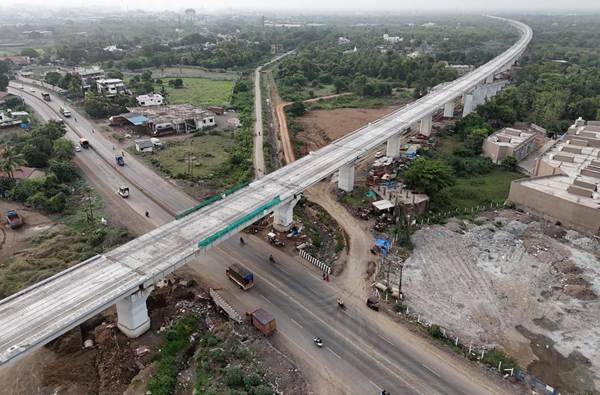
₹1.50 lakh crore road projects approved for Maharashtra : Nitin Gadkari

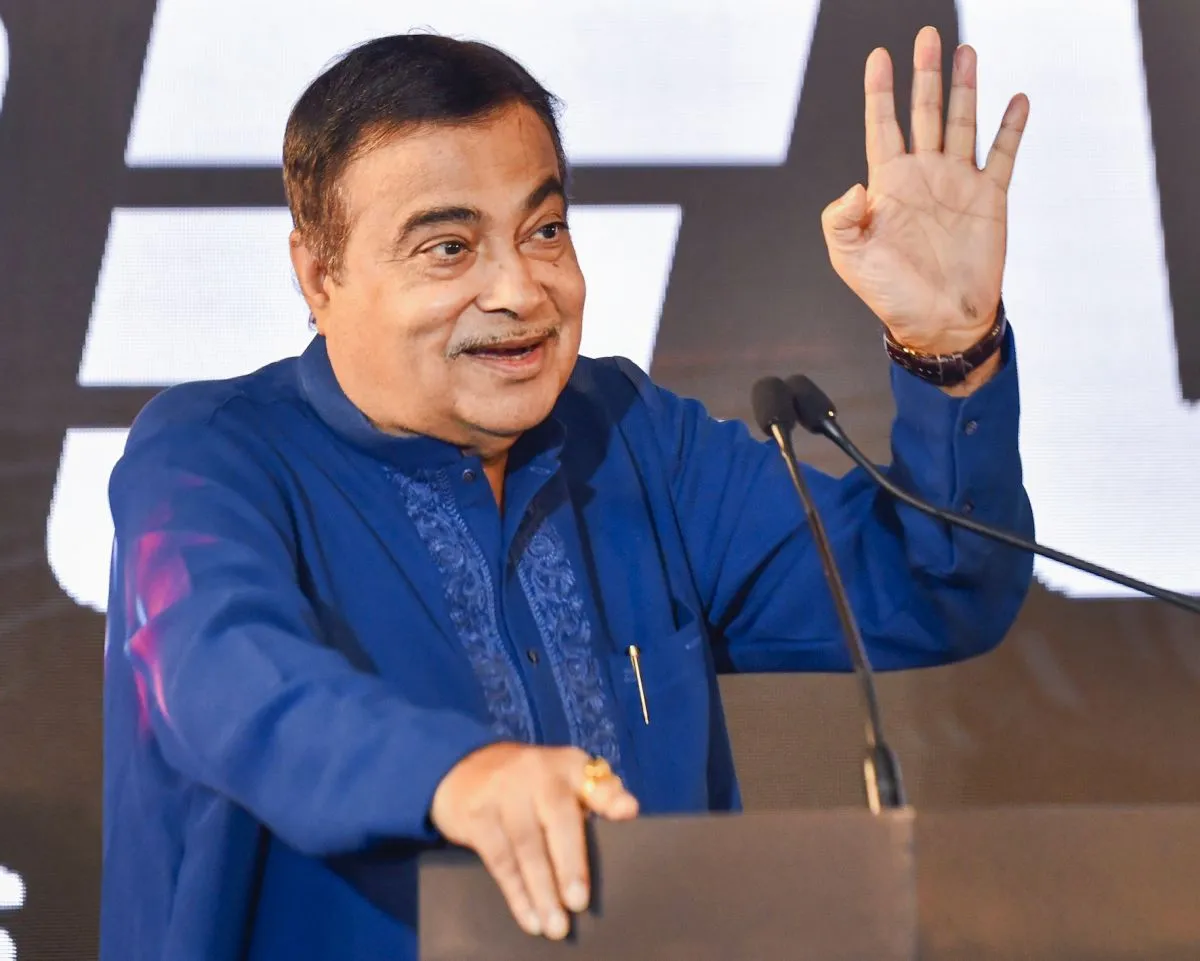
NAGPUR : Union Minister Shri Nitin Gadkari on Saturday (December 13, 2025) pointed out that road projects worth ₹1.50 lakh crore have been approved for Maharashtra for 2026, and work for most of the projects will start in “the next three months”.

The major infrastructure investments for Maharashtra, with road projects worth ₹1.50 lakh crore approved for 2026. Speaking during the winter session of the State legislature in Nagpur, Mr. Gadkari said work on most projects will begin within the next three months.

Projects under the Maharashtra State Infrastructure Development Corporation include a new Pune–Sambhajinagar expressway, highway repairs, and key flyovers aimed at reducing travel time significantly. Elevated highways connecting Talegaon–Chakan–Shikrapur and Hadapsar–Yevat have also received approval.

The Pune region alone will see investments of ₹50,000 crore, including a parallel Pune–Mumbai expressway. Major road works are also planned for Nagpur and Marathwada regions, boosting connectivity and economic growth across the State.

Despite US tariff, merchandise exports at 10 year high and sharp drop in trade deficit in Nov

NEW DELHI: India’s trade deficit narrowed to USD 24.53 billion in November from USD 41.68 billion in October, said the data released by the government on Monday. This was driven by a fall in gold, oil and coal imports, it said.

Overall trade, including merchandise and services, recorded exports of USD 73.99 billion in November 2025, up from USD 64.05 billion in the same month last year. Imports during the period declined marginally to USD 80.63 billion from USD 81.11 billion.

The overall trade deficit narrowed sharply to USD 6.64 billion in November 2025, compared to a deficit of USD 17.06 billion in November 2024.

In the merchandise sector, exports increased significantly from USD 31.94 billion in November 2024 to USD 38.13 billion in November 2025, highest in over 10 years, reflecting stronger outbound shipments.
Merchandise imports, moderated slightly, falling from USD 63.87 billion to USD 62.66 billion over the same period. This combination of higher exports and lower imports contributed positively to the overall trade balance.

The services sector also witnessed growth in rising from USD 32.11 billion in November 2024 to USD 35.86 billion in November 2025, indicating continued strength in India’s services-driven external sector.
Services imports increased marginally from USD 17.25 billion to USD 17.96 billion during the period.

Speaking on the development, Commerce Secretary, Shri Rajesh Agrawal, said, “Our record export has been USD 38.13 billion which is highest in last 10 years. In November month we have never crossed 38 billion.”

“Also, there is positive that number, the imports are down by 1.88%. There is an import trend, which is in the positive territory, but this month, it is a minus 1.8. This has to be seen,” he said.

“The trade deficit just merchandise has declined from USD 31.92 billion last year, to USD 24.5 3 billion. So this is good story, which is coming up for this month. Major drivers, if you look at what has actually led to these high fees, the detailed presentation will give the details, but one is engineering growth of 23.8%, electronic goods growth of 39%, Gems and jewelry growth of 27.8%,” the Commerce Secretary added.

As per the data released by the government, India’s exports to China registered a significant increase during the period April-November 2025 compared to the corresponding period of the previous year.
Merchandise exports to China rose from USD 9.20 billion during April-November 2024 to USD 12.22 billion during April-November 2025, reflecting a growth of about 32.83%.

On a monthly basis, exports to China during 2025-26 showed an overall upward trend despite some fluctuations. Exports stood at USD 1.39 billion in April 2025 and increased to USD 1.62 billion in May before easing slightly to USD 1.37 billion in June.

In July and August, exports moderated to USD 1.34 billion and USD 1.21 billion respectively, indicating a temporary slowdown during the mid-year period.

Source: ANI

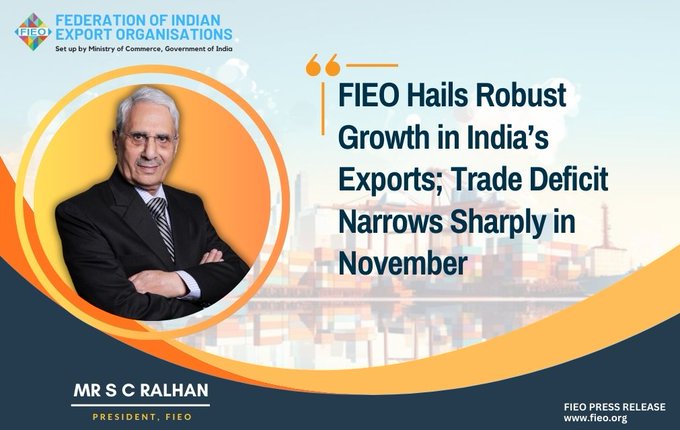
FIEO hails robust growth in India’s exports; Trade deficit narrows sharply in November – President, FIEO

NEW DELHI : Commenting on the latest trade figures released by the Ministry of Commerce & Industry, Mr. S. C. Ralhan, President of the Federation of Indian Export Organisations (FIEO), expressed satisfaction over the strong performance of India’s exports in November, reflecting the resilience and competitiveness of the country’s export sector.

India’s merchandise exports rose to USD 38.13 billion in November, registering a robust year-on-year growth of 19.37 percent. Merchandise imports during the month stood at USD 62.66 billion. On the services front, exports increased significantly to USD 35.86 billion, up from USD 32.11 billion, while services imports edged up marginally to USD 17.96 billion from USD 17.25 billion in the corresponding period last year.

Mr. Ralhan noted that the impressive growth of nearly 19.4 percent in merchandise exports, coupled with sustained momentum in services exports, is a highly encouraging signal for India’s external sector. The sharp contraction in the trade deficit underscores the ability of Indian exporters to effectively respond to global demand, even amid persistent geopolitical tensions and economic uncertainties worldwide.

Overall, India’s total exports in November reached USD 73.99 billion, marking a significant increase from USD 64.05 billion in the same period last year. Total imports during the month declined marginally to USD 80.63 billion, compared to USD 81.11 billion in November 2024. A key positive highlight was the sharp narrowing of the merchandise trade deficit to USD 24.53 billion, from USD 41.68 billion in October, reflecting stronger export momentum and improved trade management, the FIEO President said.

Mr. Ralhan further emphasized that diversification of export markets, along with the continued resilience of several key sectors, has played a crucial role in supporting export growth. With sustained policy support, enhanced logistics efficiency, and access to competitive export financing, India’s exports are well-positioned to maintain this positive trajectory in the coming months.

The FIEO Chief also reiterated that during April–November 2025, the United States remained India’s top export destination, despite the imposition of a high tariff of 50 percent—clearly demonstrating the resilience and adaptability of India’s exporting community. Other major export destinations during this period included UAE, Netherlands, China, the UK, Germany, Singapore, Bangladesh, Saudi Arabia, and Hong Kong. On the import side, key source countries were China, the USA, Russia, Saudi Arabia, Iraq, Hong Kong, Singapore, Switzerland, and Japan.

Mr Ralhan reiterated the need for continued policy interventions aimed at improving cost competitiveness, easing compliance and procedural challenges, and enhancing market access, to sustain export growth and further reduce the trade deficit.

Economists say India’s November trade data signals “export resilience”

NEW DELHI: India’s external trade performance showed marked improvement in November 2025, with exports rebounding strongly and the merchandise trade deficit narrowing to a five-month low, reflecting easing import pressures and resilient overseas demand.

According to Aditi Nayar, Chief Economist, ICRA Ltd, “Following supply normalisation after the holidays and decreased demand post the festive season, merchandise exports rose and imports declined sharply, compressing the trade deficit to a five-month low of US$24.5 billion in November 2025 from US$41.7 billion in October 2025 and US$31.9 billion in November 2024.”

“With the increase in the average merchandise trade deficit in October-November 2025, we estimate the current account deficit to widen to US$20-24 billion in Q3 FY2026 from US$11-12 billion each in Q3 FY2025 and Q2 FY2026,” she said.

As per GTRI, “India’s exports to the United States in 2025 followed an unusual path as U.S. tariffs rose sharply. Shipments initially held up despite a 10 per cent reciprocal duty, increasing from $8.4 billion in April to $8.8 billion in May, before easing slightly in June and July. The impact became clear in August, when exports fell to $6.8 billion as tariffs were raised in quick steps, eventually reaching 50 per cent by the end of the month. In September, the first full month under the higher tariff, exports dropped further to $5.5 billion, the lowest level of the year.”

“The surprising development came afterwards. Even with 50% tariffs still in place, exports recovered to $6.3 billion in October and $7.0 billion in November. This rebound suggests that exporters may have shifted toward products less affected by tariffs. Detailed product data for November are not yet available, but tariff-exempt items such as smartphones and pharmaceuticals may have helped cushion the blow,” GTRI added.

GTRI further said India’s rebound in exports to the US should strengthen, not soften, its negotiating stance. New Delhi has a strong case to press Washington to cut tariffs from 50% to 25%, especially after India substantially reduced imports of Russian crude, addressing a key US concern.

“India must also insist on a balanced trade agreement, and resist pressure to concede on non-trade issues, whether diluting data protection laws, opening the door to inventory-based e-commerce models, or accepting GM agricultural products. Export resilience is a signal of bargaining power,” it said.

Pankaj Chadha, Chairman, EEPC India, said, “Cumulatively, the total engineering goods exports recorded 4.25% year-on-year growth in the April-November period of the current financial year and stood at US$79.74 billion.”

“The latest numbers are quite encouraging, especially in light of the 50% punitive tariff imposed by the Trump administration on the bulk of items in India’s export basket. The strong performance in November 2025 shows the resilience of the engineering industry and also how it has been swiftly adapting to the evolving global situation with constant support from the government.”

“Going forward, we hope that the Indian engineering sector will successfully diversify its market,” he said.

Speaking on the trade deficit, Rajeev Juneja, President, PHDCCI, highlighted that the key drivers of merchandise export growth in November 2025 included iron ore (70%), cashew (57%), oil meals (40%), electronic goods (38%), and coffee (34%), among others. Despite global headwinds, India registered positive export growth with 14 out of its 20 major trading partners, reflecting increasing diversification and resilience in external trade.

Looking ahead, Ranjeet Mehta, CEO & Secretary General, PHDCCI, said that India’s exports are expected to continue on a resilient growth trajectory, supported by sustained government efforts to diversify export markets and enhance global competitiveness.

He noted that the government’s Export Promotion Mission (EPM) and deeper engagement across regions, including the US, EU, Gulf Cooperation Council (GCC), and Asia-Pacific, will play a pivotal role in propelling India’s export growth.

India’s trade deficit narrowed to USD 24.53 billion in November from USD 41.68 billion in October, according to government data released on Monday. This was driven by a fall in gold, oil and coal imports, it said.

Source: ANI

APSEZ launches ICD Malur to strengthen hinterland connectivity in South India

BENGALURU : Adani Ports and Special Economic Zone Ltd. (APSEZ), India’s largest integrated transport utility, has launched a new Inland Container Depot (ICD) at Malur in Karnataka, marking a significant step towards enhancing multimodal logistics infrastructure and improving cargo movement in South India.

Strategically located near Bengaluru, the Malur ICD is designed to serve the region’s growing manufacturing and export-import (EXIM) ecosystem, including electronics, automotive, engineering goods, textiles and FMCG sectors. The facility will provide seamless rail and road connectivity to Adani Ports’ key gateway ports, enabling faster and more cost-efficient movement of containers.

The ICD is equipped with modern cargo-handling infrastructure, container yards, customs clearance facilities and value-added services aimed at reducing transit time and logistics costs for exporters and importers. By bringing port-linked services closer to industrial clusters, the Malur ICD is expected to decongest seaports and highways while offering customers an integrated, end-to-end logistics solution.

With the launch of the Malur facility, Adani Ports further strengthens its inland logistics network, supporting the Government of India’s vision of multimodal logistics development and ease of doing business. The ICD is also expected to create employment opportunities and contribute to regional economic growth by improving supply chain efficiency across Karnataka and neighbouring states.

Adani Ports continues to expand its pan-India logistics footprint, integrating ports, rail, inland depots and digital platforms to offer customers reliable, scalable and sustainable logistics solutions.

Ocean Network Express announces updated East-West Service Network for 2026

SINGAPORE : Ocean Network Express (ONE) has announced an update to its East-West service network, covering the key trade lanes of Asia-North America, Asia-Europe, and Asia-Middle East. This enhanced network is scheduled to take effect from April 2026.

The updated product lineup delivers enhanced service reliability through an optimized global network. The refined structure strengthens overall service stability while maintaining our extensive global coverage. Supported by additional capacity from newbuild vessels scheduled for delivery throughout 2025 and into 2026, ONE continues to reinforce its role as Your Number ONE Shipping Partner.

Says Jeremy Nixon, CEO of ONE, “The East-West service network is a key pillar of global trade, connecting emerging markets with demand centers and serving communities worldwide. We are pleased to release our updated 2026 Product Guide, which reflects our commitment to operational excellence. This network is strategically designed to provide our customers with reliable, flexible connections that support global trade, while prioritizing safety and stability amid geopolitical uncertainties.”

The port rotations of the updated 2026 services are based on the current routes via the Cape of Good Hope. ONE is closely monitoring the situation around the Red Sea, Bab al-Mandab Strait and the Suez Canal, and will keep our customers updated on the East West Product should any changes occur.

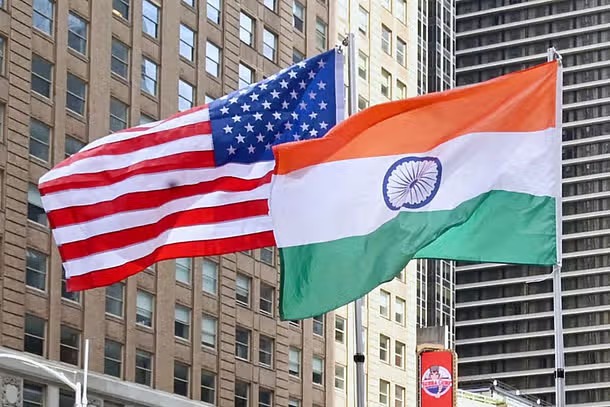
India and US ‘very close’ to interim deal to lower reciprocal tariffs : Commerce Secy

NEW DELHI : Commerce Secretary Rajesh Agrawal on December 15 said that government is “very close” to closing the initial framework deal with US to lower reciprocal tariffs.

“We are very close on closing the initial framework deal but I don’t want to put a timeline to it,” Agrawal said during a briefing.

“We have done six rounds of talks with the US where we have discussed both the BTA (Bilateral Trade Agreement) as well as an interim deal to lower reciprocal tariffs,” Agrawal said.

There’s a reasonable expectation that India and the US will reach an interim agreement to reduce steep tariffs on most Indian exports, he said, adding that the Deputy USTR’s visit earlier this month was to take stock of trade relations between the two countries and assess progress on the BTA as well as the framework deal.

A delegation led by Deputy US Trade Representative (USTR) Rick Switzer-led was in New Delhi from December 9-11 during which discussions were held on the framework deal as well as the broader Bilateral Trade Agreement.

“We are positively engaged with the US to see if we can close it (the framework deal) sooner than later,” Agrawal added on December 15.

Earlier this month, US Trade Representative Jamieson Greer said the US has received “best” ever offers from India on the proposed trade agreement.

Speaking at a Senate Appropriations Subcommittee hearing in Washington, Greer said that there is resistance in India to certain row crops and other meat and products. Row crops in the US include corn, soybeans, wheat and cotton.

Talks for a BTA between India and the US first emerged in February, when during a meeting between Prime Minister Narendra Modi and his American counterpart, President Donald Trump, the two leaders set a bold new target for bilateral trade, “Mission 500”, aiming to more than double total trade to $500 billion by 2030.

As part of this new goal, the two sides announced plans to negotiate the first tranche of a mutually beneficial, multi-sector BTA by the fall of 2025. While that deadline has been missed, India’s Chief Economic Adviser recently signalled that there should be an interim pact by at least March 2026.

A trade deal between India and the US is crucial given that Indian exports worth roughly $48.2 billion are facing elevated tariffs.

The US first imposed 25 percent duty on Indian goods stating trade deficit concerns, which stood at around $46 billion in 2024-25. An additional 25 percent penalty was imposed later tied to New Delhi’s Russian crude purchases.

The US remained India’s largest trading partner for the fourth consecutive year in 2024-25, with bilateral trade valued at $131.84 billion ($86.5 billion exports).

The US accounts for about 18 percent of India’s total goods exports, 6.22 percent of its imports, and 10.73 percent of its total merchandise trade.

India’s merchandise trade deficit declined to a five-month low of $24.53 billion in November, driven by a fall in gold, oil and coal imports, while exports to the US picked up.

Merchandise exports to the US rose almost 10 percent on-month to $6.98 billion in November.

Amid allegations by US officials of India “dumping” rice, Agrawal said, “More than 80 percent of our rice exports to the US is Basmati rice, which is higher than the general price of rice, so there is no case of dumping here. So, we already have a 50 percent tariff on rice, so I don’t see additional duties on rice as of now.”

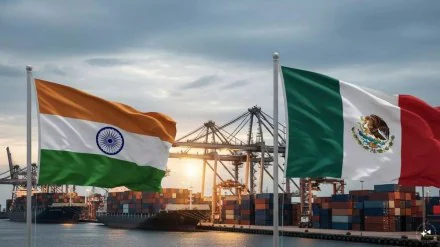
India in talks with Mexico for a preferential trade agreement

NEW DELHI: India and Mexico initiated discussions to promptly mitigate the impact of tariffs imposed on Indian goods by Mexico and to chart ways and means to protect trade interests.

Mexico has approved tariff hikes of up to 50 per cent from 2026 on imports of select products from Asian countries, including India and China, to protect the national industry and producers.

Citing support for local production and the correction of trade imbalances, Mexico has approved an increase in MFN import tariffs (5-50 per cent) starting in 2026 on 1,455 tariff lines under the WTO framework, targeting non-FTA partners.

According to India, preliminary estimates suggest that this affects around USD 2 billion exports to Mexico — particularly automobiles, two-wheelers, auto parts, textiles, iron and steel, plastics, leather and footwear, etc.

First proposed in September 2025, the proposal was deferred to August 2026 after concerns from non-FTA partners and industry. The proposal was resubmitted on December 3, 2025, and got clearance from both houses of Parliament. The proposal now awaits Presidential Gazette notification this week.

India-Mexico merchandise trade totalled USD 8.74 billion in 2024 (DGCI&S), with exports of USD 5.73 billion, imports of USD 3.01 billion, and a trade surplus of USD 2.72 billion.

Key exports include light vehicles (USD 0.88 billion), motorcycles (USD 0.39 billion), base metals (USD 0.76 billion), auto parts (USD 0.74 billion), mechanical machinery (USD 0.46 billion), textiles/clothing (USD 0.41 billion), chemicals (USD 0.43 billion), pharmaceuticals (USD 0.38 billion); key imports are crude petroleum oils (USD 1.7 billion), smartphones (USD 0.27 billion), and gold (USD 0.17 billion).

The Indian government has been continuously and comprehensively assessing Mexico’s tariff revisions since the issue emerged, engaging stakeholders, safeguarding the interests of Indian exporters, and pursuing constructive dialogue with Mexico to ensure a stable trade environment benefiting businesses and consumers in both countries, the government said on Monday, while releasing the trade data for November.

The Embassy of India had raised immediate concerns with Mexico’s Ministry of Economy in late September, which clarified that the measure is not directed against India and reaffirmed its commitment to the bilateral relationship.

“Through continuous engagement thereafter, a virtual meeting between Commerce Secretary Shri Rajesh Agrawal and Vice Minister Dr. Luis Rosendo was held on 2 December 2025, agreeing to pursue a trade agreement to mitigate the impact promptly, with technical discussions initiated from 12 December 2025,” India’s Commerce Secretary Shri Rajesh Agrawal said in a presentation.

According to a report by the Global Trade Research Initiative (GTRI), Mexico’s decision to sharply raise import duties on goods from countries without a free-trade agreement will significantly disrupt India’s exports beginning January 1, 2026. GTRI states that Mexico’s action is aligned with U.S. trade priorities.

The report notes, “Mexico’s move is seen as aligning its trade policy more closely with recent U.S. protectionist measures… signalling support for near-shoring and tighter North American supply chains”

Source: ANI

Maersk reorganises regional leadership to accelerate integrated logistics push

COPENHAGEN : A.P. Moller–Maersk has unveiled a significant reorganisation of its regional leadership, aimed at sharpening execution speed and deepening customer focus as the group accelerates its transformation into an integrated logistics provider.

Industry analysts view the leadership reset as a clear signal of Maersk’s intent to fast-track the growth of its logistics business, an area the company’s top management believes has not progressed quickly enough.

Highlighting this urgency, Maersk CEO Vincent Clerc recently acknowledged that logistics expansion needs to gather momentum. “My issue with the progress in logistics is that it is coming slowly. I would like to see it happen a little faster,” Clerc said while commenting on the company’s quarterly results.

Reflecting on the rationale behind the reconfiguration, Clerc noted that Maersk’s regional teams have laid a strong foundation over recent years. “The past years, our regions have executed strongly against our strategic priorities, driving growth, increasing customer-centricity, and integrating acquired companies,” he said. “This effort has ensured a solid foundation and brought us to a point where we with confidence can make a reconfiguration of our regional leadership—one that builds on the progress we have made and positions us to deliver with pace in a market that is constantly evolving.”

As part of the revised structure, Maersk has announced several senior leadership appointments. Ditlev Ingemann Blicher has been appointed Regional President for North America, while Scott Andrew Elliott will assume the role of interim Regional President for Asia-Pacific. Charles van der Steene has been named Regional Managing Director for India, the Middle East and Africa (IMEA).

In Europe, Guillaume Sauzedde will take over as Regional Managing Director, while Antonio Dominguez will continue in his existing role as Regional Managing Director for Latin America.

Maersk said the updated leadership framework is intended to enhance operational alignment across regions and reinforce the company’s integrated logistics strategy in its key global markets.

Mumbai-Ahmedabad Bullet Train Project: 130 metre span of 230 metre steel bridge launched over NH-64 and railway tracks in Gujarat’s Bharuch

MUMBAI : The National High Speed Rail Corporation Limited (NHSRCL) has announced that a 130 metre span of a 230 metre long steel bridge for the Mumbai Ahmedabad Bullet Train project has been launched, over National Highway 64 and the Bharuch Dahej freight line of Indian Railways near Kanthariya village in Bharuch district, Gujarat.

In a statement on Friday (12 December), NHSRCL, which is the implementing agency for India’s first bullet train corridor, said the bridge is a continuous steel structure with two spans of 130 metres and 100 metres.

The 130 metre span of the steel bridge was launched on 9 December.

The launched span is around 18 metres high and 14.9 metres wide, and weighs about 2,780 metric tonnes.

The steel superstructure was fabricated at the workshop in Bhuj, Gujarat, and has been designed for a 100 year service life, according to NHSRCL.

The corporation said the bridge has been built using about 1,22,146 Tor Shear Type High Strength bolts, with C5 system painting and metallic bearings.

It was assembled on temporary trestles at about 14 metres above ground level and pushed into position using two semi automatic jacks, each capable of lifting 250 tons with mac-alloy bars.

NHSRCL said that the bridge launching was completed within 12 hours with intermittent blocks on freight tracks and road diversion on NH-64.

“These blocks were crucial to maintain safety and ensure precise execution during the phased launching process. All activities were carefully planned to minimize disruption to road users as well as ongoing freight operations,” the Corporation said.