Home Blog Page 527

Adani Group invested Rs 10,000 Crore generating over 7,000 jobs in last 3 years in Telangana: Karan Adani

HYDERABAD: The Adani Group has so far invested nearly Rs 10,000 crores in the last three years in Telangana to build state infrastructure and manufacturing facilities and has contributed to employment generation of more than 7000 people, said Mr. Karan Adani, Managing Director of Adani Ports and SEZ Limited on Monday.

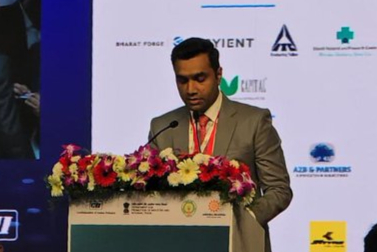
Mr. Karan Adani was addressing the Telangana Rising Global Summit 2025, the mega event of the State government led by Chief Minister A. Revanth Reddy, and witnessing a few top-notch businessmen promising huge investments in the state.

“Over the last few years, the Adani Group has forged a strong and growing relationship with the state of Telangana. In line with our earlier commitments, we have initiated investments in sectors such as Defense manufacturing, Green Data Centers, Renewable energy projects and Cement manufacturing facilities across the state,” he said.

Highlighting Adani Group’s action towards pushing the goal of Atmanirbhar Bharat, he said the Adani Group has developed a leading defense and aerospace park in Hyderabad.

“This state-of-the-art facility is the first UAV manufacturing facility in the country, where long endurance UAV’s are manufactured. The UAV’s manufactured in this facility is supplied to both the Indian Armed Forces and also caters to global markets.”

“Today, it provides direct employment to more than 1,500 youth of this state and supports many more livelihoods through its wider ecosystem,” he added.

In the area of digital infrastructure, he said, the Adani Group is setting up a 48 MW green data center in Telangana with an investment of Rs 2,500 crore.

Talking further about the capital infrastructure and logistics infrastructure, Mr. Karan Adani said, “With a total investment of Rs 4,000 crores in road infrastructure, the Adani Group has built over 100 Kms of highways, connecting key districts such as Mancherial, Suryapet, Kodad and Khammam.”

“These projects not only enhance connectivity and logistics efficiency across the state but also support the livelihoods of hundreds of families across the state.”

Further, to support Telangana’s rapid infrastructure growth, Adani Cement has invested over Rs 2,000 crore to establish state-of-the-art cement manufacturing facilities at Ganeshpahad, Tandur and Devapur, with a combined capacity of 7 MTPA, he said in his speech.

Telangana is hosting the two-day “Telangana Rising Global Summit 2025” in Hyderabad.

Global leaders, industry heads, and experts will attend 27 sessions on key sectors like energy, IT, healthcare, and startups.

Major organisations, including the WHO, World Bank, ADB, and UNICEF, will participate in the event.
Further, the State will also release its Telangana Rising 2047 Vision Document, aiming for a 3-trillion-dollar economy by 2047.

Source: ANI
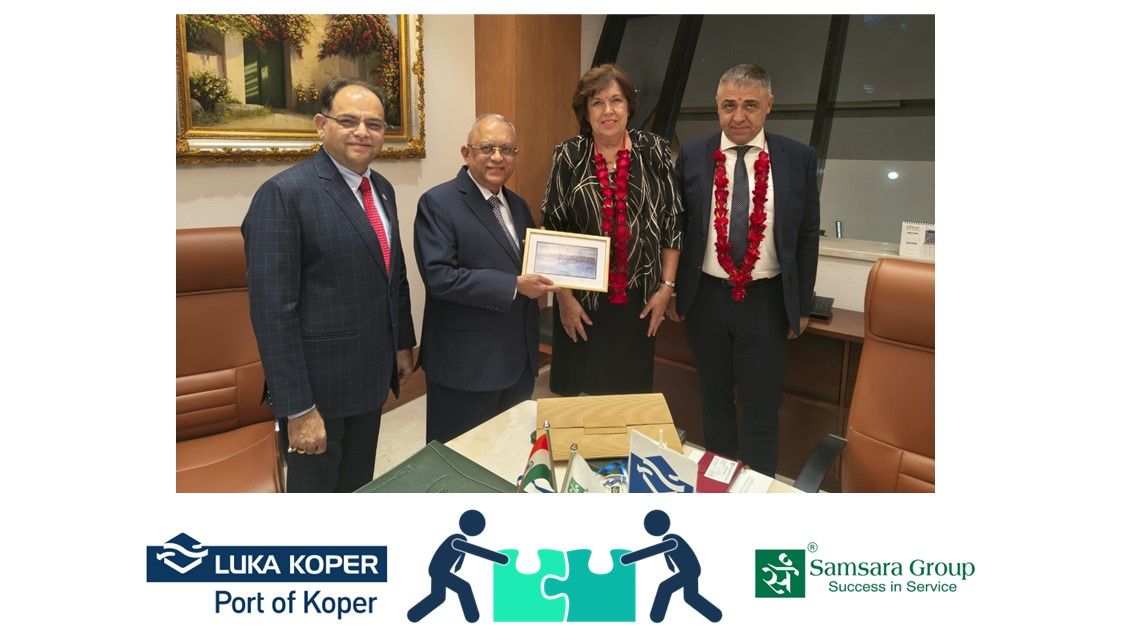
Luka Koper and Samsara Group sign cooperation agreement to strengthen port representation in India

MUMBAI : In a significant development for India–Europe maritime connectivity, Luka Koper (Port of Koper), Slovenia’s premier multipurpose port, has entered into an Agreement on Business Cooperation with Samsara Group, a leading maritime and logistics services provider in India, informs a LinkedIn post.

The agreement, signed on 08 December 2025, aims to enhance Luka Koper’s Port Marketing and Representation efforts across the Indian market. Through this collaboration, both organisations will work together to promote Koper’s strategic advantages—its position as the closest EU gateway to Central and Eastern Europe, its efficient multimodal connectivity, and its growing container and automobile handling capabilities.

Under the cooperation framework, Samsara Group will support Luka Koper in deepening engagement with Indian exporters, importers, shipping lines, and logistics stakeholders. The partnership is expected to contribute to improved trade flows between India and key European destinations served through the Port of Koper.

Samsara Group expressed appreciation for Luka Koper’s trust in the partnership, noting that the collaboration reflects a shared vision to expand opportunities for Indian trade through reliable, sustainable, and competitive European routes.

Both organisations look forward to leveraging their combined strengths to achieve impactful results in the years ahead.

“Discussed progress on India-EU FTA”: Piyush Goyal meets EU Trade Commissioner Maros Sefcovic

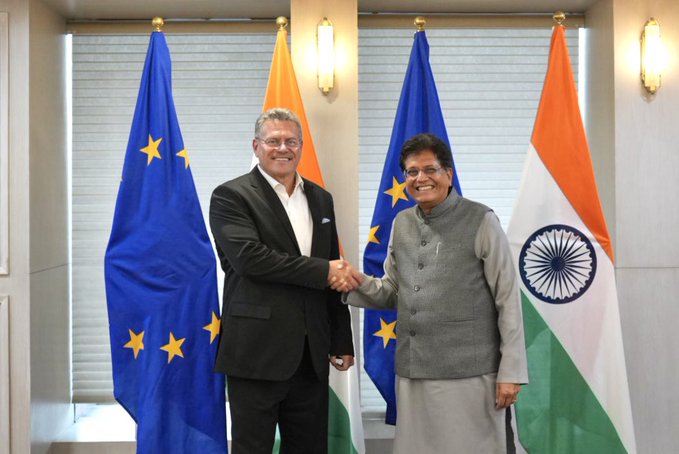
NEW DELHI: Union Commerce and Industry Minister Shri Piyush Goyal on Monday met the visiting European Union (EU) Trade Commissioner Maros Sefcovic and discussed progress on the India-EU FTA and explored ways to “resolve the issues to further advance the negotiations.”

In a post on X, Goyal said, “looking forward to continued cooperation towards a mutually beneficial India-EU FTA.”

“Held a productive meeting with EU Trade and Economic Security Commissioner, Mr. @MarosSefcovic. We discussed the progress on the India-EU FTA and explored ways to resolve the issues to further advance the negotiations. Looking forward to continued cooperation towards a mutually beneficial India-EU FTA,” the post read.

The European Commissioner for Trade and Economic Security, Maros Sefcovic, is in India for a two-day “marathon of meetings” with Union Commerce Minister Piyush Goyal to advance trade and investment negotiations.

Earlier, on the social media platform X, the EU Commissioner said, “In India for a two-day marathon of meetings with @PiyushGoyal to advance our trade and investment negotiations.”

“EU-India ties are growing fast – as they should between partners. But we’ve only scratched the surface. A commercially meaningful FTA would unlock enormous potential,” the post read.

Earlier in October, Piyush Goyal visited Brussels from 26 to 28 October 2025 and had productive and meaningful engagements with Maros Sefcovic and his team on outstanding issues related to the ongoing India-EU FTA negotiations.

Both sides reaffirmed their shared commitment to conclude the India-EU FTA by the end of 2025.

During Piyush Goyal’s visit to Brussels, a discussion was held on India’s concerns on Non-Tariff Measures and the new EU regulations.

During the negotiations, Goyal emphasised the need for preferential treatment for India’s key asks, particularly those with respect to labour-intensive sectors.

Both sides agreed to work closely to finalise the non-sensitive industrial tariff lines. They also agreed that issues related to Steel, Auto, CBAM, and other EU regulations still require further discussion, as they are more sensitive.

In February, President of the European Commission Ursula von der Leyen visited India, and upon meeting Indian Prime Minister Shri Narendra Modi, both leaders affirmed that the EU-India Strategic Partnership has delivered strong benefits for their peoples and for the larger global good.

They committed to raising this partnership to a higher level, building on 20 years of the India-EU Strategic Partnership and over 30 years of the India-EC Cooperation Agreement.

Source: ANI

Claudia Sanhueza, Treasury Undersecretary in the Ministry of Foreign Affairs of Chile, called on Piyush Goyal

NEW DELHI: The 4th Round of negotiations for the India–Chile Comprehensive Economic Partnership Agreement (CEPA) concluded successfully on 05th December, 2025. The five-day round witnessed intensive and constructive engagement between the delegations of India and Chile, resulting in substantial progress across the chapters under negotiation.

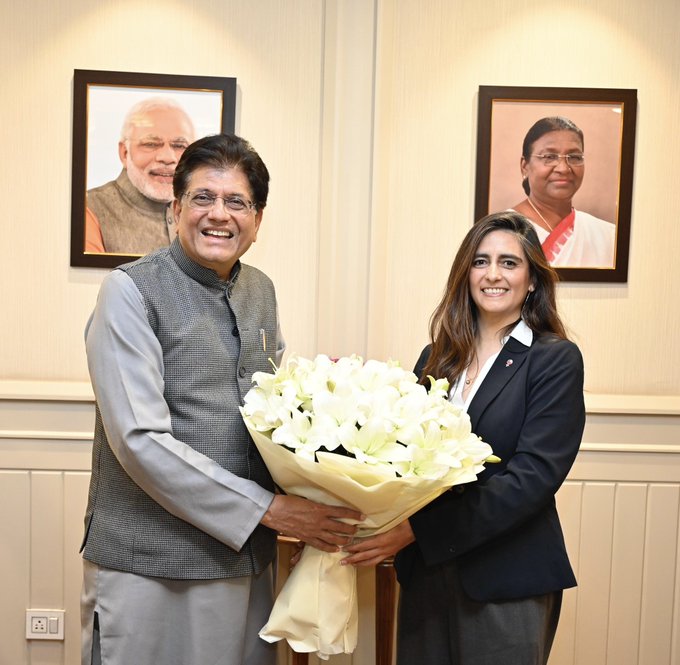
As part of the engagements associated with the round, Ms. Claudia Sanhueza,Treasury Undersecretary in the Ministry of Foreign Affairs of Chile met Union Minister of Commerce & Industry Minister, Shri Piyush Goyal on 8th December, 2025. Both sides reiterated their strong commitment to the timely conclusion of the CEPA negotiations, acknowledging the strategic significance of further strengthening bilateral economic ties. They underscored that the CEPA, once concluded, would play a pivotal role in boosting bilateral trade, deepening economic cooperation, enhancing market access and creating new opportunities for businesses in both countries.

India moves toward its own Bharat Container Shipping Line as Ports, SCI & CONCOR align

NEW DELHI : India is preparing to take a major leap toward maritime self-reliance with the planned launch of the Bharat Container Shipping Line, a new national carrier that will be jointly promoted by Shipping Corporation of India Ltd (SCI) and Container Corporation of India Ltd (CONCOR). The two PSUs are set to anchor the initiative with a majority stake, while key state-owned ports — including Chennai Port Authority, Kamarajar Port Ltd, and possibly VOC Port Authority — are poised to join as minority equity partners, according to people familiar with the developments.

The move is part of a broader effort to build an integrated, India-backed container shipping ecosystem that connects port operations, rail logistics, and ocean transport under a unified framework.

Government officials indicate that inter-ministerial consultations between the Ministry of Ports, Shipping & Waterways and the Ministry of Railways are in their final phase.

“Within the next two weeks, the equity structure will be firmed up and an MoU will be signed. A detailed business plan will be developed thereafter,” a senior official confirmed.

SCI and CONCOR: Complementary Strengths

Under the proposed arrangement:

SCI will take the lead on chartering ships and running the new container service.

CONCOR will leverage its extensive logistics backbone — including 66 terminals, 410 owned container trains, more than 56,000 ISO containers, and 4 million sq ft of warehousing capacity.

CONCOR’s established presence in major container terminals—holding 26% in GTIPL at JNPA and 15% in IGTPL at Cochin—is expected to provide additional operational heft. The rail logistics major has also widened its maritime engagements with MoUs linked to ports at Bhavnagar and Vadhvan.

CONCOR’s Expanding Maritime Push

The rail PSU has already made noticeable strides in international shipping by deploying its own containers on Middle East routes with strong two-way utilisation.

“We are getting robust load factors and margins of over 30% per container,” CONCOR CMD Sanjay Swarup said in the company’s Q2 earnings call, adding that services to the Far East are under active consideration.

Reducing Reliance on Global Carriers

At present, nearly 99% of India’s EXIM container cargo is transported by foreign shipping lines such as MSC, Maersk, CMA CGM, Hapag-Lloyd and others. SCI—the only Indian player operating mainline container ships—owns a small fleet of three vessels.

Exporters have long argued that India needs a strong domestic carrier to bring greater stability, competitive pricing, and strategic autonomy to its trade supply chain.

The creation of the Bharat Container Shipping Line, supported by SCI, CONCOR, and major government-owned ports, is being seen as a decisive step toward that goal — laying the foundation for a more resilient, India-led maritime logistics network.

JSW Infrastructure to acquire 3 rail logistics arms for Rs 1,212 crore

MUMBAI : JSW Infrastructure has announced a major expansion into the railway rake business by buying three JSW-owned rake companies for Rs 1,212 crore. The company in its BSE filing said that JSW Port Logistics, it’s wholly owned subsidiary, has signed a Share Purchase Agreement (SPA) to buy 100% stake in JSW Rail Infra Logistics, JSW Minerals Rail Logistics and JSW (South) Rail Logistics.

Agreement gives access to railway schemes and ready fleet
With this acquisition, JSW Infrastructure will get immediate access to the Indian Railways’ General Purpose Wagon Investment Scheme (GPWIS) and the Liberalized Special Freight Train Operator (LSFTO) scheme. The group has already secure a fleet of 21 rakes as of November 30, with four more on the way. These assets come with long-term licenses under the railway schemes.

The company said the move is EPS accretive from the first day and builds on its October 2024 acquisition of Navkar Corp, which marked its entry into last-mile logistics.

Dual-revenue model to support stable income
After the completion of the deal, all three companies will become step-down wholly owned subsidiaries of JSW Infrastructure. The transaction remains subject to fulfilment of conditions mentioned in the SPA, including regulatory approvals.

JSW Infrastructure noted that the rake operator business offers dual revenue streams — rebates from Indian Railways and market premiums from customers. This model ensures stable and annuity-like earnings supported by industries such as steel and cement.

Key highlights of the transaction
The company said the acquired entities have valid licences and approved routes under GPWIS and LSFTO, licences that allow private players to operate freight rakes on approved routes and earn incentives. It also has revenue visibility through 10-year contracts with customers like JSW Steel and Bhushan Power and Steel.

JSW Infrastructure expects the acquired businesses to deliver an annualised EBITDA of Rs 150 crore by FY27, translating into an EV/EBITDA of 8.1x.

The company aims to scale its rake fleet from 25 after acquisition to 45 rakes by FY27, and further to 110 rakes by FY30. The acquisition requires approval from the Ministry of Railways as well as shareholders of JSW Infrastructure. The company expects the transaction to close within 30 days after meeting all conditions precedent.

US Deputy Ambassador for Trade to visit India on 10, 11 December: MEA

NEW DELHI: In yet another push towards the India-US bilateral engagement, the new US Deputy Ambassador for Trade, Rick Switzer, will be visiting India on the 10th and 11th of December, Ministry of External Affairs (MEA) Spokesperson confirmed on Monday.

While addressing a press conference, MEA spokesperson Randhir Jaiswal said, “The new deputy US trade representative, Ambassador Rick Switzer, will be visiting India on the 10th and 11th of December. This visit is a familiarisation visit, as well as to meet with senior officials in the government of India.”

“As you are aware, both governments remain engaged with a view to concluding a fair, balanced, and mutually beneficial multi-sectoral financial trade agreement,” he added.

Notably, several rounds of discussions have already taken place between both sides already.

On November 28, Commerce Secretary Agarwal expressed confidence at the FICCI Annual General Meeting, stating, “I think our expectations….we are very optimistic and very hopeful that we should find a solution within this calendar year.”

The talks have progressed substantially, though the original target of completing the first tranche by fall 2025 was delayed due to new developments in US trade policy, including tariffs imposed by President Donald Trump on Indian goods.

India has already signed 14 Free Trade Agreements and six Preferential Trade Agreements with trading partners and is currently negotiating FTAs with several countries, including the European Union.

The road to the Bilaterla Trade Agreement (BTA) has been complicated by US tariff measures, with President Trump imposing a 25% tariff on Indian goods starting August 1, followed by another 25% increase days later, citing India’s continued purchase of Russian oil as part of reciprocal tariffs on countries where the US faces trade deficits.

The BTA aims to more than double bilateral trade from the current USD 191 billion to USD 500 billion by 2030, with talks first announced during Prime Minister Shri Narendra Modi’s visit to Washington earlier this year.

Source: ANI

US delegation to visit India today for crucial bilateral trade negotiations

NEW DELHI: A high-level delegation from the office of the US Trade Representative, led by Deputy US Trade Representative Ambassador Rick Switzer, will visit India from December 9-11, 2025, official sources told ANI.

Negotiations between the two countries are scheduled for December 10 and 11, focusing on all trade-related issues as both nations work to advance the Bilateral Trade Agreement (BTA). Commerce Secretary Shri Rajesh Agarwal, serving as India’s Chief Negotiator, will lead the Indian negotiating team during these critical discussions.

India remains optimistic about finalizing the first tranche of the India-US BTA within the current calendar year, despite recent challenges in the global trade environment. On November 28, Commerce Secretary Agarwal expressed confidence at the FICCI Annual General Meeting, stating, “I think our expectations….we are very optimistic and very hopeful that we should find a solution within this calendar year.”

The talks have progressed substantially, though the original target of completing the first tranche by fall 2025 was delayed due to new developments in US trade policy, including tariffs imposed by President Donald Trump on Indian goods.

The road to the BTA has been complicated by US tariff measures, with President Trump imposing a 25 per cent tariff on Indian goods starting August 1, followed by another 25 per cent increase days later, citing India’s continued purchase of Russian oil as part of reciprocal tariffs on countries where the US faces trade deficits. Despite these obstacles, multiple rounds of talks have taken place to finalize the agreement, which was formally proposed in February following directives from the leadership of both nations. The BTA aims to more than double bilateral trade from the current USD 191 billion to USD 500 billion by 2030, with talks first announced during Prime Minister Shri Narendra Modi’s visit to Washington earlier this year.

The upcoming negotiations reflect India’s broader trade engagement strategy, as the country simultaneously pursues agreements with multiple partners. India has already signed 14 Free Trade Agreements and six Preferential Trade Agreements with trading partners and is currently negotiating FTAs with several countries, including the European Union.

External Affairs Minister Shri S. Jaishankar, speaking at the HT Leadership Summit 2025, emphasized India’s autonomy in maintaining bilateral relationships with major countries, stating that “for any country to expect to have a say on how we develop our relations with others is not a reasonable proposition.” He reaffirmed India’s policy of upholding “strategic autonomy” and “freedom of choice” in its international engagements.

Source: ANI

Trump considers fresh tariffs on Indian rice as US farmers allege unfair dumping

WASHINGTON D.C. : US President Donald Trump signalled that his administration is ready to consider fresh tariffs on agricultural imports, including Canadian fertiliser and Indian rice, as he confronted farmers’ complaints about cheap foreign goods undercutting US producers, according to Bloomberg.

Speaking at the White House roundtable meeting to unveil a $12 billion bailout package for American farmers, Trump said the government would investigate claims that countries are dumping low-priced rice into the American market.

Farmers at the table pressed Trump to take a harder line, arguing that subsidised rice imports are battering US markets and pushing domestic prices down. Trump replied that they’re cheating and suggested tariffs could follow. He also hinted that fertiliser imported from Canada may be next, saying severe duties were on the table to boost US production.

TRUMP ASKS FARMERS WHICH COUNTRIES TO TARIFF NEXT
CEO of Louisiana-based Kennedy Rice Mill, Meryl Kennedy, told Trump that India, Thailand and China were among the top culprits, noting that Chinese shipments were going into Puerto Rico rather than the mainland. “We haven’t shipped rice to Puerto Rico in years,” said Kennedy, adding that “us in the South are really struggling”.

“The tariffs are working, but we need to double down,” Meryl Kennedy said.

“You want more?” Trump asked incredulously.

“They shouldn’t be dumping,” he told farmers gathered for a roundtable. He then asked Treasury Secretary Scott Bessent to write down the countries cited by farmers as sources of unfair competition.

As Kennedy began outlining how India could be propping up its rice industry with unlawful subsidies, Trump cut in before he could finish. “Give me the countries if you could? Go ahead. India, who else? Mark it down, Scott,” the US President said.

The Treasury Secretary again listed India, Thailand and China as the “main culprits,” and added, “But there’s others too and we can get you a full list.” Trump responded by assuring the group that he would “take care” of the matter quickly.

Bloomberg reported that both Canada and India have been pushing for trade agreements to steady their economic ties with the United States, but negotiators have struggled to make real headway.

In August, Trump imposed 50 per cent tariffs on Indian goods, saying the move was meant to punish New Delhi for its trade barriers and continued purchases of Russian oil.

US DELEGATION TO VISIT INDIA TO DISCUSS TARIFFS

A senior delegation from the US Trade Representative’s office, led by Deputy USTR Rick Switzer, is set to resume trade discussions with India this week. The two sides will meet on December 10 and 11 to take up a wide range of issues as they try to push the Bilateral Trade Agreement (BTA) forward.

Commerce Secretary Rajesh Agarwal, India’s chief negotiator, will head the Indian side in the talks. New Delhi is still aiming to wrap up the first tranche of the BTA before the end of the year. Speaking at the FICCI Annual General Meeting on November 28, Agarwal said he remained very optimistic and very hopeful that an agreement could be reached within the calendar year.

Source : India Today

Assam Cabinet clears new Logistics & Warehousing Policy to transform state into Northeast Supply Chain Hub

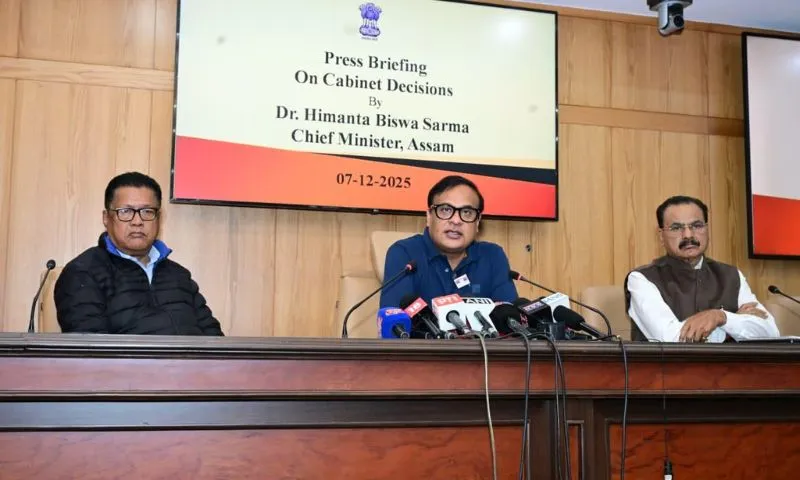
GUWAHATI : Assam Chief Minister Shri Himanta Biswa Sarma addressed the media after the conclusion of the State Cabinet meeting on Sunday, announcing a series of key decisions aimed at accelerating infrastructure development, education reform, and social justice across the state.

One of the most significant announcements was the government’s decision to establish a Greenfield Airport at the Doloo Tea Estate in Silchar. To facilitate the project, the Assam government has approved the allotment of 3,000 bighas of land to the Airports Authority of India. The Chief Minister expressed confidence that the Union Cabinet will grant formal approval for the project within a short time, marking a major step forward for connectivity and economic development in the Barak Valley.

In another landmark decision under Mission Basundhara, the Cabinet approved land allotments to 1,200 families, further strengthening the government’s commitment to providing land rights to the landless and resolving long-pending disputes.

The Cabinet also gave its nod to the Assam Logistics and Warehousing Policy 2025, aimed at transforming the state into a major logistics hub in the Northeast by strengthening storage infrastructure, streamlining supply chains, and attracting private investment.

Boosting technical education, the government has approved the construction of a new project at Assam Engineering College at an estimated cost of ₹243 crore. The project is expected to significantly upgrade the institution’s infrastructure and academic capabilities, reinforcing Assam’s position as a centre for technical excellence.

Addressing pending compensation issues, the Cabinet approved financial assistance to 884 families in Dima Hasao, who were awaiting payments for land acquired for the construction of a four-lane highway.

In a major boost to defence-linked education in the hills, the government sanctioned ₹335 crore for the construction of a new Sainik School in Karbi Anglong, aimed at nurturing future leaders for the armed forces while uplifting the region’s education ecosystem.

Perhaps the most culturally significant decision was the Cabinet’s approval to make Assam’s History and Geography compulsory subjects in the school curriculum for Classes VI, VII and VIII. The move is designed to strengthen students’ understanding of the state’s identity, heritage, and geography from an early age.