Home Blog Page 529

India turns to Belgium, Egypt, others for specialty fertilisers amid China export curbs

NEW DELHI: Amid reports of China withholding exports of specialty fertilisers to India over the past few months, domestic companies have turned to alternative suppliers in Belgium, Egypt, Germany, Morocco, and the United States to bridge the supply gap, the government informed Parliament on Friday (December 5, 2025).

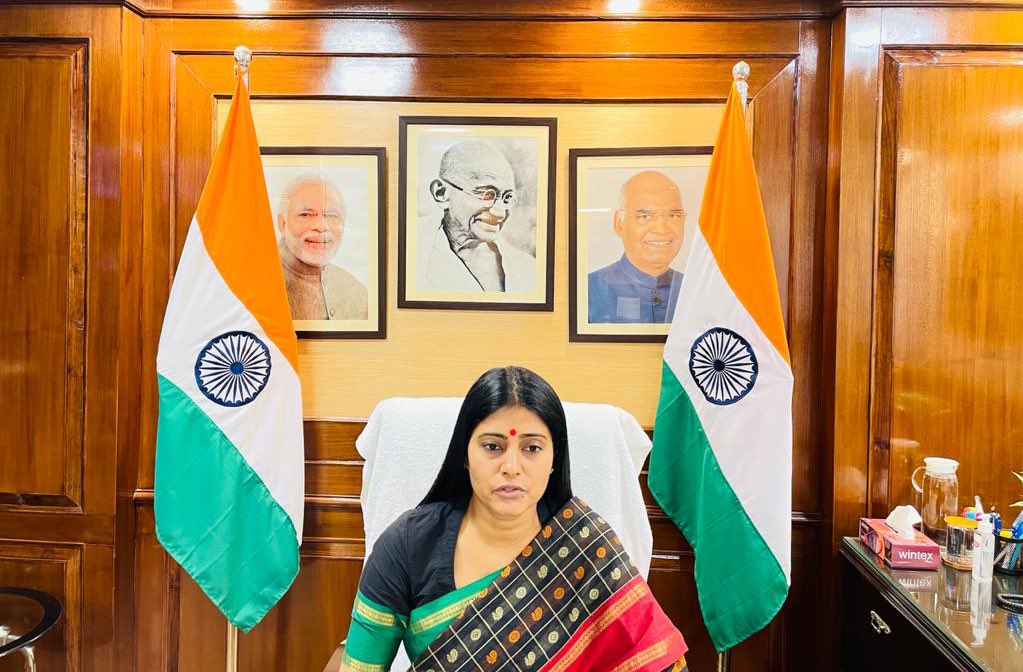
In a written reply to the Lok Sabha, Minister of State for Fertilisers Anupriya Patel clarified that specialty fertilisers fall outside the Nutrient-Based Subsidy (NBS) scheme overseen by the Department of Fertilisers, and are thus unsubsidised. “Fertiliser companies are free to import these products based on market dynamics,” she said.

Ms. Patel highlighted ongoing efforts by Indian research bodies to foster self-reliance in nutrient management. Institutions such as the Indian Council of Agricultural Research (ICAR) and State Agricultural Universities are developing indigenous alternatives, including zinc EDTA, boron blends, nano-fertilisers, and bio-fertilisers enriched with micronutrients like zinc-solubilising bacteria. These innovations are aimed at reducing import dependence while promoting sustainable agricultural productivity. Ms. Patel added.

ICAR’s institutes, including the Indian Institute of Soil Science (IISS) in Bhopal, the Indian Agricultural Research Institute (IARI) in Delhi, and the Indian Institute of Horticultural Research (IIHR) in Bengaluru, have pioneered technologies such as nano-fertilisers, bio-fertilisers, and customised nutrient blends.

These advancements are bolstered by government initiatives like Soil Test-Based Fertiliser Recommendations and Site-Specific Nutrient Management (SSNM), which form the backbone of a comprehensive Integrated Nutrient Management Strategy.

Under the Fertiliser Control Order (FCO) of 1985, no category is explicitly classified as “specialty fertiliser”. However, it includes provisions for 100% water-soluble complex fertilisers and 100% water-soluble mixtures.

Official data underscores China’s dominant role in India’s imports of water-soluble fertilisers. In the 2024-25 fiscal year, 1.71 lakh tonnes were sourced from China, accounting for 65.65% of the country’s total imports of 2.60 lakh tonnes. This compares to 1.22 lakh tonnes from China in 2023-24, or 59% of the 2.07 lakh tonnes imported that year.
Gujarat Maritime University Welcomes M. K. Das, IAS as Chief Secretary of Gujarat and President of GMU

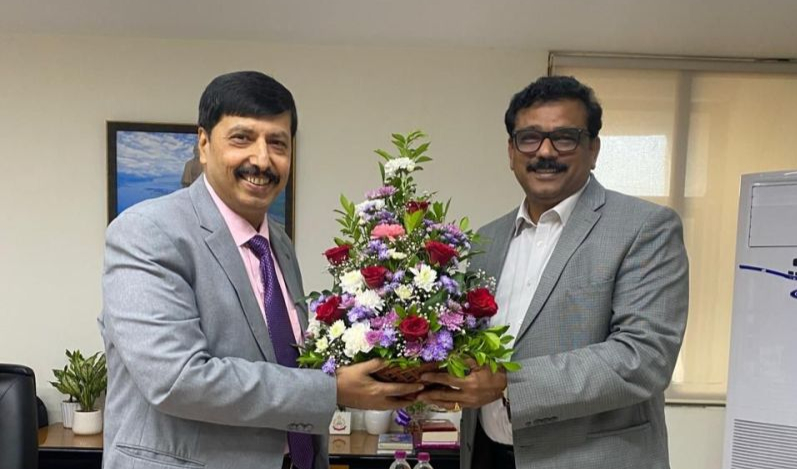
GANDHINAGAR: Gujarat Maritime University (GMU) has extended a warm welcome and heartfelt congratulations to Shri M. K. Das, IAS, on his appointment as the Chief Secretary of the Government of Gujarat. By virtue of this esteemed role, Shri Das also assumes office as the ex officio President of Gujarat Maritime University.

Prof. (Dr.) Sanjeevi Shanthakumar, Provost, GMU, greeted Shri Das and conveyed his best wishes, expressing confidence in his visionary leadership that will further strengthen the University’s contributions to maritime education and policy excellence.

A seasoned administrator known for his strategic insights and exemplary service, Shri M. K. Das brings with him a wealth of experience that is expected to significantly elevate GMU’s academic and institutional achievements. His guidance is anticipated to drive transformative growth, foster innovation, and reinforce Gujarat’s leadership in the maritime sector.

With Shri Das at the helm, GMU looks forward to a new era of progress and global engagement as it continues its mission to shape world-class maritime professionals and advance India’s maritime ambitions.

U.S. team led by Deputy USTR Switzer to visit India from December 10-12 to discuss tariffs

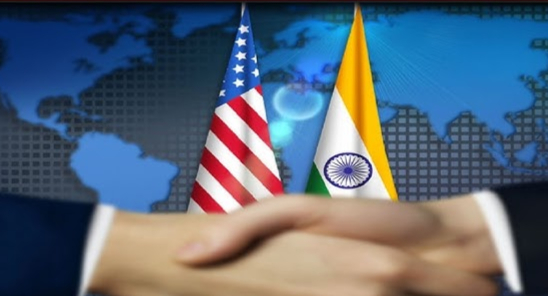
NEW DELHI: A team of negotiators from the U.S. will visit India on December 10-12 to take forward talks on the first tranche, dealing with tariffs, of a Bilateral Trade Agreement between the two countries.

According to sources in the Ministry of Commerce and Industry (MoCI), the U.S. delegation is expected to be led by Deputy US Trade Representative Rick Switzer, while the Indian side will be represented by Mr. Darpan Jain, Joint Secretary in MoCI.

The talks are not expected to constitute an official round of negotiations, the last of which took place in the U.S. in October. However, the two sides are looking forward to making “strong progress” towards addressing the issue of tariffs.

The U.S. currently has imposed a total of 50% tariffs on imports from India, with 25% of these constituting reciprocal tariffs, and another 25% being imposed as a penalty for India’s imports of Russian oil.

Last month,x who was India’s chief negotiator on the U.S. trade deal until he took over as Commerce Secretary in October, said that he was hopeful that the first tranche of the BTA, dealing with tariffs, would be concluded soon.

Commerce and Industry Minister Shri Piyush Goyal has also voiced similar sentiments about the deal. 

It has also been reliably learnt from officials closely tracking the deal negotiations that India has presented the U.S. with a revised version of what it considers its “final concessions” on the wider issues of market access and sectoral benefits.

“The officials and negotiators have done what they can on that front,” a second official said. “Now it really is up to the leaders, and that too, one more than the other.” 

There are also indications that the U.S. delegation to India might be accompanied by a “more senior” American government official. 

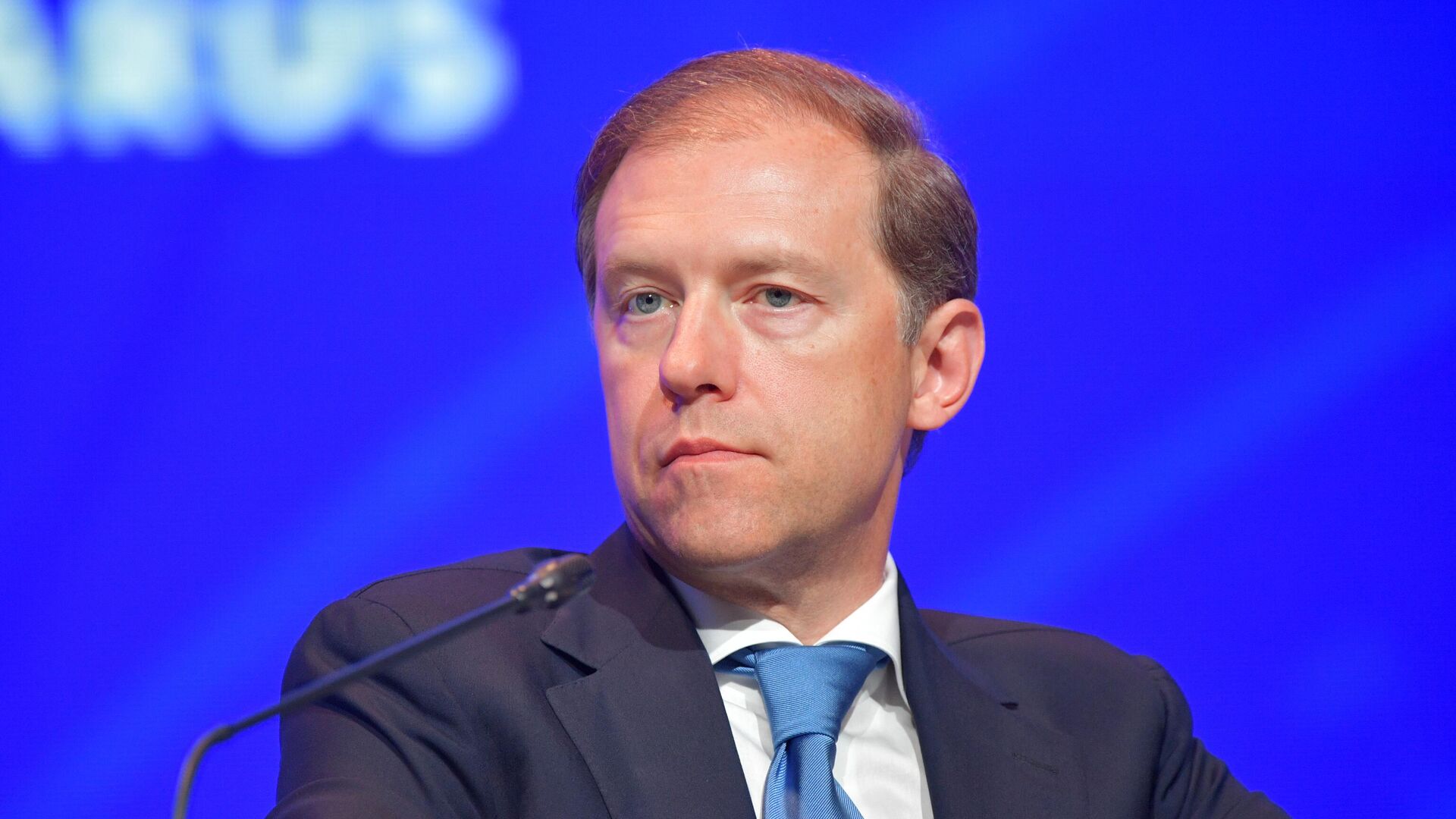
Russia plans shipbuilding foray in India: First Deputy PM Manturov

NEW DELHI: Russia is exploring joint production of polar-class vessels in India, the country’s First Deputy Prime Minister Denis Manturov has said, a plan which, once realised, could give a fillip to India’s domestic shipbuilding sector. 

“The organisation of joint production of Arctic-class vessels could become a promising area of cooperation,” Manturov told Russian state-owned media house Sputnik India. 

Russia is among the leaders in polar cargo vessel manufacturing, which are equipped with ice-breaking technology to weather harsh conditions in the Arctic. 

Manturov also said that talks have been going on with India’s ministry of ports shipping and waterways in this regard.

The move assumes significance in view of a mutual understanding of increasing trade through two India-Russia maritime routes including the International North-South Transport Corridor and the Eastern maritime corridor connecting Vladivostok to Chennai.

Russia and India seek to establish a stable Eurasian Transport Framework, he said. 

India has also been involved in discussions over the Northern Sea Route with melting of the arctic ice in the past opening up new possibilities for shipping routes through the northern coast of Russia, and the rise in Indian cargo handled in northern Russia. 

The India-Russia Joint Working Group (JWG) has been in nascent talks on the shipbuilding proposal, with Russian transport and logistics conglomerate Delo Group being among the players interested in establishing presence in India through joint ventures, a shipping ministry official said.

“The matter has been discussed in the last India-Russia JWG meeting. So far, the talks on the government end have been very nascent but the players may be individually approaching private shipyards for collaborations,” the official said, requesting anonymity. 

The shipping ministry has not received any firm proposal for joint ventures with Indian state-owned shipyards so far. 

Cochin Shipyard has been a beneficiary of the early shipbuilding push as one of India’s largest yards. Earlier this year, it secured a letter of intent from French carrier CMA CGM for six dual-fuel container vessels. 

In June, state-owned Kolkata-based Garden Reach Shipbuilders and Engineers Limited (GRSE) and Norway’s Kongsberg Oslo signed a memorandum of understanding which paved the way for India to build its first-ever Polar Research Vessel (PRV) indigenously.

Currently, the two countries have operationalised the eastern corridor between Chennai and Vladivostok. 

“Key commodities on this route have primarily been crude oil and coking coal, and talks are on to expand the cargo base,” the official added. 

HD Hyundai picks Tamil Nadu for first India shipyard

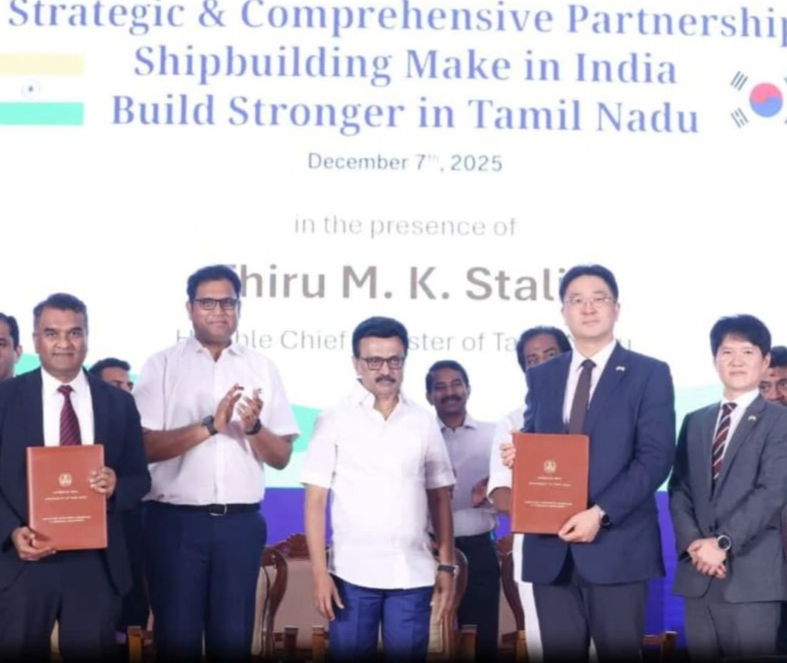
MADURAI: South Korean shipbuilding major HD Hyundai on Sunday announced plans to set up its first shipyard in India, choosing the port city of Thoothukudi in Tamil Nadu for the project. A memorandum of understanding (MoU) was signed in the presence of Tamil Nadu Chief Minister MK Stalin, Industries Minister TRB Rajaa and senior leadership from HD Korea Shipbuilding & Offshore Engineering (KSOE) at the Tamil Nadu Investment Conclave 2025 in Madurai.

While neither the government nor the company disclosed the investment outlay, informed sources told FE that the project could require at least $2 billion (around ₹18,000 crore).

For a shipbuilding project of this size, it takes at least $2 billion in initial investments,” one source said. They added that the company is in the process of raising funds for the project, and the final investment commitment will become clearer in the coming days.

HD Hyundai, one of the world’s largest shipbuilders, crossed a major milestone earlier this year by delivering a cumulative total of 5,000 vessels. The company already operates shipyards in Vietnam, the Philippines and Saudi Arabia. Internally, the India initiative was initially referred to as the “SMITH Project” — Shipbuilding Make in India Together with Hyundai — signalling long-term cooperation with India.

“This vision to build a mega-scale shipyard will be made possible together with the Government of India, the Government of Tamil Nadu, and HD Hyundai,” said Hannae Choi, Vice President and Head of the Corporate Planning Division at HD KSOE, while speaking at the conclave.

Why Thoothukudi?
The HD Hyundai project in Thoothukudi comes just months after Indian majors Cochin Shipyard and Mazagon Dock Shipbuilders announced their plans to set up two greenfield commercial shipyards in Thoothukudi, together committing around ₹30,000 crore and an employment potential of 55,000 jobs.

“Tamil Nadu was chosen by HD Hyundai because it offered a clear policy roadmap, fast coordination and a strong coastal ecosystem for a project of this scale,” Tamil Nadu Industries Minister TRB Rajaa said.

He noted that the employment multiplier in shipbuilding is significant, often cited at around 6.4x in India. “Shipbuilding is labor-intensive and supports numerous ancillary sectors (60-65% of value addition), making it a key driver for industrial growth and technological innovation in regions,” he said.

Tamil Nadu has been stepping up its maritime ambitions, identifying shipyard development as a priority to boost coastal economies, attract large-scale investments and develop skilled talent.

Meanwhile, the ‘TN Rising’ Investor Conclave saw the signing of 91 MoUs with investment commitments worth ₹36,660.35 crore.

Source: FE

BEML signs MoU with KSOE and HSHI to develop next-generation maritime & port crane ecosystem in India

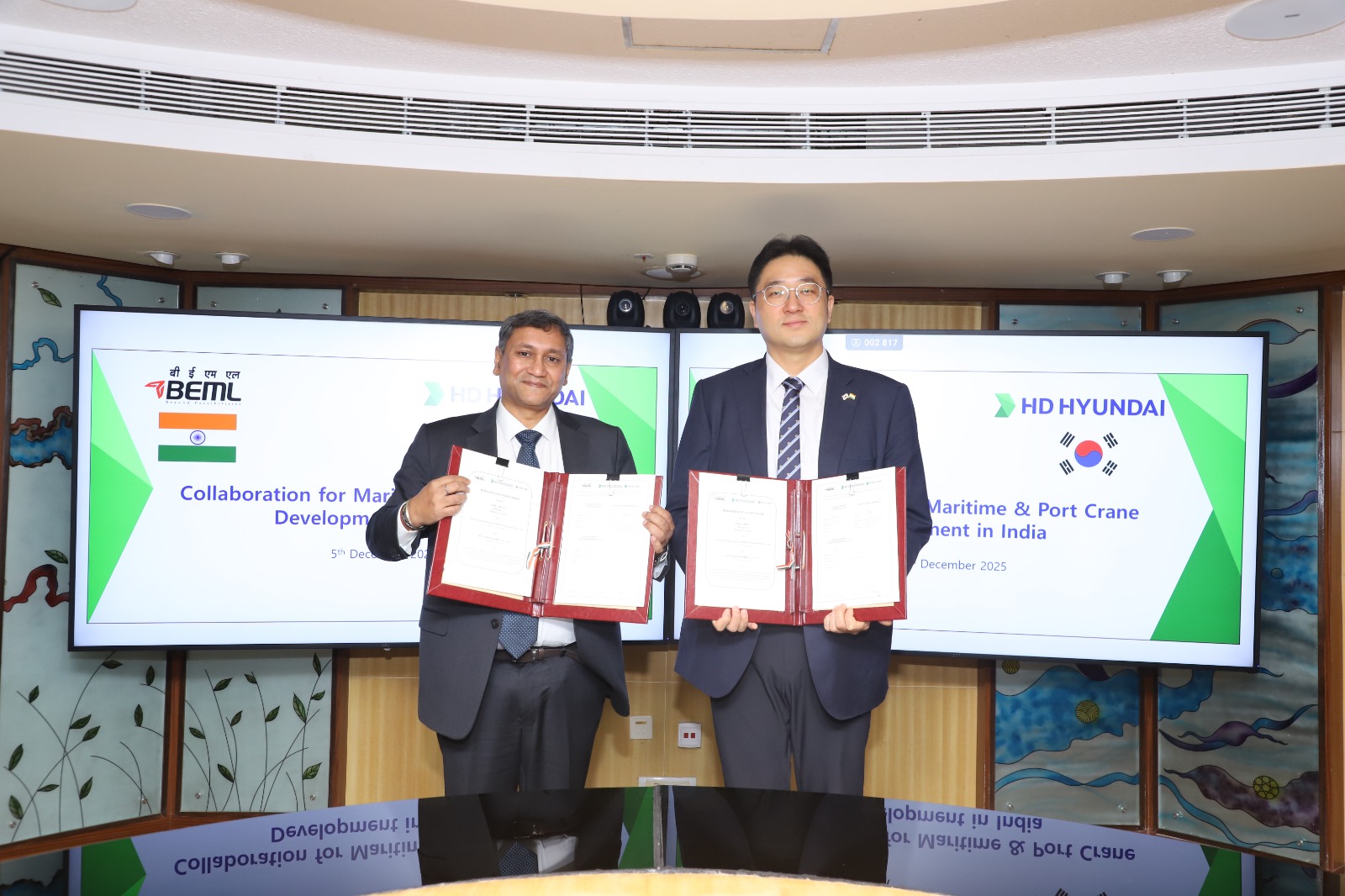
BENGALURU: In a major step toward boosting India’s maritime manufacturing capabilities, BEML Limited has signed a strategic Memorandum of Understanding (MoU) with HD Korea Shipbuilding & Offshore Engineering Co. Ltd (KSOE) and HD Hyundai Samho Heavy Industries (HSHI) to jointly design and build next-generation maritime and port crane systems in India.

The partnership, signed under the aegis of the Ministry of Defence and the Ministry of Ports, Shipping and Waterways, aims to develop a new generation of conventional and autonomous maritime and port cranes. The scope of collaboration includes design, development, manufacturing, integration, installation, commissioning, and long-term support, along with comprehensive after-sales service, training, and availability of spare parts.

According to BEML, the alliance aligns closely with India’s Maritime Amrit Kaal Vision 2047, which seeks to expand the country’s port handling capacity to 10,000 MMTPA and position India among the world’s top five maritime powers. The initiative is expected to reduce import dependence in a strategic high-technology sector, strengthen indigenous capabilities, and accelerate the modernisation of port operations and maritime infrastructure.

By leveraging BEML’s industrial scale and engineering expertise alongside KSOE and HSHI’s advanced global capabilities, the collaboration aims to support the development of high-capacity, energy-efficient, smart crane systems tailored for port expansion, shipyard automation, and next-generation cargo handling. It is also expected to boost private sector participation and generate high-value direct and indirect employment.

The MoU was formalised at BEML’s headquarters in Bengaluru in the presence of BEML’s Chairman and Managing Director (CMD) Shantanu Roy; senior officials from HD KSOE, including Han Nae Choi, Senior Vice President, Corporate Planning Division, and Young Hoon Kwon, Director of Global Business; HD KSOE and from HD Samho, including Jong Ho Park, Head of Crane and Industrial Plant Department. The agreement has been signed by Cmde R.G.K. Rao, Head (Maritime Strategic Business Unit) of BEML, and representatives of KSOE and HSHI.

BEML’s Maritime Strategic Business Unit has been actively contributing to national maritime goals through indigenous solutions for shipbuilding support systems, port modernisation, dredging, cargo and material handling, and specialised marine engineering. With a strong industrial footprint and decades of proven engineering expertise, the company said it remains committed to enabling self-reliance in critical maritime technologies.

KSOE, one of the world’s largest shipbuilding groups, will bring its extensive experience in commercial and naval vessels, offshore structures, and heavy marine engineering to the project. HSHI, known globally for advanced industrial crane design and large-scale automation capabilities, will contribute deep technical insights across manufacturing and systems integration.

The three companies said the joint initiative will help build a future-ready, high-technology maritime crane ecosystem in India, catalysing infrastructure development and supporting the country’s long-term vision for sustainable and globally competitive port and shipyard operations under Maritime Amrit Kaal 2047.

MoCA Action on IndiGo Operational Crisis – Air Fare Regulation

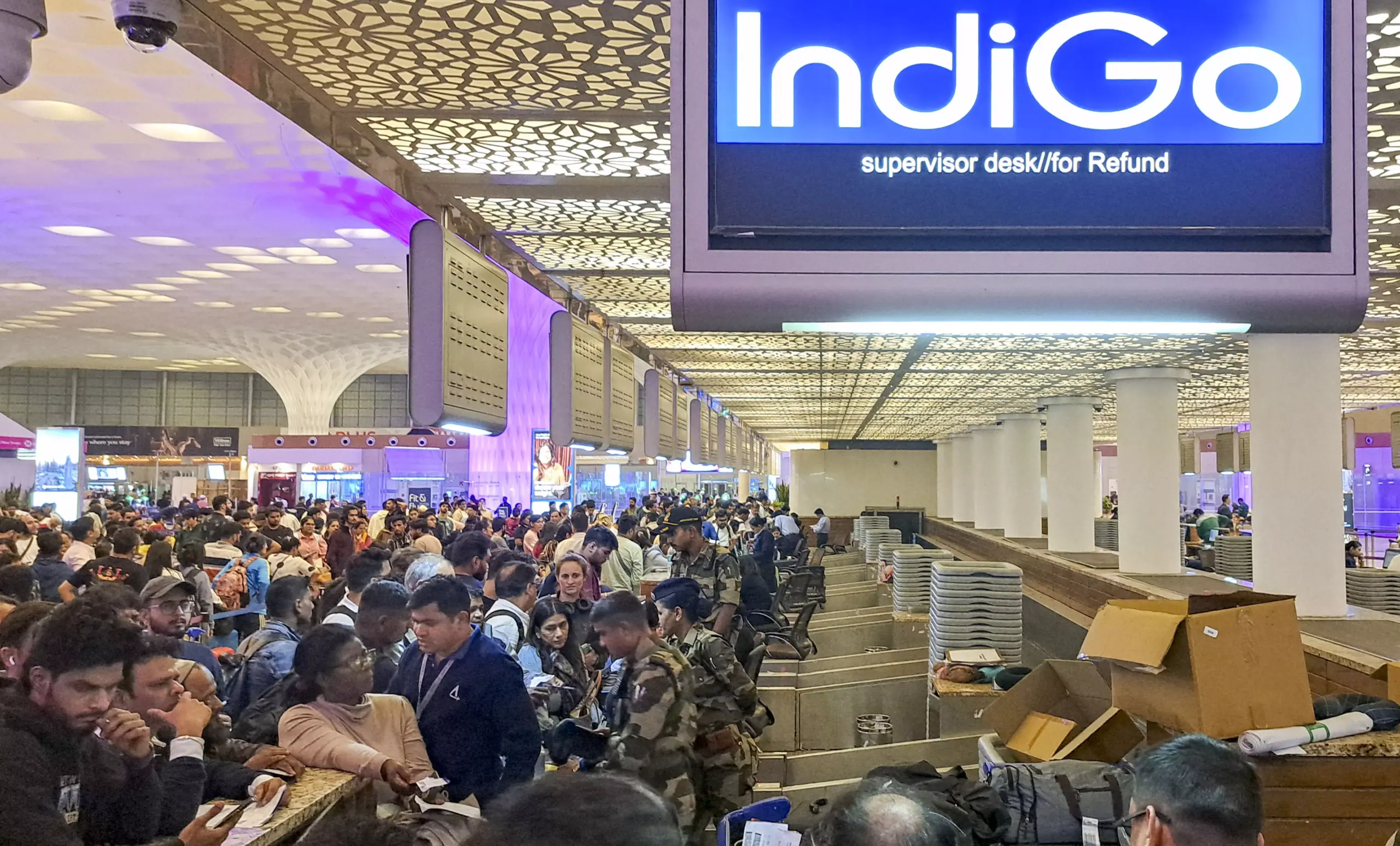
NEW DELHI: The Ministry of Civil Aviation has taken serious note of concerns regarding unusually high airfares being charged by certain airlines during the ongoing disruption. In order to protect passengers from any form of opportunistic pricing, the Ministry has invoked its regulatory powers to ensure fair and reasonable fares across all affected routes.

An official directive has been issued to all airlines mandating strict adherence to the fare caps that have now been prescribed. These caps will remain in force until the situation fully stabilises. The objective of this directive is to maintain pricing discipline in the market, prevent any exploitation of passengers in distress, and ensure that citizens who urgently need to travel — including senior citizens, students, and patients — are not subjected to financial hardship during this period.

The Ministry will continue to closely monitor fare levels through real-time data and active coordination with airlines and online travel platforms. Any deviation from the prescribed norms will attract immediate corrective action in the larger public interest.

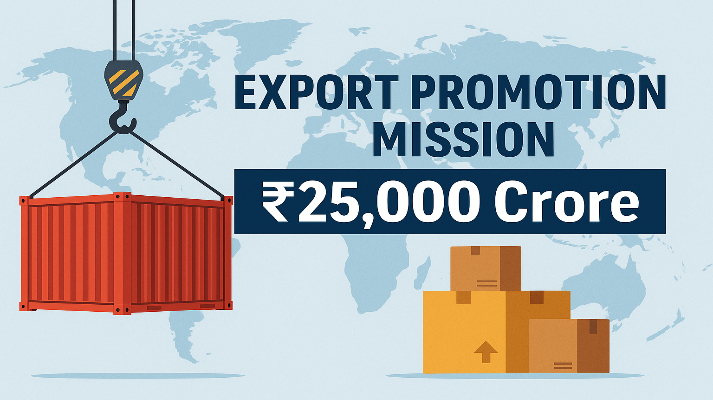
Export Promotion Mission sets unified path to strengthen India’s export competitiveness

NEW DELHI: India took a major step to strengthen its export ecosystem with the launch of the Export Promotion Mission (EPM), a unified framework approved in the Union Budget 2025-26. The Mission was designed to provide Indian exporters, especially MSMEs and first-time exporters, with simpler, faster, and more coordinated support.

As per data from a government release, with an outlay of Rs 25,060 crore for FY 2025-26 to FY 2030-31, the Mission aims to improve trade finance, strengthen market readiness and build competitiveness across regions and sectors. EPM brings together several fragmented schemes into one system so exporters can access support in a clear and predictable manner.

The policy rationale behind EPM is rooted in the need for a more coordinated export-support structure. India already has programmes such as interest equalisation and market-access initiatives, but official assessments show that challenges remain in access to affordable finance, meeting international quality standards, coordinated branding and easing logistics gaps. Recent export trends also point to the need for stronger digital systems and a single mechanism that can respond quickly to global trade changes.

The Directorate General of Foreign Trade (DGFT) will act as the implementing agency, which will run a digital platform for applications, approvals and disbursal. The framework brings together the Department of Commerce, the Ministry of MSME, the Ministry of Finance, Export Promotion Councils, financial institutions and state governments. The focus is on real-time monitoring, inter-ministerial coordination and outcome-based delivery.

The Mission functions through two integrated components: Niryat Protsahan and Niryat Disha.
Niryat Protsahan deals with financial support, including interest subvention, export factoring, deep-tier financing and credit enhancements.

Niryat Disha focuses on non-financial needs such as testing and certification, branding, packaging, trade fairs, logistics help and district-level capacity-building.

Alongside the Mission, the government has also expanded the Credit Guarantee Scheme for Exporters with an additional support of up to Rs 20,000 crore. The scheme provides 100 per cent credit guarantee coverage, helping exporters, especially MSMEs, access collateral-free working capital.

The Reserve Bank of India has added further support through the Trade Relief Measures issued in November 2025. These include moratoriums on loan repayments, extended credit tenures, flexible working-capital rules, regulatory forbearance and relaxed FEMA timelines for export realisation.

“By merging fiscal incentives, financial facilitation, digital governance and regulatory flexibility into a single mission-mode framework, the government has created a powerful platform to enhance India’s global trade competitiveness,” the release said.

Source: ANI

Rupee slide offers little relief to textile exporters as US tariffs hit volumes, margins

NEW DELHI: India’s textile and apparel exports fell 13% year-on-year to $2.67 billion in October, as per data from the Confederation of Indian Textile Industry (CITI).

India’s $37-billion textile and apparel exports industry is seeing little to no benefit from the rupee’s fall to a record low, as the steep 50% US tariffs have more than offset any currency-led gains.

According to exporters, the tariff shock has already hit their export volumes and squeezed wafer-thin margins, leaving the sector with almost no relief from the latest depreciation.

The rupee on Wednesday plunged to a historic low of 90.14 against the US dollar, breaching the ₹90 mark amid sustained capital outflows driven by continued FPI sell-offs, strong importer demand, and uncertainty over the US-India trade deal.

What did industry reps say?

“A weaker rupee normally helps exports, but in the current tariff-driven situation the benefit is very limited,” Prabhu D, convenor of the Coimbatore-based Indian Texpreneurs Federation (ITF), told FE. The 500-member federation represents the entire textile value chain, from standalone spinning and weaving units to apparel and home textile exporters.

According to him, exporters to the US are trying to sustain volumes by offering heavy discounts to retain buyers, with many operating at cost levels or even absorbing losses as they wait for the trade deal to conclude in December. 

“The bigger challenge is China’s improved tariff position with the US, which has given American buyers greater comfort to source from them,” he adds.

On October 30, the United States reduced tariffs on Chinese goods to 47% from 57%, effectively leaving India among the more heavily taxed countries. The US imposed a 50% duty on Indian imports — comprising a 25% reciprocal tariff and an additional 25% penalty linked to India’s purchases of Russian oil.

Impact of the tariff burden on Indian exports
The higher tariff burden has already begun to affect India’s $37-billion textile and apparel exports industry, where the US is the single-largest market with a 28% share. India’s textile and apparel exports fell 13% year-on-year to $2.67 billion in October, as per data from the Confederation of Indian Textile Industry (CITI). During April–October, textile exports declined 3.54% year-on-year, while apparel exports grew 1.13%.

However, Vishal Pacheriwal, MD of Parnika India, a Surat-based women’s wear manufacturer and exporter, says the rupee’s depreciation can offer some marginal gain by improving price competitiveness in dollar-denominated markets. “This can give firms flexibility: they may either pass on savings to buyers (to protect volume), or keep prices stable and enjoy improved margins,” Pacheriwal said, adding that many companies have already been offering discounts to American buyers to retain orders.

Some textile processing units also point out that a weaker rupee raises the cost of imported raw materials. “The cushioning effect (of currency depreciation) is limited when exporters rely on imported inputs, as those costs also rise in rupee terms. Moreover, many competing economies have also seen their currencies weaken, narrowing the relative advantage India might gain,” said Suketu Shah, CEO, Vishal Fabrics, which specialises in dyeing, printing and processing of denim, cotton and other fabrics.

Shah notes that the benefit of rupee depreciation is most visible only for exporters with limited import dependence, as their input costs are less affected by currency swings. “It’s important to note that the benefits remain nuanced like import-linked costs for fabrics, dyes, packaging, and logistics have also risen,” he points out.

For now, the industry’s “real hope”, according to Prabhu, is an early resolution of the trade issue — ideally a removal of the additional 25% tariff in December — to help India retain its market share in the US.

Source: FE

Kamarajar Port To Lead Rs 440 Billion Galathea Transhipment Project..

Kamarajar Port Ltd, India’s only state-owned port run as a company, has been tasked with implementing the Rs 440 billion International Container Transhipment Port (ICTP) at Galathea Bay in Great Nicobar Island, officials said.

The Ministry of Ports, Shipping and Waterways had earlier designated the Syama Prasad Mookerjee Port Authority in Kolkata as the nodal agency. That authority has now finalised and submitted the detailed project report to the Ministry, after which implementation responsibilities were transferred to Kamarajar Port Ltd.

It is not yet clear whether Kamarajar Port Ltd will act as the sole implementing agency. Officials suggested the shift reflects the company’s stronger ability to raise funds from the market or attract equity investments compared with a major port authority. Kamarajar Port Ltd is a subsidiary of the Chennai Port Authority.

Initially, the Ministry planned to execute the project through a special purpose vehicle (SPV) comprising four major port authorities — Deendayal, Jawaharlal Nehru, Paradip and V.O. Chidambaranar — each expected to hold a 20–25 per cent stake. The SPV would have developed core infrastructure such as dredging and breakwater construction before outsourcing cargo operations to private specialists.

However, these port authorities expressed reservations about committing funds, as each is pursuing substantial expansion projects, including VOC Port’s outer harbour terminal and new greenfield ports such as Vadhvan in Maharashtra and Bahuda Muhan in Odisha.

The Ministry has notified the Galathea Bay ICTP as a ‘major port’, making it India’s 14th such facility once completed. The port is planned to be developed in four phases, with the first phase offering capacity for 4 million twenty-foot equivalent units (TEUs). Capacity is projected to rise to 16 million TEUs by 2058.

Galathea will be India’s third international container transhipment hub after Vizhinjam, operated by Adani Ports, and Cochin, managed by DP World.

Source: Construction World