Home Blog Page 678

DP World’s global investment creates 5,000 new Jobs across four continents this year

DUBAI: DP World’s $2.5bn investment in developing end-to-end logistics infrastructure around the globe in 2025 is creating thousands of new jobs in construction.

Almost 5,000 new roles are being created to help deliver major transport projects in India, Britain, Ecuador, Senegal and the Democratic Republic of Congo, illustrating the scale of the economic transformation which accompanies DP World’s commitment to make trade flow. The international supply chain solutions business already employs more than 100,000 people directly.

Sultan Ahmed bin Sulayem, Group Chairman and Chief Executive Officer of DP World, said: “We are delighted that our investment is providing jobs for almost 5,000 people this year alone to help deliver major upgrades to the transport infrastructure of five different countries.”

“Trade has the potential to transform people’s lives and these new jobs show one of the ways that works in practice. When the projects are complete, the construction workers will leave a legacy of word class logistics infrastructure which will benefit customers, communities and continents for the next 50 years.”

TunaTekra Construction DP World's global investment creates 5,000 new Jobs across four continents this year
Tuna Tekra Construction

The key growth market of India will see 2,000 new construction jobs this year through the development of a new terminal at Tuna Tekra in the north-west. A further 500 new roles will be created from DP World’s delivery of rail and inland terminals across the sub-continent, a vital link in its end-to-end logistics network.

In Senegal, construction of a brand-new deep-sea port at Ndayane – which will support the country’s development for the rest of the century – is generating 600 jobs. Almost 3,000 miles along the west coast of Africa in the Democratic Republic of Congo, DP World’s Port of Banana is creating around 500 roles to build a first deep-sea port for the almost-landlocked nation.

DP World’s $1bn expansion of London Gateway – including two new berths and a second rail terminal – is creating 1,000 new jobs. The logistics hub on the doorstep of the capital is on course to become Britain’s largest port by the end of the decade.

On the other side of the Atlantic in Ecuador, the expansion of DP World Posorja is generating over 300 construction jobs through its contractor, in addition to more than 100 new direct operational roles.

When the projects are completed, the infrastructure at all five sites will support thousands more direct and indirect jobs as well as enhancing transport connectivity and economic growth in their regions. The company’s flagship Jebel Ali freezone in Dubai alone directly employs 160,000 people.

DP World is building a unique array of assets and suite of capabilities globally, helping its customers stay competitive in a fast changing and unpredictable trading environment.

Community Network Services (CNS) expands digital customs platform to The Netherlands in boost for UK-EU trade

LONDON: Leading digital trade solutions provider and DP World company, Community Network Services (CNS), has Wednesday announced the expansion of its industry-leading Customs Management services to The Netherlands.

The expansion, which went live on 1st July, marks the first step in the UK company’s broader European expansion strategy. Operating out of DP World’s Rotterdam office, CNS’s team provide Dutch logistics service providers, international shipping companies, cross-border trade partners and other logistics partners the tools to simplify and automate customs declarations, ensure regulatory compliance and optimise their supply chains via their dedicated online platform.

Mark Scott, Commercial Director of CNS, said: “We are thrilled to announce our expansion into the Netherlands, a key strategic market for our European growth. For almost 40 years, CNS has been the partner-of-choice for the movement and clearance of goods through UK and Irish ports, so we are delighted to begin operations in The Netherlands which will bring significant value to Dutch businesses.

“This expansion is a testament to our commitment to providing digital solutions that deliver speed, simplicity and cost-effective technology that enables a seamless, compliant customs declaration software solution – a must for cross border UK-EU trade.”

Leveraging decades of expertise and innovation, CNS’s digital platform offers a range of features, including automated customs declarations, real-time compliance monitoring, integrated data management and streamlined communication with Dutch, British and Irish customs authorities.

The expansion follows CNS’s major awards win at Multimodal 2025 in Birmingham in June, which saw the company take home the ‘Customs Technology Company of the Year’ award, cementing its position as a market leader in the field of customs and cross-border freight transit software solutions.

For further information about CNS and our ongoing expansion in The Netherlands, businesses can contact us at getonboard@cnsonline.net.

ZELIM urges adoption of Advanced Situational Awareness Technology to prevent Ship Collisions

EDINBURG: Zelim, the Edinburgh-headquartered maritime safety and security innovator, is calling for the mandatory adoption of advanced situational awareness technology to help prevent ship collisions, reduce fatalities, and improve operational safety at sea.

The call follows the recent publication of the Marine Accident Investigations Board’s (MAIB) 2024 Annual Report, which noted: “We need to radically rethink the role of human watchkeepers in the digital age. Humans do not make good monitors and if under-stimulated, they will find other things to occupy themselves.”

This was also reinforced in MAIB’s preliminary report on the Solong and Stena Immaculate incident in the North Sea, where the lack of real-time situational awareness contributed to the severity of events.

On 10 March 2025, the Portugal-registered container ship MV Solong collided with the anchored oil tanker Stena Immaculate near the Humber Estuary, rupturing a cargo tank and triggering a major fire. Thirty-six crew were rescued; one seafarer remains missing and presumed dead.

Zelim CEO, Sam Mayall, said: “We wholeheartedly support the MAIB’s position on this. By combining AI-powered cameras and real-time alerting, advanced technologies such as our ZOE system can help crews act faster, prevent incidents from escalating, and provide trusted records post-event. Beyond preventing collisions and man-overboard incidents, these systems can also provide critical forensic data to support investigations and regulatory compliance. Crucially, today’s situational awareness technology reduces reliance on human vigilance alone, allowing crews to focus where their judgment and experience matter most.”

India has already taken decisive action to reduce the risk of collision and lives lost to man-overboard incidents. Earlier this year, its Directorate General of Shipping mandated CCTV systems on all domestic vessels of 500 GT and above, with full implementation required by 2028. The regulation specifies comprehensive camera placement, resolution standards, and integration with AI-based monitoring. It is designed not just for surveillance, but for proactive detection, tracking, and alerting to protect lives at sea.

“Voluntary measures are no longer enough. To strengthen safety and security at sea, global regulators must follow India’s lead and mandate advanced situational awareness solutions. Smarter ships result in safer sea,” added Mayall.

PM Narendra Modi inaugurates Semicon India 2025 in New Delhi

NEW DELHI : The Prime Minister Shri Narendra Modi inaugurated the ‘Semicon India – 2025’, aimed at catalysing India’s Semiconductor ecosystem, at Yashobhoomi in New Delhi. Addressing the gathering, the Prime Minister acknowledged the presence of semiconductor industry CEOs and their associates from India and abroad. He welcomed distinguished guests from various countries, entrepreneurs associated with start-ups, and young students who had come from different states across the nation.

Shri Modi stated that he returned last night from his visit to Japan and China, and today he is present among the audience in Yashobhoomi, a hall filled with aspirations and confidence. Mentioning his passion for technology has always been natural and well-known, the Prime Minister said that during his recent visit to Japan, he had the opportunity to visit the Tokyo Electron factory along with Japanese Prime Minister H.E. Mr. Shigeru Ishiba. He mentioned that the CEO of that company is present among the audience today. The Prime Minister emphasized that his inclination towards technology repeatedly brings him among such gatherings. He expressed that being present among the audience today brings him great joy.

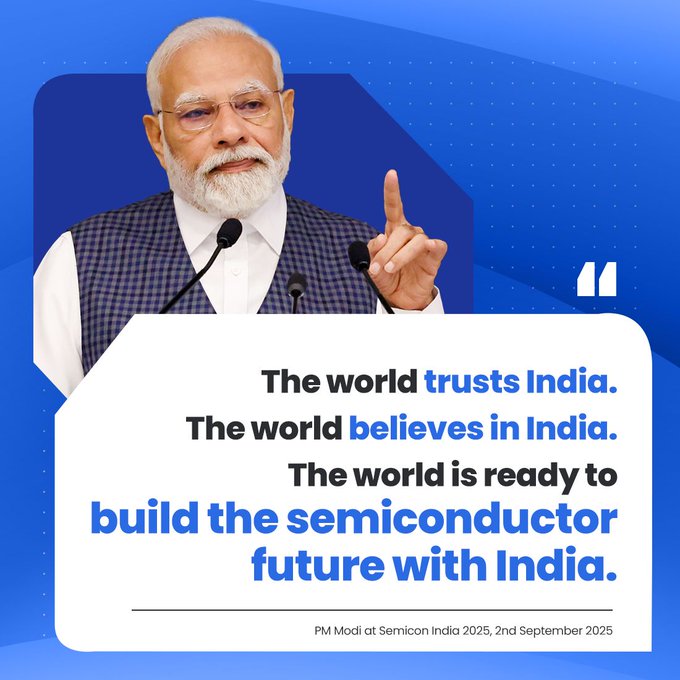
Noting the presence of semiconductor sector experts from across the globe, with representation from over 40 to 50 countries, Shri Modi emphasized that India’s innovation and youth power are also visibly present at the event. He stated that this unique combination sends a clear message, “The World trusts India, the World believes in India and the World is ready to build the Semiconductor Future with India”. The Prime Minister welcomed all distinguished guests attending Semicon India and affirmed that they are important partners in India’s journey towards a developed and self-reliant nation.

Pointing to the GDP figures for the first quarter of this year that were released recently, the Prime Minister said, “Once again, India has outperformed every expectation, every estimate, and every forecast”. He noted that while economies around the world are facing concerns and challenges driven by economic self-interest, India has achieved a growth rate of 7.8 percent. Shri Modi emphasized that this growth is visible across all sectors—manufacturing, services, agriculture, and construction—with enthusiasm evident everywhere. He remarked that India’s rapid growth is infusing new energy across industries and among every citizen. He affirmed that this trajectory of growth is propelling India swiftly towards becoming the third largest economy in the world.

Remarking that in the world of semiconductors, it is often said, ‘Oil was black gold, but chips are digital diamonds’, the Prime Minister stated that oil shaped the previous century, and the fate of the world was determined by oil wells. The global economy fluctuated based on how much petroleum was extracted from these wells. However, he emphasized that the power of the 21st century is now concentrated in the small chip. Though tiny in size, these chips possess the potential to accelerate global progress significantly. Shri Modi highlighted that the global semiconductor market has already reached $600 billion, and in the coming years, it is expected to surpass $1 trillion. He expressed confidence that, given the pace at which India is advancing in the semiconductor sector, India will hold a significant share in this $1 trillion market.

Stating that he wished to highlight the speed at which India is progressing, Shri Modi recalled that in 2021, the Semicon India programme was launched. He added that by 2023, India’s first semiconductor plant had been approved, in 2024, several more plants received approval and in 2025, five additional projects were cleared. He further stated that in total, ten semiconductor projects are now underway, involving an investment of over eighteen billion dollars —more than ₹1.5 lakh crore. The Prime Minister emphasized that this reflects the growing global trust in India.

Emphasising that in the semiconductor sector, speed matters, Shri Modi said, “the shorter the time from file to factory, and the lesser the paperwork, the sooner wafer work can begin”. He stressed that the government is working with this very approach. The National Single Window System has been implemented, enabling all approvals from both the Centre and States to be accessed on a single platform. As a result, investors have been freed from extensive paperwork, he further added. The Prime Minister highlighted that semiconductor parks are being developed across the country under a plug-and-play infrastructure model, which offer facilities such as land, power supply, port and airport connectivity, and access to a skilled worker pool. He remarked that when such infrastructure is combined with incentives, industrial growth is inevitable. Whether through PLI incentives or Design Linked Grants, India is offering end-to-end capabilities. This is why investment continues to flow in, he emphasised. Affirming that India is moving beyond backend operations and progressing towards becoming a full-stack semiconductor nation, Shri Modi reiterated that the day is not far when India’s smallest chip will drive the world’s biggest change. He stated, “Our journey began late… but nothing can stop us now.” The Prime Minister informed that CG Power’s pilot plant commenced operations on August 28, just 4–5 days ago. He added that the pilot plant of Kaynes is also about to begin. Test chips from Micron and Tata are already in production. He reiterated that commercial chip production will begin this year, underscoring the rapid progress India is making in the semiconductor sector.

Emphasizing that India’s semiconductor success story is not confined to a single vertical or a single technology, Shri Modi stated that India is building a comprehensive ecosystem—one that encompasses designing, manufacturing, packaging, and high-tech devices, all within the country. He clarified that the Semiconductor Mission is not limited to establishing a single fab or producing a single chip. Rather, India is creating a robust semiconductor ecosystem that will make the nation self-reliant and globally competitive, the Prime Minister added.

Underlining another key feature of India’s semiconductor mission, Shri Modi said that the country is advancing in this sector alongside the world’s most advanced technologies. He stated that India’s focus is to empower emerging technologies through chips manufactured domestically. The Prime Minister noted that design centers being developed in Noida and Bengaluru are working on some of the world’s most advanced chips—capable of storing billions of transistors. He emphasized that these chips will power the immersive technologies of the 21st century. Addressing the challenges faced by the global semiconductor sector, the Prime Minister affirmed that India is actively working to overcome them. He remarked that while towering buildings and impressive physical infrastructure are visible in cities, their foundation lies in steel. Similarly, the foundation of India’s digital infrastructure is built on critical minerals. Shri Modi stated that India is currently working on the National Critical Mineral Mission and is committed to meeting its demand for rare minerals domestically. He added that over the past four years, significant progress has been made on critical minerals projects.

Underscoring that the government envisions a significant role for start-ups and MSMEs in the growth of the semiconductor sector, the Prime Minister highlighted that India contributes 20 percent of the world’s semiconductor design talent, and that the country’s youth represent the largest human capital factory for the semiconductor industry. Addressing young entrepreneurs, innovators, and start-ups, Shri Modi urged them to come forward, assuring that the government stands shoulder to shoulder with them. He emphasized that the Design Linked Incentive Scheme and the Chips-to-Startup Programme are specifically designed for them. He also announced that the Design Linked Incentive Scheme is being restructured to better serve its objectives. The Prime Minister stated that the government is committed to developing Indian intellectual property (IP) in this sector. He added that the recently launched National Research Fund will also support this effort through strategic tie-ups. Noting that several states are actively participating in the semiconductor mission, with many having formulated special policies for the sector, the Prime Minister said that these states are focusing on developing dedicated infrastructure. He called upon all states to engage in healthy competition with one another to build semiconductor ecosystems and enhance the investment climate within their regions.

“India has reached this stage by following the mantra of Reform, Perform, and Transform. A new phase of next-generation reforms will soon be initiated”, stated the Prime Minister affirming that work is underway on the next phase of the India Semiconductor Mission. Addressing all investors present, he expressed India’s readiness to welcome them with an open heart and said, “Design is ready. Mask is aligned. Now is the time for precision execution and delivery at scale”. He emphasized that India’s policies are not short-term signals but long-term commitments and assured that every investor’s needs will be met. “The day is not far when the world will say: Designed in India, Made in India, Trusted by the World”, said the Prime Minister. He concluded by expressing his wish that every bit of India’s efforts be successful, every byte be filled with innovation, and the journey remain error-free and high-performance.

Union Ministers, Shri Ashwini Vaishnaw, Shri Jitin Prasada, Chief Minister of Delhi, Smt Rekha Gupta, Chief Minister of Odisha, Shri Mohan Charan Majhi were present among other dignitaries at the event.

Background

Semicon India – 2025 is a three-day Conference, from 2nd to 4th September, will focus on advancing a robust, resilient, and sustainable semiconductor ecosystem in India. It features sessions on the progress of the Semicon India Programme, semiconductor fab and advanced packaging projects, infrastructure readiness, smart manufacturing, innovations in R&D and artificial intelligence, investment opportunities, state-level policy implementation, among others. Additionally, the event will highlight initiatives under the Design Linked Incentive (DLI) scheme, the growth of the startup ecosystem, international cooperation, and the future roadmap for India’s semiconductor sector.

Over 20,750 attendees will participate including more than 2,500 delegates from over 48 countries, over 150 speakers, including over 50 global leaders, and more than 350 exhibitors. It will also include 6 countries Round Table discussions, country pavilions and dedicated pavilions for Workforce Development & Start-Ups among others.

PM Modi to take part at India Maritime Week in Mumbai, to address at the Global Maritime CEO Forum”: Sarbananda Sonowal

GUWAHATI : The Union Minister of Ports, Shipping and Waterways (MoPSW), Shri Sarbananda Sonowal announced that Prime Minister Shri Narendra Modi will attend the upcoming ‘India Maritime Week’ in Mumbai from Oct. 27–31, where he will deliver the keynote address at the Global Maritime CEO Forum.

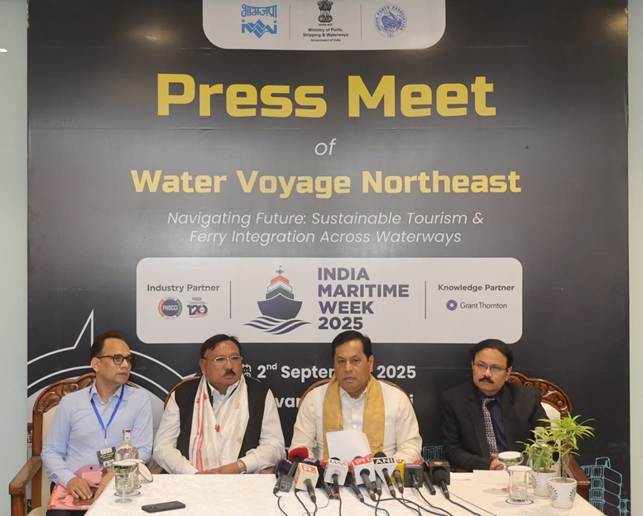
Speaking at the Water Voyage Northeast 2025 conference in Guwahati, Sonowal described the event as “a historic opportunity to showcase India’s maritime strength to the world” with participation expected from over 100 countries and more than 100,000 stakeholders. Sarbananda Sonowal said the Prime Minister’s presence will reaffirm India’s global maritime leadership at a time when the sector is undergoing unprecedented transformation.

“India Maritime Week will not only be a confluence of ideas, but a confluence of confidence,” Sarbananda Sonowal said. “The way Prime Minister Modi has guided our maritime vision, the world now looks at India as a trusted partner and a rising maritime power. His presence at the Global Maritime CEO Forum will inspire global industry leaders to invest in India’s growth story.”

The Minister also revealed a major development for the Northeast: two luxury cruise ships are being built at a combined investment of ₹250 crore for deployment on the Brahmaputra River. These ships, currently under construction at Hooghly Cochin Shipyard in Howrah, Kolkata, will be launched in 2027, providing a new dimension to Assam’s river tourism under the Cruise Bharat Mission.

Maritime reforms and transformation

Sonowal said India’s maritime ecosystem has been reshaped since 2014 under the leadership of Prime Minister Modi. Flagship initiatives such as Sagarmala, the Maritime India Vision (MIV) 2030, and the Maritime Amrit Kaal Vision (MAKV) 2047 are transforming ports, shipping, and inland waterways.

Sarbananda Sonowal highlighted that port capacity has nearly doubled, cargo handling has reached 1,600 million metric tonnes, and turnaround time at ports has reduced to 22 hours.

“From five operational waterways in 2014, we now have 30 today,” Sonowal noted. “Cargo movement on inland waterways has grown from 18 million tonnes in 2013-14 to 145 million tonnes last year. These are not just statistics, they are milestones of transformation.”

The Minister underscored the green transition being led by the Harit Sagar policy and Harit Nauka initiative, which promote clean fuels, renewable energy, and eco-friendly inland vessels. He also highlighted the Jalvahak Scheme, launched in December 2024, which incentivises cargo transport over 300 km on National Waterways 1, 2, and 16 through the Indo-Bangladesh Protocol route with up to 35% reimbursement of operating expenditure.

“With the Jalvahak scheme and fixed day scheduled sailings, we are not just moving cargo, we are moving confidence. We are providing the industry with predictability, affordability, and sustainability,” Sarbananda Sonowal said.

Water Voyage Northeast 2025 conference2 PM Modi to take part at India Maritime Week in Mumbai, to address at the Global Maritime CEO Forum": Sarbananda Sonowal

Northeast at the Center of Growth

The Union Minister placed special emphasis on the Northeast’s role in the maritime roadmap. Over ₹1,000 crore has been invested in inland waterway infrastructure in the region, of which ₹300 crore worth of projects are complete and the rest nearing completion.

Sarbananda Sonowal said, “Under the visionary leadership of Prime Minister Narendra Modi ji, we are unlocking the immense maritime potential of the Northeast. A ₹239 crore ship repair facility at Pandu — the first of its kind in the region — will be ready by 2026. By September 2025, a ₹180 crore dedicated approach road will directly link NH-27 to Pandu Port. To boost cruise tourism, we are investing ₹299 crore in new tourist jetties at Guijan, Neamati, Bishwanath Ghat and Silghat. At Dibrugarh, a ₹188 crore Regional Centre of Excellence is being developed to train 5,000 maritime professionals, empowering our youth to lead India’s maritime growth story.”

“The Brahmaputra is not just a river, it is our lifeline. By developing modern cruise terminals, ship repair facilities, and skill centres, we are unlocking the full potential of this mighty river,” Sonowal said.

Cruise Bharat Mission and Tourism Push

The Cruise Bharat Mission, launched in 2024, aims to develop 100 river cruise terminals, 10 sea cruise terminals, and five marinas, while doubling passenger numbers by 2029. Today, 25 river cruise vessels are operational on national waterways, including 14 on the Brahmaputra alone.

Sarbananda Sonowal noted that Forbes recently ranked the Ganga river cruise among the world’s top 10, adding that “Assam is poised to become the next global river cruise destination.”

India Maritime Week – a ₹1 Trillion Opportunity

The Minister said India Maritime Week 2025 will unveil investment opportunities worth nearly ₹1 trillion, ranging from shipbuilding clusters and port-led connectivity to coastal community development and eco-friendly logistics.

“This is the decade of maritime resurgence for India,” Sonowal said. “By 2047, our goal is to handle 10,000 MMT of EXIM cargo and 500 MMT through inland waterways. India will be among the world’s top five shipbuilding nations and command a 20% share in global ship recycling. This is our Amrit Kaal vision for maritime India.”

The Water Voyage Northeast conference, organised by the Inland Waterways Authority of India (IWAI) and the Indian Ports Association (IPA), brought together over 240 stakeholders including cruise operators, cargo vessel owners, and traders.

Concluding his address, Sonowal called upon stakeholders to actively participate in the Mumbai event, “India Maritime Week 2025 is not just an event, it is a movement. It is about shaping a maritime India that is globally competitive, digitally empowered, environmentally sustainable, and socially inclusive. I invite the world to join us in this voyage of confidence, commerce, and connectivity.”

Adani Ports delivers record cargo performance, boosts Gujarat’s role in India’s maritime economy

AHMEDABAD: Adani Ports and Special Economic Zone Ltd. (APSEZ), India’s largest integrated transport utility, reported a 16% year-on-year growth in cargo volumes for August 2025, handling 41.9 MMT of total cargo. This growth was largely driven by a 29% surge in container traffic, reinforcing APSEZ’s leadership in port operations and its role as a critical enabler of India’s trade.

According to a release, Mundra Port, the flagship gateway on India’s western coast, delivered a series of record-breaking performances during the month. The T2 terminal achieved its highest-ever monthly throughput, handling 1,29,780 TEUs, while AMCT (CT2) set a new milestone with 1,04,793 TEUs across 40 vessels, surpassing its previous best of 1,01,441 TEUs in July 2023. In addition, Mundra’s RoRo operations established a new single-day benchmark on August 29, 2025, with the wharfing of 1,460 cars, overtaking the earlier record of 1,435 cars achieved in March 2025.

Container and rail operations also recorded new highs, the release said. The port handled 0.97 lakh outward container TEUs across 756 import rakes, exceeding the previous record of 0.94 lakh TEUs. Double stack handling touched fresh peaks with 542 import rakes carrying 0.31 lakh TEUs, while overall double stack volumes reached 0.50 lakh TEUs (0.19 export and 0.31 import) across 885 rakes, surpassing the earlier benchmark of 0.46 lakh TEUs in July 2025.

Across all ports, APSEZ handled 202.6 MMT of cargo in the year-to-date period from April to August 2025, reflecting 11% year-on-year growth, led by a 22% increase in container volumes. Logistics operations also showed upward momentum, with rail volumes at 57,347 TEUs in August, up 8% year-on-year, and GPWIS cargo at 1.69 MMT, an increase of 3%. Year-to-date, rail volumes rose 14% to 2,97,766 TEUs, while GPWIS cargo reached 9.35 MMT, a 3% increase.

Beyond operational records, Mundra Port holds deep economic and strategic significance for both the region and the nation. Situated in Kutch, Gujarat, the port has emerged as a vital hub for international trade, serving as India’s largest commercial port and the country’s principal gateway for containerized, bulk, and liquid cargo.

“Its seamless connectivity through rail, road, and pipelines integrates hinterland markets with global supply chains, reducing logistics costs and enhancing trade competitiveness. By supporting the government’s “Make in India” and “Maritime India Vision 2030” initiatives, Mundra Port is not only driving regional prosperity but also strengthening India’s position in the global maritime sector,” the release said.

PSA Mumbai sets new all-time record with 243K TEU throughput in August 2025

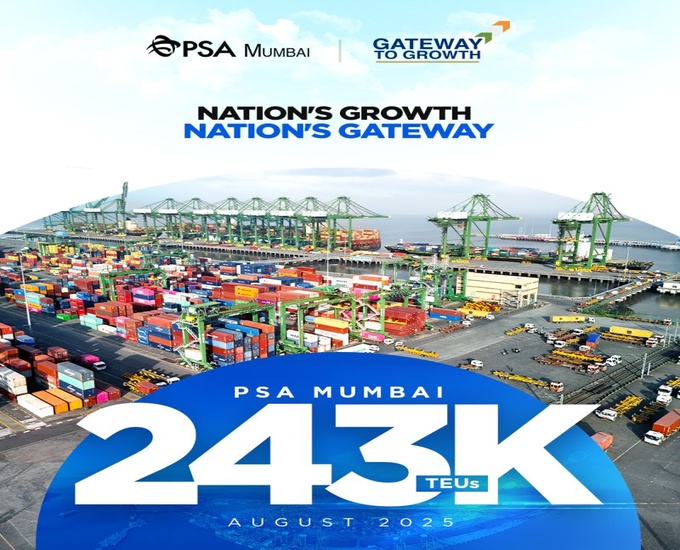
NAVI MUMBAI: PSA Mumbai, one of the largest container terminal in India at Jawaharlal Nehru Port Authority (JNPA), has shattered its own volume records by handling 243,000 TEUs in August 2025—securing a dominant 35 percent market share at JNPA, informs a communique.

This milestone extends a record-breaking performance trajectory that began with July 2025, when PSA Mumbai recorded 231,000 TEUs, marking its highest-ever monthly throughput and similarly capturing a 35 percent market share.

While industry reporting consistently recognizes the 231,000-TEU mark in July, the August figure of 243K TEUs was announced via PSA Mumbai’s official LinkedIn statement.

Infrastructure investments, operational efficiency enhancements, and robust rail connectivity continue to fuel this sustained growth.

As India’s premier container terminal, PSA Mumbai plays a pivotal role in the nation’s trade ecosystem. Its consistent gain of a 35 percent share at JNPA highlights its strategic importance in supporting India’s broader $5 trillion economic ambitions. The terminal’s advancement continues to elevate JNPA’s competitive edge in the maritime logistics space.

India among best-performing G20 nations in meeting sustainability commitments: Piyush Goyal at CII’s 20th Global Sustainability Summit

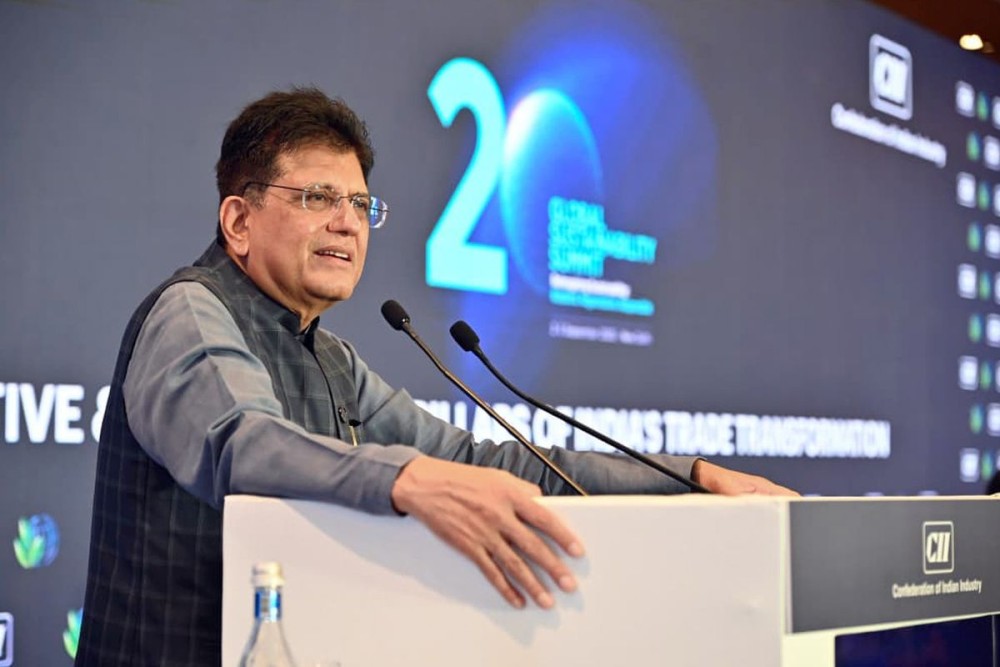
NEW DELHI : India is one of the best-performing G20 nations in meeting our sustainability commitments. This was said by Union Minister of Commerce and Industry, Shri Piyush Goyal, at CII’s 20th Global Sustainability Summit here.

Remarking on the role played by India for the cause of environment, Shri Goyal noted that Prime Minister Shri Narendra Modi had played a decisive role in making COP21 a success. “PM Narendra Modi had a very important role in making COP21 a success. Without his active participation, without him weighing in with the developed nations to contribute to the sustainability efforts of the less-developed countries, probably COP21 could not have come to fusion. Prime Minister Narendra Modi had got the whole global south together, that this should be a collective responsibility of every country in the world,” he said.

Shri Goyal emphasised that India continues to remain firmly committed to its sustainability goals, upscaling renewable energy targets five-fold since 2014 and successfully creating a national interconnected grid under the principle of “One Nation, One Grid.”

Highlighting achievements in the power sector, Shri Goyal noted that India is achieving renewable energy goals well ahead of schedule, with 50% renewable energy capacity already installed. He highlighted that India aims to reach 500 GW by 2030, powered by Make in India products, self-reliant manufacturing and rapid innovation. He pointed out that renewable power is now available in India at globally unmatched prices, around Rs. 4.60 to Rs. 5.00 per kWh for 24-hour clean energy supply. He added that there was no contradiction in simultaneously pursuing coal and renewables, and that transparent bidding processes reduced the price of solar power from Rs. 7–8 to Rs. 2.41. He noted that India now has the ability to offer renewable energy round-the-clock at highly competitive rates unmatched globally.

The Minister called on startups to innovate solutions for challenges such as water harvesting and energy efficiency. Citing the UJALA scheme launched in 2015, he said India had replaced incandescent bulbs with LED bulbs, showcasing how small steps can have transformational impacts.

Shri Goyal further said that India’s supply chains are resilient, and the nation is not at the mercy of any other country choosing to switch on or switch off the tap. This, he said, is making India Atmanirbhar and self-reliant, building the confidence of young India to take on any challenge the world wants to throw at it.

Highlighting the role of every section of society, the Minister said that young men and women, startups, entrepreneurs, corporates, farmers, hawkers, kirana stores and shopkeepers—every player—collectively contributes to the nation’s 7.8 percent GDP growth in the first quarter of this year. He said that being the fastest growing large economy in the world could not have happened without the conviction and resolve of 1.4 billion people.

Shri Goyal stressed that with India contributing 18% to global growth, soon to become the world’s third-largest economy and already a $15 trillion economy in purchasing power parity terms, the country is engaging with the world from a position of strength. He said that India’s future rests on sustainability, high quality, cost competitiveness and inclusive growth that reaches the last person at the bottom of the pyramid.

Referring to GST reforms widely anticipated to boost consumption expenditure and demand, Shri Goyal said that with government continuing to support infrastructure creation through huge resource allocation, India’s strong macroeconomic fundamentals will enable it to beat every estimate that economists or pessimists may come up with. He noted that challenges will arise, but India’s ability to take on volatile and uncertain times has only increased.

On sustainability, Shri Goyal underlined that it is not only about renewable energy or pollution, but also effective use of water resources and addressing the risks of climate change such as flash floods, cloudbursts, and flooding in cities due to haphazard planning. These, he said, can become opportunities for further economic growth.

Quoting the Prime Minister, Shri Goyal pointed out that less than 1% of textile waste in India is recycled, while developed countries are willing to pay a premium for recycled products. He said that cleaning up oceans and rivers can generate value from waste while saving aquaculture. Commending institutions like CII, he urged industry to adopt the Prime Minister’s mantra of “Zero Defect, Zero Effect”—quality and sustainability as the twin pillars for powering India through the Amrit Kaal journey until 2047.

Shri Goyal criticised the developed nations for failing to deliver on their Paris commitments. “The developed world has let us down very badly. In spite of making huge promises at Paris of ensuring trillions of dollars will be available in concessional finance or grants to support the efforts of the developing world or the less developed countries, at least $100 billion a year are committed. But we are yet to see any of these commitments to fulfill,” he said.

Shri Goyal urged for collective action on sustainability, saying India’s competitiveness will only improve with sustainable pathways, energy efficiency and responsible consumption. With the aspirations of a young India and the commitment of 1.4 billion people, he said, “India’s future is safe, secure, and resilient, resting on sustainability, quality and inclusivity.”

The Minister said that India is expanding trade ties across the globe, with FTAs already concluded with Mauritius, Australia (first tranche), the EFTA block, the UK, and UAE, while talks are ongoing with the European Union, Chile, Peru, New Zealand, Australia (second tranche), and Oman. India is in dialogue with the United States for a bilateral trade agreement, he added.

Shri Goyal stressed the need for innovation and energy efficiency in daily life, drawing from the Prime Minister’s ideas. He said, “In every way we can, we must start assessing every single opportunity towards energy efficiency. In fact, Prime Minister only recently was sharing here is an example and experience about street lights not being switched off on time. Smart startup over here can come up with a simple device connecting all these street lights that automatically as the illumination goes up, the sun rises, the lights go off. And when the sun sets and starts getting dark, the lights start getting on. Elementary things, ladies and gentlemen, and we can make a transformational impact.”

Shri Goyal concluded by affirming that India’s future rests firmly on resilience, sustainability and collective determination. He said, “With this collective commitment and mindset, with the effort of 1.4 billion people, meeting the aspirations of a young India, one of the youngest countries in the world, I am very confident that India’s future is safe, is secured, is resilient, and rests on the pillar of sustainability and high quality, cost competitiveness, to be able to engage with the whole world with confidence, and at the same time, ensuring that inclusive growth, growth which reaches the last man at the bottom of the pyramid will be our credo, will be our ultimate and final target or mountain that we have to cross.”

Government committed to ensuring EoDB by deregulating, reducing procedures, simplifying policies, and decriminalising laws: Piyush Goyal

NEW DELHI : India has a history of converting a difficult situation into an opportunity, said Union Minister of Commerce and Industry, Shri Piyush Goyal, while addressing the 21st Annual Global Investor Conference 2025. He highlighted India’s remarkable economic performance, strengthened fundamentals, and the nation’s vision towards Viksit Bharat 2047. Recalling how India emerged stronger from the crises of 1991, 2008, and the pandemic, Shri Goyal said the country is once again poised to turn challenges into opportunities. He emphasized the collective responsibility of government and industry in realizing the vision of Viksit Bharat 2047.

The Minister highlighted India’s manufacturing PMI at a 17.5-year high and called for greater investment in Make in India. He emphasised the role of infrastructure as a force multiplier, driving consumption and boosting the economy.

The Minister highlighted 7.8% GDP growth in the first quarter of financial year 2025—the fastest growth in the last five years for a quarter. He underscored that private capex is up by 66%, foreign direct investment has increased by 14%, and millions of new demat accounts are being opened every month. Strong macroeconomic fundamentals, lowest CPI inflation in a very long time, and significant domestic capital inflows reflect renewed confidence in India’s growth story, he added.

Shri Goyal said India’s banking sector has achieved its highest performance in many years, providing safety and confidence to depositors and borrowers alike. He noted that India’s sovereign rating has been upgraded from BBB- to BBB with a stable outlook, backed by robust growth and strong external financial stability.

On trade, the Minister recalled the FTAs already concluded with Mauritius, UAE, and Australia, and noted ongoing engagements with the EFTA bloc, European Union, and the United Kingdom. He informed that discussions with the EU are advancing, with senior delegations visiting both sides. Shri Goyal expressed hope of concluding a bilateral trade agreement with the USA by November, as discussed by the two leaders earlier this year.

He emphasised that the Government of India, under the leadership of Prime Minister Shri Narendra Modi, continues to work towards ease of doing business and ease of living by deregulating, reducing procedures, simplifying policies, and decriminalising laws. He invited suggestions from industry leaders to further improve the investment climate, avoid duplication, enhance use of technology, and strengthen ethics and fairness in markets.

The Minister stated that upcoming GST 2.0 reforms, expected in the forthcoming GST Council meetings, will boost consumer sentiment, spur demand, and simplify compliance. He also highlighted the government’s significant reduction in corporate and personal tax rates, coupled with RBI’s reduction in policy rates and CRR, while maintaining inflation at 1.5%.

Shri Goyal reiterated India’s commitment to Aatmanirbhar Bharat—not by closing doors to international engagement, but by building resilient supply chains to avoid dependency on any one geography. He cited the government’s push for manufacturing in key sectors including drones, semiconductors, and CRGO steel, noting growing commitments by Indian industry and buyers to source domestically.

Speaking on sustainability, he urged industry participants to support energy efficiency and renewable energy, citing examples such as LED bulbs and 5-star appliances. He recalled the Prime Minister’s call for Zero Defect, Zero Effect, stressing on quality manufacturing that neither harms the environment nor compromises standards.

Recounting India’s history of emerging stronger from crises in 1991, 2008, and during the pandemic, Shri Goyal said India is once again poised to convert challenges into opportunities. He underlined the collective responsibility of government and industry in making the journey towards Viksit Bharat 2047 a reality.

“We are not here for incremental change; we are here for quantum leaps. Let us dream big, aspire big, and achieve big. This is the India of my dreams, the India of 140 crore Indians, a nation that matters in the world and shows light to the rest of the world,” Shri Goyal concluded.

FM Sitharaman chairs textile industry representatives’ meet on economic challenges

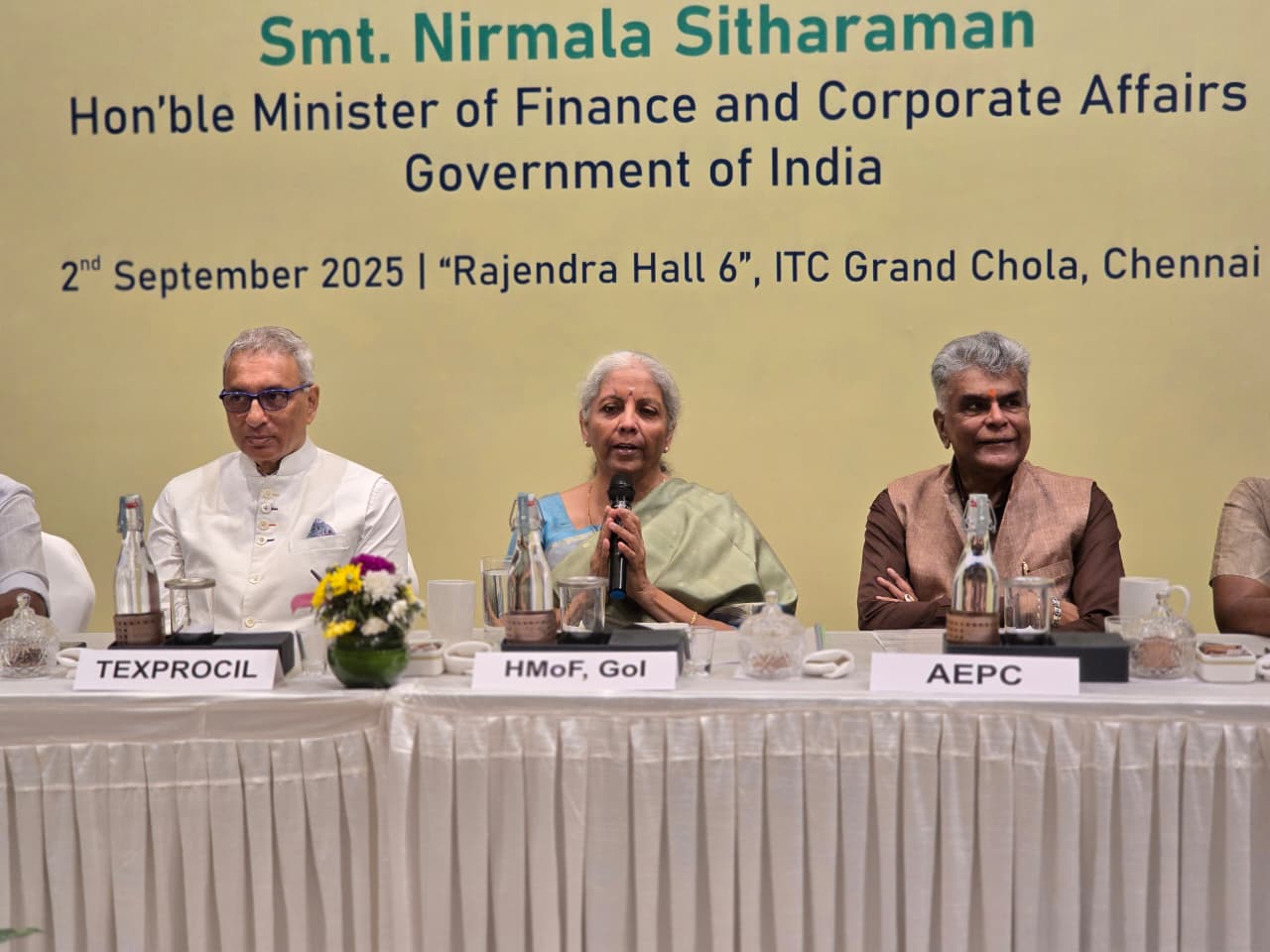
CHENNAI : Union Finance Minister Shri Nirmala Sitharaman chaired an interactive meeting with the representatives of the textile industry here on Tuesday in the backdrop of economic challenges affecting the sector, including concerns over the US tariff of 50 per cent.

India’s textile exports (to the US) accounted for 28 per cent (USD 11 billion) of the sector’s total exports, Federation of Indian Export Organisation (FIEO) represented by P Gopalakrishnan, Regional Chairman, FIEO (SR), said.

He sought financial relief measures, export incentives, GST support, working capital solutions, and urgent relief announcements. Speaking to representatives from the textile industry in Chennai on Tuesday, the Finance Minister is said to have assured them that she was aware of the issues faced by the industry and would, in consultation with the Commerce Ministry, help them. With the GST Council meetings to be held on Wednesday and Thursday, the textile industry anticipates some announcement to support them.

Financial viability
A joint memorandum submitted by the textile industry associations and export promotion councils said that the high tariffs imposed by the US would severely impact not only the growth of exports but also the financial viability of thousands of textile units catering to the US market.

This includes those in the power loom, independent weaving, readymade garment, made-up and kitchen linen segments. The major clusters in Tamil Nadu, including Coimbatore, Tiruppur, Erode, Karur, Madurai, Theni and Virudhunagar are the worst affected, the joint memorandum said.

Among the various requests in the memorandum, the industry wants the government to address GST inverted duty structure in the man-made fibre (MMF) value chain and slotting the entire MMF value chain under 5 per cent GST slab on par with cotton value chain. It also requested the refund of accumulated capital goods GST credit to ease liquidity.

“We highly appreciate the bold stand taken by the Prime Minister against the US tariff and we commit that we would fully support the decisions taken by the Government in this regard,” the memorandum said.

It thanked the Minister for considering industry plea and giving exemption from the 11 per cent import duty on cotton up to December 31, 2025. “This timely relief is a boon to the predominantly cotton-based Indian textile value chain,” the memorandum read.

Relief package
Given the threat posed by the US tariff hike, there is an urgent need for a special relief package and support measures to prevent the units becoming non-performing assets (NPAs), retain the existing US customers to the maximum extent possible, sustain the financial viability till we find alternate markets, the memorandum said.

The US market accounts for approximately 28 per cent ($10 billion-$11 billion) of India’s total textile and clothing exports. Of this, readymade garments constitute around 60 per cent, while yarn, fabric, and made-ups contribute about 32 per cent. The stagnation in export growth for more than 10 years has already rendered 25-30 per cent of production capacity idle, leading to significant financial stress across the textile sector.

Among other requests, the industry has sought extension of the two-year moratorium for the repayment of principal amount and a 30 per cent collateral free loan under Emergency Credit Line Guarantee Scheme with 5 per cent interest subvention (similar to the one extended during Covid both for MSMEs and larger companies).

The industry also requested the reintroduction the Focus Market Incentive Scheme and extend 20 per cent of the freight on board value for all the exports made to US with effect from 27 August 2025 in the form of transferrable duty credit scrip.