Home Blog Page 811

DNV and COSCO sign new class contract for methanol-ethanol ready KNOT shuttle tanker

OSLO : Classification society DNV has signed a new contract with Cosco Shipping Heavy Industry Zhoushan Shipyard (COSCO) during Nor-Shipping 2025 for the classification of a newly contracted methanol-ethanol ready Suezmax DP2 shuttle tanker ordered by Knutsen NYK Offshore Tankers (KNOT). The vessel, part of a broader fleet expansion by KNOT, to be operated under charter to Norwegian energy major Equinor, marks the latest milestone in a long-standing collaboration between the companies.

The 154,000-deadweight-tonne (dwt) shuttle tanker features dual-fuel capability with methanol-readiness, and complies with IMO NOx-Tier III and EEDI Phase 3 regulations. The advanced vessel design is another demonstration of how technical innovation and global partnerships are enabling the maritime industry to meet environmental requirements, and enhance sustainability and safety, while remaining efficient and competitive.

Guo Zhiqiang, Deputy General Manager, Commercial Headquarters, COSCO Shipping Heavy Industry, said: “We, COSCO Shipping Heavy Industry are pleased to see this great milestone achieved for the exciting project. We appreciate the trust and support from our partners, namely KNOT, DNV, and Equinor in the past years. COSCO Shipping Heavy Industry have delivered more than ten 154K DP shuttle tankers for KNOT together under the classification of DNV, and this project will be the first DP shuttle tanker we build for world first class oil major – Equinor. We are proud of it and committed to implement with our high QHSE standards during the project execution and deliver a most satisfied shuttle tanker to our partners. This new milestone is a new start, and we also look forward to seeing future cooperation among the parties.”

Tom Ketil Knutsen, General Manager Newbuiding & Innovation at KNOT added: “We are proud to attend the signing of a new contract between DNV and COSCO SHIPPING Heavy Industry (Zhoushan) Co., Ltd, for a 154.000 dwt DP2 Shuttle Tanker, set for delivery in early 2028. Knutsen NYK Offshore Tankers are thrilled to mark this as another exciting chapter in the enduring relationship between DNV, Equinor and Knutsen – a partnership rooted in mutual trust and collaboration from our early beginning in the North Sea to our expansion into the Brazilian waters. This milestone not only strengthens our bond but also celebrates the continued success of our collaboration.”

Øyvind Pettersen, Head of the Technical Centre China at DNV Maritime, commented: “At DNV we are very pleased with the trust placed in us as the classification partner for this exciting new project, and to support the continued expansion of KNOT’s shuttle tanker fleet. Each COSCO newbuilding reflects a shared commitment from all partners to safer, lower-carbon, more efficient, and technically advanced offshore operations. We are committed to providing the independent assurance and technical standards that are helping to bring greater transparency and trust to these investments and look forward to continuing this productive cooperation. In addition, DNV extend our heartfelt congratulations to KNOT as they celebrate their 40th anniversary, made even more special by marking it here at Nor-Shipping.”

The vessel will be equipped with a fifth-generation bow loading system developed by McGregor, to enhance the safety and efficiency of loading from offshore production units in challenging sea conditions. In addition, it will be shore power ready and fitted with VOC prevention systems to reduce operational emissions. This is the sixth vessel in a current series of newbuilds placed by KNOT at COSCO, bringing the total number of DP2 Suezmax shuttle tankers ordered by KNOT at the yard to 12 vessels.

Berg Propulsion package prepares Skarv Shipping Solutions for zero-emission future

HONO(SWEDEN) : Skarv Shipping Solutions has increased its order for ‘zero carbon project carriers’ from Shandong Huanghai Shipbuilding Co. Ltd to five ships, extending its commitment to a Berg Propulsion package that optimizes vessel efficiency regardless of power source.

Bergen-based Skarv, a joint venture formed by Peak CSL Group and Grieg Edge to develop sustainable short-sea shipping, specified inline ammonia-ready engines for the initial four 7,000 dwt ships, with the first ship due delivery in Q4 2025, followed by three more through 2026. The fifth vessel – due delivery in the second half of 2027 – will feature DF ammonia/MGO capability.

In all cases, vessel performance will count on integrated control and propulsion technology from Berg which is future-proofed to work with a full range of alternative marine fuels and other green energy sources.

Berg collaborated closely with Skarv and ship designer LMG Marin to devise a tailor-made, adaptable propulsion solution for the 108m length vessels. The system’s efficiency has already proved itself as ahead of fuel economy and emissions expectations in extensive model tests at Norway’s independent research organisation SINTEF.

“We have worked closely with LMG Marin, Berg and Shandong Huangdai Shipbuilding to secure efficiencies in every detail of these ships,” said Jan Øivind Svardal, CEO, Skarv. “As well as serving shipping’s decarbonisation agenda, we are confident that these high performance and adaptable carriers will attract charters from project cargo customers who expect the most cost efficient decarbonisation.”

Each ship will feature a single screw controllable pitch installation from Berg with a large propeller diameter and high system torque capability, optimised to match hull/power/speed – and in this case ice class – as well as thrusters. Berg’s control, power distribution and energy management system integrates main engine, battery and shore power sources to optimize vessel efficiency in all scenarios.

“The zero carbon carrier will be far more climate-friendly than what we see in Europe’s short-sea market today, with a very low fuel consumption,” said Svardal. “It is not what we imagine is the final climate solution for shipping, but it is a giant step in the right direction.”

Including electric motors with permanent magnet technology and run by Berg’s MPC800 Control System, the package provides continuous dynamic optimization of propeller rpm/pitch/vessel speed, in a setup also future-proof to integrate bigger batteries and fuel cells. It integrates dual DC-Hubs from The Switch, which control propulsion motors, batteries and the inverter for the main switchboard and deliver the variable speed capability to optimize genset energy use.

“The results from SINTEF verified how Berg technology future-proofs ships for efficiency independent of the power and fuel sources by reducing energy consumption dynamically and adaptively on an integrated basis,” said Mattias Hansson, Senior Global Sales Manager, Berg Propulsion. “We are therefore delighted that the owner has returned to place a fifth order in this innovative ship series.”

“This is an outstanding example of what can be achieved by ship, main propulsion and electrical systems when a shipowner, a ship designer, a shipyard and an equipment and system integrator work together in the early design phase to prioritize performance and sustainability.”

Gulf of America Logistics launched to meet surging U.S. project cargo demand

BOSSIER CITY,LOUISIANA : A new logistics company has launched in Louisiana with a mission to offer U.S.-based, veteran-owned solutions for capital projects across the Gulf Coast region. Gulf of America Logistics (GOAL), headquartered in Bossier City, enters the market at a time of significant investment in large-scale energy, infrastructure and industrial developments.

Led by managing partner Brent Patterson, a U.S. Navy logistics veteran and former senior vice president at Blue Water Shipping, GOAL has been established to support clients executing major capital projects across sectors including LNG, petrochemicals, power generation, and infrastructure.

“The Gulf Coast is currently one of the hottest markets for capital projects in North America,” said Patterson. “From hydrogen hubs to carbon capture and refinery expansions, the demand for heavy-lift and specialized transport services is accelerating – and yet there have been very few local solutions providers. GOAL is here to change that.”

GOAL’s leadership team combines technical expertise with local regulatory knowledge and political insight. The company offers a full suite of logistics services including transportation engineering, feasibility studies, barging, rail and trucking, chartering, customs clearance, and HSSEQ.

“Our team brings decades of experience, not just in project execution but in navigating Louisiana’s complex regulatory environment – from permitting to levee systems,” Patterson added. “We’ve lived and worked through the Gulf’s hurricanes, tides and terrain. That local understanding is invaluable in mitigating the inherent risk that comes with operating in a challenging area such as the Gulf.”

Patterson said that while GOAL is focused primarily on delivering for U.S. capital projects, it also provides international 3PL support and multimodal solutions through its extended network.

The GOAL leadership team is strengthened by the appointment of Rock Bordelon, owner and CEO of Allegiance Health Management, who joins as a partner. A prominent Louisiana entrepreneur with deep ties to the region’s business and regulatory landscape, Bordelon brings valuable local insight, commercial acumen and strong regional connections.

Their fellow partner Chuck Paddock is a former executive at Ceres Barge Line and specialist in steel and inland waterways, while GOAL’s vice president of operations, Keith Lincoln, is a former director of logistics at Bertling Logistics Inc. with over 20 years of global projects experience.

“Our team brings forwarding, barge, trucking, rail and EPC experience that’s critical to supporting the huge investment going on here in the Gulf,” said Patterson. “And as barge and other asset capacity tightens, we’re ready with solutions.”

GOAL is in the process of securing a port facility in Cameron Parish, Louisiana and has also struck an exclusive agreement to provide asset-based trucking services in the region.

“There’s clearly a growing America First agenda, and we’re part of that,” Patterson said. “We want to ensure that logistics contracts – and the jobs that come with them – are staying in the U.S. We’re helping to defragment the supply chain, reduce risk to projects, and deliver value for developers, EPCs and OEMs.”

About Gulf of America Logistics
Gulf of America Logistics (GOAL) is a veteran-owned logistics company headquartered in Bossier City, Louisiana, serving capital projects across the U.S. Gulf Coast. GOAL provides specialized transport and logistics solutions including multimodal transport, engineering, barging, customs, and HSSEQ support.

Diversity’s ‘forgotten twin’ Inclusion must be made priority in maritime, says Columbia Group

FAIRFAX (VIRGINIA) : Inclusion is every bit as important as diversity in ensuring that shipping becomes a truly welcoming, authentic and inclusive community, says Mark O’Neil, CEO of Columbia Group.

Mr O’Neil (pictured) was a guest speaker at the TradeWinds Shipowner’s Forum on the third day of NorShipping and discussed how People ‘with a capital P’ must be made to feel valued, listened to and included. This is the key to a truly diverse and welcoming industry, he said.

Referring to inclusion as “diversity’s forgotten twin”, the head of Columbia Group said without inclusion, “diversity risks being woke window-dressing, and moral washing. He said: “Inclusion makes it authentic, real, attractive, reliable and ensures the wonderful power of diversity is harnessed and harvested.”

Mr O’Neil was proud to reveal that 10% of Columbia Group’s seafarers are female, compared to the shockingly low industry average of 1% and the Group’s entire workforce is spilt nearly equally with a 48% to 52% female to male ratio. More than 50 females in the Group hold leadership positions. Despite these positive numbers and diversity and sustainability being part of Columbia Group’s core values since 2022, he acknowledged there is still more work to do.

Addressing the forum, he said: “Our maritime sector faces many challenges which we have heard about this morning. But the greatest challenge in my mind is not AI, decarbonisation or digitalisation but it is the challenge to attract motivated, educated, healthy, fit, properly compensated people – with a capital P – of every creed and colour, and political and religious persuasion into our sector. And not only attract them into our sector but – and here’s the inclusion bit – keep them in our sector.

“If we don’t keep them, listen to them and involve them then they will go out disaffect and do more damage to our industry than failing to attract them in the first place. We’ll only achieve that if we make them feel welcome, listen to them, identify with their views and viewpoints and let them contribute and value them. In short if we include them in our business.”

Approaching diversity with a non-genre specific approach will enable the industry to cast its net far and wide, he said. “We will be the envy of every other industrial sector because those sectors are not so exposed to the wonderful variety of humankind which we are. We will attract more quality people ashore and aboard our vessels than we know what to do with. Each diverse genre will indirectly benefit from the greater understanding and relatability that such an inclusive approach will generate.”

Mr O’Neil also congratulated WISTA on the remarkable achievements they have already made over the past 50 years but urged the industry to look further than equality.

In conclusion he said: “We now need to do even more as an industry and really focus on every genre across the diversity spectrum to attract all people and keep them at the table with mutual respect, understanding and value of one another’s contribution. That is Inclusion – and is no more Diversity’s forgotten twin.”

BIMCO to develop standard clause addressing uncertainties regarding Chinese-related vessels calling US ports

LONDON : BIMCO, the world’s largest shipping association, has initiated the development of a standard industry clause with the aim to address contractual uncertainties arising from the United States Trade Representative’s (USTR) Notice of Actions to impose fees on Chinese-related ships calling US ports.

The USTR has announced actions to impose fees on ships calling at US ports which are Chinese-built or have Chinese owners or operators. The actions are part of the USTR’s “Section 301 Investigation of China’s Targeting of the Maritime, Logistics, and Shipbuilding Sectors for Dominance”. When implemented, the actions will also result in fees imposed on any car carrier built outside of the United States. 

“When implemented, the measures will significantly raise the cost of seaborne trade to and from the United States,” says David Loosley (pictured), BIMCO Secretary General & CEO. “Additionally, the actions present complex contractual challenges for the shipping industry which is responsible for transporting around 90 percent of world trade.”

Recognising the complexities, the BIMCO Documentary Committee has decided to prioritise the drafting of clauses to support the shipping industry in navigating the new rules.

“Seen in the light of the complex nature of the USTR actions, we have decided to make this a priority,” says Stinne Taiger Ivø, Deputy Secretary General & Director of Contracts at BIMCO. “A BIMCO subcommittee comprising legal and commercial experts has been established and work on a clause is already underway. The clause is expected to be published in the near future and further communication is planned once it is adopted.”

IMO: Shipping gears up for massive investments in decarbonization

LONDON : The global shipping industry is preparing for a net-zero transformation that will have a sector-wide impact on everything from supply chains and business models, to ships, ports and the maritime workforce. IMO approved new regulations for net-zero ship fuels and emissions in April, set for adoption in October. Calls for investments in decarbonization are getting louder.

“Regulations alone cannot do the job. We need technological development and we need alternative fuels… And that can only happen in one way – with investment,” said Secretary-General Arsenio Dominguez, speaking at the Blue Economy Finance Forum in Monaco (8 June).

This includes investing in scaling up production of alternative fuels in large enough quantities to replace the 350 million tonnes of fuel oil currently burned by ships each year.

Upgrading port infrastructure and bunker operations will also be required to safely provide clean energy for ships when they call at ports around the world.

“It is a complete transformation of the shipping business. It will take ecosystems to do it together,” said Christine Cabau-Woehrel, Executive Vice-President of shipping and logistics company CMA CGM, at the same event. “It will be a long and difficult journey, but we want to be running in front.”

Early movers are already taking action. According to the World Shipping Council, there are at least 200 ocean liners (container ships) already in operation that can run on zero or near-zero emission fuels (ZNZ fuels), while close 80% of all new orders for container ships and vehicle carriers will have the same hybrid capability.

“The liner industry has already invested USD 150 billion in decarbonization. It is unprecedented for the transport sector,” said President of the World Shipping Council, Joe Kramek. “But we need the fuel supply… it’s a tremendous investment opportunity.”

The new set of regulations, known as the “IMO Net-Zero Framework”, takes a two- pronged approach: a global fuel standard that limits the greenhouse gas (GHG) fuel intensity of marine fuels, and a price placed on the GHG emissions from ships.

The regulations send a clear demand signal to fuel producers, while rewarding ‘first movers’ – shipping companies who take the risk to adopt low- and zero-emission solutions early, and who are then able to share their experiences and expertise with others.

The IMO Net-Zero Framework works alongside earlier measures adopted by IMO to enhance energy-efficient ship design, operational improvements and carbon intensity ratings. They will be reviewed every five years, with emission limits tightened over time.

Mr. Dominguez highlighted that these regulations are mandatory, to be applied to all ocean-going ships trading internationally, regardless of their flag.

There will be an impact on training, with nearly half a million seafarers requiring upskilling by 2030, and safety measures will need to be comprehensively updated to ensure fuels are deployed safely and efficiently.

Mr. Dominguez urged the international community to focus on concrete actions and implementation the various global commitments already agreed.

“It’s time for us to move from the statements and commitments into actions. That’s what we’ve been doing at IMO for over a decade. That is what we are going to demonstrate again in October, and we will not stop there,” said Secretary-General Dominguez.

He added: “Decarbonization has a cost. We have already spent money in polluting the environment. It is time for all of us to invest in cleaning it, and making it sustainable for future generations.”

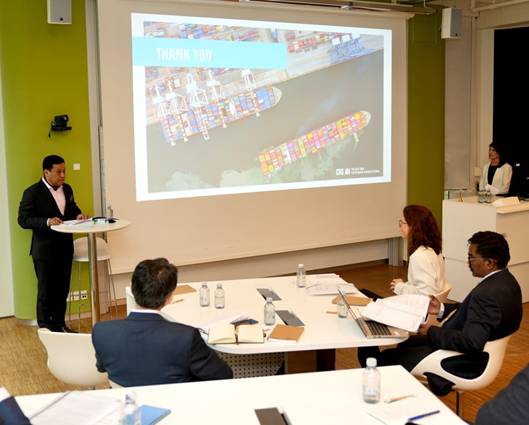
Sarbananda Sonowal addresses Blue MBA Cohort at Copenhagen Business School (CBS) on India’s Growth & Green Vision

“Through Shipping, you are truly connecting humanity — its needs, its aspirations, its dreams”: Sarbananda Sonowal

COPENHAGEN : The Union Minister of Ports, Shipping and Waterways, Shri Sarbananda Sonowal, interacted with students of the prestigious Blue MBA Executive Programme at the Copenhagen Business School (CBS), on Saturday. The session spotlighted India’s robust economic trajectory, expanding investment opportunities, and the country’s efforts to harmonise economic growth with ecological responsibility. Shri Sonowal also became the first Minister from India to visit the prestigious business school.

The Minister was joined by a distinguished panel of faculty and maritime experts, including Brian Wessel, Director General of the Danish Maritime Authority; Leif Christensen, Associate Dean, Copenhagen Business School; and Irene Rosberg, Programme Director of the Blue MBA. The Union Minister was accompanied by Manish Prabhat, Ambassador of India to Denmark.

Speaking to the Blue MBA cohort, Minister Shri Sonowal outlined India’s maritime growth strategy driven by the Sagarmala Programme and the Maritime Amrit Kaal Vision 2047, both aimed at creating sustainable infrastructure, multimodal logistics, and a future-ready maritime ecosystem.  Shri Sarbananda Sonowal said, “CBS is a globally respected institution, and the Blue MBA programme in particular stands as a beacon for future-ready leadership in the maritime world. I am especially pleased to be among students whose drive and vision will help shape the course of global shipping in the years ahead and I am eager to interact with you all today and learn more about your experiences, insights, and aspirations. India and Denmark have enjoyed a long and constructive relationship, and our maritime partnership is growing from strength to strength. As coastal nations with rich maritime traditions and deep strategic interests in ocean-based industries, our collaboration today carries great potential—not just for our two countries, but for global maritime sustainability. India’s economic rise—as the fourth largest economy—offers immense opportunities for maritime businesses, both domestic and international. Sustainability is at the heart of our maritime policy, and we are committed to achieving Net Zero emissions at major ports by 2047. From green hydrogen to digital shipping, our roadmap is ambitious yet inclusive.”

The discussion delved into India’s role as a global maritime hub and emerging logistics power, underpinned by the country’s focus on developing green ports, multimodal connectivity, and digital infrastructure to boost international trade.

“Today, India represents a compelling story of growth that is inclusive, innovative, and sustainable,” said Union Minister Shri Sarbananda  Sonowal during the interactive session. “As we expand our port capacity and integrate logistics across the hinterland, we also remain deeply committed to decarbonising the maritime sector. The aim is to make India the global epicentre for green shipping and clean trade corridors.”

The Blue MBA cohort includes senior professionals and alumni from global maritime and logistics leaders such as Noble Corporation, MAN Energy Solutions, American Bureau of Shipping, and Bureau Veritas. Their interaction with the Minister focused on the investment landscape in Indian maritime infrastructure, upcoming public-private partnership opportunities, and India’s policy incentives for green shipping.

Speaking further, Shri Sarbananda Sonowal said, “Denmark, a frontrunner in green maritime technologies, has set global standards in areas like energy efficiency, innovation, and digital shipping. India, under the visionary leadership of Hon’ble Prime Minister Shri Narendra Modi ji, is undertaking a transformative journey to modernise its maritime sector, enhance sustainability, and expand opportunities through policy reform, infrastructure investment, and international cooperation. With a vast coastline and over 90% of its trade by volume moving via the sea, India is one of the world’s foremost maritime nations. The maritime sector is thus a central pillar of India’s growth strategy.”

The Minister emphasised the growing demand for efficient, sustainable shipping, spurred by India’s trade expansion and industrial growth. He noted India’s significant investment in maritime education, with institutions like the Indian Maritime University and Gujarat Maritime University preparing a globally competent workforce for careers that go far beyond seafaring—into logistics, cruise tourism, green fuels, port management, and ship recycling. India’s maritime workforce is projected to grow from 7.86 million to nearly 40 million by 2047, with a remarkable rise in women seafarers—from 1,699 in 2014 to over 7,000 in 2024—reflecting a strong focus on diversity and inclusion.

CBS faculty appreciated India’s maritime policy reforms and its evolving position as a vital link between Southeast Asia, the Middle East, and Europe. The event reinforced the growing cooperation between India and Denmark, particularly in the areas of green shipping, clean energy, and sustainable development, and underscored India’s increasing engagement with global academic and professional institutions.

Sarbananda Sonowal at Copenhagen Business School 3 Sarbananda Sonowal addresses Blue MBA Cohort at Copenhagen Business School (CBS) on India’s Growth & Green Vision

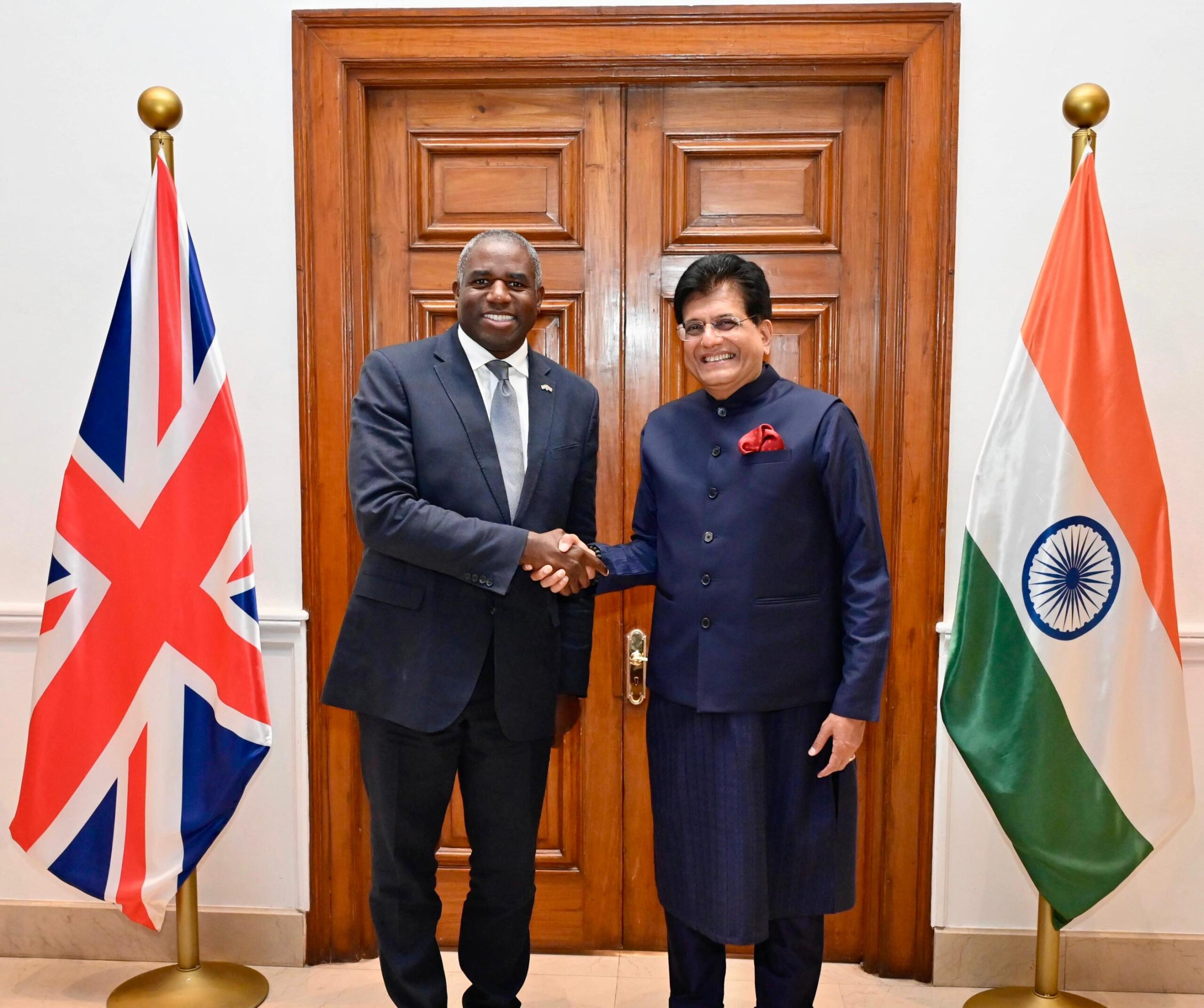
‘Had a fruitful meeting’: Piyush Goyal, UK’s David Lammy discuss India-UK FTA, bilateral trade boos

NEW DELHI : Union Minister of Commerce & Industry Shri Piyush Goyal, late Saturday evening, described his meeting with UK Foreign Secretary David Lammy as “fruitful,” highlighting discussions on deepening bilateral trade and enhancing cooperation across key sectors under the Comprehensive Strategic Partnership.

Taking to microblogging site X, he wrote, “Had a fruitful meeting with UK Foreign Secretary @DavidLammy today. We both expressed our appreciation towards the work done in finalising the historic India-UK FTA, which is poised to give further boost to our growing ties.

“We further discussed avenues to deepen bilateral trade and strengthen collaboration across various sectors to unlock the full potential of our Comprehensive Strategic Partnership”, he also noted.

He noted that the two sides explored ways to unlock the full potential of the partnership.

The meeting followed high-level engagements between Lammy and top Indian leaders.

Prime Minister Narendra Modi also met the UK Foreign Secretary a day earlier and acknowledged his “substantive contribution” to strengthening the bilateral relationship.

“Pleased to meet UK Foreign Secretary David Lammy. Appreciate his substantive contribution to the remarkable progress in our Comprehensive Strategic Partnership, further strengthened by the recently concluded FTA,” PM Modi posted on X. He also thanked the UK for supporting India in the fight against cross-border terrorism.

Lammy responded with a message of mutual commitment, “Thank you Prime Minister @narendramodi for your warm welcome to India. Building on the free trade agreement between our great countries, we will continue working together to deepen our partnership, celebrate our unique living bridge, and deliver growth and security.”

Earlier, External Affairs Minister S. Jaishankar held bilateral talks with Lammy, during which the UK’s strong condemnation of the recent Pahalgam terror attack was appreciated.

“We practice a policy of zero tolerance against terrorism and expect our partners to understand it. We will never countenance perpetrators of evil being put at par with their victims,” Jaishankar said.

Lammy also conveyed condolences from UK Prime Minister Keir Starmer over the Pahalgam attack and reiterated Britain’s support in countering terrorism. “My Prime Minister wishes me to convey once again the deep condolences of the UK and a hand of friendship with India,” Lammy stated.

The visit marked a significant step forward in the evolving UK-India relationship, focusing on trade, technology, climate cooperation, and regional security.

US trade team extends India stay as talks progress ahead of July deadline

NEW DELHI : A US trade team that’s currently in India for negotiations has extended its stay, according to people familiar with the matter, in a sign talks are progressing ahead of a July deadline.

The team, which was initially scheduled to hold talks with Indian officials on June 5-6, will now be staying till Tuesday to continue discussions, the people said, asking not to be identified because the information isn’t public. Most of the issues may get finalized within a week, the people estimated.

India and the US are working on a phased trade deal with an early agreement targeted for July, the deadline for implementation of the so-called reciprocal tariffs. At the same time, those tariffs are facing legal challenges in Washington.

Indian Commerce Minister Piyush Goyal described his meeting with US counterpart Howard Lutnick during a visit to the US in May as “constructive.” Earlier this month, Lutnick said he’s “very optimistic” about prospects for a trade deal between the US and India “in the not-too-distant future.”

India was one of the first countries to begin negotiating a trade deal with the US, hoping to avert President Donald Trump’s reciprocal tariffs, which are scheduled to kick in on July 9.

New credit cover MSME exporters by September

NEW DELHI : The Indian government is set to launch a new credit guarantee scheme for export-oriented MSMEs by September, offering collateral-free loans of up to ₹20 crore per borrower.

The Centre will prepare the draft of the new credit guarantee scheme for export-oriented MSMEs in a month, covering collateral-free loans of up to Rs 20 crore per borrower.

Under this scheme, it may guarantee up to 95% of loans for micro and small enterprises and up to 75% for medium enterprises. The guarantee fee for borrowers may be around 1.5%, sources told FE.

“The target is to roll out the scheme by September,” a senior official said, adding that the scheme will be in place for six years or till the end of the 16th Finance Commission award cycle ending FY31. 

The department of financial services has already held several rounds of discussions with MSME representatives and banks after finance minister Smt. Nirmala Sitharaman announced the launch of a credit guarantee scheme for “for well-run exporter MSMEs, for term loans up to Rs 20 crore.”

This would be the first of its kind scheme for MSME exporters. The credit facility will be offered to meet the borrower’s working capital requirements, as well as for expansion projects, in the form of term loans.

Currently, there is no such credit guarantee scheme catering to export-oriented MSMEs. The Export Credit Guarantee Corporation (ECGC) provides risk cover against export orders as a packing/post shipment facility.

However, these borrowers have other working capital needs also which they avail as cash credit and overdraft facilities from banks, which are not covered by ECGC. Further, EOUs will also need term loans for expansion, modernisation or setting up new units for which credit guarantee scheme is not available.

The new scheme for EOUs is likely to be managed by the National Credit Guarantee Trustee Company Limited (NCGTC). The credit guarantee scheme would facilitate the increase in exports, helping to earn foreign currency and strengthening the economy.

Over 1 crore registered MSMEs, employing 7.5 crore people, and accounting for 36 per cent of the country’s manufacturing and 45% of exports Growth and stability of MSME sector is important to further our position as a global manufacturing hub Increase in in both investment criteria and turnover across all categories of MSMEs, viz. Micro, Small and Medium.

Interest rate on these facilities can be charged as per board board-approved policies of the lender and as per regulatory guidelines. However, it is expected that the interest rates charged will be competitive to account for the reduced risk levels due to the guarantee cover offered to the credit facility.

At the initial launch stage, it is proposed to roll out the guarantee scheme for EOUs. However, at a later stage with the stabilization of the scheme, it is proposed to include units which facilitate import substitution, also to avail the benefits of the scheme.

Source : Financial Express