LONDON : Rates for shipping containers from Asia to the US are already facing upward pressure amid the 90-day tariff pause, but Wednesday’s ruling by a federal court could add fuel to the trend, according to shipping analysts.
“The decision of the US Court of International Trade to deem [US President Donald] Trump’s sweeping tariffs as unlawful is good news for shippers – but it could signal the beginning of the next era of confusion in global supply chains,” analysts at ocean and freight rate analytics firm Xeneta said.
Emily Stausboll, Xeneta senior shipping analyst, said that even if the appeal fails, Trump will not throw in the towel, and he has other levers to pull to achieve the same outcome as the sweeping tariffs.
“We only have to look at the US government proposal to introduce port fees on China-affiliated ships and the SHIPS for America Act to understand the range of options at Trump’s disposal in the ongoing trade wars,” Stausboll said.
Judah Levine, head of research at online freight shipping marketplace and platform provider Freightos, said the 90-day pause on 145% tariffs on Chinese goods has already driven a sharp rebound in ocean freight demand.
“Shippers have been frontloading to beat the August expiration,” Levine said. “This ruling may add fuel to that trend, especially if tariffs are actually suspended – even temporarily.”’
Levine said that some shippers deterred by the 30% tariffs may now rush to move goods before the appeals process concludes or new tariff mechanisms are activated.
“That could increase container demand even further, adding to the strength of the early start to peak season,” Levine said.
RULING ADDS UNCERTAINTY Lars Jensen, president of consultant Vespucci Maritime, said the ruling by the court adds a new level of uncertainty for US importers.
“Not only do they have to contend with the risks associated with changing tariffs, now it is also cast into doubt whether or not the announced tariffs will even be implementable – and this also raises the question whether tariffs paid in recent weeks can ultimately be reclaimed,” Jensen said in a post on LinkedIn.
If, after appeals, the tariffs are ultimately found to be unlawfully implemented, shippers should have a good case for getting the paid tariffs back, Jensen said.
Container ships and costs for shipping containers are relevant to the chemical industry because while most chemicals are liquids and are shipped in tankers, container ships transport polymers, such as polyethylene (PE) and polypropylene (PP), are shipped in pellets. Titanium dioxide (TiO2) is also shipped in containers. They also transport liquid chemicals in iso tanks.
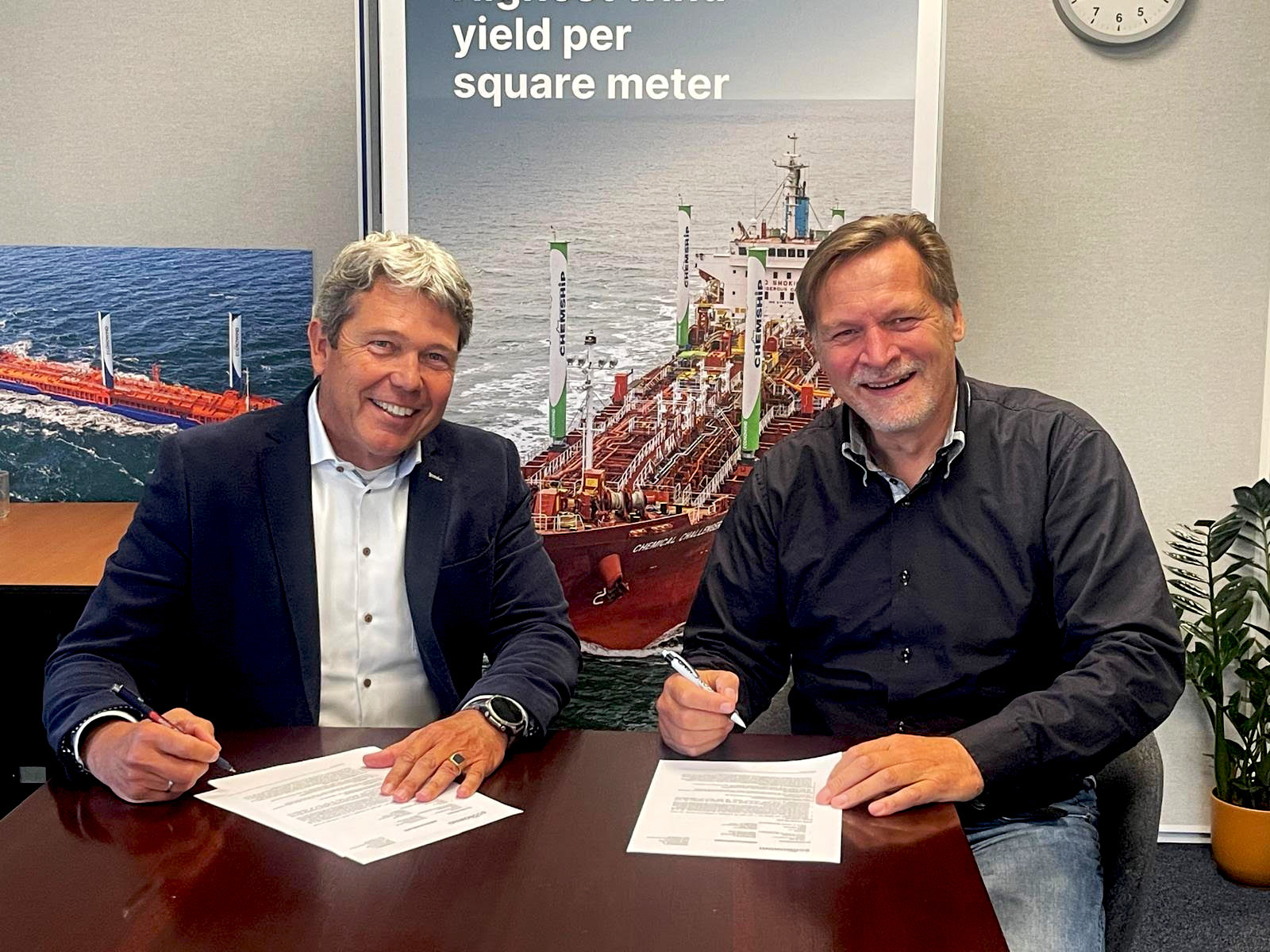
ZEEWOLDE : Wind propulsion pioneer Econowind has appointed Daan Koornneef as its new Chief Executive Officer. The appointment comes at a decisive moment for the Dutch company, which is scaling up operations to meet growing global demand for sustainable propulsion solutions. Founder Frank Nieuwenhuis will now dedicate his time fully to research and development, driving innovation behind the company’s next-generation VentoFoil technology.
The shipping industry is under mounting pressure to meet tightening decarbonization targets, including the introduction of FuelEU Maritime and other regional regulations. Wind-assisted ship propulsion is rapidly gaining traction as a practical and immediate measure to reduce fuel consumption and emissions, particularly as the sector transitions toward alternative fuels such as methanol, ammonia, and biofuels.
“I am proud to join Econowind at this exciting stage of growth,” said Koornneef. “Throughout my career, I have worked at the intersection of maritime operations and sustainability. What drew me to Econowind is the clarity of its mission, the practical value of its solution, and the ambitious team. Wind propulsion is not a future concept. It is available today and ready to make a real impact.”
Koornneef brings over 35 years of experience in the maritime and offshore sectors. He began his career in the Royal Netherlands Navy and later worked in towage, salvage, offshore energy, and manufacturing equipment for wind farm construction. His roles span a range of projects and services, including deep-water oil recovery from wrecks, marine management at LNG terminals and floating storage & regasification units, offshore wind installation, and heavy-lift transport for the energy transition. A commitment to environmental improvement has remained a consistent focus.
“Daan’s deep maritime background and strong sustainability mindset make him the right person to lead Econowind into the future,” said founder Frank Nieuwenhuis.“Leading a scale-up requires full-time focus. With Daan as CEO, I can work on what I enjoy most: pushing our technology forward and driving continuous improvements to the VentoFoils. Our goal is to maximise wind yield and minimise payback time, making wind propulsion an even more attractive investment for shipowners.”
Econowind started in shortsea and is now preparing to deploy larger VentoFoil units, measuring up to 30 meters, to meet the needs of deep-sea shipping. These systems are designed to complement alternative fuels by helping offset energy costs and compensating for the space required for larger fuel tanks. For many operators, wind propulsion is emerging as a key enabler in meeting emission reduction goals without compromising commercial performance.
About Econowind Econowind develops Wind-Assisted Ship Propulsion systems that help the shipping industry reduce fuel use and emissions. Its patented VentoFoil technology uses suction-based airflow control to deliver scalable, cost-effective energy savings. With more than 100 units sold, the company is contributing to a practical and profitable path toward maritime decarbonization.
GOA : The 25th Biennial Convention of the FFFAI – FEDERATION OF FREIGHT FORWARDERS’ ASSOCIATIONS IN INDIA officially commenced on May 29, 2025, in the vibrant state of Goa, setting the tone for three days of high-level discussions, networking, and collaboration within the logistics and freight forwarding industry, held four insightful Sessions on the Day 2, 30th May 2025.
The opening session of the FFFAI Convention in Goa set the tone with a powerful theme: “Vision 2047 – Unleashing India’s Potential Towards Viksit Bharat”. Moderated by industry veteran Shri Shantanu Bhadkamkar , the session brought together thought leaders who shared insights into India’s transformative journey in logistics and infrastructure.
Mr. Unmesh Sharad Wagh Chairman, JNPA- Jawaharlal Nehru Port Authority highlighted key initiatives at JNPA, including solutions for empty container management, progress on Vadhavan Port, the One Nation – One Port framework, and strategic advantages of Chabahar Port and the India-Middle East-Europe Economic Corridor.
Dr. Sudhir Kohakade, DDG Shipping, outlined the Amrit Kaal Vision 2047, benchmarking India’s transport and logistics sector against global standards, and emphasized the critical role of DG Shipping in driving reforms and connectivity.
Dr. Sudhanshu Mani, the visionary behind Vande Bharat, inspired the audience with insights on innovation and Make-in-India success.
Mr. Turgut Erkeskin Erkeskin, President of FIATA International Federation of Freight Forwarders Associations drew a vivid analogy between the Kumbh Mela and the freight forwarding industry—both being dynamic confluences. He urged global adoption of the FIATA Digital Bill of Lading, pushing the industry towards digital transformation.
Mr. G. Sambasiva Rao, Vice Chairman, FFFAI, concluded the session with a comprehensive summary, reinforcing the commitment to a unified vision for India’s logistics future.
Session 2: Opportunities in the Geo-Political Landscape & Enhancing Strategic Partnerships
The second session of the FFFAI 25th Biennial Convention brought into focus the evolving geo-political landscape and the critical need for strategic global partnerships in the logistics and trade ecosystem.
Moderated by Mr. Samir J Shah , Advisor, FFFAI, the session featured a distinguished panel:
Mr. Niraj Ambani, Group President, Reliance Industries Limited , highlighted the power of strategic partnerships in unlocking the potential of Indian logistics. He emphasized how geopolitics is shaping trade priorities, and how FTAs (Free Trade Agreements) will be instrumental in accelerating global commerce.
Mr. Mikhail Goncharov, Secretary General, CCTT, presented insights on the India–Russia cargo corridor, growth of the global container market, and emerging opportunities in sea trade between the two nations.
Mr. Denis Bandura MD, BBC Chartering offered a global perspective on chartering logistics and evolving maritime dynamics.
Dr. Pritam Banerjee Head – WTO Studies, Ministry of Commerce, delved into the impact of trade policies and international agreements on India’s logistics future.
A special highlight of the session was a virtual address by Prof. Edward Kieswetter Chairperson, WCO Council, who reinforced the importance of customs collaboration and global trade alignment in an increasingly interconnected world.
The session offered deep insights into how policy, partnerships, and geopolitics are reshaping global supply chains and India’s role within them.
The third session of the FFFAI 25th Biennial Convention focused on how robust infrastructure is the engine driving India’s logistics transformation. Moderated by Mr. Haresh Lalwani , the session brought together leaders across government, Maritime, Aircargo, and Multimodal Logistics.
Mr. Sagar Kadu , Director – Logistics, DPIIT, Ministry of Commerce, presented the government’s integrated vision to position India as a global logistics hub, underlining the significance of the PM Gati Shakti initiative and the National Logistics Policy in enabling seamless infrastructure development and reducing logistics costs.
Dr. Dr Ennarasu Karunesan, PhD (Maritime) ,Regional Director, International Association of Ports and Harbors (IAPH), praised FFFAI as a “game changer” in the global logistics ecosystem. He emphasized the critical role of collaborative port strategies, sustainability, and aligning Indian port development with global benchmarks.
Captain B V J K Sharma , CEO, Adani Noida International Airport, shared insights into the development of new-age greenfield airports, highlighting their role in building a multimodal logistics ecosystem and enabling faster, more efficient cargo movement across borders.
Mr. Aniruddha Lele CEO, NSFT, spoke on the integration of rail and terminal infrastructure with smart technology and automation, which will be vital in managing increasing cargo volumes and improving service reliability.
The session concluded with a shared vision: Integrated, intelligent infrastructure is the cornerstone of India’s journey towards a world-class logistics network.
Session 4: “In Data We Trust” – Unleashing the Power of Digital Intelligence in Logistics
The final session of Day 1 ended on a high-tech note, diving deep into the world of data, digital intelligence, and innovation. Moderated by Mr. Tej Contractor, the session was a compelling showcase of how the future of logistics is being reshaped by smart technologies.
The session opened with Mr. Jayendran Venkateswaran, Professor at Indian Institute of Technology, Bombay , who provided a powerful foundation on digitalintelligence and its role in optimizing logistics operations and decision-making.
Next, leading tech experts offered insights into the digital transformation underway: Mr. Parvinder Singh, MD, Team Hans Infomatic, emphasized the critical importance of data security in logistics systems, highlighting the need for resilient and secure digital infrastructure.
Mr. Vineet Malhotra, CMD, Kale Logistics Solutions, advocated for a connected data ecosystem, where seamless information sharing can eliminate delays, reduce costs, and bring real-time transparency.
Mr. Kunal Maheshwari, CGO, Softlink Global, introduced BoxyAI, their AI-powered solution that makes data “talk”—helping logistics professionals make faster, smarter decisions through actionable insights.
The session concluded with Ms. Meera Kumar , FICS, CEO, DIABOS Global FZE, who underlined the strategic importance of data analytics in enhancing efficiency, especially in the maritime domain.
Key Message: In logistics, data isn’t just supportive—it’s transformative. With digital intelligence, the supply chain isn’t just connected—it’s conscious.
NEW DELHI : Shri T.K. Ramachandran (IAS), Secretary of the Ministry of Ports, Shipping and Waterways (MoPSW), chaired a comprehensive review meeting with the Inland Waterways Authority of India (IWAI) on Friday at Transport Bhavan here. The meeting focused on assessing the progress of key initiatives, projects, and policy measures aimed at promoting inland water transport across the country.
During the session, the Secretary took stock of the ongoing development of National Waterways, infrastructure modernization, and the implementation status of Gati Shakti initiatives. Discussions also revolved around enhancing cargo movement, improving connectivity, and strengthening multi-modal logistics efficiency.
Shri Ramachandran emphasized the importance of timely execution, inter-agency coordination, and leveraging digital technologies to streamline operations and boost the role of inland waterways in India’s logistics ecosystem. The IWAI team presented updates on recent achievements and outlined future plans aligned with the Government’s vision of sustainable and efficient waterway transport.
The review reflects the Ministry’s continued commitment to advancing the inland waterways sector as a vital component of India’s transport and economic infrastructure.
MUMBAI : The first meeting of the National Shipping Board, constituted on 30th April 2025, was held on Friday at the Directorate General of Shipping, Mumbai. Formed under the Merchant Shipping Act, the Board serves as an advisory body providing strategic guidance to the Government on matters related to shipping.
Chaired by Shri Sameer Kumar Khare, Retired IAS and Chairperson of NSB, the meeting focused on various initiatives under Maritime India Vision 2030 (MIV 2030) and Amrit Kaal Vision 2047 (MAKV 2047). The Board discussed priorities and a detailed action plan to be pursued during its tenure.
Key discussions also featured collaboration with leading maritime institutions including IPA, DGS, and DGLL, aimed at strengthening coordination and advancing India’s maritime roadmap.
Steering India’s maritime future with vision, purpose, and unified action.
GOA : The 25th Biennial Convention of the Federation of Freight Forwarders Associations in India (FFFAI) started in presence of more than 700 delegates and their spouses on May 29, 2025 at Taj Citade De, Goa. The Inauguration of the 3 days Convention from May 29 to 31 was addresses by Mr. Rohan Ashok Khaunte, Minister for Tourism & IT Government of Goa as Chief Guest; Mr. Sanjay Kumar Agarwal, Charman, Central Board of Indirect Taxes & Customs (CBIC) as Keynote Speaker; FFFAI Charman Mr. Dushyant Mulani; Immediate Past Chairman and Convention Chairman Mr. Shankar Shinde; Chairman Elect Mr. Amit Kamat; Dr. Kunio Mikuriya, former Secretary General, World Customs Organisations; Capt. BVJK Sharma, CEO, Adani Navi Mumbai International Airport Ltd. and Mr. Niraj Ambani, Group President, Reliance Industries Ltd.
Dignitaries on Dais at the Inauguratioin of FFFAI 25th Biennial Convention in Goa
Welcoming the dignitaries and delegates Mr. Shankar Shinde stated that FFFAI Convention is not only a gathering of cream of the logistics service providers, it makes declarations on the critical role being played by the industry stakeholders in shaping up the future of Exim trade as well as the country’s economy towards ‘Vikshit Bharat’ by 2047. “It’s a declaration that logistics is no longer back office — it is front page. It is that supply chains are not just pipelines — they are lifelines. And that we are the partners in supply chain freight and not just facilitators of trade. We are architects of transformation,” Mr. Shinde said.
According to him, collaborative and integrated logistics should be the way forward as the industry experienced from Covid Pandemic period. “We live in an era where geopolitics shapes supply chains, where data travels faster than cargo, and where partnerships — not products — determine performance,” he added.
In his opinion, collaboration is no longer optional. It is the only option. When the industry speaks of enhancing strategic partnership, it is laying down a four-pillar vision:
1. Policy Synergy – Working with government to make regulation a platform, to facilitate.
2. Digital Fusion – Integrating with technology to bring agility, transparency, and scale.
3. Global Connectivity – Tapping into international trade corridors, FTAs, and market access to put India on the map — and at the helm.
4. Fraternity First – Learning from each other, backing each other, and rising together as a collective force.
In his opening address FFFAI Chairman Mr. Dushyant Mulani said that the logistics industry should also learn from the recent Defense exceresise called “Operation Sindoor” which was meticulously executed by India’s strong Defense logistics infrastructure and operations. “We are proud of our Defense Logistics set up and should convey the message to the world that India is also a strong logistics hub for the manufacturing Exim trade,” he asserted. He also underlined the importance of FFFAI as an association which has evolved and established to a umbrella organization of 31 Member Associations from across the country thanks to the wisdom and hard work of its predecessors during the past 62 years. The Federation is now focused on skill development through its training arm Indian Institute of Freight Forwarders and Women Wing to woo young entrepreneurs and enhance domain knowledge of the industry professionals. With this the Federation created significant career opportunities to freshers/aspirants. FFFAI is also closely working with the CBIC, Ministry of Finance, Ministry of Commerce & Industry, Ministry of External Affairs, Ministry of Ports & Shipping, Ministry of Civil Aviation and other allied Ministries, Government of India to facilitate the Exim logistics operations pan India. “With technology support like AI and global integration Indian logisticians should explore the global market aggressively.
The FFFAI Chairman also commended trade-friend initiatives of CBIC and Government of India which is focused on paperless transactions, digitisation and infrastructure building for world class logistics operations.
CBIC Chairman Mr. Sanjay Agarwal while delivering his Keynote Address highlighted the recent technology-driven trade facilitation initiatives in line with the National Logistics Policy and Ease of Doing Business mandates of the Government of India. He appreciated FFFAI’s contribution towards the endeavour of CBIC with a global outlook for the larger interest of the Exim trade. The CBIC Chairman pointed out the gradual improvement in cargo clearance time by significantly reducing dwell time at various ports and border check posts. He also highlighted India’s significant improvement in World Bank’s Logistics Performance Index (LPI), with a target to be within top 25 countries by 2030. It is pertinent to mention that India is ranked 38th out of 139 countries, according to the 2023 LPI report. The country’s logistics sector is also projected to grow significantly, reaching a market size of Rs. 42.35 lakh crore (US$ 484.43 billion) by 2029.
Mr. Agarwal also emphasised on proper data management/data analysis regarding the current scenario and future requiremenst of logistics services which may sourced by logistics service providers. ”With Industry collaboration CBIC is committed to Trade Facilitation and Ease of Doing Business adhering to the highest level of compliances and security,” he stated. The CBIC Chairman emphasized that due to the partnership between CBIC and FFFAI based the logistics industry would be immensely benefited.
According to him, Customs is very sincere in facilitating MSME by providing level playing field to this sector making Supply Chain Management seamless, uniform examination order by reducing physical examination, and ease in uploading online NOC to compete with global market. He shared the findings of National Time Release Studies which would support the Government in taking further trade facilitation measures. He informed that Customs is working for an Integrated System having the logistics stakeholders on board.
Dr. Kunio Mikuriya also emphasized on Public Private Partnership in trade facilitation as experienced across the globe. He commended Government of India and Indian Customs in this regard. He also recommended the Indian logistics industry stakeholders to focus on the IT initiatives to go with the global requirements based on the country’s strength in this sector. He also urged for data-driven trade facilitation measures.
Mr. Rohan Ashok Khaunte, Minister for Tourism & IT Government addressing the gathering FFFAI 25th Biennial Convention
While addressing the gathering the Mr. Rohan Ashok Khaunte, Minister for Tourism & IT Government appreciated FFFAI for organizing its Silver Jubilee Convention in Goa. Significantly FFFAI organized its first Annual Convention in Goa itself. He invited FFFAI to have strategic partnership with the Government of Goa to facilitate skill development initiative and create logistics infrastructure. He said that Goa is not about beach tourism, it is a lucrative destination for MICE (Meeting, Incentive, Conference & Exhibition) tourism and manufacturing & logistics business. He pointed out that Goa has two airports which are well equipped with all facilities for cargo handling. He emphasized on synergy between the Govt. of Goa and FFFAI in IT initiatives, MICE Tourism and logistics services.
The Goa Logistics and Warehousing Policy, 2023, aims to develop a robust and efficient logistics ecosystem in the state, granting industry status to the sector. It focuses on leveraging Goa’s existing infrastructure (ports, airports, rail, and road networks) to create opportunities in warehousing and container logistics. The policy also emphasizes skill development, technological advancements, and environmental sustainability within the logistics sector.
In this Convention FFFAI felicitated Mr. Costa Fernandes, a brave officer who took down smugglers and paid a heavy price for justice. While introducing him, Mr. Amit Kamat, Chairman Elect FFFA highlighted that born on April 26, 1942, in Cabinda, Angola, Fernandes is an Angolan diplomat who has served as ambassador to Egypt, India, and the United Kingdom. However, it was his tenure as a Preventive Officer with Goa Customs beginning in 1979 that gained him recognition
Remarkably, based on the heroic activities during his stint as an honest and brave Customs officer, film star Nawazuddin Siddiqui starred a film ‘Costao’ on ZEE5. Mr. Costa Fernandes received the President’s Award in 1996 for his bravery. The film is inspired by the extraordinary life of Antonio Fwaminy da Costa Fernandes, who is widely known as Tony da Costao Fernandes. He was a fearless customs officer whose bravery left an incredible mark on Indian law enforcement history.
Mr. Sudip Dey, Hony. Secretary, FFFAI proposed a vote of thanks expressing his sincere gratitude to the Chief Guest, Keynote Speakers, other dignitaries and all the delegates from across the country and overseas. He stated that the next two days would be very exciting thanks to insightful business sessions and beyond business sessions and entertainment prorgammes in the evening.
GOA : Dr. Kunio Mikuriya, Former Secretary General of the World Customs Organization (WCO), delivered a thought-provoking theme address at the FFFAI Convention in Goa.
He shared valuable insights from his experience at the WCO, highlighting past global efforts in customs modernization, trade facilitation, and supply chain security. Dr. Mikuriya emphasized the importance of continued collaboration between customs authorities and freight forwarders, and the need for digitalization and standardization to enhance cross-border trade efficiency.
His address reaffirmed WCO’s vision of building resilient, technology-driven, and cooperative global trade systems.
GOA : The Women Wing of FFFAI organised an interactive workshop atthe FFFAI 25th Biennial Convention on May 29, 2025 at Taj Horizon Goa,. The workshop was conducted by Ms. Rama Ravee Titti – Founder Director, Thee Shiksha Group and moderated by Ms Chaitaly Mehta, Convenor FFFAI Women Wing. The workshop was attended by a good number of women delegates who have come to attend the FFFAI 25th Biennial Convention being held from May 29 to May 31 in Goa.
According to Ms Rama Ravee Titti, the “Journey to Self-Respect and Empowerment,” is designed to equip women with practical tools to enhance self-awareness, self-acceptance and self-respect. At this workshop the participants explored core pillars of embracing oneself, including mindfulness, self-reflection, self-compassion, and assertive communication.
The workshop also addressed specific contexts relevant to women, such as navigating challenges in entrepreneurship or recognizing the value of skills utilized in household management, while fostering a supportive environment that encourages women to connect with their inner strength and collective power.On the above aspects there were a number of activities assigned to the participants which they completed with due diligence.
PARADIP : Paradip Port Authority(PPA) hosted a Port Users Meet, encouraging open dialogue. Chairman Shri P.L.Haranadh stressed innovation & efficiency, while Dy. Chairman Shri Nilabhra Dasgupta highlighted user-centric growth & collaboration for a smarter port future.
In a significant initiative to foster stakeholder engagement and promote collaborative development, the Paradip Port Authority (PPA) hosted the Port Users Meet at its premises. The event brought together a diverse group of stakeholders, including shipping agents, exporters, importers, stevedores, customs officials, terminal operators, and other key players from the maritime and logistics sectors.
The meet aimed to create a common platform for open dialogue between the Port Authority and its users, addressing operational challenges, reviewing performance, and discussing new initiatives to improve efficiency and service delivery.
Chairman of PPA, [Insert Name if Known], in his keynote address, emphasized the port’s commitment to transparency, stakeholder satisfaction, and continuous improvement. He highlighted recent infrastructure upgrades, digital initiatives, and future expansion plans aimed at transforming Paradip into a world-class smart port.
Key topics discussed during the meet included:
Enhancing cargo handling capacity and turnaround times
Modernizing port infrastructure and logistics support
Streamlining customs and clearance processes
Adoption of green and sustainable practices
Upcoming investments under the Sagarmala and PM Gati Shakti initiatives
Participants appreciated the Port Authority’s proactive approach in organizing such an inclusive session and provided valuable feedback and suggestions. The interactive session concluded with an assurance from PPA to take swift action on user concerns and further strengthen the port’s role as a crucial trade gateway for eastern India.
The Port Users Meet reaffirmed PPA’s vision to build strong partnerships with all stakeholders and to continue driving economic growth through efficient, customer-centric port services.
MUNDRA : DP World Mundra has commenced new direct shipping service operations, linking North-West India with the East Coast of the United States. This development aims to enhance trade connectivity between the two regions.
The M.V. MAERSK ATLANTA recently made its first port call at DP World Mundra, marking the launch of the MECL Service. This service is designed to improve transit times and facilitate bilateral trade between India and the U.S. East Coast.
The MECL service includes port calls at Houston, Norfolk, Newark, Port Tangier Mediterranean, Salalah, Jebel Ali, Charleston North, and Savannah. Industries in India, such as textiles, pharmaceuticals, handicrafts, and machinery components, are expected to benefit from this new route due to strong demand from the U.S. East Coast.
The introduction of this direct service from DP World Mundra underscores efforts to strengthen trade relations and foster economic growth between India and the United States. It is anticipated to support India’s expanding role in global trade by providing more efficient maritime routes and robust port operations.
The service is supported by multimodal logistics capabilities, connecting seamlessly with India’s road and rail networks. This allows businesses across various Indian states, including Gujarat, Haryana, Delhi, Punjab, Uttar Pradesh, Rajasthan, and Himachal Pradesh, to utilize the new route for efficient cargo movement.
The DP World Mundra terminal, which features a 632-meter quay, a deep draft for large vessels, and a 50-acre container freight station with dedicated rail connectivity, is designed to facilitate seamless cargo movement. This infrastructure aims to provide Indian exporters and importers with faster and more reliable access to international markets.