Home Blog Page 826

Online training provider OneLearn Global has joined forces with TalentHacks to enhance its training offering with AI-powered edutainment

LIMASSOL : In an initiative aimed at redefining training across the maritime industry, OneLearn Global will work with TalentHacks to deliver training courses – blending AI and edutainment alongside a serious focus on human connection and transforming the way that maritime professionals communicate and connect.

According to TalentHacks, 95% of all workplace issues are caused by poor communication. In the maritime industry specifically, poor communication is estimated to contribute to approximately 40% of accidents, highlighting the urgent need for more effective, modern training solutions.

Delivered through OneLearn Global, member of OneCare Group, the online training courses blend entertainment with education, integrating engaging and interactive elements to maximise learning and retention.

The online course ‘Working With Humans’, will be the first course to be available via the OneLearn Global platform, leverages AI-powered personalisation to cater to the unique needs of each learner and enable teams to reduce friction and enhance collaboration, whether onshore or at sea.

The programme has been proven to reduce fatigue, relieve stress-like symptoms, and help create fruitful relationships. ‘Working With Humans’ is a dynamic learning experience designed to help individuals and teams make stronger connections by boosting communication skills and self-awareness.

“We are excited to bring a fresh approach to maritime training that goes beyond traditional methods,” said Marinos Kokkinis, Managing Director of OneLearn Global. “This goes far beyond crew training; it’s designed for the entire industry, supporting communication and collaboration at every level.”

With a global active user base of over 35,000, OneLearn Global is positioned to share this transformative training with maritime professionals around the world.

Paris Thomas CEO of TalentHacks, added: “This is about building stronger teams through smarter learning. Our ‘Working With Humans’ course goes beyond training — it transforms. By combining cutting-edge AI with deep human insight, we help create emotionally intelligent, resilient teams. The program is tailored to each member’s personality, with a focus on action and measurable results.”

Discussing the collaboration, Mr Kokkinis said: “Today’s seafarers face a different world of work — they are younger, more connected, and used to consuming personalised digital content. They experience new stressors and have different expectations. This modern demographic calls for a modern approach to learning and development. Traditional soft skills training, built around long lectures and theory, is no longer fit for purpose. What crews need now is content that is adaptive, engaging and human-centred — and that is exactly what this partnership brings.”

An exclusive webinar took place on May 28 which provided a closer look at how the training works in practice and how it is helping teams communicate better, work together more smoothly and perform at the highest level.

BASSnet and Closelink Integration Streamlines Marine Lubricant Procurement

OSLO/HAMBURG : Closelink GmbH, a maritime technology company specialising in marine lubricant procurement, and BASS Software, the leading global provider of maritime ERP cloud solutions, have successfully completed an integration between their platforms. 

The connection enables data sharing, allowing shipping companies to manage marine lubricant procurement with greater speed, accuracy, and efficiency. The integration was fast-tracked to support the smooth onboarding of a new Closelink customer. To avoid disruption during the implementation, both teams worked closely together to deliver a fully operational system integration to the mutual customer in just a couple of weeks. The current setup will leverage BASS’s generic adaptor, which enables data exchange with external platforms—a key component of BASS’s framework which supports broader third-party integrations.

The newly completed integration enables two-way data exchange between BASSnet Fleet Management Systems’ planned maintenance and procurement software and Closelink’s lubricant-specific planning and ordering platform. The connection eliminates the need for manual data transfer, streamlining the entire lubricant procurement process from requisition creation to order optimization and supplier confirmation.

“The ability to exchange data instantly between the two systems is essential,” said Philippe Lavarde, Managing Director at Closelink. “It offers the speed and visibility that the customer needs to respond to operational demands with confidence and without delays”.

A fully connected workflow
Closelink’s platform brings transparency and automation to lubricant procurement, helping teams manage demand, plan deliveries, place orders, and track performance, all in one place. By automating data collection from various sources and providing actionable insights, Closelink empowers procurement teams to make faster, more informed decisions.

“Maritime operations are more connected than ever, and integrations like this are key to delivering real value,” said Per Steinar Upsaker, CEO & Managing Director of BASS Software. “BASSnet is the best-in-class, advanced software to streamline fleet-wide purchasing and logistics with end-to-end visibility. We’re proud to work with Closelink to enhance our scalable and integrated solution and support smarter, more connected fleet management for our
customers worldwide. Our customers will gain significant value from this seamless integration to drive greater efficiency.”

Built to support growth

The integration offers a foundation for all BASSnet users looking to optimize their lubricant procurement. BASSnet’s scalable ERP environment supports large, complex fleets and makes it easy to onboard new vessels while extending access to tools like Closelink. As the maritime industry accelerates its digital transformation, such integrations provide a proven path to roll out best practices in procurement across entire fleets.

Baltic Index posts weekly gain on Higher Capesize Rates

LONDON : The Baltic Exchange’s Dry Bulk Sea Freight index, which tracks rates for ships carrying dry bulk commodities, rose on Friday to post a weekly gain on higher capesize vessel rates.

The main index, which monitors rates for capesize, panamax and supramax shipping vessels, was up 65 points, or 4.8%, at 1,418, its highest in four weeks since May 2. The index also logged a 5.8% weekly gain.

The capesize index (.BACI) added 218 points, or 10.6%, to 2,277, to post a weekly gain of 20%. The index reached its highest level since April 3 on Friday.

Average daily earnings for capesize vessels (.BATCA), which typically transport 150,000-ton cargoes such as iron ore and coal, climbed $1,811 to $18,885.

“There is an increase in rates for coal transportation from Australia and Bauxite rates being higher just before the rainy season in August in Guinea are together driving capesize higher,” said Yiannis Parganas, head of Intermodal’s research department.

“With regards to capesize rates, we might see small increases but it will be difficult for prices to reach or exceed the $20,000 mark,” Parganas added.

Iron ore futures prices ticked lower and posted weekly losses amid softening demand for the steelmaking ingredient in China, while traders braced for further bouts of uncertainty around trade.

The panamax index (.BPNI) slid 18 points, or 1.6%, to 1,119, and lost 10% during the week.

Average daily earnings for panamax vessels (.BPWT), which usually carry 60,000-70,000 tons of coal or grain, lost $163 to $10,071.

Among smaller vessels, the supramax index (.BSIS) dipped 5 points to 951, down 3% for the week.

Source: Reuters

India to remain Fastest-Growing Economy for Next 30 Years: Piyush Goyal

NEW DELHI : India to remain fastest-growing large economy in the world for next 30 years, said Union Minister for Commerce & Industry Shri Piyush Goyal at CII Annual Business Summit 2025 on Thursday in New Delhi.

On India’s economic trajectory, Shri Goyal stated that the country has maintained sustained growth of 6–7% and hopes to push it to 8% at constant prices. “Even amidst international upheavals, we are among the better-performing emerging markets. Today, India holds the 4th largest foreign exchange reserves in the world at about 690 billion dollars. Our inflation has remained below 4% for the last three months. The Reserve Bank has done a commendable job balancing liquidity and currency management,” he said.

Shri Goyal highlighted India as an attractive investment destination. “Over the past 20–25 years, Indian companies have delivered nearly 20% CAGR returns, making India a compulsive investment destination. FDI inflows are consistently breaking records. We are back on track on the growth trajectory, working through international trading relations,” he added.

He cited progress on various Free Trade Agreements (FTAs), including those with the UAE, Australia, the UK, the four EFTA countries (Iceland, Liechtenstein, Norway, and Switzerland), and the ongoing bilateral trade agreement negotiations with the USA. “We are well on track with our bilateral trade agreement with the USA and making fast progress with the European Union’s 27-nation bloc. We have also launched negotiations with New Zealand,” he stated.

The EFTA countries have committed $100 billion in Foreign Direct Investment (FDI) to India over the next 15 years. This is expected to crystallise into a total investment of $500 billion. Furthermore, the large ecosystem that will be created around this investment has the potential to attract an additional $500 billion. “We are not aiming small,” said Shri Goyal, emphasising that this figure does not include investments from the Norwegian Pension Fund and represents pure FDI. He further highlighted that this is the first Free Trade Agreement (FTA) in the world to include such a forward-looking investment clause.

Shri Goyal expressed pride at India’s continued economic progress and stated that the IMF has projected that by 2027, India will be the world’s third largest GDP. He added that despite global volatility, uncertainty and complexity, India remains the fastest-growing economy and continues to power global growth through growth in India.

The Minister underlined that growth through trade, resilient supply chains and innovation would remain incomplete without inclusive growth.

Highlighting the Government’s sustained push for ease of doing business, the Minister said that over 40,000 compliances have been reduced, several laws have been decriminalised, and nearly 2,000 obsolete laws have been removed from the statute book. He noted that the Jan Vishwas Bill reflects the trust between the people of India and the Government of India. “The Act promotes self-certification, encourages businesses to offer suggestions to improve ease of doing business, and simplifies people’s lives. It reflects a government that trusts its stakeholders,” he said, acknowledging CII’s important role in this journey.

Speaking on the role of technology and future-readiness, Shri Goyal appreciated the continuous engagement between CII and the Government. “CII has acted as a bridge between aspirations and Government actions. As the Government promotes Artificial Intelligence (AI), we recognise CII’s role in skilling people, MSMEs and industries, understanding regulatory frameworks, and ensuring responsible AI adoption. This includes assessing AI’s impact on business and employment, as well as the need for skilling and reskilling professionals to embrace smarter, more efficient technologies in public interest,” he said.

He further stated that renewable energy coupled with storage is now available at ₹3.30 per kilowatt hour in India — among the lowest globally. “Solar and wind plus storage make a compelling case for data centres to come to India. We have a large interconnected grid with low-cost clean energy to power these centres,” he noted, adding, “This is not just about sustainability — it is an economic case.”

Touching on inclusive growth, Shri Goyal reiterated Prime Minister Narendra Modi’s vision to ensure dignity for every individual, especially the last person at the bottom of the pyramid. “Free healthcare, quality education and basic needs are being addressed. We are now seeing employment growth, and skill development centres are playing a key role. No child should be deprived, and no man should be left behind,” he said.

In conclusion, Shri Goyal said, “India’s growth is based on three tracks — strong macroeconomic fundamentals; a nation respected across the world as a trusted partner; and a nation of 140 crore aspirational Indians. On these three tracks, we are preparing for Viksit Bharat 2047 — a journey of growth through speed, skill and scale.”

Shantanu Thakur chairs Port Review Meeting at Administrative Office Building at DPA Kandla

GANDHIDHAM : Shri Shantanu Thakur, Hon’ble Minister of State for Ports, Shipping & Waterways, chaired a comprehensive Port Review Meeting at Administrative Office Building, Deendayal Port Authority, Gandhidham, in the presence of Shri Sushil Kumar Singh, IRSME, Chairman, DPA, along with senior port officials.

Following the review, the Hon’ble Minister also led a Stakeholders Meet, marked by constructive dialogue and valuable exchange of ideas aimed at enhancing port operations and trade facilitation.

CBIC Chairman delivered Keynote Address at FFFAI 25th Biennial Convention 2025 in Goa

GOA : Shri Sanjay Kumar Agarwal, Chairman, CBIC, along with Mr. Rohan Khaunte Hon’ble Minister for Tourism, IT, E&C and Printing and Stationery, Govt. of Goa; Dr. Kunio Mikuriya Former Secretary General, WCO; Mr. Dushyant Mulani Chairman, FFFAI, members of trade and federation participated in FFFAI 25th Biennial Convention 2025 begun from Thursday, to be held from 29th – 31st May, 2025 in Goa.

In his Keynote Address, Chairman CBIC highlighted that the India’s growth story is intrinsically linked to the strength of its logistics and infrastructure. Under the visionary leadership of the Hon’ble Prime Minister, the country has embarked on a transformative journey towards Viksit Bharat ,where seamless and efficient logistics will be the backbone of our economic progress. CBIC has been following a “Whole of Government” and “Coordinated Border Management” approach to achieve measurable outcomes in cargo clearance.

CBIC Chairman at CBIC Stall FFFAI 25th Biennial Convention 2025 CBIC Chairman delivered Keynote Address at FFFAI 25th Biennial Convention 2025 in Goa

CBIC Chairman also visited Indian Customs Pavilion established for Trade Outreach at the FFFAI 25th Biennial Convention. The pavilion has following trade facilitation measures.

“We are well on Track in bilateral trade agreement with US,” says Piyush Goyal

NEW DELHI : Union Minister of Commerce and Industry Shri Piyush Goyal said on Thursday that the talks for a bilateral trade agreement (BTA) with the United States are on track, and progress is also being made for an FTA with the European Union.

“We are well on track in our bilateral trade agreement with the United States of America, making fast progress with the European Union,” the Union Minister Piyush Goyal said, speaking at the Confederation of Indian Industry’s (CII) Annual Business Summit here.

He cited progress on various Free Trade Agreements (FTAs), including those with the UAE, Australia, the UK, the four EFTA countries (Iceland, Liechtenstein, Norway, and Switzerland). The minister said that India has also launched negotiations with New Zealand.

He said EFTA countries have committed 100 billion dollar FDI to India in the next 15 years.
Goyal said India is respected and recognised “for our work around the world”.

“We are preparing India for Viksit Bharat by 2047 – a developed, prosperous nation where speed, skill and scale will define our growth journey,” he said.

“Growth through trade, growth through resilient supply chains, growth through innovation, all of it will be incomplete until we promote inclusive growth that encompasses one and all,” he added.

The minister said India continues to power global growth through its own growth.

“It is a moment of pride for us that we are well on track as the IMF has projected that by 2027, India will be the world’s 3rd largest GDP. It is also very appropriate that despite all the turbulence, all the volatility, uncertainty & complexities that the world is going through, we continue to be the fastest growing economy of the world. We continue to power global growth through growth in India,” he said.

“We continue to be the fastest-growing economy in the world, and we continue to power global growth. For the next 30 years, India will continue to be the fastest-growing, largest economy,” the minister added.

India and the US had earlier said that they aim to finalise the first tranche of BTA by the fall of the current year.

There is expectation that India and the United States could sign the first tranche of the much-anticipated Bilateral Trade Agreement (BTA) before July.

Trump tariffs ruled illegal and blocked by Federal Judicial Panel

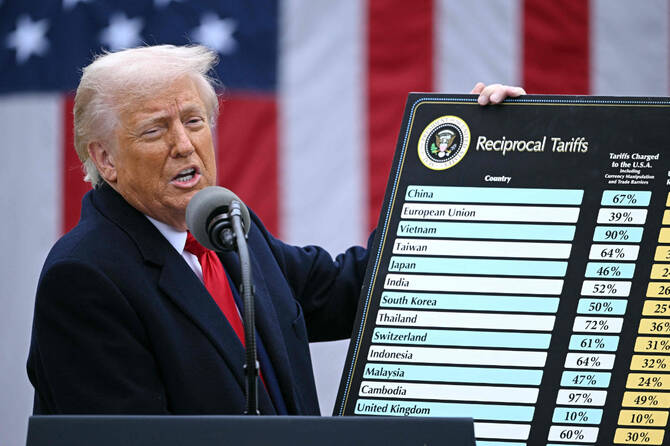
WASHINGTON D.C. : The U.S. Court of International Trade said the President had overstepped his authority in imposing his “reciprocal” tariffs globally, as well as levies on Canada and Mexico.

A panel of federal judges on Wednesday blocked President Trump from imposing some of his steepest tariffs on China and other U.S. trading partners, finding that federal law did not grant him “unbounded authority” to tax imports from nearly every country around the world.

The ruling, by the U.S. Court of International Trade, delivered an early yet significant setback to Mr. Trump, undercutting his primary leverage as he looks to pressure other nations into striking trade deals more beneficial to the United States.

Before Mr. Trump took office, no president had sought to invoke the International Emergency Economic Powers Act, a 1977 law, to impose tariffs on other nations. The law, which primarily concerns trade embargoes and sanctions, does not even mention tariffs.

But Mr. Trump adopted a novel interpretation of its powers as he announced, and then suspended, high levies on scores of countries in April. He also used the law to impose tariffs on products from Canada and Mexico in return for what he said was their role in sending fentanyl to the United States.

On Wednesday, the Court of International Trade, the primary federal legal body overseeing such matters, found that Mr. Trump’s tariffs “exceed any authority granted” to the president by the emergency powers law. Ruling in separate cases brought by states and businesses, a bipartisan panel of three judges essentially declared many, but not all, of Mr. Trump’s tariffs to have been issued illegally.

It was not clear precisely when and how the tariff collections would grind to a halt. The ruling gave the executive branch up to 10 days to complete the bureaucratic process of ending them. The Trump administration immediately filed its plans to appeal in the U.S. Court of Appeals for the Federal Circuit.

For now, the decision threatens to undercut the administration’s efforts to reach trade agreements globally since the president is using the prospect of boundless tariffs — enacted on his own, without congressional approval — as a bargaining chip in negotiations with roughly 18 countries. Those deals are still under negotiation, and some of Mr. Trump’s top aides had told the court in recent days that an adverse ruling could imperil the talks.

The ruling does not affect tariffs issued by the Trump administration under separate legal authorities, including levies on steel, aluminum and cars, and others that Mr. Trump has threatened on pharmaceuticals, semiconductors and other critical products.

A White House spokesman, Kush Desai, sharply rebuked the court, saying in a statement that unfair trade relationships had “decimated American communities, left our workers behind and weakened our defense industrial base — facts that the court did not dispute.”

“It is not for unelected judges to decide how to properly address a national emergency,” he said, adding that Mr. Trump would use “every lever of executive power to address this crisis.”

Everett Eissenstat, a partner at the law firm Squire Patton Boggs who served as deputy director of the National Economic Council during Mr. Trump’s first term, said the decision “dramatically impacts near-term dynamics surrounding the president’s tariff and trade agenda.”

“The story is far from over, but today marks a significant chapter in its evolution,” Mr. Eissenstat added.

Lawyers for the Justice Department had staunchly defended the legality of Mr. Trump’s strategy, telling the Court of International Trade repeatedly that it had no right to review the president’s actions.

That stance discomfited the judges multiple times over weeks of arguments. The tension arose repeatedly last Wednesday, when a coalition of 12 states, led by Oregon, asked the court to issue a permanent injunction that would halt Mr. Trump’s tariffs.

“The president identified the emergency, and he decided the means to address that emergency,” Brett Shumate, a Justice Department lawyer, told the court. He added that the goal had been to “bring our trading partners to the table” and create political leverage for possible deal-making.

“It may be a very dandy plan, but it has to meet the statute,” replied Senior Judge Jane A. Restani, who was nominated to the trade court by President Ronald Reagan.

By invoking emergency authority, Mr. Trump had sought to impose the tariffs immediately, without waiting for Congress to act or the government to compile reports or request public comments that other trade laws require. Frequently, the Trump administration pointed to the country’s large trade deficit to justify its actions to impose tariffs using emergency authorities.

The U.S. trade representative, Jamieson Greer, also warned that a court ruling against the administration could stymie its efforts to negotiate trade deals with other countries.

Those agreements remain elusive. Mr. Trump has steadily lowered tariff rates in cooperation with China, while striking a tentative bargain with Britain. Yet the administration is far from its goal of ratifying “90 deals in 90 days,” as a Trump adviser proclaimed in April.

The court decision nonetheless was a victory for the group of businesses and the coalition of states that had each sued on the grounds that Mr. Trump had overstepped the authority of his office, resulting in a trade war that had saddled them with steep financial losses.

Appearing at the trade court this month, businesses including VOS Selections, a wine and spirits importer, described Mr. Trump’s steep levies on China and other countries as a “power grab,” arguing that the economic emergency law does not explicitly say the president can impose tariffs. They also disputed Mr. Trump’s rationale for invoking that law, saying the nation’s persistent trade deficit — decades in the making — does not qualify as an emergency.

Jeffrey Schwab, a senior counsel at the Liberty Justice Center, which represented the business plaintiffs, told the court that Mr. Trump’s position essentially would allow him to “impose tariffs on any country at any rate at any time, simply by declaring a national emergency.” The nonprofit has past ties to Richard Uihlein, who is an Illinois industrialist and a Republican megadonor.

State officials also argued that nothing about the U.S. trade deficit merited Mr. Trump’s invocation of the emergency powers law. Brian Marshall, a lawyer at the Oregon Justice Department, told the court that the president had improperly sought to use the statute as a form of leverage anyway.

Ted Murphy, a trade lawyer at Sidley Austin, said the ruling was a blow to the president’s trade agenda but “not the final word.”

In addition to an appeal, he said, the government is likely to seek an emergency stay of the court’s ruling and could begin initiating alternative tariffs under more standard legal authorities. “In short, this story is not finished,” Mr. Murphy said.

Source : The new York Times


White House vows Supreme Court fight over Trump tariff ruling

WASHINGTON D.C. : The Trump administration has threatened to escalate its tariffs dispute to the Supreme Court after a court ruling overturned many of the president’s new import duties. The administration is demanding that the decision be suspended.

White House Press Secretary Karine Leavitt declared, “We will win this battle in court”, in a press briefing and said the administration is working to “tackle rogue judges.”

When asked why other countries would continue trade negotiations amid the legal uncertainty, she said the U.S. trade ambassador had heard from countries that morning confirming their intention to continue working with the United States.

During a Thursday briefing, Leavitt also informed reporters that U.S. President Donald Trump and Japanese Prime Minister Shigeru Ishiba spoke by phone on Thursday, exchanging views on tariff-related issues.

The press secretary added that members of the president’s cabinet–Secretary Lutnick, Secretary Bessent, and Ambassador Jamieson Greer–have been in contact with their counterparts worldwide to signal that the United States remains committed to negotiations.

“Countries around the world have faith in the negotiator in chief, President Donald J. Trump. And they also probably see how ridiculous this ruling is, and they understand the administration is going to win,” Leavitt said. “And we intend to win. We already filed an emergency appeal, and we expect to fight this battle all the way to the Supreme Court,” the press secretary asserted.

White House lawyers petitioned the Court of Appeals for the Federal Circuit on Thursday to halt Wednesday’s decision from taking effect. The move followed a second court ruling that found President Trump had exceeded his authority in implementing the tariffs.

The rulings represent significant victories for small businesses and states that have mounted legal challenges to the measures, striking at policies central to Trump’s economic and foreign policy agenda.

Leavitt also criticised the court’s tariff ruling as an example of “judicial overreach.” She argued that Trump’s tariffs were introduced to address U.S. trade deficits with other nations and described the taxes as “legally sound” and “long overdue.”

Meanwhile, a US team is scheduled to visit India on June 5-6 for the next round of negotiations on a Bilateral Trade Agreement (BTA) between the two countries.

The India-US trade deal would mark a significant milestone in economic relations between the two big economies, potentially opening new avenues for bilateral commerce and investment.

Additionally, Ray Vickery, Former United States Assistant Secretary of Commerce for Trade Development, said that the trade agreement between India and the US can’t happen with Washington’s “bullying approach.”

“In Trump, 1.0, there was a negotiation that came close to getting a freer trade, not a free trade arrangement between the United States and India. One hopes that that would happen, but it’s not going to happen with this bullying approach, which the Trump administration has indicated,” Ray Vickery told ANI.

President Donald Trump has made repeated claims that the US mediated the cessation of hostilities between India and Pakistan and offered them “a lot of trade.”

However, India has emphasised that the two nations’ militaries negotiated directly and resolved the conflict through an agreement and understanding for a cessation of fire and military action.

The cessation of hostilities was agreed upon following a call from Pakistan’s Director General of Military Operations (DGMO) to his Indian counterpart, Lieutenant General Rajiv Ghai, after India destroyed nine terror infrastructure sites in Pakistan and Pakistan occupied Jammu and Kashmir under Operation Sindoor.
Additionally, Vikrey said that the Trump administration has a “misunderstanding” regarding trade deficits, due to whichthe US is determined to impose tariffs on other countries.

“The Trump administration has a misunderstanding in regard to trade deficits. Trade deficits are not necessarily something imposed just by unfair trade practices by another country, but they have to do with the United States’ own saving and spending habits”, he said.

Source : ANI

Pipavav Port Q4 results : Net profit surges 70.7% YoY despite flat revenue

PIPAVAV : Gujarat Pipavav Port Ltd on Thursday reported a 70.7% year-on-year jump in fourth-quarter net profit to ₹112.3 crore, aided by improved operational efficiency despite largely flat revenue growth.

Revenue from operations rose marginally by 0.2% to ₹251.7 crore for the quarter ended March 31, compared with ₹251.2 crore a year earlier.

Earnings before interest, tax, depreciation, and amortisation (EBITDA) declined slightly by 0.4% to ₹156.6 crore, while EBITDA margin narrowed to 62.22% from 62.58% in the same quarter last year.

The company’s board also approved the audited annual accounts and recommended a final dividend of ₹4.20 per equity share, subject to shareholders’ approval at the upcoming Annual General Meeting scheduled for September 4, 2025.

Gujarat Pipavav Port Ltd, a unit of APM Terminals, operates one of India’s leading private sector ports located on the west coast in Gujarat. The port handles containers, dry bulk, and liquid cargo and serves key industrial hubs in north and west India.