AHMEDABAD : Adani Ports and Special Economic Zone (APSEZ), the transport and logistics arm of Adani Group, plans to consider a US dollar bond buyback as robust business growth has given it ample cash flows.
The board is scheduled to meet on May 31, 2025, to deliberate on the proposal, subject to prevailing market conditions, according to a regulatory filing.
The move comes on the back of robust cash flows. “We have more cash flow than we can utilise,” Karan Adani, Managing Director of APSEZ, had stated in a recent media interaction.
He noted that the excess liquidity has led to the company’s leverage ratio falling to sub-optimal levels.
In FY25, the company reported an EBITDA (earnings before interest, taxes, depreciation, and amortisation) of ₹20,471 crore, marking a 19 per cent increase year-on-year. As a result, its net debt-to-EBITDA ratio declined to 1.8x – the lowest in the past decade.
This performance comes despite ongoing capital expenditure across its network of 18 ports and terminals, including the launch of Vizhinjam in Kerala – India’s first global transshipment port – and a new terminal in Colombo, Sri Lanka.
Buoyed by its strong financials and stable business model, APSEZ recently became the first infrastructure company in India to be rated ‘AAA’ by domestic rating agencies. Global rating agencies have assigned it a ‘BBB-‘ rating, in line with India’s sovereign rating, with potential for an upgrade if the country’s sovereign rating improves.
The quantum of the proposed bond buyback has not yet been disclosed.
THIRUVANANTHAPURAM : The Kerala Government on Thursday declared the wreckage of a cargo ship flying the Liberian flag off the state’s coast a state-specific disaster.
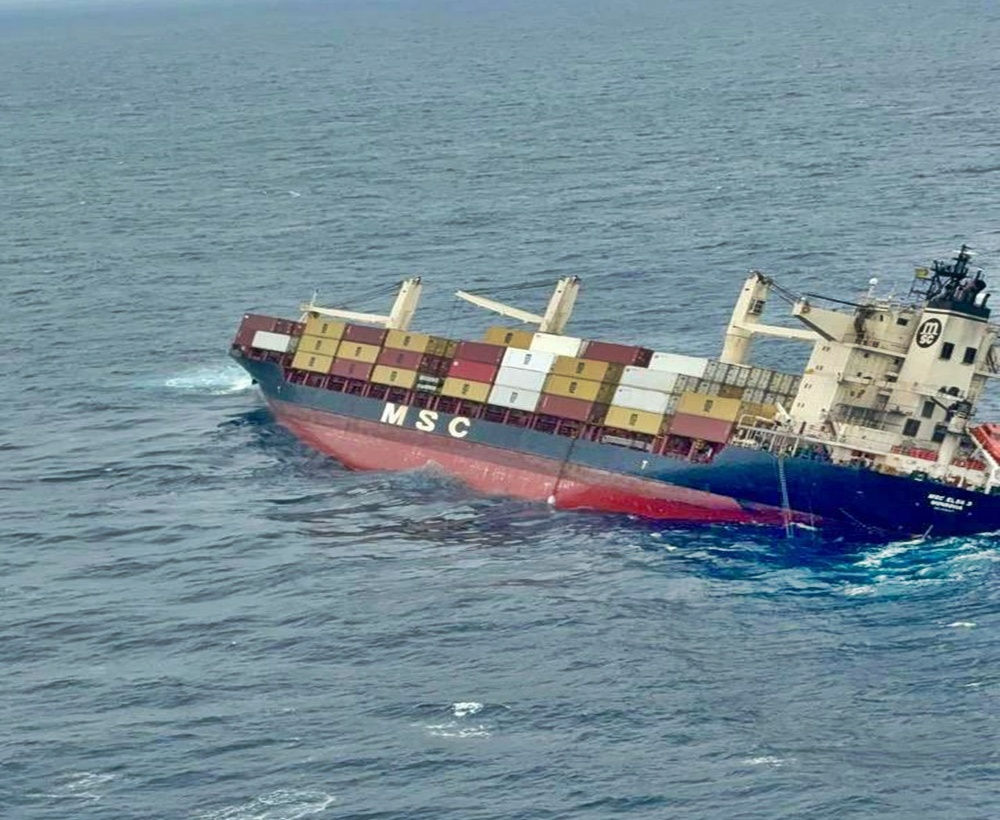
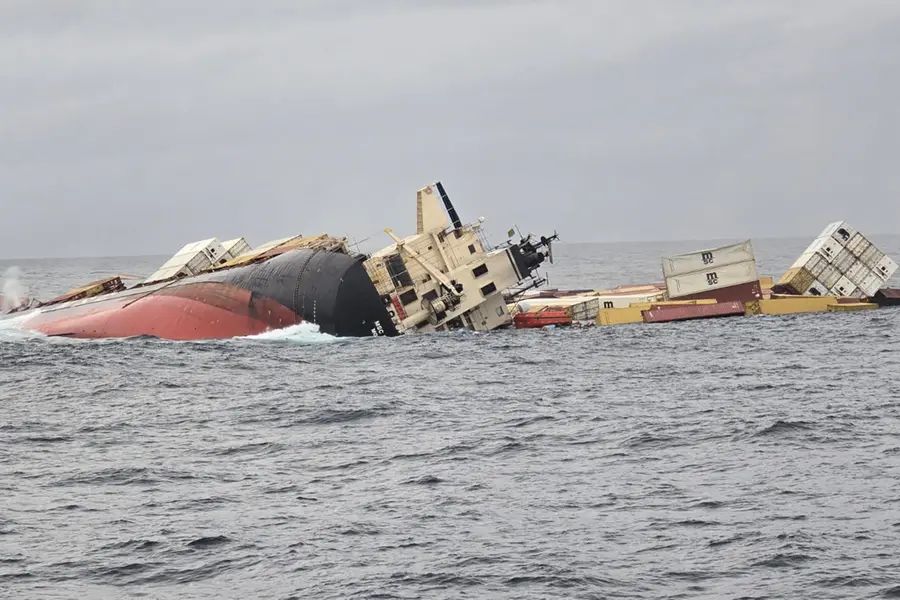
The vessel, MSC ELSA-3, carrying more than 643 containers, including hazardous cargo, sank about 14.6 nautical miles from the coast near Thottappalli in Alappuzha district on May 25, raising environmental concerns.
In an official order, the state government said the maritime incident has raised serious environmental concerns, including the potential for oil spills and drifting debris, such as cargo, along Kerala’s coastline.
“Considering the potentially serious environmental, social, and economic impact of the ship wreckage, Government hereby declare the wreckage of ship M/s ELSA 3 in the Arabian sea 14.6 nautical miles off the Kerala coast as a State-Specific disaster,” the order said.
KOCHI : Dismissing the sabotage theory behind the capsize of container vessel MSC Elsa 3, the Director General (DG) of Shipping Shyam Jagannathan on Wednesday said the ship sank due to the failure of its ballast management system, which ensures the vessel’s stability.
The containers that fell off the ship when it sank off Kochi coast on Sunday and were floating in the Arabian Sea would be retrieved in 48 hours, Jagannathan said, adding that environmental damage was minimal.
“The oil spill is limited and the Coast Guard is cleaning it. The oil in the ship bunker will be removed by July 3,” he said.
“Our primary inference is that the vessel sank due to mechanical failure of the ballast management system. Safety and environmental requirements of the ships are governed by norms set by International Maritime Organisation (IMO) and this vessel complied with international norms.
We have no evidence of other reasons. Failure of the ballast system may be due to lack of operational understanding. When the vessel listed to 26 degrees, there was a complete blackout due to failure of internal power generation. This virtually incapacitated all operations of the ship,” said chief surveyor of Union government Ajith Sukumaran.
About the cargo, Jagannathan said there were 13 containers carrying hazardous cargo of which 12 had calcium carbide, while one had rubber chemical antioxidants.
Vessel will be recovered : DG Shipping
“Five containers carrying calcium carbide were on the deck and might have landed on the sea floor. The other seven containers are in the cargo hold and are safe. The calcium carbide is stored in 200-litre drums inside the containers and chances of it mixing with sea water are sparse. There are some containers having iron and ethylene polymers which are plastic nodules,” he said, adding that all sunken containers as well as the ship will be recovered.
Jagannathan said around 100 containers floated in the sea of which 50 beached in coastal areas of three southern districts. “Most of these containers are empty while some had waste cotton and plastic nodules. A 108-member team from T&T Salvage, a US firm engaged by the shipping company (MSC) is engaged in coastal cleaning,” he said.
The priority, he said, is to retrieve the floating containers and clean the coastline which will be completed in 48 hours. “After that, the salvage team will start removing oil from the ship’s bunkers. Subsequently, the vessel will be lifted. The vessel will not be abandoned and all sunken containers will be removed. There is an international convention and the owner is required to remove the wreck,” said Jagannathan.
“The salvage team has mobilised two salvage masters, two project managers, two chemists, a six member diving team, a three member site scanner team and oil spill response team at the site of ship capsize,” said Union government’s nautical officer Captain Abdul Kalam Azad.
“A team comprising naval architects, salvage engineers and oil spill specialists have reached Kochi to address any oil spill risk. The salvage team has brought high range drones for surveillance of coastal area. High precision multi-beam side scanner has been brought for underwater scanning. A specialised oil spill response equipment and fuel recovery equipment have also been mobilised,” Azad said.
Jagannathan said removal of plastic nodules that have spread on the sea surface is one concern as it is time consuming. “There is a concern the oil spill may enter the backwaters through the river-sea interface. This is being addressed by the disaster management authority and Coast Guard,” he said.
NEW DELHI : NITI Aayog, India’s top policy think tank, has announced a bold plan to shift more freight from roads to railways, focusing on container cargo. The goal is to make India’s freight system more efficient and sustainable, as the country is expected to handle 6,366 million tonnes of goods by 2026, with containers making up 411 million tonnes.
Right now, trucks carry 66% of non-bulk cargo, while trains handle only 30%. To change this, NITI Aayog is launching a study to tackle issues like high costs, complex regulations, and operational delays. The study will look at how Indian Railways sets prices for container freight, compare it to global standards, and suggest fairer rates to help businesses. It will also explore ways to improve private container operations, speed up train turnarounds, and fix last-mile delivery challenges.
Key Highlights:
NITI Aayog launches a study to shift more container freight from roads to rail, aiming to boost efficiency and sustainability The plan targets fairer pricing, faster train turnarounds, and better last-mile delivery to attract businesses to rail transport This initiative supports India’s National Logistics Policy goal to halve logistics costs by 2030 through greener, cheaper rail freight “The study aims to provide policy-level suggestions for cargo consolidation, particularly for parcel and less-than-container-load (LCL) shipments, while attracting more customers to rail for non-bulk movements,” a NITI Aayog spokesperson said. The study will also check the condition of inland container depots, freight stations, and terminals, while addressing shortages of containers.
This effort supports India’s National Logistics Policy, which aims to cut logistics costs from 16% of GDP to 8% by 2030. Rail transport is cheaper and greener than road, making it key to this goal. The Finance Ministry has also asked NITI Aayog to find the best balance between rail, road, and waterway transport and improve connections between them.
Industry experts are optimistic. “Dedicated freight corridors and modernized rail infrastructure could significantly decongest roads and boost efficiency,” said Lalit Trivedi, a former Indian Railways official. By solving these challenges and encouraging private partnerships, NITI Aayog’s plan could transform how goods move across India, making railways a vital part of a greener, more efficient logistics network.
KOLKATA : It was a red-letter day for Garden Reach Shipbuilders and Engineers (GRSE) Ltd on Thursday, 29th May, 2025, when the keels of 13 hybrid ferries, being built by the shipyard for the Transport Department, Government of West Bengal, was laid in the presence of Shri Snehasis Chakraborty, Hon’ble Minister-in-Charge, Transport Department, Government of West Bengal, Shri Dilip Mondal, Minister-of-State, Transport Department, Government of West Bengal, Cmde PR Hari, IN (Retd), Chairman and Managing Director, GRSE, Dr. Moinul Hassan (Ex-MP), Chairman, WBTIDCL, Shri R K Dash, Director (Finance), GRSE, Cdr Shantanu Bose, Director (Shipbuilding), Shri Abhishek Ranjan, IOFS, CVO, GRSE, Shri Shiraz Daneshyar, IAS, Project Director, WBIWTLSDP, and senior officials from GRSE & WBTIDCL.
GRSE had signed a contract with the Transport Department, Government of West Bengal on 19th November, 2024, for the design and construction of the 13 hybrid ferries that are to be operated on the River Hooghly by the West Bengal Transport Infrastructure Development Corporation Ltd. (WBTIDCL). These ferries will bring about a massive change in river transportation in and around Kolkata, by reducing pollution and providing a comfortable journey for passengers.
These vessels will have catamaran hull design and be built with aluminium and Fiber Reinforced Polymer (FRP). The hybrid electric propulsion systems will be powered by batteries as well as diesel generators. The hybrid system will offer greater flexibility to the operator to switch from one mode to the other as per requirement, allowing for greater safety. The use of batteries will reduce pollution substantially.
GRSE had earlier designed and built a next generation zero-emission ferry for the Government of West Bengal. This ferry, named ‘Dheu’ was delivered on January 9, 2025 and is now operating on the River Hooghly.
Of the 13 ferries of which the keels were laid during the day, six will have twin decks with a capacity of 200 passengers each. The main deck will be air-conditioned. These vessels will be about 30 meters long and 8-10 meters wide. Their maximum speed will be 12 knots and each will require a crew of five. The estimated cost of these six vessels is Rs 126 crore.
The remaining seven vessels will have a single deck with a passenger capacity of 100. These ferries will be nearly 25 meters long and 8 meters wide with a top speed of 9 knots. There is provision for five crew members on board. These seven vessels are expected to cost nearly Rs 100 crore.
As per the contract, the hybrid ferries will carry passengers in all-weather conditions on River Hooghly (part of National Waterway – 1, the Ganga-Bhagirathi-Hooghly River System) in the Kolkata Metropolitan Area (KMA), stretching from Triveni in the north to Diamond Harbour in the south.
On the occasion, Shri Snehasis Chakraborty, Hon’ble Transport Minister, Government of West Bengal, credited the Hon’ble Chief Minister’s vision for promoting sustainable transport solutions. He praised GRSE’s shipbuilding excellence for delivering ‘Dheu’, India’s largest and fastest fully electric ferry, now operational between Kolkata and Belur Math.
Further, he stated that 13 hybrid ferries have been ordered from GRSE to replace old diesel vessels, and expressed hope that other states would follow Bengal’s lead in green river transport. Cmde P R Hari, IN (Retd), spoke on the shipyard’s latest achievements and plans to take forward green technology in the field of shipbuilding for larger platforms.
“We are proud to spearhead the green initiatives of Government of West Bengal and I am confident that we shall design & deliver high quality vessels to minimize the carbon emission in the maritime sector,” CMDE Hari said.
KOLKATA : Balmer Lawrie & Company, under the Ministry of Petroleum and Natural Gas, will focus on its four core areas, including logistics and industrial packaging, to boost topline growth, an official said.
The Kolkata-headquartered company is targeting a revenue of around Rs 3,000 crore during the current financial year, and the focus will be on industrial packaging (IP), grease and lubricants, travel and vacations, and logistics, he said.
In the previous fiscal, the company posted a turnover of Rs 2,580 crore, and a net profit of Rs 232.80 crore.
“Our main challenge had been to drive the topline. We are aiming to boost the topline growth, and the four key growth areas will be IP, grease and lubricants, travel and vacations and logistics,” Balmer and Lawrie Chairman & Managing Director Mr. Adhip Nath Palchaudhuri told reporters.
The PSU has major business verticals like ticketing, vacations, grease and lubricants, logistics Infrastructure, logistics services, IP and chemicals.
During the current fiscal, the company is “expecting a revenue of Rs 650 crore from grease and lubricants, Rs 1,100 crore from logistics (services and infrastructure), Rs 350 crore from travel and vacations and Rs 850 crore from IP”, he said.
Palchaudhuri said IP had traditionally been the biggest revenue earner for the company so far.
“But the logistics business as a cluster will be bigger this fiscal. We are also exploring expansion of the portfolio in the IP vertical,” he said.
By 2030, the company is aiming at a revenue of Rs 6,000 crore, with the turnover from manufacturing and services in an equal ratio. Now the contribution of the manufacturing and services ratio is 60:40, he said.
Palchaudhuri said grease and lubricants have a big business opportunity, while logistics will be the biggest area for growth of the PSU in the coming years.
He said the company has forayed into new areas like third-party logistics (3PL) and rail logistics.
For 3PL, the company will commence a hub at Dankuni near Kolkata, and spokes in Siliguri, Guwahati and Bhubaneswar, the official said.
For rail logistics, the PSU has taken a rake on lease from a US company and will dispatch steel from the Rourkela Steel Plant to start with. NMDC and RINL are also potential customers for Balmer Lawrie, he said.
The PSU will also open a temperature-controlled warehouse for cold chain logistics at Dankuni, expected to be operational by the last quarter of the current financial year.
“We aim to become an integrated player in the entire logistics space”, he said.
The company has a capital expenditure plan of Rs 200 crore for 2025-26, he added.
RIYADH : The Saudi Ports Authority “Mawani” has announced the addition of Evergreen’s new shipping service “ARPG” to King Abdulaziz Port in Dammam, further strengthening maritime connectivity between the Kingdom and international markets. The move reinforces the port’s strategic standing, boosts its competitiveness for exporters, importers, and shipping agents.
The new shipping service links King Abdulaziz Port with nine major regional and global ports, including Port Klang (Malaysia), Laem Chabang (Thailand), Vung Tau (Vietnam), Kaohsiung (Taiwan), Yantian, Ningbo, and Shanghai (China), Umm Qasr (Iraq), and Jebel Ali (UAE), with a total capacity of 9,466 TEUs.
This initiative reflects Mawani’s broader efforts to elevate Saudi Arabia’s ranking on global performance indices and to improve the operational efficiency of King Abdulaziz Port. It also supports the movement of national exports and imports in alignment with the objectives of the National Transport and Logistics Strategy “NTLS”, to solidify the Kingdom’s standing as a global logistics hub bridging the three continents.
It is worth noting that King Abdulaziz Port in Dammam features advanced operational and logistical capabilities, with 43 fully equipped berths, a handling capacity of up to 105 million tons of cargo and containers, and a range of specialized terminals, modern infrastructure, and state-of-the-art equipment that enable the port to handle all types of cargo efficiently.
SHANGHAI : CULines and UGL have officially commenced operations in the Mediterranean by launching the new Asia–East Mediterranean Plus (AEM+)Service—a strategic container route linking China’s major ports directly to Alexandria. Represented by SeaGlory Egypt, the burgeoning shipping agency joint venture between Sharaf Group and Finmar Group, the new service enhances Egypt’s role as a regional maritime hub amid shifting global shipping dynamics.
The AEM+ service offers weekly direct calls between China and Alexandria, supported by additional port calls in Istanbul, Izmit, Jeddah, and Port Klang. This configuration ensures a stable and efficient route designed to navigate around current Red Sea disruptions while optimizing transit times. The service includes two separate calls at Alexandria Port, providing increased flexibility for Egyptian importers and exporters and reinforcing trade integration with the Turkish market.
The launch marks CULines’ debut on Egypt’s Mediterranean coast, building on its earlier entry into the Red Sea market through Sokhna. The move aligns with the company’s broader expansion strategy and the growing need for reliable east–west corridors as global supply chains seek greater resilience. Transit times for imports range from 23 to 32 days from major Chinese ports, while export schedules are calibrated to ensure operational consistency and market responsiveness.
SeaGlory’s entry into the market underlines its strategic commitment to growing its presence in international shipping. Backed by decades of maritime experience and regional know-how, the agency is positioned to offer tailored solutions that align with Egypt’s ambitions to become a leading transshipment and logistics center.
Alexandria Port, already one of the Mediterranean’s most active gateways and Egypt’s largest port, plays a pivotal role in Egypt’s foreign trade and is central to ongoing national efforts to attract foreign shipping lines and enhance logistics capacity. The addition of the AEM+ service is viewed as a strong vote of confidence in the country’s investment climate and geographic advantage, particularly as global operators recalibrate routing strategies.
Through this partnership, SeaGlory, CULines, and UGL aim to redefine the Asia–Mediterranean trade lane. The collaboration underscores a shared commitment to resilient shipping solutions and expanded market access across North Africa, the Middle East, and Asia, reinforcing Alexandria’s position as a vital link in global commerce.
SINGAPORE : Ocean Network Express (“ONE”) has advanced its Green Strategy by implementing a Ship Recycling Policy and joining the Ship Recycling Transparency Initiative (SRTI), reinforcing its commitment to responsible practices and environmental stewardship. Both moves align with ONE’s efforts to enhance transparency, promote ethical operations, and uphold high environmental standards throughout the entire lifecycle of its vessels.
As ONE continues to expand its owned fleet, the Company is strengthening its commitment to the safe and environmentally responsible decommissioning of ships at the end of their operational life.
In line with this commitment, ONE has established a Ship Recycling policy, requiring that all ONE vessels be recycled only at certified and reputable recycling facilities that operate in compliance with applicable international regulations and standards. In joining the SRTI, ONE will disclose its ship recycling policies and practices, supporting the initiative’s efforts to enhance accountability and sustainability within the maritime industry by encouraging voluntary data disclosure from shipowners.
Michimasa Noda, Senior Vice President, Sustainability, says, “The development of our Ship Recycling Policy, together with our participation in the SRTI, marks a meaningful step forward in our ‘Clean Ship Recycling’ initiative – one of the seven key pillars of ONE’s Green Strategy.” He adds, “We remain committed to fulfilling our responsibilities as a shipowner and to promoting safe, environmentally sound, and socially responsible ship recycling practices across the maritime industry.”
ONE’s announcement coincides with the upcoming entering into force of the Hong Kong International Convention for the Safe and Environmentally Sound Recycling of Ships (HKC) on June 26, 2025. The HKC stipulates that the recycling of vessels must be conducted in a manner that does not pose any unnecessary risk to human health, safety and the environment.
The development of Mexico’s National Action Plan (NAP) for maritime decarbonization is officially underway, setting the course for a greener and more resilient shipping future.
Spearheaded by the Mexican Secretariat of the Navy (SEMAR), with technical support from the IMO’s GreenVoyage2050 Programme, the process was formally kicked off at a national stakeholder workshop held in Mexico City on 21 May 2025. The event brought together key institutions including SEMAR, the Ministry of Environment (SEMARNAT), Ministry of Energy (SENER), Ministry of Foreign Affairs (SRE), and representatives from national ports (ASIPONAs), academia, industry, and civil society.
Participants engaged in breakout discussions to identify national priorities and opportunities for reducing GHG emissions across the shipping and port sectors. These included adopting cleaner fuels, upgrading port infrastructure, enhancing regulatory coordination, and investing in innovation and workforce development. Discussions also focused on the integration of port decarbonization with national climate goals and international cooperation on green shipping corridors.
Rear Admiral Javier Mendoza Rosales, Deputy Director General for Liaison, Implementation, Regulations, Marine Accidents and Casualties, Port Captaincies and Maritime Affairs Unit (UNICAPAM), emphasized the importance of seizing the moment: “Mexico has a real opportunity to take advantage of global momentum on maritime decarbonization. Through this collaboration with the IMO, we can strengthen our regulatory frameworks and build a forward-looking maritime sector that supports both economic growth and environmental sustainability.”
The workshop also underscored the strategic role of ports in this transition. Actuary Diana Elena Portilla, Executive Director of Maritime-Port Strategic Planning, General Coordination of Ports and Merchant Marine, noted “Our ports are pillars of national economic development and their transformation is essential to respond to today’s challenges. Through the National Action Plan process, it is possible to align port operations with the country’s energy and climate priorities, thus laying the foundations for a greener, more efficient and competitive port system.”
Recognizing Mexico’s vast potential, Subaskar Sitsabeshan, Programme Officer at IMO’s GreenVoyage2050 Programme, highlighted the country’s strengths and leadership: “Mexico’s extensive coastline and network of over 100 ports offer a unique opportunity to drive sustainable growth in the maritime sector. With strong national ambition and cross-sector engagement, GreenVoyage2050 is pleased to collaborate on this important initiative in Mexico – bringing together actors from shipping, ports, and energy to co-create an ambitious, yet practical National Action Plan for maritime decarbonization.”
A strong focus was placed on enhancing national capacity to develop low- and zero-carbon solutions for ships and ports, including exploring Mexico’s potential in hydrogen, ammonia, and electrification. The dialogue highlighted the need for targeted financing, pilot projects, and regional cooperation to unlock long-term opportunities.
As a next step, Mexico will undertake a baseline assessment of GHG emissions from its maritime sector to guide the development of the plan.
GreenVoyage2050 Programme
GreenVoyage2050 is a major technical cooperation programme initiated by the IMO to assist developing countries in reducing GHG emissions from shipping, aligning with the 2023 IMO GHG Strategy. Phase I of GreenVoyage2050 (2020–2023) supported partnering countries in developing policy frameworks and pilot projects to reduce GHG emissions from ships. Phase II (2024–2030) continues and expands this support, leveraging funding from the Governments of Denmark, Finland, France, Germany, the Netherlands, and Norway.