Home Blog Page 849

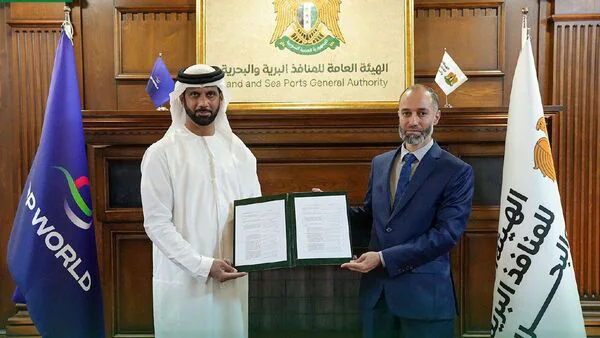
Syria & DP World sign $800 million port deal after Donald Trump announces to lift US sanctions

TARTOUS : The Syrian Government has signed a memorandum of understanding (MoU) worth $800 million with DP World to develop Syria’s Port of Tartous, Syrian state news agency SANA said on Friday, days after US President Donald Trump announced to lif US sanctions on the country.

The deal is said to be the biggest MoU by far for Syria’s transitional government under interim president Ahmed al-Sharaa. The deal to develop, manage and operate a multi-purpose terminal at Tartous includes cooperation in establishing industrial and free trade zones, news agency Reuters said.

The two sides also agreed to cooperate in establishing industrial zones and free zones in addition to dry ports and freight transit stations in a number of strategic areas within Syria, reflecting both parties’ commitment to supporting economic development and facilitating trade and transport.

DP World is a subsidiary of United Arab Emirates (UAE) investment company Dubai World.

Syria is seeking to attract foreign investments to boost its struggling economy, and the deal was signed days after President Donald Trump announced plans to lift of sanctions on Syria during a visit to Riyadh.

On 14 May, Trump became the first US president in 25 years to meet a Syrian leader after he met Ahmed al-Sharaa in Saudi Arabia after offering sanctions relief in hopes of offering a new path to the war-battered country.

Trump said he took the decision to lift sanctions after discussions with Saudi Crown Prince Mohammed bin Salman and Turkish President Tayyip Erdogan, whose governments have both strongly urged the lifting of sanctions.

Sanctions on Syria
The Syrian sanctions were put during the reign of President Bashar al-Assad to, perhaps, inflict pain on his regime but ended up with devastating economic fallout for Syrian civilians. Assad governed the country from 1971 to 2024.

Trump, who just visited Saudi Arabia, Qatar and UAE in the Middle East, said the sanctions had served an important function and that it was time for Syria to move forward.

The US has yet to formally recognise Al-Sharaa’s government. The Trump administration had been weighing its approach since former President Joe Biden left the decision open, amid growing international momentum for re-engagement with Damascus.

Trump’s latest move to list sanctions marks a major shift in US policy. The US declared Syria a state sponsor of terrorism in 1979, which led to an arms embargo and financial restrictions, including on foreign assistance.

US Secretary of State Marco Rubio said on 15 May that Trump intends to issue waivers under the “Caesar Syria Civilian Protection Act”, through which Washington imposed stiff sanctions on former President Bashar al-Assad’s government and secondary sanctions on outside companies or governments that worked with it.

Why remove sanctions now?
Syria has been trying to convince the US that it is not a threat but a potential partner and that it was engaged in indirect talks with Israel to de-escalate tensions with the US’s Middle Eastern ally– despite Israel’s bombing of Syria and occupation of its territory, news agency Reuters said last week.

Also, Al Sharaa has slowly been gaining international legitimacy for his government since it came to power in December 2024 after toppling Assad. The Syrian president, a former ‘terrorist’, has been able to travel internationally and meet world leaders.

The new Syrian government led by Sharaa has been projecting itself as a moderate force that could be acceptable to the international community, including by distancing itself from designated ‘terrorist’ groups.

Sharaa’s dispensation has also promised to cooperate with other countries on ‘counterterrorism’ measures and supporting minority rights. This assumes significance amid sectarian fighting involving pro-government forces and minority groups after the fall of Al-Assad in Syria.

Drewry: World Container Index up 8% last week

LONDON : For many years, World Container Index has been the go-to, independent, global reference for index-linked contracts. If your organisation is considering index-linked contracts or requires regional visibility/coverage beyond the eight trade lanes provided below, contact our ocean freight cost benchmarking team.

Drewry’s World Container Index increased 8% to $2,233 per 40ft container this week.

Drewry detailed assessment for Thursday, 15 May 2025

  • The Drewry WCI composite index increased 8% to $2,233 per 40ft container, 78% below the previous pandemic peak of $10,377 in September 2021. However, the index was 57% higher than the average $1,420 in 2019 (pre-pandemic).
  • The average YTD composite index closed at $2,746 per 40ft container, $151 lower than the 10-year average of $2,896 (inflated by the exceptional 2020-22 Covid period).
  • Freight rates from Shanghai to New York surged 19% or $704 to $4,350 per 40ft container and those from Shanghai to Los Angeles shot up 16% or $423 to $3,136 per 40ft container whereas rates from New York to Rotterdam increased a marginal 1% or $10 to $824 per 40ft container. On the other hand, rates from Shanghai to Rotterdam, Shanghai to Genoa and Rotterdam to New York decreased 1% to $2,035, $2,742 and $1,961 per 40ft container, respectively, while those from Rotterdam to Shanghai and Los Angeles to Shanghai remained stable. Following the latest US–China trade developments, Drewry expects an increase in Transpacific spot rates in the coming week due to shortage in capacity.

Source: Drewry

ClassNK Academy starts offering the 2025 edition of e-learning courses

TOKYO : ClassNK has started offering the 2025 edition of ClassNK Academy‘s e-learning content. These courses help new employees understand the maritime industry, deepen engineers’ knowledge of ship stability, performance design, and structural strength, and enhance cybersecurity awareness for crew members and IT staff. Each course is available on the ClassNK Academy website, making it possible to learn the necessary knowledge anytime, anywhere.

English website URL: https://academy-en.classnk.or.jp/
Japanese website URL: https://academy.classnk.or.jp

ClassNK Academy was established in 2009 with the aim of utilizing the expertise gained through ship surveys and audits of ship management systems to help those involved in shipbuilding, maintenance, or operation acquire the basic knowledge required for these tasks. In 2024, more than 2,000 participants from around the world took part in the Academy, contributing to the development of industry professionals.

In the 2025 edition of the e-learning courses, ClassNK have started offering “The First Course of Shipping and Shipbuilding” for new employees and prospective employees, “The Step-up Course on Shipping and Shipbuilding”, which includes three courses mainly for young engineers working at shipyards, and ‘Maritime Cybersecurity Course’ which is structured as four courses mainly for IT personnel and seafarers involved in ship operations. The courses have been updated to reflect the latest information and feedback received.

These courses are available in an e-learning format that allows repeated learning anytime, anywhere on PCs and smartphones. The materials include numerous videos and photos. Comprehension tests are provided to check the learning progress, and companies can track participants’ status and issue certificates of completion. By taking these courses, participants can acquire knowledge directly applicable to practical work. Please refer to the attached document for course details. 

Quiet Thriving: The Silent Revolution of Meaningful Work

By Dr.Saamta Jain

When was the last time you genuinely  felt fulfilled at work?
Not just productive or busy — but aligned, energized, and quietly content?
What if growth didn’t always have to be loud? What if thriving could be subtle, internal, and self-led?

As we enter a new chapter in the world of work, a silent shift is underway. Amid the noise around burnout, disengagement, and “quiet quitting,” there lies an emerging and hopeful counter-movement: quiet thriving. Unlike its more cynical cousin, quiet quitting, which reflects disengagement and frustration, quiet thriving is a conscious and mindful decision to grow, flourish, and find meaning — even when external conditions don’t change.

This phenomenon is not just a passing trend. It reflects the deeper yearnings of a workforce, particularly the new generation of Millennials and Gen Z, who are redefining success, well-being, and personal agency.

What Is Quiet Thriving?

The term “quiet thriving” was first popularized by psychologist Dr. Megan Bruneau, who described it as the act of making mental shifts and small changes to stay engaged and fulfilled at work, without necessarily changing your job.

It’s a mindset. A self-led movement. A form of gentle rebellion against burnout, stagnation, and misalignment.

It means choosing to:

  • Reframe your perspective
  • Reconnect with your values
  • Cultivate joy in small wins
  • Set boundaries that protect your peace
  • Lean into learning, even when it’s not mandated

In essence, quiet thriving is about internal transformation that radiates outward. It doesn’t need a title change or a dramatic leap. It begins within.

Why Quiet Thriving Matters Now

Post-pandemic, employees around the world are reassessing their relationships with work. The Great Resignation, the rise of hybrid work, and growing conversations around mental health and purpose have revealed a truth many long knew but rarely voiced: work isn’t just about output — it’s about identity, emotion, and meaning.

While “quiet quitting” garnered headlines as a sign of disengagement, it also illuminated a critical workplace failure: environments where people feel unheard, underappreciated, or stuck. In response, quiet thriving offers a healthier path forward — especially for employees who want to stay but don’t want to lose themselves in the process.

For the new generation of workers, particularly Millennials and Gen Z, the old metrics of success no longer apply. Job security and compensation matter, but they are not enough. They are seeking:

  • Purpose over perks
  • Flexibility over formality
  • Growth over grind
  • Well-being over workaholism

In this landscape, quiet thriving is the bridge between ambition and authenticity.

The Psychology Behind It

At its core, quiet thriving is rooted in intrinsic motivation — the desire to do something because it is inherently rewarding, not just because of external outcomes.

According to self-determination theory (SDT), developed by psychologists Edward Deci and Richard Ryan, human beings are driven by three basic psychological needs:

  1. Autonomy — the need to feel in control of one’s own behavior and goals
  2. Competence — the need to gain mastery of tasks and learn different skills
  3. Relatedness — the need to feel a sense of belonging and connection

Quiet thriving often occurs when these needs are met, even in environments that aren’t ideal. It’s about leveraging internal strengths to create fulfillment.

How Quiet Thriving Shows Up at Work

Unlike loud achievements, quiet thriving doesn’t always show up in boardroom presentations or performance reviews. But it can be seen in everyday moments:

  • An employee volunteering for a side project that fuels their creativity
  • A designer reorganizing their schedule to align with their creative peak hours
  • A team member setting respectful boundaries around their availability
  • A young manager mentoring interns to give back and stay energized

These micro-shifts often lead to macro impact — not just on performance, but on morale, collaboration, and culture.

Ways Organizations Can Nurture Quiet Thriving

Companies often ask: “How do we stop quiet quitting?” But the better question is: “How do we create the conditions for quiet thriving?”

Here are five proven ways:

 Enable Autonomy and Flexibility

Trust people to design their workday in ways that work best for them. This could mean flexible hours, results-only environments, or project-based structures that value outcome over face-time.

Recognize the Person, Not Just the Performer

Leaders must look beyond KPIs. Notice effort. Celebrate thoughtfulness. Acknowledge when someone uplifts the team, takes initiative, or shares ideas.

Create Psychological Safety

Encourage open conversations without fear of judgment. When employees feel safe to express doubts, ask for help, or share feedback, they invest more of themselves.

 Support Purpose Alignment

Help employees connect their personal values with organizational goals. When someone believes their work has real-world impact, they thrive quietly but powerfully.

 Invest in Personal Growth

Quiet thriving is closely tied to learning. Offer micro-learning modules, peer mentoring, coaching, and opportunities for passion projects.

A simple check-in like, “What’s been energizing you lately?” can unlock deep insights and engagement.

Individual Strategies for Quiet Thriving

Employees can also take ownership of their quiet thriving journey. Here are strategies that can help:

  • Reframe your mindset – Instead of saying, “I have to do this,” try “I choose to do this because…”
  • Practice gratitude – Celebrate small wins, positive interactions, and personal growth
  • Build micro-boundaries – Say no when necessary. Carve out focus time. Protect mental space.
  • Find flow – Identify tasks that absorb your attention and energize you. Seek more of them.
  • Connect with your “why” – Revisit what drew you to your work. Rediscover the passion beneath the routine.

From a Movement to a Mindset

Quiet thriving is more than a temporary trend. It’s a cultural evolution. A leadership opportunity. A personal philosophy.

In a world still healing from collective trauma and burnout, where employees are more attuned than ever to emotional labor and authenticity, this mindset offers a sustainable way forward.

It tells us:

  • You don’t have to be loud to lead
  • You don’t have to be in charge to make a difference
  • You don’t have to be perfect to find peace

 You just need to start where you are. With what you have. And a quiet decision to thrive.

Author :

Dr. Saamta Jain Quiet Thriving: The Silent Revolution of Meaningful Work

Dr.Saamta Jain, Chief People Officer – Jewelex Group & Clinical Psychologist

She can be reached at drsamtaj@gmail.com

PM Modi chairs high-level meeting to review the progress of Fisheries sector to boost seafood exports

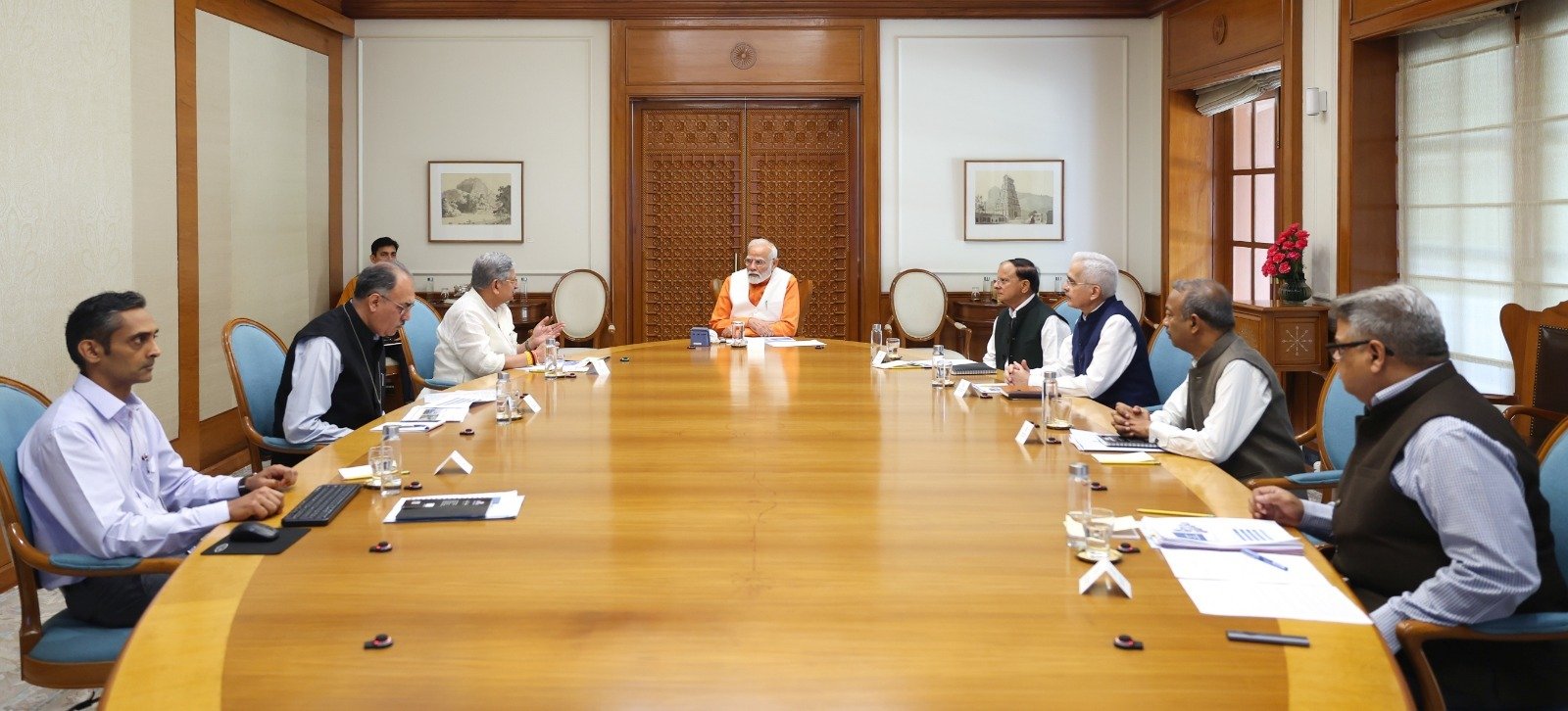
NEW DELHI : Prime Minister Shri Narendra Modi chaired a high-level meeting to review the progress of the fisheries sector, with focus on Fishing in the Exclusive Economic Zone(EEZ) and High Seas, at his residence at Lok Kalyan Marg on Thursday.

Prime Minister emphasized the extensive use of satellite technology to harness better use of fish resources and give safety instructions to fishermen.

Prime Minister stressed on modernization of the sector through smart harbours and markets, use of drones in transportation of the catch and its marketing. He said that there is a need to move toward a healthier system of functioning so as to add value in the supply chain.

Further, Prime Minister suggested exploration of the usage of drones, as per technical protocols, for transportation of fresh fish from production centres to big nearby markets in cities / towns in consultation with civil aviation.

Prime Minister underlined the need for improvements in processing and packaging of the produce. Facilitation of investments from the private sector was also discussed.

Regarding the use of technology, Prime Minister said that similar to agro tech in the agriculture sector, adoption of fish tech in the fisheries sector should be enhanced for improving the production, processing and marketing practices.

Prime Minister said that taking up fisheries production in Amrit Sarovars will not only improve the sustenance of these water bodies but also improve the livelihoods of the fishermen. He also highlighted that ornamental fisheries also needs to be promoted as an avenue for income generation.

Prime Minister said that a strategy should be worked out to serve the needs of landlocked areas where there is high demand for fish but not enough supply.

Prime Minister suggested that usage of seaweeds for fuel purposes, as nutritional inputs, in pharmaceuticals and other sectors should be explored. He said that all the departments concerned should work together and use technology to create the required outputs and outcomes in the seaweed sector, ensuring complete ownership.

Prime Minister also suggested undertaking capacity building of fishermen in modern fishing practices. He also suggested maintenance of a negative list of items that hinder the growth of the sector so that action plans can be made to overcome these and further enhance Ease of Doing Business and Ease of Living of the fishermen.

During the meeting, a presentation was also done on the progress made in important initiatives, compliances to the suggestions given during the last review, and the proposed enabling framework for sustainable harnessing of fisheries from the Indian Exclusive Economic Zone(EEZ) and High Seas.

Since 2015, Government of India has stepped-up investment to Rs. 38,572 crore through various GoI schemes and programs namely Blue Revolution Scheme, Fisheries and Aquaculture Infrastructure Development Fund (FIDF), Pradhan Mantri Matsya Sampada Yojana (PMMSY), Pradhan Mantri Matsya Samridhi Sah Yojana (PM-MKSSY) and Kisan Credit Card (KCC). India has registered an annual fish production of 195 lakh tons in 2024-25 with sectoral growth rate of more than 9%.

The meeting was attended by the Union Minister of Fisheries, Animal Husbandry and Dairying Shri Rajiv Ranjan Singh alias Lalan Singh, Principal Secretary to PM Dr. P.K. Mishra, Principal Secretary-2 to PM Shri Shaktikanta Das, Advisor to PM Shri Amit Khare, Secretary of the Department of Fisheries and senior officials.

India-EU join hands to find innovative research solutions to Marine Plastic Litter and Waste to Hydrogen

NEW DELHI : India and the European Union (EU) have launched two major research and innovation initiatives under the India-EU Trade and Technology Council (TTC). The TTC was established in 2022, by Indian Prime Minister, Shri Narendra Modi and European Commission President, Ursula von der Leyen to strengthen the bilateral partnership on trade and technology. With a joint investment of ₹391 crore (~ €41 million), the initiatives focus on two coordinated calls in the areas of Marine Plastic Litter (MPL) and Waste to Green Hydrogen (W2GH), co-funded by Horizon Europe—the EU’s research and innovation framework programme—and the Government of India.

“Collaborative research is the cornerstone of innovation. These initiatives will harness the strengths of both Indian and European researchers to develop solutions that address our shared environmental challenges.”, said Prof. Ajay Kumar Sood, Principal Scientific Adviser to the Government of India during the call launch.

Highlighting the increasing momentum of the EU-India collaboration, H.E. Mr. Hervé Delphin, EU Ambassador to India, remarked, “These research calls under the EU-India Trade and Technology Council demonstrate the dynamism of the EU India partnership, renewed by our leaders in Delhi last February. By tackling concrete issues like marine pollution and sustainable energy together, we’re driving innovation, circular economy and energy efficiency. Development of cutting-edge technologies in these areas makes both economic and environmental sense. We are committed to a cleaner, more sustainable future that will benefit both the EU and India.”

Dr. Parvinder Maini, Scientific Secretary, Office of the Principal Scientific Adviser to the Government of India noted “Undertaking collaborative efforts through the joint calls in areas like marine plastic pollution and waste to green hydrogen serves testament to our shared commitment for sustainable development”.

Mr. Marc Lemaître, Director-General, Directorate-General for Research and Innovation (RTD), European Commission highlighted the scale of investment being made- “Together the EU and India are putting forward €41 million for collaborative research. Our cooperation in two coordinated research calls into marine pollution and waste-to-renewable hydrogen shows our commitment to invest in a shared sustainable future.”

The first coordinated call focuses on combating marine pollution, particularly the pervasive issue of marine plastic litter. Despite global efforts, marine pollution continues to threaten biodiversity, disrupt ecosystems, and impact human health. This call, co-funded by the EU (€12 million/~₹115 crore) and India’s Ministry of Earth Sciences (₹90 crore/~€9.3 million), seeks innovative solutions to monitor, assess, and mitigate the cumulative impacts of various pollutants, including microplastics, heavy metals, and persistent organic pollutants. The resulting research will support international commitments such as the UN Decade of Ocean Science for Sustainable Development and contribute to the objectives of the EU’s Zero Pollution Action Plan and India’s National Marine Litter Policy.

Dr. M. Ravichandran, Secretary, Ministry of Earth Sciences, Government of India said that
“Marine pollution is a global concern that requires collective action. This joint call will enable us to develop advanced tools and strategies to protect our marine ecosystems.”​

The second coordinated Call addresses the urgent need for sustainable energy solutions through the development of waste-to-green hydrogen technologies. With the global push towards clean energy, converting biogenic waste into hydrogen presents a promising avenue. This joint call, supported by the EU (€10 million/~₹96 crore) and India’s Ministry of New and Renewable Energy (INR 90 crore/~€9.3 million), aims to develop efficient, cost-effective, and environment friendly methods for hydrogen production. The research will align with the EU’s Hydrogen Strategy and India’s National Green Hydrogen Mission, contributing to global efforts in reducing greenhouse gas emissions and promoting energy security.​

Mr. Santosh Kumar Sarangi, Secretary, Ministry of New and Renewable Energy, Government of India said that “Advancing waste-to-hydrogen technologies is crucial for our energy transition goals. This collaboration will accelerate the development of sustainable hydrogen production methods.”​

Call on Cumulative Impacts of Marine Pollution on Marine Organisms & Ecosystems

  • Total Budget: India/MoES INR 90 Crore | EU €12 million
  • Scope: Tackling marine pollution, its cumulative effects, and links to climate change.
  • Focus Areas: Developing tools to detect marine micro/nano plastic litter and pollutants, advance assessment of risks and ecotoxicological effects on marine life, evaluating bioaccumulation in the food chain and human health risks, innovative technology and solutions for the reduction and mitigation of the marine plastics from the source/entry points including the waste management and recycling.
  • Expected Outcomes: New analytical tools for pollution assessment, scientific insights for policy support, strengthened EU-India cooperation on marine litter.
  • Call Opened on: 6th May 2025
  • For more information: https://moes.gov.in/news-and-announcements

Call on Hydrogen from Biogenic Wastes

  • Total Budget: India/MNRE INR 90 Crore EU | €10 Million
  • Scope: Joint innovation for sustainable renewable hydrogen production from biogenic wastes (agriculture, forestry, municipal, sewage sludge, industrial).
  • Scope: Joint innovation for sustainable renewable hydrogen
  • Key Technologies: Advanced catalysts, process intensification, feedstock pre/post-treatment, and utilization of side streams via biological, electrochemical, and catalytic methods.
  • Goals: High carbon-to-hydrogen yield, lower GHG emissions (or negative footprint), reduced costs, and minimized environmental impact.
  • Expected Outcomes: Enhanced sustainability, safety, and affordability of hydrogen production, expanded technology portfolio, knowledge sharing, and strengthened EU-India cooperation.
  • Call Opened on: 15th May 2025
  • For more information: https://research.mnre.gov.in/

These initiatives aim to bring together researchers, startups, and industries from both India and the EU to develop sustainable, scalable solutions with global impact

Make India a global hub for eyewear manufacturing and exports: Piyush Goyal to Lenskart CEO

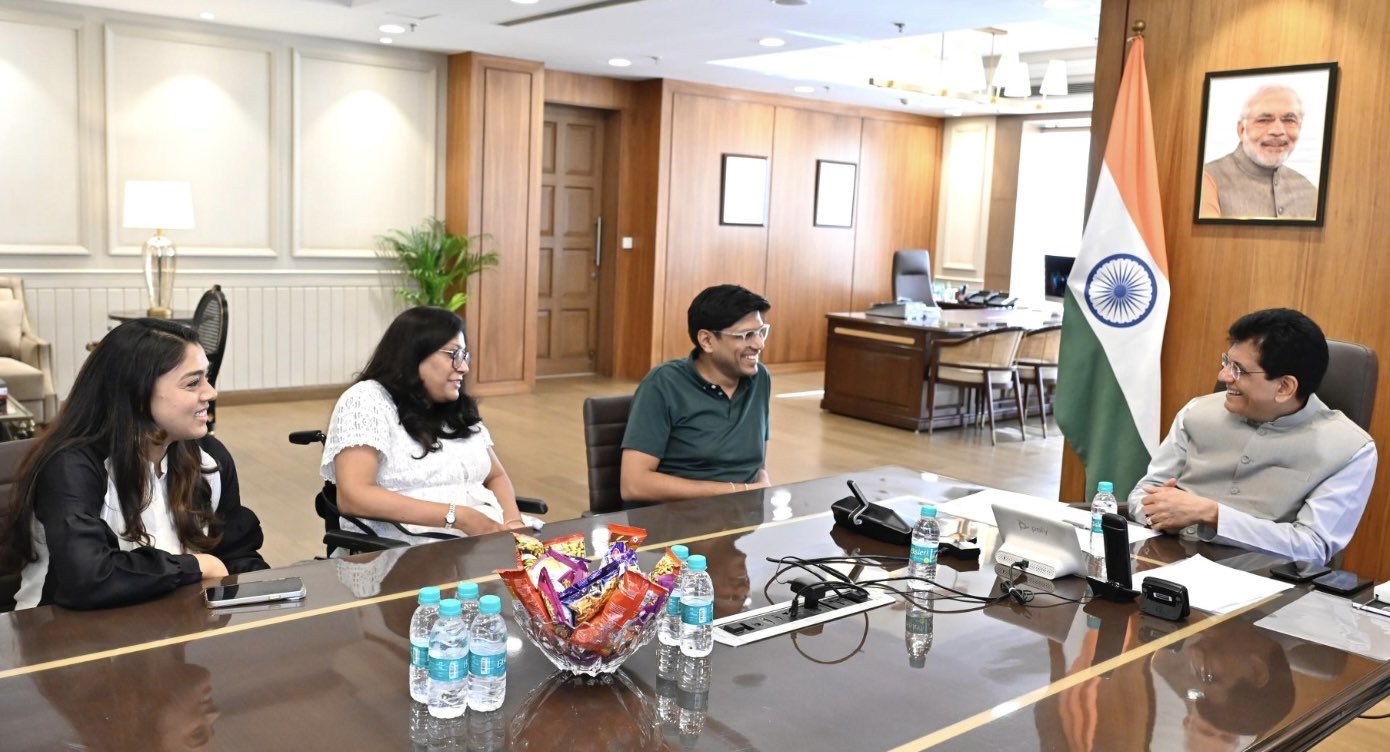
NEW DELHI : Union Commerce and Industry Minister Shri Piyush Goyal met Lenskart Co-founder and CEO Peyush Bansal to discuss the potential of making India a global hub for manufacturing and exporting eyewear.

The meeting focused on tapping into India’s growing capabilities in this sector and reducing the country’s dependence on imported eyewear products.

In a social media post the minister stated that he was pleased to see the steps Lenskart is taking to improve access to vision care across India. He also spoke about how Indian companies like Lenskart can play a key role in boosting exports and creating a strong global presence for Indian-made eyewear.

He said “Met Mr. Peyush Bansal, Co-founder & CEO of Lenskart, and discussed how India can become a global manufacturing & export hub for eyewear. I was pleased to learn about the company’s impactful social initiatives to expand access to vision care across the country”.

According to data from the Observatory of Economic Complexity, India’s share in global eyewear exports was only 0.39 per cent in 2023, placing the country at the 16th position out of 209.

In value terms, India exported eyewear worth USD 48.8 million in 2023, ranking 594 out of 1,212 products.

The United Kingdom was the top destination for Indian eyewear exports, receiving products worth USD 17.3 million. It was also the fastest-growing market for India, with exports increasing by USD 14.4 million from 2022 to 2023.

However, on the import side, India brought in eyewear worth USD 198 million in 2023, with China being the largest supplier at USD 171 million.

China is showing fastest growth by increasing its exports to India by USD 92.7 million between 2022 and 2023.

Further data from the World Integrated Trade Solutions (WITS) by the World Bank shows that India imported sunglasses worth USD 177,353.44K in 2023, with a total quantity of 193,266,000 items.

Most of these sunglasses came from China (USD 154,152.35K for 191,691,000 items), followed by Italy, the United States, Japan, and other Asian countries.

The Economic Complexity Index (ECI) for India stood at 0.65 in 2023, placing it 39th out of 132 countries. This index shows the diversity and complexity of a country’s export products.

With high imports and low global export share, the meeting between Piyush Goyal and Peyush Bansal highlighted the need for India to boost local manufacturing and aim to become a major exporter of eyewear in the world.

India’s total exports (Merchandise & Services) during April 2025

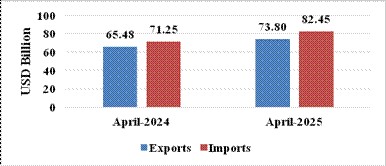
NEW DELHI : India’s total exports (Merchandise and Services combined) for April 2025* is estimated at US$ 73.80 Billion, registering a positive growth of 12.70 percent vis-à-vis April 2024. Total imports (Merchandise and Services combined) for April 2025* is estimated at US$ 82.45 Billion, registering a positive growth of 15.72 percent vis-à-vis April 2024.

Table 1: Trade during April 2025*

  April 2025(US$ Billion)April 2024(US$ Billion)
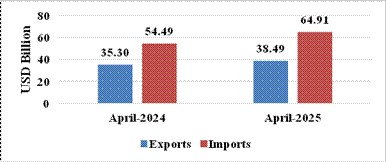
MerchandiseExports38.4935.30
Imports64.9154.49
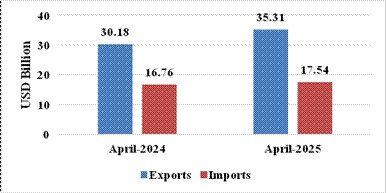
Services*Exports35.3130.18
Imports17.5416.76
Total Trade(Merchandise +Services) *Exports73.8065.48
Imports82.4571.25
Trade Balance-8.65-5.77

* Note: The latest data for services sector released by RBI is for March 2025. The data for April 2025 is an estimation, which will be revised based on RBI’s subsequent release.

Fig 1: Total Trade during April 2025*

15T70 India's total exports (Merchandise & Services) during April 2025

MERCHANDISE TRADE

  • Merchandise exports during April 2025 were US$ 38.49 Billion as compared to US$ 35.30 Billion in April 2024.
  • Merchandise imports during April 2025 were US$ 64.91 Billion as compared to US$ 54.49 Billion in April 2024.

Fig 2: Merchandise Trade during April 2025

2RG75 India's total exports (Merchandise & Services) during April 2025
  • Non-petroleum and non-gems & jewellery exports in April 2025 were US$ 28.61 Billion compared to US$ 26 Billion in April 2024.
  • Non-petroleum, non-gems & jewellery (gold, silver & precious metals) imports in April 2025 were US$ 39.27 Billion compared to US$ 33.26 Billion in April 2024.


Table 2: Trade excluding Petroleum and Gems & Jewellery during April 2025

 April 2025(US$ Billion)April 2024(US$ Billion)
Non- petroleum exports31.1128.26
Non- petroleum imports44.2037.99
Non-petroleum & Non-Gems & Jewellery exports28.6126.00
Non-petroleum & Non-Gems & Jewellery imports39.2733.26

Note: Gems & Jewellery Imports include Gold, Silver & Pearls, precious & Semi-precious stones

Fig 3: Trade excluding Petroleum and Gems & Jewellery during April 2025

3QPO7 India's total exports (Merchandise & Services) during April 2025

SERVICES TRADE

  • The estimated value of services export for April 2025* is US$ 35.31 Billion as compared to US$ 30.18 Billion in April 2024.
  • The estimated value of services imports for April 2025* is US$ 17.54 Billion as compared to US$ 16.76 Billion in April 2024.

Fig 4: Services Trade during April 2025*

4FPES India's total exports (Merchandise & Services) during April 2025
  • Exports of  Tobacco (66.43%), Coffee (47.85%), Electronic Goods (39.51%), Mica, Coal & Other Ores, Minerals Including Processed Minerals (34.43%), Fruits & Vegetables (30.72%), Marine Products (17.81%), Tea (15.93%), Meat, Dairy & Poultry Products (15.85%), Rmg Of All Textiles (14.43%), Rice (13.63%), Engineering Goods (11.28%), Gems & Jewellery (10.74%), Spices (8.38%), Cereal Preparations & Miscellaneous Processed Items (7.71%), Petroleum Products (4.68%), Jute Mfg. Including Floor Covering (4.58%), Plastic & Linoleum (4.58%), Man-Made Yarn/Fabs./Made-Ups Etc. (4.18%), Leather & Leather Products (3.91%), Carpet (3.32%), Drugs & Pharmaceuticals (2.37%), Cotton Yarn/Fabs./Made-Ups, Handloom Products Etc. (1.71%) and Ceramic Products & Glassware (0.23%) record positive growth during April 2025 over the corresponding month of last year.
  • Imports of Pulses (-23.5%), Newsprint (-14.4%), Coal, Coke & Briquettes, Etc. (-12.28%), Fruits & Vegetables (-8.97%), Vegetable Oil (-8.09%), Leather & Leather Products (-4.84%) and Transport Equipment (-3.18%) record negative growth during April 2025 over the corresponding month of last year.
  • Services exports is estimated to grow by 17.01 percent during April 2025* over April 2024.
  • Top 5 export destinations, in terms of change in value, exhibiting positive growth in April 2025 vis a vis April 2024 are U S A (27.31%), U Arab Emts (33.65%), Australia (74.16%), Tanzania Rep (87.2%) and Kenya (132.44%).
  • Top 5 import sources, in terms of change in value, exhibiting growth in April 2025 vis a vis April 2024 are U Arab Emts (88.97%), China P Rp (27.08%), U S A (63.76%), Russia (17.82%) and Ireland (425.65%).

DPA Kandla Shipyard cancels tender for Mega Shipbuilding Cluster after single bid

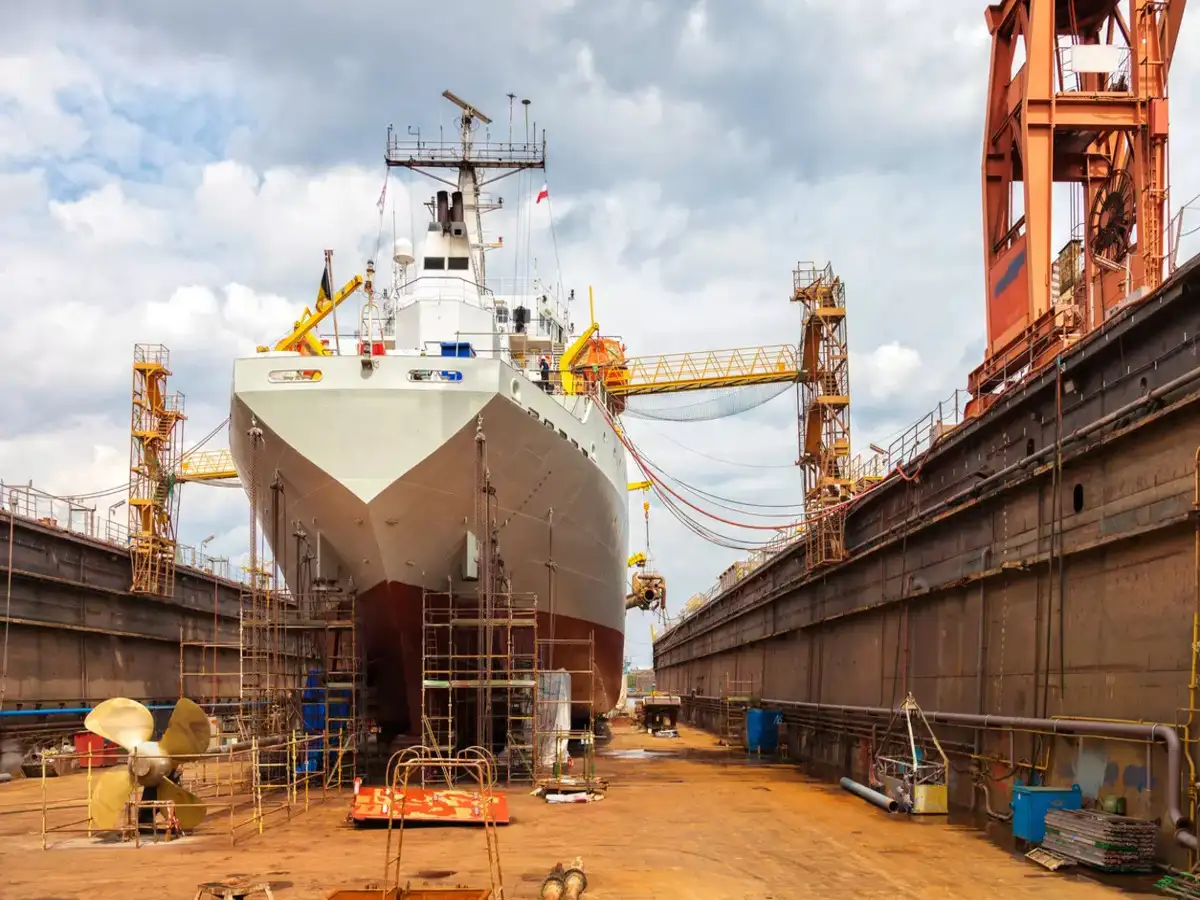
GANDHIDHAM : In a major setback to India’s ambitions of revitalising its shipbuilding industry, the Deendayal Port Authority (DPA) has scrapped a high-profile tender to develop an integrated shipbuilding cluster on 2,000 acres of land at Kandla, Gujarat. The decision was made after the tender attracted only a single bid from Pune-based Accurate Industrial Controls Pvt Ltd, backed by Korea Maritime Consultants Co., Ltd (KOMAC), a South Korean entity.

A person familiar with the matter confirmed that DPA did not proceed to open the price bid submitted by the Accurate-KOMAC joint venture, citing concerns over limited competition and the domestic partner’s credentials. “Deendayal Port Authority has discharged the tender; it did not open the price bid submitted by the Accurate Industrial Controls – KOMAC joint venture,” the source said.

The DPA plans to re-issue the tender with revised qualification norms, acknowledging that the stringent eligibility criteria may have discouraged broader participation. Originally, the tender required bidders to have independently — and not through joint ventures or consortia — designed, executed, and constructed a shipyard with Very Large Crude Carrier (VLCC) class shipbuilding capabilities.

The rigid terms were crafted with major South Korean shipbuilders in mind. However, South Korean companies, while interested in the Indian market, are generally reluctant to invest directly in greenfield shipyard projects. “They prefer to participate through joint ventures, not direct investment,” the person added.

During the pre-bid stage, some Indian companies expressed interest but sought relaxation in the qualification norms, pointing out their lack of direct experience with projects of this magnitude. While DPA eventually allowed consortiums and joint ventures to participate, it did not revise the core qualification clause, rendering the concession ineffective.

“Unless the qualification criteria explicitly state that experience can be through a joint venture or consortium, allowing such formations in the bidding process serves no purpose,” the person noted.

The port authority was also reportedly uneasy with awarding such a high-stakes project to a single bidder. “They weren’t comfortable with the capabilities of the Indian partner,” the source said, suggesting that the joint venture failed to meet the expectations required for a project of national importance.

This project is significant not only for Gujarat but for India’s broader maritime strategy. The shipbuilding cluster at Kandla was intended to be the country’s first greenfield shipyard in over 17 years. The last such development was Larsen & Toubro’s shipbuilding facility at Kattupalli, near Chennai, completed in 2008.

The project follows the central government’s recent policy push to revive the domestic shipbuilding sector. In the Union Budget presented on February 1, Finance Minister Nirmala Sitharaman unveiled a ₹25,000 crore Maritime Development Fund (MDF), a revamped shipbuilding financial assistance policy, and infrastructure status for large shipyards. Additional incentives included a 10-year extension on customs duty exemptions for shipbuilding and shipbreaking inputs.

Sitharaman emphasized the formation of shipbuilding clusters with upgraded infrastructure, skilled manpower, and new technology to bolster the sector’s ecosystem. The goal: to raise India’s global shipbuilding share from under 1% to rank among the top 10 by 2030 and top 5 by 2047.

As per the scrapped tender, DPA had set a provisional reserve price of ₹27,510 per acre per year for the land lease. Bidders were expected to quote a premium over this base rent. The lease was to run for a maximum of 30 years with no renewal option.

India’s long-term plans are aligned with global trends. Over 50,000 ships are projected to be built worldwide in the next three decades, many incorporating green technologies as the shipping industry pivots toward decarbonization.

The revised tender from DPA, which is expected to lower entry barriers for qualified joint ventures and consortia, may attract broader participation when reissued. However, experts say consistent and flexible policy support will be crucial if India is to become a competitive force in global shipbuilding.

India’s Warehousing Sector booms with 50% surge in Q1 2025 Leases

NEW DELHI : India’s warehousing sector is experiencing a strong revival, with leasing volumes jumping 50% year-on-year in the first quarter of 2025 to reach 16.7 million square feet. This sharp increase is driven by a revitalized manufacturing sector and a rebound in e-commerce activity, reflecting growing investor confidence in the country’s dynamic logistics landscape.

The manufacturing sector spearheaded the growth, accounting for 48% of total warehousing space leased between January and March 2025—nearly twice the share recorded during the same period last year. This surge highlights the positive effects of India’s industrial policies and shifting global supply chains.

E-commerce companies also significantly expanded their warehousing footprint, with leasing activity soaring by 151%. Although this growth came from a smaller base, it signals a strong push toward scaling distribution networks, supported by rising digital retail penetration and improvements in freight and storage infrastructure.

India’s logistics transformation is gaining momentum, driven by the China-plus-one strategy, the ‘Make in India’ initiative, and the implementation of the National Logistics Policy.

As infrastructure development accelerates and states promote sustainable logistics ecosystems, the warehousing sector is increasingly poised to support India’s shift toward smarter, more efficient urban centres. The outlook remains optimistic, with growing demand for last-mile, tech-enabled warehousing solutions across diverse sectors.

The third-party logistics (3PL) operators recorded a modest 12 per cent growth. Their share of overall transactions dropped to 23 per cent, indicating a trend towards in-house logistics operations by manufacturers and e-commerce firms aiming to cut costs and reduce delivery times.

Mumbai topped leasing activity with 27 per cent share, amounting to 4.4 million square feet. Pune, Chennai, and the National Capital Region (NCR) followed, each accounting for 16–17 per cent. Manufacturing companies drove demand in Pune and Chennai, while NCR remained a 3PL stronghold.

Among emerging hubs, Chennai and Hyderabad stood out, registering growth of 154 per cent and 137 per cent respectively. This shift signals a strategic decentralisation of warehousing clusters in line with infrastructure enhancements and proactive state-level policies.

A clear shift toward Grade A facilities was observed, accounting for 59% of total leasing activity. As companies aim to align with international standards, there is rising demand for energy-efficient, structurally advanced, and digitally integrated warehouses.