Home Blog Page 871

The CMA CGM Group accelerates its development in air freight in Europe with the acquisition of Air Belgium

  • Expansion of CMA CGM Group’s European air fleet through the integration of Air Belgium’s aircraft.
  • 124 jobs preserved, including 72 pilot positions, thanks to the acquisition of Air Belgium’s cargo operations.
  • Continuation of the Air Belgium brand, an iconic Belgian airline, which will maintain operations within the CMA CGM Group’s specialized air cargo division.
  • Long-term continuation of air freight activities in Belgium, developing solutions tailored to the needs of the Group’s customers.

MARSEILLE : The CMA CGM Group, a global player in sea, land, air and logistics solutions, today announces the transfer of assets from Air Belgium, following the approval by the Brabant Wallon Commercial Court of its binding offer for the takeover of Air Belgium’s cargo operations and the conclusion of the asset transfer agreement with the liquidator.

This operation ensures the preservation of the Air Belgium brand, employment, and the expertise of the Belgian teams while maintaining a robust air cargo network that addresses market demands. This move aligns with the CMA CGM Group’s strategy to offer European clients comprehensive and flexible logistics solutions amid global logistical challenges.

New sulphur emission limits enter into effect in the Mediterranean

LONDON : The Mediterranean Sea officially became an Emission Control Area (Med SOx ECA) under MARPOL Annex VI on 1 May 2025. The sulphur content in fuel oil for ships operating in the area is now limited to 0.1%, significantly reducing air pollution and delivering major benefits to both human health and the marine environment.

Ships operating in Emission Control Areas for Sulphur Oxides and Particulate Matter, such as the Mediterranean Sea, are now subject to strict mandatory measures to prevent, reduce, and control air pollution. This new ECA must comply with stricter sulphur content limits than those set by the global standard (0.10% mass by mass (m/m), compared with 0.50% m/m allowed outside SOx ECAs).

Decreasing SOx emissions from shipping improves human health by lowering rates of lung cancer, cardiovascular disease, strokes, and childhood asthma. The environment also benefits significantly, as reduced acidification helps protect crops, forests, and aquatic species. Finally, this measure is expected to reduce haze caused by ships, increasing visibility and decreasing the risk of maritime accidents.

The Mediterranean Sea is home to some of the busiest maritime routes in the world, supporting 20% of seaborne trade. It is estimated that more than 17% of worldwide cruises and 24% of the world fleet navigate the Mediterranean Sea.

The Med SOx ECA is the fifth designated Emission Control Area under MARPOL Annex VI, alongside the Baltic Sea area; the North Sea area; the North American area (covering designated coastal areas off the United States and Canada); and the United States Caribbean Sea ECA (around Puerto Rico and the United States Virgin Islands). In 2024, IMO designated two further ECAs: the Canadian Arctic and the Norwegian Sea. In April 2025, MEPC 83 approved a proposal to designate the North-East Atlantic as an Emission Control Area.

On 1 January 2020, new limits on sulphur content in fuel oil led to a 70% reduction in total sulphur oxide emissions from shipping by setting a maximum sulphur content of 0.5% outside the emission control areas.

Drewry: World Container Index Down 3% Last Week

LONDON : For many years, World Container Index has been the go-to, independent, global reference for index-linked contracts. If your organisation is considering index-linked contracts or requires regional visibility/coverage beyond the eight trade lanes provided below, or would like to learn more, please contact our team of ocean freight cost benchmarking and procurement specialists.

Drewry’s World Container Index decreased 3% to $2,091 per 40ft container this week.

Drewry’s detailed assessment for Thursday, 01 May 2025

  • The Drewry WCI composite index decreased 3% to $2,091 per 40ft container, 80% below the previous pandemic peak of $10,377 in September 2021. However, the index was 47% higher than the average $1,420 in 2019 (pre-pandemic).
  • The average YTD composite index closed at $2,811 per 40ft container, $82 lower than the 10-year average of $2,893 (inflated by the exceptional 2020-22 Covid period).
  • Freight rates from Shanghai to Rotterdam decreased 5% or $110 to $2,202 per 40ft container and those from Rotterdam to Shanghai and Shanghai to Genoa decreased 4% to $464 and $2,889 per 40ft container, respectively. Following the trend, rates from Shanghai to New York and Rotterdam to New York decreased 3% to $3,500 and $2,041 per 40ft container, respectively. Also, rates from Los Angeles to Shanghai decreased 2% or $16 to $689 per 40ft container and those from Shanghai to Los Angeles reduced 1% or $27 to $2,590 per 40ft container while rates from New York to Rotterdam increased 2% or $17 to $842 per 40ft container. Drewry expects rates to continue declining in the coming week due to uncertainty stemming from reciprocal tariffs.

Baltic Index posts Weekly Gain on Higher Capesize demand

LONDON : The Baltic Exchange’s Dry Bulk Sea Freight index, which measures shipping rates for vessels transporting dry bulk commodities, edged higher on Friday and posted a weekly rise due to higher demand for capesize vessels.

The main index, which monitors rates for capesize, panamax and supramax shipping vessels, added 10 points, or 0.8%, to 1,421. It was up 3.5% for the week.

The capesize index gained 36 points, or 1.8%, to 2,079. The index was up more than 10% this week.

Average daily earnings for capesize vessels, which typically transport 150,000-ton cargoes such as iron ore and coal, increased by $300 to $17,241.

Meanwhile, the panamax index fell six points to 1,368 and slipped 1.8% for the week.

Average daily earnings for panamax vessels, which usually carry 60,000-70,000 tons of coal or grain, was down $52 to $12,310.

Among smaller vessels, the supramax index shed one point to 955. The index fell 2.6% during the week.

Source: Reuters

PM to dedicate to the nation Vizhinjam International Deepwater Multipurpose Seaport

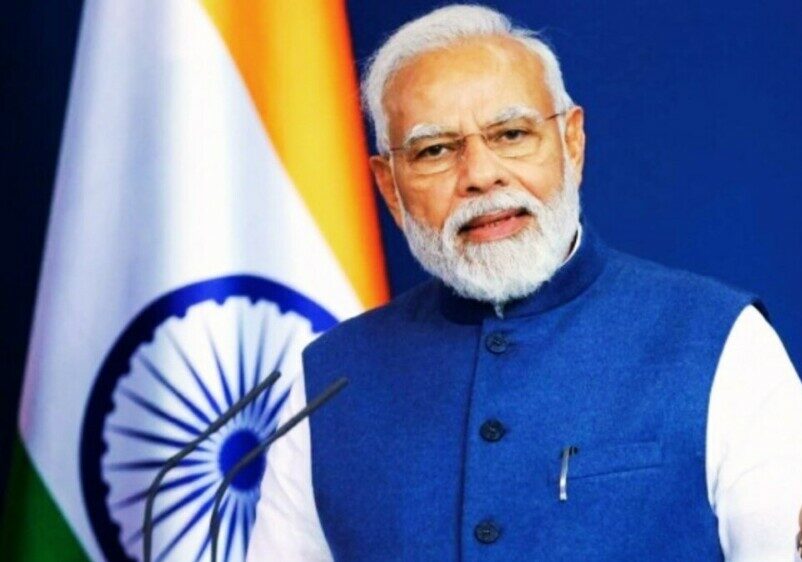
NEW DELHI : Prime Minister Shri Narendra Modi will visit Kerala and Andhra Pradesh on 2nd May, at around 10:30 AM, he will dedicate to the nation Vizhinjam International Deepwater Multipurpose Seaport. He will also address the gathering on the occasion.

Further, he will travel to Andhra Pradesh and at around 3:30 PM, he will lay the foundation stone, inaugurate and dedicate to the nation multiple development projects worth over Rs 58,000 crore in Amaravati. He will also address the public function.

PM in Kerala

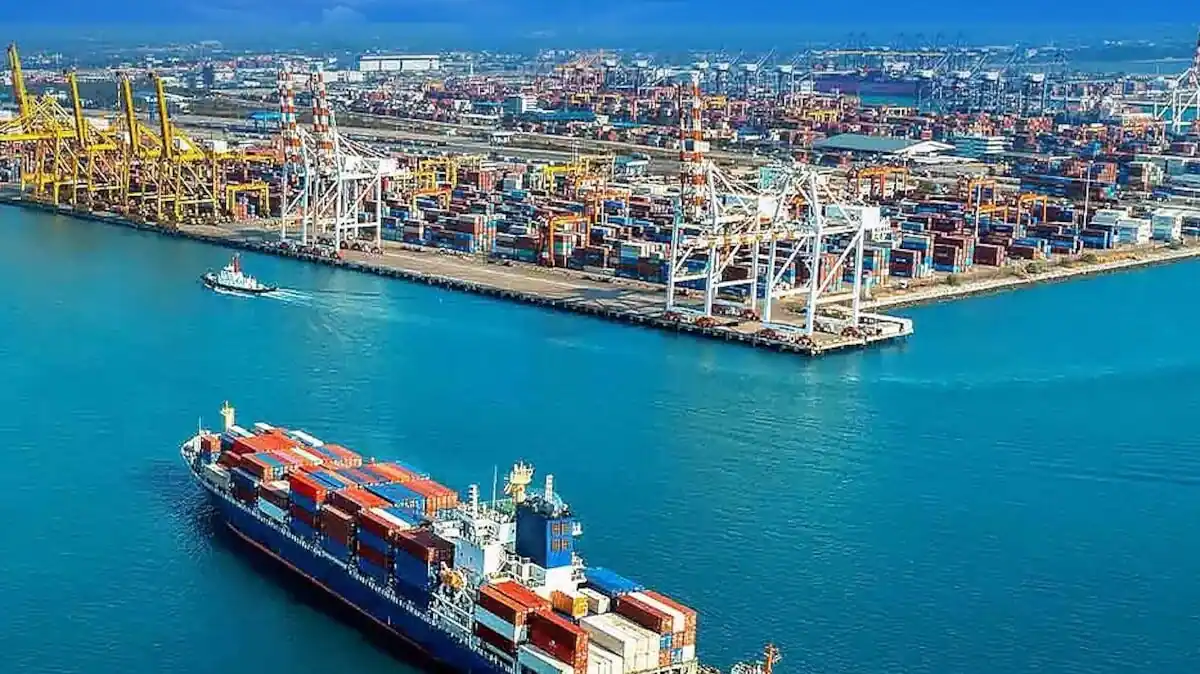
Prime Minister will dedicate to the nation Vizhinjam International Deepwater Multipurpose Seaport worth Rs 8,900 crore. It is country’s first dedicated container transshipment port that represents the transformative advancements being made in India’s maritime sector as part of the unified vision of Viksit Bharat.

Vizhinjam Port, having strategic importance, has been identified as a key priority project which will contribute in strengthening India’s position in global trade, enhance logistics efficiency, and reduce reliance on foreign ports for cargo transshipment. Its natural deep draft of nearly 20 meters and location near one of the world’s busiest sea trade routes further strengthens India’s position in global trade.

Prime Minister will lay the foundation stone of PM Ekta Mall at Madhurawada in Visakhapatnam. It has been envisioned with the objective of fostering national integration, supporting the Make in India initiative, promoting One District One Product, generating employment opportunities, empowering rural artisans, and enhancing the market presence of indigenous products

National Environmental Engineering Research Institute (NEERI) appointed for the Environmental Evaluation of Vadhvan Port Project

MUMBAI : Vadhvan Port Project Ltd. (VPPL), the 13th major port of India, in compliance with the Hon’ble Supreme Court of India’s Order dated 28.02.2025, has received approval from the Competent Authority for engagement of the National Environmental Engineering Research Institute (NEERI), Nagpur. NEERI will conduct an evaluation of the environmental impact of the Vadhvan Port project to assist the Hon’ble Supreme Court of India, as per the prescribed Terms of Reference.

(i) To study the reports of various lnstitution/Experts etc. conducted as part of Terms of Reference (TOR) given by Expert Appraisal Committee (EAC) and also as per the directions of Dahanu Taluka Environment Protection Authority (DTEPA) for grant of NOC for the Vadhvan Port and submit its observations/report on the issues/ contentions about environmental impact raised by Petitioners regarding the construction of the Port in light of the above studies

(ii) The Ministry of Environment, Forest and Climate Change (MOEF&CC) and Dahanu Taluka Environment Protection Authority (DTEPA) has set up monitoring body to oversee the Port Project. Are these arrangements sufficient to monitor environmental impact of project or something more required to be done?

Expressing his thoughts about this development in VPPL, Shri Unmesh Sharad Wagh, IRS, Chairman, JNPA and CMD, VPPL, stated, “At Vadhvan Port Project Ltd., we are committed to upholding the highest standards of environmental responsibility and transparency. The engagement of NEERI, as approved in compliance with the Hon’ble Supreme Court’s directive, marks a constructive step toward a thorough and independent assessment of the project’s environmental impact. We remain fully aligned with the due process and are confident that this evaluation will provide valuable guidance as we move forward.”

NEERI shall submit its report within 30 days from the date of issuance of this O.M. The report shall be submitted through the Secretary, Ministry of Ports, Shipping & Waterways to the Competent Authority. VPPL remains committed to following due process and working in line with all statutory requirements.

About VPPL:
Vadhvan Port Private Limited (VPPL) is the 13th major port of India, a special purpose vehicle (SPV) formed between Jawaharlal Nehru Port Authority (JNPA) and the Maharashtra Maritime Board (MMB). Strategically located in Palghar district, near Dahanu, Maharashtra, VPPL is poised to be among the top 10 ports globally. The foundation stone for the port was laid on August 30th, 2024, by the Hon’ble Prime Minister of India, Shri Narendra Modi.

Committed to sustainability, VPPL will be 100% green from inception, ensuring minimal environmental impact. The port is set to enhance trade efficiency with the capacity to handle 24 million TEUs, stimulate economic growth, and contribute to regional development. Through initiatives like the Vadhvan Port Skilling Program, VPPL focuses on empowering local communities.

German firm Trutzschler India opens its manufacturing plant at Sanand GIDC

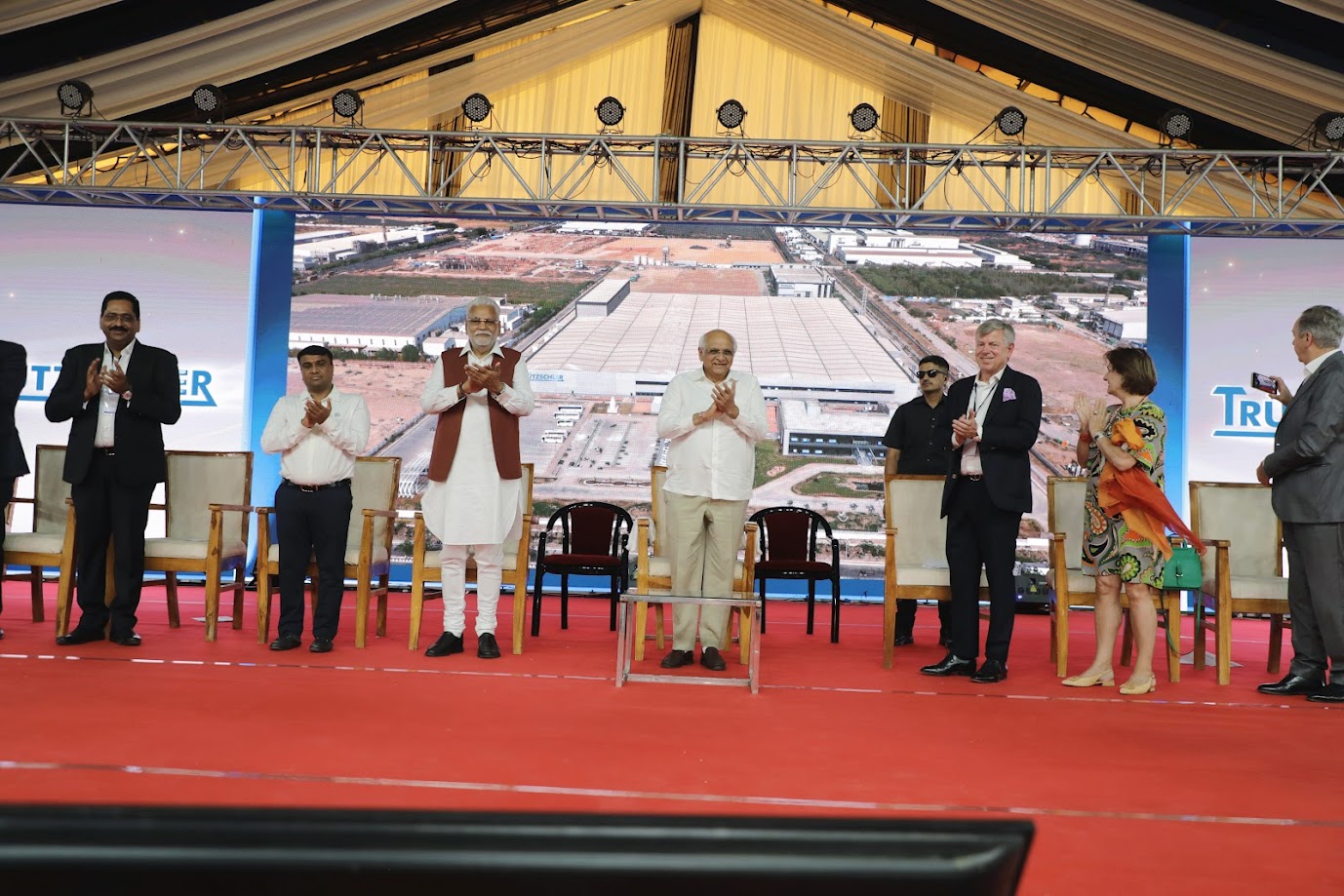
SANAND : Trutzschler India Private Limited’s new manufacturing plant in Sanand GIDC was inaugurated by the Chief Minister Shri Bhupendra Bhai Patel.

On this occasion, the promoter of the company Trutzschler said that company’s goal will be to provide quality products in the field of textile machinery manufacturing. The trust and confidence of Indian customers over the years has encouraged us to become a ‘dominant player’ in the Indian textile market and to start this new plant here.

On this occasion, the promoter of the company, Dr. Schurrenkramer, while delivering the inaugural address, spoke in detail about the company’s history from its inception to its business in India, its expansion and development. He expressed his gratitude to the state government for providing facilities quickly and for other cooperation.

The inauguration of the new plant of Trutzschler India Private Limited was attended by Trutzschler’s owners, promoters, CEOs, office bearers of Trutzschler India and Trutzschler Germany, company officials, employees etc.

Trützschler’s Indian subsidiary formerly known as “Trumac” was established in 1977 in Ahmedabad, India. In the initial years from 1981 to 1992, company activity was mainly concentrated on supplying blow room machines. In 1992 cards were added to the production program and in 2002 draw frames. It was in 2009 that a transition began with supply of Trützschler series of machines to the Indian market under the brand name of “ Trützschler”. These cutting-edge machines ensured that products and services were of the global level.

Today ”Trützschler India“ is not only the place where machines of international quality are produced, but also project planning, sales and nation-wide service are independently taken care. Trützschler India’s (TIPL) plant admeasuring 36000 sq. m. is upgraded with extensive investments in building, machines and processe in order to align itself with Trützschler’s “Global Production Strategy”. With the addition of new highly sophisticated machines like high speed laser cutting machines from Trumpf, CNC press brake Weinbrenner , CNC roll bending machine, machining center from Hueller Hille (MAG), turning center from Magdeburg and Monforts, turn-mill centers from DMG and Mazak and new powder coating plant from GEMA, the plant capacity has stepped up resulting into improved productivity. This helped us to follow the best manufacturing processes and operations, as practiced in Germany.

TIPL’s card clothing division is equipped with flat top pin setting machines, grinding cylinders and Profile wire line for rigid wire, to support ever increasing demand for TCC products from domestic and global markets.

TIPL also introduced ‘Lean Manufacturing’ and ‘5S’ concept. This improved material flow in the production, resulting higher productivity and lower wastage. These initiatives together with quality circle, daily reviews, involvement of people and cross functional interactions in the shop floor has been a real success at all levels. With ISO 9001:2008 certification under its belt, TIPL is confident to remain competent enough to shoulder future responsibilities.

TIPL is active in the Spinning preparation and Card clothing divisions, and also supports the Trützschler group’s Nonwovens activities in India.

Source :DeshGujarat

APSEZ beats quarterly profit view on higher cargo growth

AHMEDABAD : Adani Ports and Special Economic Zone reported fourth-quarter profit above estimates on Thursday, as growth in cargo volumes accelerated during a seasonally strong quarter for construction activity.

The country’s top private port operator reported a consolidated net profit of ₹3,014 crore ($356 million) for the quarter ended March 31, beating analysts’ average estimate of ₹2,571 crore, as per data compiled by LSEG.

Private port operators including Adani Ports and smaller rival JSW Infrastructure have benefitted from steady cargo movement across Indian borders, especially during the fourth quarter, which typically sees increased construction activity due to favourable weather.

Adani Ports’ cargo volumes rose 8 per cent to 118 million metric tonnes (MMT) in the reported quarter.

This drove revenue nearly 24 per cent higher to ₹8,488 crore, surpassing analysts’ estimate of a 16.5 per cent rise.

However, U.S. President Trump‘s erratic tariff policies have threatened to disrupt trade and pile additional risks on India’s slowing economy.

DG Shipping meets with Seven Islands Shipping Ltd to discuss shipping sector issues

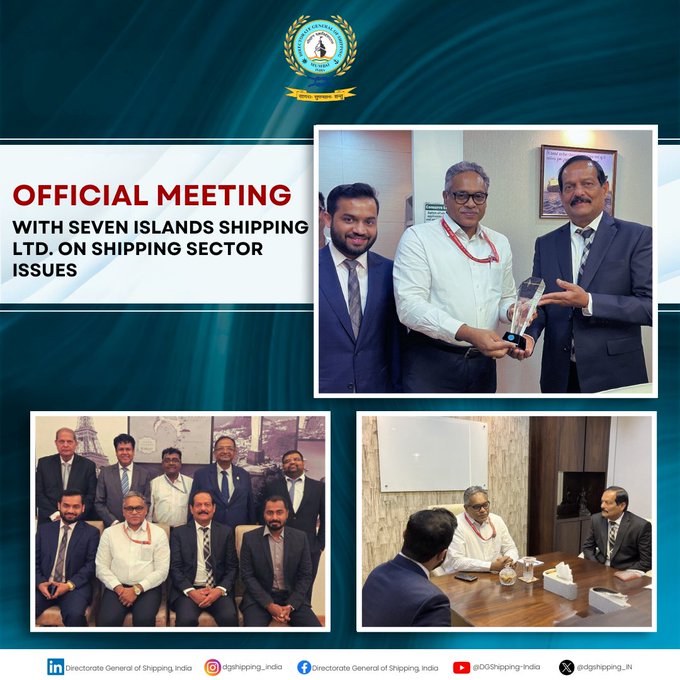
MUMBAI : Shri Shyam Jagannathan, IAS, Director General of Shipping, along with Shri Nebu Oommen, Deputy Director General (Technical), visited the office of M/s. Seven Islands Shipping Ltd. at Andheri, Mumbai.

A detailed deliberation was held with the top management on various operational and commercial disadvantages affecting the growth of Indian shipping. Key issues discussed included matters related to direct and indirect taxation, additional levies as per Customs notifications, and regulatory concerns pertaining to the Reserve Bank of India. Challenges faced by shipping companies during vessel importation, and during conversion from international to coastal operations and vice versa—particularly during regular runs and repair voyages—were also comprehensively discussed.

Commerical operations begins at MMLP in Nagpur

NEW DELHI : Under the PM Gati Shakti initiative of Hon’ble Prime Minister with the aim to provide seamless and efficient connectivity for the movement of people, goods and services across various modes of transport, thereby enhancing last-mile connectivity and reducing travel time, and under the guidance of Union Minister of Road Transport and Highways, Shri Nitin Gadkari, the Multi Modal Logistics Park Limited, Nagpur (MMLP Nagpur) at Sindi, near Wardha commenced its commercial operations with a goal to establish a faster link.

The MMLP Nagpur established by National Highway Logistics Management Limited (NHLML), a 100% owned company of National Highways Authority of India (NHAI) received its first rake of 123 Maruti Cars from Ex-Farukhnagar on 28th April marking a major achievement for the facility.

NHLML has signed an agreement with a private developer for the Multi Modal Logistics Park (MMLP) in an area of 150 acres in three phases under Public-Private Partnership model with Concession Period of 45 years, at an estimated cost of Rs.673 crore. Phase-I will be developed with an investment of Rs. 137 crore.

An Authority SPV, Maharashtra MMLP Pvt. Ltd., is formed between National Highways Logistics Management Limited (NHLML) and Jawaharlal Nehru Port Authority (JNPA). The Authority SPV has to provide land, external rail and road connectivity as well as water and power supply for development of MMLP.

The MMLP will provide facilities such as warehouses, cold storages, intermodal transfers, handling facilities for container terminals, bulk / break-bulk cargo terminals along with Value Added Services such as sorting / grading and aggregation / desegregation areas, bonded warehouse and customs facilities as well as support logistics facilities such as offices for freight forwarders and transporters and truck terminals.

Development of MMLP Nagpur will help improve country’s freight logistics sector by enabling efficient inter-modal freight movement to lower overall freight costs and time; providing efficient warehousing, improved tracking and traceability of consignments, thereby enhancing efficiency of the Indian logistics sector. It will further create employment opportunities and bring in economic development in the region.