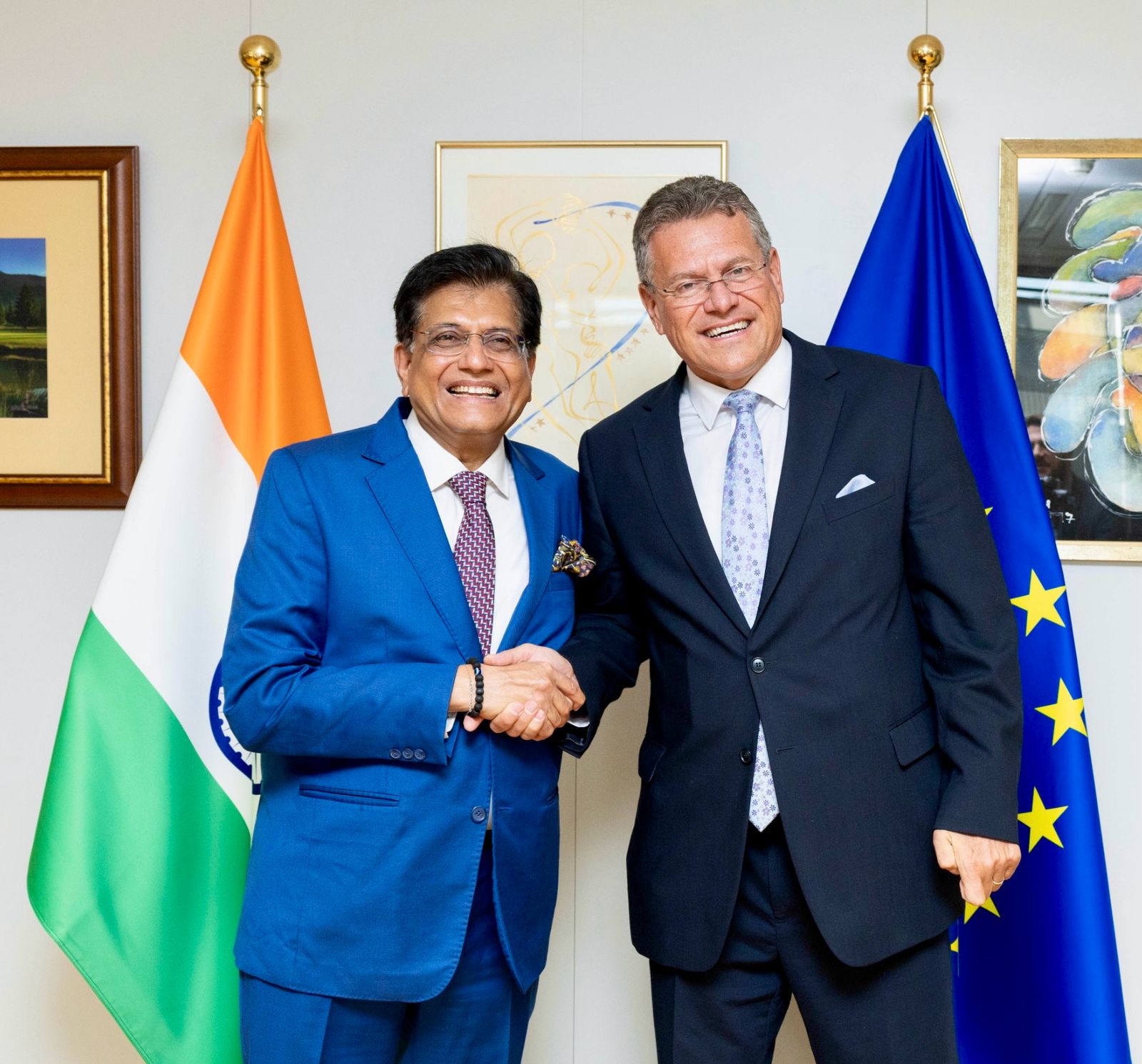
NEW DELHI : Shri Piyush Goyal, Minister of Commerce & Industry of India, and Mr. Maroš Šefčovič, European Commissioner for Trade and Economic Security, engaged in a forward-looking and substantive dialogue to address global trade challenges and reaffirm their shared resolve to conclude the India-European Union Free Trade Agreement (FTA) by the end of 2025. This commitment builds on the strategic direction given by Prime Minister, Shri Narendra Modi and President of the European Commission, Ms. Ursula von der Leyen during the landmark visit of the EU College of Commissioners to New Delhi in February 2025.
The high-level engagement underscores the strategic importance both partners attach to building a commercially meaningful, mutually beneficial, balanced, and a fair trade partnership that supports economic resilience and inclusive growth. The meeting highlighted the progress made across multiple negotiating tracks and emphasized the importance of maintaining the ongoing momentum through monthly negotiating rounds and continued virtual engagement. Both sides reiterated their aim to address pending issues in a spirit of mutual respect and pragmatism, including at the next round scheduled to be held from 12-16 May 2025 in New Delhi.
India emphasized that meaningful progress in trade negotiations requires equal focus on non-tariff barriers (NTBs) alongside tariff discussions and regulatory frameworks must be inclusive, proportionate, and avoid restricting trade.
The India-EU FTA aspires to reflect the evolving realities of global commerce by supporting digital transition, promoting diversified and resilient supply chains. Both sides expressed optimism that the agreement, once concluded, will serve as a transformative pillar of the broader India-EU strategic partnership, enhancing market access, supporting regulatory cooperation, and fostering innovation and competitiveness on both sides. Both sides acknowledged the crucial role of investment flows and people-to-people mobility in sustaining economic vitality.
In the spirit of India’s emergence as a “Vishwa Mitra”—a partner to the world—and aligning with its 2047 development goals, the India- EU FTA is seen as an instrument to promote diversified production networks and uphold fair trade principles. As India continues to broaden its footprint through multiple free trade deals, this dialogue reflects its broader vision of shaping a future-ready framework aligned with national priorities and global aspirations.
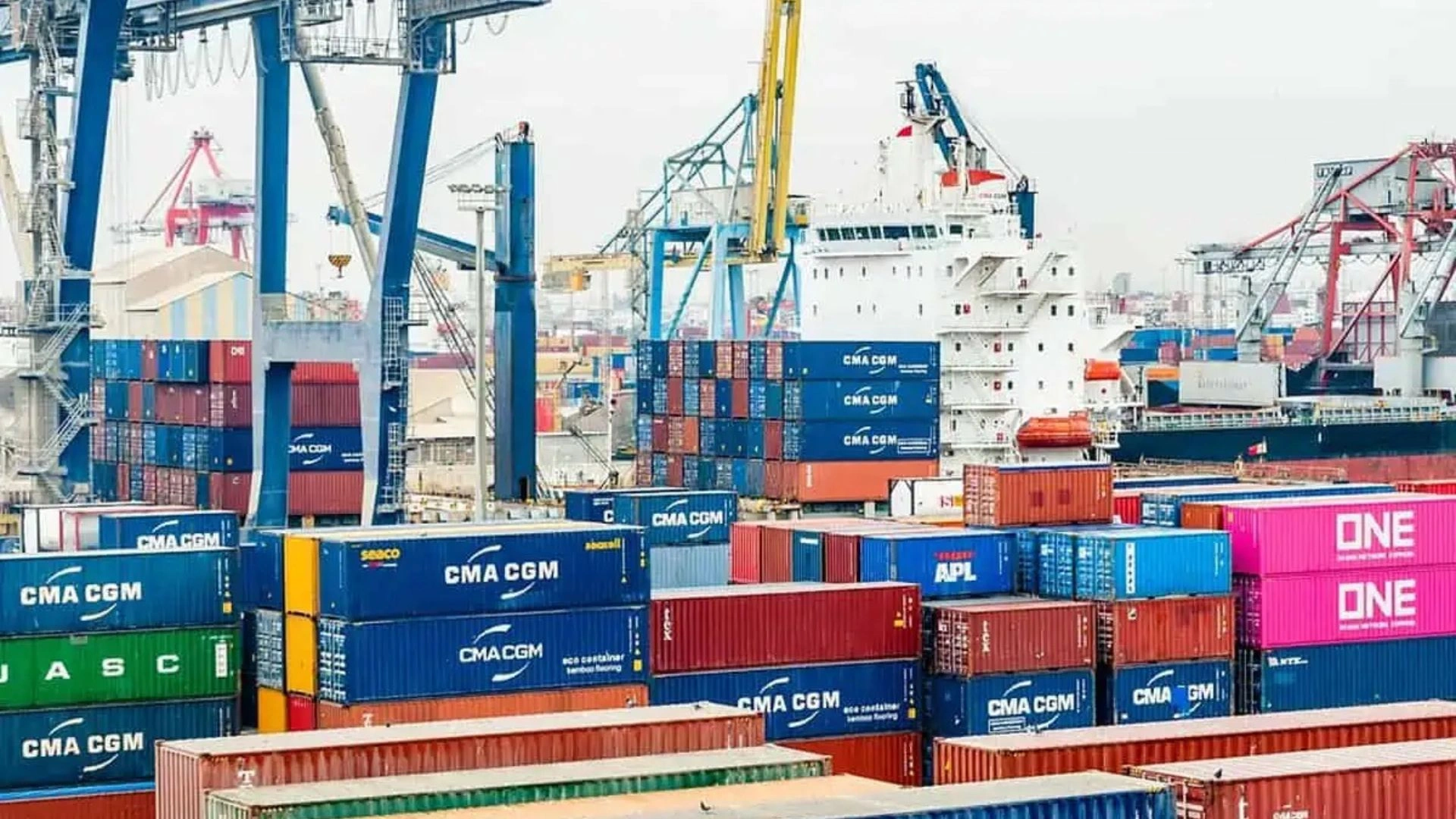
THIRUVANANTHAPURAM : Karan Adani, the Managing Director of Adani Ports and SEZ Ltd (APSEZ), on Friday said Kerala’s Vizhinjam Port is “much better equipped” and said it will “enable the growth” of the country.
The Vizhinjam International Seaport in Kerala – India’s first mega transshipment container terminal – was formally inaugurated by Prime Minister Shri Narendra Modi on Friday
It has been built by the APSEZ, the country’s biggest port developer and part of the Adani Group, in partnership with the government under a public-private model. The project cost around Rs 8,900 crore and received its commercial go-ahead in December last year after a successful trial phase.
Speaking to reporters after the inauguration event, Mr Adani thanked PM Modi and Kerala Chief Minister Pinarayi Vijayan for their support.
He also said the average cost of calling a ship to Vizhinjam Port would roughly be $40 per box.
“We have to be enablers of the growth in the country, and we do believe that whatever we are building today, it’s not enough. When we built this (port), everybody was questioning whether this would be filled up or not. Today, we are clocking almost 100 thousand moves every month,” he said.
Mr Adani said the APSEZ is targeting 90 per cent utilisation of the resources.
Speaking on the impact of tariffs imposed by US President Donald Trump, Mr Adani said that any disruption in trade routes “definitely impacts shipping lines and the movement of cargo”.
“In that way, some of the transhipment points actually benefit from disruptions because shipping lines will have to re-route some of the cargo. That is from a transhipment perspective. I think from a trade perspective, we are seeing that a lot of manufacturing is moving into India and the export boxes increasing from India to the US,” he added.
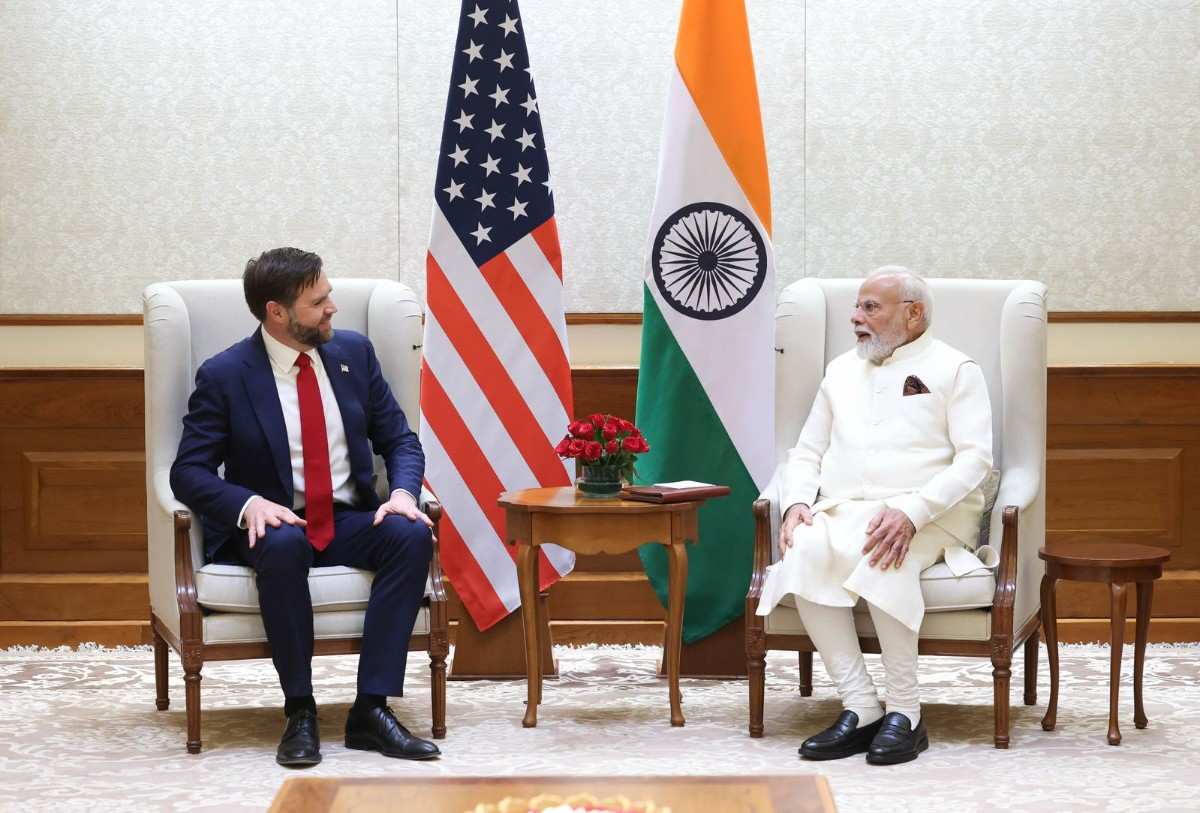
NEW DELHI : U.S. Vice-President J.D. Vance has called Prime Minister Shri Narendra Modi a “tough negotiator” and accused New Delhi of taking advantage of America, while predicting that India could be among the first countries to strike a trade deal to avert reciprocal tariffs.
In an interview with Fox News on Thursday (May 1, 2025), Mr. Vance said “good negotiations” were now on with India on tariffs.
India is among the countries negotiating with the U.S. to avoid the high import taxes, most of them on pause right now, announced by President Donald Trump.
“Modi, the Prime Minister, is a tough negotiator, but we’re going to rebalance that relationship, and that’s why the President’s doing what he’s doing,” Vance said during the interview. “Is India the first deal coming through?” Vance was asked in the interview on Fox News’s ‘Special Report’.
“I don’t know if it’ll be your first deal, I think it would be among the first deals for sure. Pretty soon the President look, we’ve got negotiations with Japan, with Korea, we’ve got negotiations going on with some folks in Europe, and obviously we’ve got a good negotiation going on in India,” Vance replied.
U.S. President Trump announced sweeping reciprocal tariffs on a number of countries, including India and China, on April 2. However, on April 9, he announced a 90-day suspension of these tariffs until July 9 this year, except for those on China and Hong Kong, as about 75 countries approached America for trade deals.
However, the 10% baseline tariff imposed on the countries on April 2 remains in effect, besides the 25% duties on steel, aluminium, and auto components.
“What the President has said is, we just want to rebalance trade. So some of the conversations I’ve had in India, for example, I think most Americans may not know, may not appreciate this, we have great agricultural products.”
“Our farmers are making great things, but the Indian market is effectively closed off to American farmers. So what that means is that it makes American farmers and American consumers more reliant on foreign competitors to grow the food that we eat.”
“What our India deal will do, fundamentally, I think, is open up India to American technology. It will open up India to American farmers. It will create more good American jobs. And it’s the kind of trade deal that Donald Trump loves.”
“He’s not anti-trade. He’s anti-unfair trade. He’s not entirely the kind of trade where foreign competitors take advantage of us, the Indians, let’s be honest, they’ve taken advantage of us for a very long time,” Mr. Vance said.
New Delhi and Washington are now holding negotiations to seal a bilateral trade agreement as agreed during PM Modi’s talks with Mr. Trump in Washington DC in February. The trade pact is expected to address a variety of issues, including tariffs and market access.
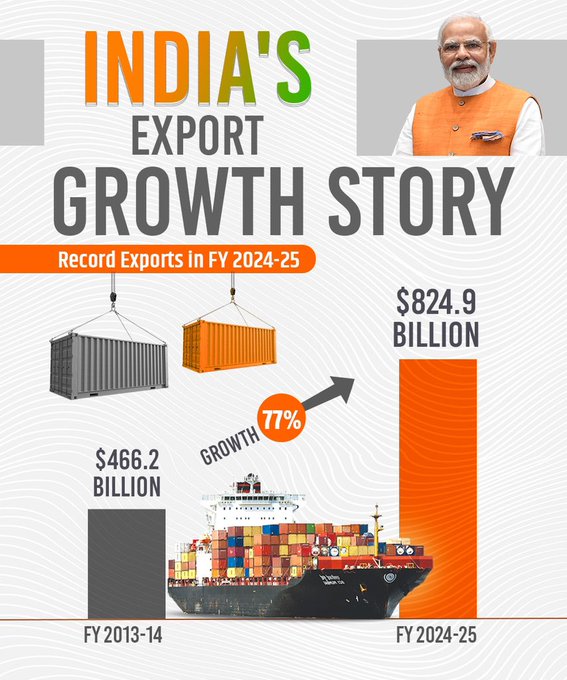
NEW DELHI : India’s total exports have touched an all-time high of US$824.9 billion in the financial year 2024–25, as per the latest data released by the Reserve Bank of India on services trade for March 2025. This marks a growth of 6.01% over the previous year’s export figure of US$778.1 billion, setting a new milestone in the country’s trade trajectory.
Services exports continued to drive the growth momentum, reaching a historic high of US$387.5 billion in 2024–25, up 13.6% from US$341.1 billion in the previous year. For March 2025, services exports stood at US$35.6 billion, reflecting a year-on-year growth of 18.6% compared to US$30.0 billion in March 2024.
In 2024–25, merchandise exports excluding petroleum products rose to a record US$374.1 billion, registering a 6.0% increase from US$352.9 billion in 2023–24 — the highest ever annual non-petroleum merchandise exports.
MUMBAI : Under the leadership of Shri Ashok Goyal, Team AITWA (All India Transport Welfare Association) had a constructive meeting with Shri KR Uday Bhaskar, Principal Chief Commissioner, Maharashtra, on Tuesday (29-04-2025) to discuss critical challenges faced by the transport and logistics sector.
Shri Bhaskar ji acknowledged the practical issues raised by AITWA and assured a thorough review, with a commitment to escalate discussions further.
Key Issues Addressed:
1) Reducing enroute interceptions and penalties – Minimizing unnecessary checks to curb corruption and reduce logistics costs.
2) Expanding the scope of Circular 64/2018 – Establishing clear SOPs to ensure Section 129 is not invoked indiscriminately.
3) Easing compliance burden for GTAs under RCM – Streamlining return filing to eliminate duplicacy and unnecessary compliance.
4) Clarifying ISD Rules for movable assets – Ensuring new regulations do not apply to trucks that operate nationwide.
Shri Bhaskar ji especially appreciated AITWA’s emphasis on technology-driven interventions, recognizing their potential to enhance efficiency and transparency in the sector. He also assured AITWA’s inclusion in upcoming trade-related discussions, where crucial industry concerns will be deliberated.
“AITWA remains committed to advocating for progressive policies and plans to extend similar dialogues across different states to reinforce industry engagement and minimize legal hurdles for genuine taxpayers”, said ShriAshok Goyal,National President, AITWA.
“We look forward to positive developments in the upcoming financial year as we continue to work toward a more efficient and transparent logistics ecosystem” said Shri Abhishek A Gupta, General Secretary AITWA.
BENGALURU : India’s manufacturing sector growth accelerated in April to its strongest pace in 10 months, powered by robust export demand and increased output despite companies raising selling prices at the fastest rate in over 11 years, a survey showed on Friday.
The HSBC India Manufacturing Purchasing Managers’ Index (PMI) (INPMI=ECI), opens new tab, compiled by S&P Global, inched up to 58.2 in April from 58.1 in March, a tad lower than a preliminary estimate of 58.4.
PMI readings above 50.0 indicate growth in activity, while those below that level point to a contraction. “The notable increase in new export orders in April may indicate a potential shift in production to India, as businesses adapt to the evolving trade landscape and U.S. tariff announcements,” said Pranjul Bhandari, Chief India Economist at HSBC.
Manufacturing output expanded at the sharpest rate since June 2024, with consumer goods makers registering the fastest increase among the surveyed sectors. New orders remained buoyant, with growth holding close to March’s eight-month high. Export orders grew at the second-fastest pace in over 14 years, behind only January’s surge. Survey respondents reported increased sales to clients across the world.
The hiring pace also accelerated from March, with both permanent and temporary contracts being offered. Meanwhile, healthy demand allowed manufacturers to hike their selling prices at the steepest pace since October 2013, passing on rising costs to customers. This aggressive pricing strategy occurred even as input cost inflation remained moderate. “Input prices increased slightly faster, but the impact on margins could be more than offset by the much-faster rise in output prices,” Bhandari added. Business confidence remained historically high, with over 30% of manufacturers forecasting higher output in the year ahead.
NEW DELHI : The United States (US) hasn’t yet budged to repeated requests to exempt India from steeper sectoral tariffs, especially on steel and aluminium in return for concessions New Delhi plans to provide through the proposed trade deal between them, a source privy to the development said.
“So far, they (US) have not agreed on sectoral tariffs coming down. Steel and aluminium, exports are getting impacted due to higher duties though automobile sector is not seeing an impact since India does not sell much auto to the US,” the source added.
Requests to exempt India from the 25-percent tariff on US imports, specifically on steel and aluminium was likely raised when India’s Department of Commerce and the US Trade Representative’s Office held extensive discussions between April 23 and April 25 in Washington.
India’s push to secure relief from steeper duties come at a time when additional duties imposed by the US on iron and steel and auto parts are set to hit the engineering exports sector. “There could be a potential annual drop of $4-5 billion in engineering shipments to the US as a consequence of it. Besides, we are going to face massive competition from China in other markets as they vehemently push their products there as they chase new regions to de-risk the US,” according to Pankaj Chadha, Chairman, EEPC India.
The US is also the number one destination for Indian engineering exports. Engineering goods exports to the US grew 8.7 percent to $19.15 billion in FY25 from $17.62 billion in FY24.
US President Donald Trump’s administration has levied a 25-percent sectoral tariff on steel, aluminium, automobiles and auto parts coming into America from all nations.
To be sure, on April 29, Trump softened tariffs on automobile parts by rolling certain measures, including reducing the amount companies with US factories will pay in import taxes on foreign parts.
While Trump, on April 9 paused the country-specific tariffs on all nations, barring China, including an additional 16 percent reciprocal levy on India, the baseline tariff of 10 percent and certain sectoral duties have started to spell trouble for Indian exporters.
Therefore, India is looking to garner relief from these sectoral duties while leveraging the mutual concessions on tariffs expected through the trade deal with US.
Commerce minister Piyush Goyal on April 25 said that India is seeking greater access for its steel through free trade agreements (FTA) with countries and blocs.
India and the US are looking to conclude negotiations for the first tranche of the proposed bilateral trade agreement (BTA) by autumn of 2025, after both nations signed the terms of reference for the pact, the commerce ministry said on April 15.
The BTA is part of a new goal – Mission 500 – aiming to more than double bilateral trade between the two countries to $500 billion by 2030.
NEW DELHI : Triton Logistics & Maritime is aiming to increase its turnover to ₹500 crore from the current ₹150 crore in the next two to three years, its CEO Jitendra Srivastava said on Friday.
“Triton is still in a very early stage. Right now, we’re touching around ₹150 crore in turnover. The aim is to scale this up to ₹500 crore in the next two to three years,” the CEO said.
The company which specialises in freight forwarding, logistics, and global supply chain management with end-to-end solutions plans to scale up its turnover by investing into a lot of services and solutions, he said.
“Our business plan is focused around two main pillars – geography and industry. On one hand, we are looking at which geographies we want to expand into, on the other hand, we are identifying industries where we can deliver tailored solutions,” he explained.
Apart from that, the company is putting a lot of effort into digitalisation and that’s a major area where Triton Logistics & Maritime is investing heavily.
“The goal is to stay close to the business and provide solutions that are driven by technology. That’s a very significant part of our growth strategy,” he said.
There are three to four industries where the company is strategically focused, the CEO said.
“Pharma and healthcare is one of them. Then we are also looking at automotive components and chemicals, both dangerous (DG) and non-dangerous (non-DG),” he said.
The logistics needs of every product and every industry is different, and the company is customising its solutions accordingly.
“The US is one of our strongest and most strategic markets…The Gulf is another strategic region for us,” he said. Triton Logistics & Maritime delivers expertise in end-to-end logistics and supply chain services.
In an era dominated by hashtags, viral videos, and boardroom theatrics, leadership has come to be perceived as a performance. Those who speak the loudest, post the most, or occupy the front row of media attention are often mistaken for the true leaders of our time. But underneath the noise, a quiet revolution is brewing—one that values steadiness over spectacle, substance over show, and service over self. This is the revolution of Silent Leadership.
Silent leadership isn’t about muteness or submission. It is about intentional presence. It is the art of leading not from the front of the stage, but from within the core of an organization. These leaders move not to impress, but to inspire; not to be seen, but to be felt.
Why Silent Leadership Now?
The past few years have been a test of every kind of leadership model. The COVID-19 pandemic, economic recessions, wars, inflation, political instability, and environmental collapse have shaken the foundations of traditional power structures. In these “black swan” events, performative leadership—flashy yet shallow—struggled to respond effectively. What people longed for was calm, clarity, and compassion.
It was in 2020, at the height of global uncertainty, that the idea of Consequential Intelligence emerged in parallel. This form of intelligence, which focuses on foresight, impact analysis, and ethical action, aligns perfectly with silent leadership. When decisions have massive ripple effects, it is not the impulsive voice but the thoughtful one that becomes consequential.
The Corporate Realm: Examples of Silent Leaders
One doesn’t need to look far to find real-world examples of silent leaders. Take Satya Nadella, CEO of Microsoft. When he took the reins in 2014, Microsoft was perceived as a tech behemoth on the decline. Nadella didn’t arrive with sweeping statements or dramatic purges. Instead, he listened. He encouraged empathy. He changed the culture from the inside out, placing more value on collaboration and emotional intelligence. Today, Microsoft is not just more profitable; it is more human.
Or consider Shantanu Narayen, CEO of Adobe. He has led one of the most successful transitions in the software world—from licensed software to a cloud-based subscription model. His leadership style? Focused, low-profile, and quiet. But the impact has been massive. Adobe’s market cap has skyrocketed, and its innovation pipeline remains robust, all under the steady hand of a leader who leads with focus, not flair.
In India, Ratan Tata is an icon of this brand of leadership. Never the loudest voice in the room, Tata has always let actions speak. His post-retirement philanthropic focus, his timely and ethical interventions in the Tata Group’s internal issues, and his humility in interacting with common citizens reveal a man whose strength lies not in rhetoric but in resonance.
The Individual Level: Silent Leadership in Action
Silent leadership is not restricted to CEOs. It exists across every level of an organization. A mid-level HR leader who defuses interpersonal tensions quietly behind the scenes, a frontline supervisor who always leads with empathy rather than authority, or a teacher who nurtures excellence in students without ever seeking credit—these are silent leaders, too.
Take the case of Meera, a plant operations manager in a diamond manufacturing unit. She never speaks loudly in team meetings, rarely challenges aggressively, but her unit records the highest quality metrics. Her secret? She spends time listening to her team members, removes blockers quietly, and coaches those struggling with emotional resilience. Her absence is more noted than her presence because her leadership is felt more than seen.
Another example is Rajiv, a procurement professional in a large auto-ancillary firm. He is known for his ethical conduct, transparency in vendor negotiations, and for always being available when things go wrong. He doesn’t claim successes, but when the COVID supply chain crisis hit, it was Rajiv who ensured that their plant remained operational. No interviews, no press releases—just calm competence.
Characteristics of Silent Leaders
So what defines a silent leader? It’s not the volume of their voice, but the values they embody:
Clarity Over Clamor: Silent leaders think deeply and communicate clearly, only when needed. They avoid noise for the sake of visibility.
Humility Over Hype: They don’t need constant validation. Recognition is a byproduct, not the goal.
Consistency Over Drama: They are predictable in the best way—stable in crisis, grounded in chaos.
Listening Over Broadcasting: They ask questions more than they give answers. They observe, absorb, and act.
Empathy Over Ego: Their leadership begins with understanding others. They don’t project power; they share it.
Impact Over Impressions: They focus on outcomes, not optics. They know legacy is built in actions, not announcements.
Silent Leadership and Consequential Intelligence
Silent leadership ties closely with the concept of Consequential Intelligence (CQ), which centers around the long-term impact of decisions. CQ is about seeing the chessboard, not just the next move. Silent leaders often exhibit high CQ because they are not reactionary. They pause. They reflect. They visualize consequences beyond profits—on people, purpose, and the planet.
A silent leader with high CQ might ask: “If we automate this process, what happens to the livelihoods of 500 workers?” Or: “If we relocate our plant, what does that mean for the ecosystem in that region?”
Such questions don’t make headlines, but they create history.
Why This Matters in 2025 and Beyond
As we look toward the future of leadership in a world grappling with AI disruption, climate urgency, rising inequality, and the search for purpose, we need leaders who can steer not just with vision, but with wisdom.
The age of hypervisibility has given us some lessons. Loud isn’t always effective. Charisma isn’t always character. Visibility isn’t always value. The leaders we need may not come trending on LinkedIn or delivering fiery keynote speeches. They may be the ones silently mentoring, building inclusive cultures, making ethical decisions, and preparing their teams for resilience.
They are not trying to go viral. They are trying to go vital.
Final Word: A New Paradigm
It is time we reframe our collective understanding of leadership. Let us begin to celebrate the leader who listens. The one who carries the emotional burden of their team without broadcasting it. The one who says “we” more than “I.” The one who doesn’t steal credit but generously shares it.
Because sometimes, the loudest leaders leave the softest footprints. And the silent ones leave the strongest legacies.
So here’s to the silent leaders. The calm anchors in the corporate storm. The stewards of ethics in a world obsessed with speed. The ones who change the world without changing their tone.
They are not just leaders of today. They are the leaders of consequence.
Author :
Dr Saamta Jain, Chief People Officer, Jewelex, Psychologist, Mumbai
DUBAI : Indian airline startup Air Kerala has taken another step to become a reality for its UAE-based investors. The carrier announced Friday it has received its International Air Transport Association (IATA) airline code. “The code we’ve been allocated is KD,” said Harish Kutty, CEO of the ultra-low-cost carrier. “The code ‘KD’ will be firmed up once we secure the air operator certificate (AOC),” Kutty added.
IATA airline designators, sometimes called IATA reservation codes, are two-character codes assigned by IATA to the world’s airlines. For example, Air India’s IATA code is AI and IndiGo’s is 6E. Airlines are usually allotted either two letters or a letter and a numerical code. “Getting a two-alphabet code is a privilege. We are very honoured with the allocation,” said Kutty.
For Dubai-based Air Kerala founder and Chairman Afi Ahmed, the ‘KD’ stands for ‘Kerala Dream’. “For non-Keralites, the KD has a multitude of meanings. It could stand for ‘Kerala to Dubai’ or ‘Kerala to Doha’. For us, this is another step towards making the Air Kerala dream come true,” said Ahmed.
Air Kerala expects to receive its AOC by the end of June. According to Ahmed, the airline has been receiving great interest and enquiries from prospective UAE and GCC non-resident Keralites (NRKs).
Headquarters, new aircraft The airline opened its headquarters in Kochi, Kerala, on April 15. The spacious office complex, spread across three floors and equipped with modern training facilities, is located near Aluva Metro station in Ernakulam.
The office was inaugurated by Kerala Minister of Industries P. Rajeev. Members of Parliament (MPs) Hibi Eden, Benny Behanan, and Haris Beeran, and Members of Legislative Assembly (MLAs) Anwar Sadath and Roji M. John were also present.
According to its owners, the airline is designed to accommodate over 200 aviation professionals working simultaneously. The airline has completed the recruitment of 69 employees. “By closer to launch, we will have 200 employees. We are targeting 1,000 employees by the end of the year, and we hope to have seven aircraft by then as well,” said Ahmed.
For now, essential staff, including pilots and cabin crew, have been recruited. They are undergoing training at the moment in India,” said Kutty.
The airline’s first flight will take off from Kochi International Airport, said Kutty. Airline owners are yet to confirm launch destinations.
Several new airlines are set to launch operations this year. Closer to home, PIF-funded Riyadh Air will launch operations later this year.