Home Blog Page 888

FM to visit USA and Peru to attend IMF-World Bank meeting, G20 FMCBG meeting besides bilateral meetings with many countries and organisations

NEW DELHI : Union Minister for Finance and Corporate Affairs Smt. Nirmala Sitharaman is on an official visit to USA and Peru beginning 20th April, 2025. During the visit to the USA, the Union Finance Minister will visit San Francisco and Washington D.C. from 20th to 25th April, 2025.

In the course of her two-day visit to San Francisco beginning 20th April 2025, the Union Finance Minister will deliver a keynote address at the Hoover Institution at the Stanford University, San Francisco, on ‘Laying the foundations of Viksit Bharat 2047’ followed by a fireside chat session.

Smt. Sitharaman will also interact with top CEOs from prominent fund management firms during a Roundtable meeting with investors, besides holding bilateral meetings with CEOs from top information technology (IT) firms based in San Francisco. Smt. Sitharaman will also participate in an event featuring Indian diaspora in San Francisco and interact with the Indian community settled there.

During her visit to Washington D.C., USA, from 22nd to 25th April 2025, Smt. Sitharaman will participate in the Spring Meetings of the International Monetary Fund (IMF) and the World Bank, the 2nd G20 Finance Ministers and Central Bank Governor (FMCBG) Meetings, Development Committee Plenary, IMFC Plenary, and Global Sovereign Debt Roundtable (GSDR) meeting.

On the sidelines of the Spring Meetings in Washington D.C., Smt. Sitharaman will hold bilateral meetings with her counterparts from several countries, including Argentina, Bahrain, Germany, France, Luxembourg, Saudi Arabia, United Kingdom, and USA; besides meeting EU Commissioner for Financial Services; President, Asian Development Bank (ADB); President, Asian Infrastructure Investment Bank (AIIB); United Nations Secretary-General’s Special Advocate for Financial Health (UNSGSA); and First Deputy Managing Director of the International Monetary Fund (IMF).

During her maiden visit to Peru from 26th to 30th April 2025, the Union Finance Minister will lead an Indian delegation of officials from the Ministry of Finance and business leaders, highlighting the strengthening bilateral economic and trade relations between the two nations.

Beginning her visit in Lima, Union Finance Minister Smt. Sitharaman is expected to call on the President of Peru, H.E. Ms. Dina Boluarte, and Prime Minister of Peru, H.E. Mr. Gustavo Adrianzén, besides holding bilateral meetings with the Peruvian Ministers of Finance and Economy; Defence; Energy and Mines; and also holding interaction with local public representatives.

In the course of her visit to Peru, the Union Finance Minister will chair the India-Peru Business Forum meeting with prominent business representatives in attendance from both India and Peru. Smt. Sitharaman will also hold an interaction with the Indian investors & businesses currently operating in Peru, as well as the Indian Business delegation visiting Peru.

Given Peru’s importance in the global supply chain of critical minerals and precious metals, discussions during these engagements are also expected to explore avenues for greater collaboration in the mining sector, particularly to strengthen India’s resource security and facilitate value-chain linkages between the two economies.

The Union Finance Minister will also participate in a community event at Lima, where she will interact with the Indian diaspora living in Peru.

India, UK talks for proposed pact moving towards final stages: Sources

NEW DELHI : The negotiations for the proposed free trade agreement between India and the UK are progressing towards the final stages, with both sides working to resolve remaining issues, sources said.

They said that a UK team was here to discuss issues in the bilateral investment treaty.

Finance Minister Smt. Nirmala Sitharaman on April 9 wrapped up the 13th Ministerial India-UK Economic and Financial Dialogue (EFD) with her British counterpart, Chancellor Rachel Reeves, on a note of positivity and eagerness to conclude the bilateral Free Trade Agreement (FTA) negotiations soon.

Sources indicated that now another full round of negotiations is unlikely as discussions are progressing at a faster pace.

On February 24, Commerce and Industry Shri Minister Piyush Goyal and UK Secretary of State for Business and Trade Jonathan Reynolds announced the resumption of negotiations for the proposed FTA between the two countries.

The negotiations resumed after a gap of over eight months. The talks were launched on January 13, 2022. So far, 14 rounds of talks have been completed.

The two countries are actively negotiating on three different fronts – FTA, a bilateral investment treaty (BIT), and a Double Contribution Convention Agreement.

In the BIT, the sticking point between the two nations is with regard to the resolution of disputes.

On the progress of negotiations for the proposed India, European Union (EU) free trade pact, one of the sources said that both are discussing for an early harvest agreement.

“In-principle they are agreed for that,” the source added. The 11th round of negotiations is scheduled from May 12-16 here. The two are looking to conclude the free trade agreement in phases amidst an uncertain global trade environment.

India has followed the practice of negotiating such trade pacts in two phases with Australia.

India to deepen defence and trade partnership with Saudi Arabia during PM Modi’s upcoming visit

NEW DELHI : India and Saudi Arabia are expected to strengthen their defence cooperation and expand their economic partnership, currently valued at nearly USD 43 billion during Prime Minister Shri Narendra Modi’s visit to the Kingdom on April 22 and 23, Foreign Secretary Vikram Misri said on Saturday.

Foreign Secretary Vikram Misri said that defence cooperation has grown rapidly in recent years, with joint exercises, training, and defence trade gaining momentum.

“The Defence Partnership has witnessed several firsts in the past few years. We had the first ever joint land forces exercise between the two countries in 2024. I think it’s called the ‘Sada Tanseeq’. Two editions have been held of joint naval exercises. We’ve had regular exchanges on training and capacity building and staff talks are taking place across all the three services,” he said.

According to the MEA, India is also emerging as a key defence supplier to Saudi Arabia. “Our cooperation has also expanded on the defence industry front. And India is gaining space as an important supplier of defence stores to Saudi Arabia. And a special agreement on the export of munitions to the Kingdom worth about USD 225 million was signed last year,” he added.

The two countries will also discuss deepening economic engagement during the visit. The value of bilateral trade in FY 2023-24 was close to USD 43 billion.

“The value of total trade between the two countries in FY 23-24 was nearly USD 43 billion. Saudi Arabia is India’s fifth-largest trading partner overall, and India is the Kingdom’s second-largest trading partner overall,” Misri said.

India’s imports from Saudi Arabia stood at USD 31.42 billion, while exports were valued at USD 11.56 billion. “Apart from trade, investment also continues to do well. And there are investments across different sectors such as energy, steel, chemicals, food sector, telecommunications and startups,” he added.

Energy will also be a key topic during the talks. “The value of the energy trade in FY 23- 24 was USD 25.7 billion. The Kingdom remains India’s third largest crude and petroleum sourcing destination… and also the third largest source of LPG for India, accounting for almost 18 per cent of the total LPG imports of India,” Misri said.

The visit will include the second summit-level meeting of the Strategic Partnership Council, which was established during Crown Prince Mohammed bin Salman’s visit to India in 2019. The council has two subcommittees, one focused on security and cultural relations, and the other on trade and investment.

“This is a visit at the invitation of His Royal Highness Prince Mohammed Bin Salman, Crown Prince and Prime Minister of the Kingdom of Saudi Arabia,” Misri said, adding that the two leaders share “a very close personal relationship with a lot of warmth and respect for each other.”

This will be PM Modi’s third visit to Saudi Arabia. He was earlier conferred with the Kingdom’s highest civilian honour, the “King Abdulaziz Sash”, during his 2016 visit.

India-US trade talks from April 23, Tariffs, Customs negotiations on agenda: Report

NEW DELHI : Indian and US officials will hold three-day talks from April 23 in Washington for a proposed trade pact with terms of references (ToRs) covering around 19 chapters, such as tariffs, non-tariff barriers, and customs facilitation, official sources said.

The Indian official team is visiting the US to give further impetus to the negotiations in the 90-day tariff pause window and discuss these ToRs to iron out differences on certain issues before formally launching talks for the bilateral trade agreement (BTA).

India’s chief negotiator, Additional Secretary in the Department of Commerce Mr. Rajesh Agrawal, will lead the team for the first in-person talks between the two countries. Agrawal was appointed as the next commerce secretary on April 18. He will assume office from October 1.

“Both sides will discuss the level of ambition. The ToRs will be further developed and discussed. What will be the pathway for talks? The ToRs will include issues like tariffs, non-tariff barriers, rules of origin, goods, services, custom facilitation and regulatory issues,” the official said, adding general contours of the pact will be discussed, besides scheduling, so that things can be finalised in 90 days.

The three-day deliberations assume significance, as a senior government official had recently stated that an interim trade agreement between the two countries could be finalised in the 90-day tariff pause announced by the Trump administration if it is a “win-win” for both sides.

In international trade parlance, the level of ambition refers to the extent to which two countries are willing to commit to specific trade liberalisation measures.

The visit also follows senior official-level talks held between the two countries last month here.

Brendan Lynch, the Assistant US Trade Representative for South and Central Asia, was in India from March 25 to 29 for crucial trade discussions with Indian officials.

The two sides are keen to utilise the 90-day tariff pause, announced by US President Donald Trump on April 9, to push the talks.

On April 15, Commerce Secretary Shri Sunil Barthwal had stated that India will try to close the negotiations as quickly as possible with the US.

India and the US have been engaged in negotiating a bilateral trade agreement since March. Both sides have targeted to conclude the first phase of the pact by the fall (September-October) of this year, with an aim to more than double the bilateral trade to USD 500 billion by 2030, from about USD 191 billion, currently.

In a trade pact, two countries either significantly reduce or eliminate customs duties on the maximum number of goods traded between them. They also ease norms to promote trade in services and boost investments.

While the US is looking at duty concessions in sectors like certain industrial goods, automobiles (electric vehicles particularly), wines, petrochemical products, dairy, and agriculture items such as apples, tree nuts, and alfalfa hay; India may look at duty cuts for labour-intensive sectors like apparels, textiles, gems and jewellery, leather, plastics, chemicals, oil seeds, shrimp, and horticulture products.

From 2021-22 to 2024-25, the US was India’s largest trading partner.

In the last fiscal, India’s exports to the US rose by 11.6 per cent to USD 86.51 billion as against USD 77.52 billion in 2023-24. The imports were up by 7.44 per cent in 2024-25 to USD 45.33 billion against USD 42.2 billion in 2023-24. With America, India had a trade surplus (the difference between imports and exports) of USD 41.18 billion in goods in 2024-25.

America accounted for nearly 19.78 of India’s total exports and 6.29 per cent of the total imports.

To address the gap and boost manufacturing, the Trump administration announced sweeping tariffs on April 2, including 26 per cent on India. It was later suspended for 90-day till July 9.

In 2024, India’s main exports to the US included drug formulations and biologicals (USD 8.1 billion), telecom instruments (USD 6.5 billion), precious and semi-precious stones (USD 5.3 billion), petroleum products (USD 4.1 billion), gold and other precious metal jewellery (USD 3.2 billion), ready-made garments of cotton, including accessories (USD 2.8 billion), and products of iron and steel (USD 2.7 billion).

Imports included crude oil (USD 4.5 billion), petroleum products (USD 3.6 billion), coal, coke (USD 3.4 billion), cut and polished diamonds (USD 2.6 billion), electric machinery (USD 1.4 billion), aircraft, spacecraft and parts (USD 1.3 billion), and gold (USD 1.3 billion).

Last leg of WDFC in Maharashtra paves way for direct freight rail link from Delhi-NCR to Jawaharlal Nehru Port

MUMBAI : India’s biggest freight infrastructure project is nearing completion with a major milestone achieved in Maharashtra. The Dedicated Freight Corridor Corporation of India Ltd (DFCCIL) has achieved the breakthrough on the Kundevahal Tunnel in Panvel, opening the way for the final 102.90 km Vaitarna-Jawaharlal Nehru Port Trust (JNPT) section of the Western Dedicated Freight Corridor (WDFC).

This tunnel marks the completion of all major tunnel work on the WDFC, which is 1,504 km long from Dadri in Uttar Pradesh to JNPT in Navi Mumbai. The last segment goes through Palghar, Thane, and Raigad districts and is crucial to link India’s busiest container port with the industrial corridor.

“The Kundevahal breakthrough is not merely symbolic; it removes a major bottleneck and allows the final stretch to move ahead unhindered.We are well on track to complete the Vaitarna–JNPT corridor by December 2025,” a DFCCIL official said.

The final stretch involves 81.47 km of alignment alongside Indian Railways’ existing route and 21.42 km of diversion alignment. Construction had been delayed due to high-density urbanisation and environmental issues in the Mumbai Metropolitan Region, but progress has now been made on a large scale. Approximately 225 hectares of land were procured at Rs 2,600 crore, and almost 2,960 project-affected families were resettled.

DFCCIL has built over 15 km of elevated rail tracks to ensure environmental protection not to disturb mangrove areas. Rail flyovers are being undertaken at Kalamboli, Kopar, and Kharbao to speed up movement and improve connectivity.

Efforts are also in place to remove 20 level crossings for improved efficiency and safety, with 13 already eliminated. Eight road underbridges (RUBs) and five road overbridges (ROBs) have been constructed, while one RUB and five more ROBs are ongoing.

After it is finished, the freight corridor will avoid traffic-congested passenger routes. “A double-stack freight train from Dadri to JNPT will now take less than 50 hours, as against more than 75 hours on traditional lines,” the official said.

The WDFC and the Eastern DFC are part of a nationwide logistics overhaul worth Rs 1.24 lakh crore. These corridors are backed by international lenders such as JICA and the World Bank, and they are expected to enhance India’s freight capacity while lowering logistics costs.

DFCCIL managing director Praveen Kumar said ,”9 per cent financial rate of return on the corridors is impressive. They also have indirect advantages like less emission, reduced accidents, and timely delivery of goods.”

As freight traffic will continue to cross-subsidise passenger movement on Indian Railways, DFCs are crucial to free up congested tracks. Indian Railways’ target to handle 3,000 million tonnes annually by 2027 depends on such high-capacity corridors.

The corridors will also facilitate the growth of industrial areas, multimodal terminals, and inland waterway connections under the Gati Shakti scheme. With DFC operations, 480 more freight trains can be handled, and carbon emissions are expected to decrease by 457 million tonnes in 30 years.

The other major advantage of the DFC is that it will help build industrial clusters and connect freight networks with inland waterways at JNPT.

“With the new corridor, we can now transport 360 containers simultaneously instead of 90, reducing haulage costs by half. This is the first direct connection between Delhi-NCR and JNPT, and logistics will become much more competitive,” said Unmesh Wagh, Chairman, JNPT.

Mumbai and Maharashtra will gain significantly. The Vaitarna-JNPT corridor will take the pressure off Mumbai suburban and mainline rail networks and enable hassle-free access to JNPT, turbocharging cargo movement.

With the last mile falling into place, the Western DFC will redefine freight transport in India—faster, greener, and more efficient—with Mumbai at the centre of this revolutionary change.

Source : Indian Express

Visakhapatnam Port will soon have a state of the art Unified Command Control Centre: VPA Chairperson

HYDERABAD : Visakhapatnam Port Authority (VPA) is setting up a state of the art Unified Command Control Centre (UCCC) as a centralised hub to coordinate the entire port ecosystem with next generation technologies including artificial intelligence (AI).

“The UCCC will be a future-ready infrastructure and will be a a single interface for customs, shipping lines, rail authorities, and other port-users to streamline coordination and reduce administrative overhead. It will be scalable, readily adaptable to additional sensors, advanced analytics modules, or new data platforms that VPA may adopt,’‘ Mr. Madhaiyaan Angamuthu, Chairperson, VPA told businessline. 

The VPA is working with National Institute For Smart Governance (NSIG) for the upcoming Centre which will be fully ready in the next six months.

The UCCC will help to reduce the operational downtime in the port through predictive insights, that can result in pre-empting of equipment failures and traffic bottlenecks in the port. There will also be enhanced compliance and safety by combining drone surveillance, multispectral imaging, and IoT sensors,’‘ the VPA Chair said. 

KEY COMPONENTS

The key components of UCCC will be multispectral cameras. With AI/ML edge computing capabilities will they will monitor road-rail crossings, cargo yards, and terminals. Drone feeds will augment this coverage, particularly for larger or hard-to-reach areas. 

For IoT sensor sensor data from berth equipment (mooring hooks, cranes, front-end loaders) will be fed into predictive maintenance models, reducing downtime and repair costs.

“The UCCC will interface with the POS application for shipping and cargo operations, National Logistics Portal (NLP) -Marine for stakeholder coordination, and ULIP portal for container tracking. This integrated view delivers immediate insights into port-wide performance metrics, according to the VPA Chair . 

For enhanced safety, a specialised module within the UCCC will handle emergency alerts, providing step-by-step escalation procedures for events like road accidents, rail derailments, or environmental hazards. “Automatic notifications can be triggered to relevant departments and external agencies that will hasten response,’‘ he said.

VPA’s ongoing AI/ML-driven land management platform will feed into the UCCC for lease monitoring, rent collection tracking, and detection of unauthorised land usage.

VPA’s journey toward a smart, transparent, and future-ready port is illustrated through its seamless ERP integration, adoption of NLP-Marine, and real-time management platforms like the Electronic Measurement Book (eMB). The Unified Command Control Centre represents the next logical step for us,’‘ Mr. Angamuthu said.

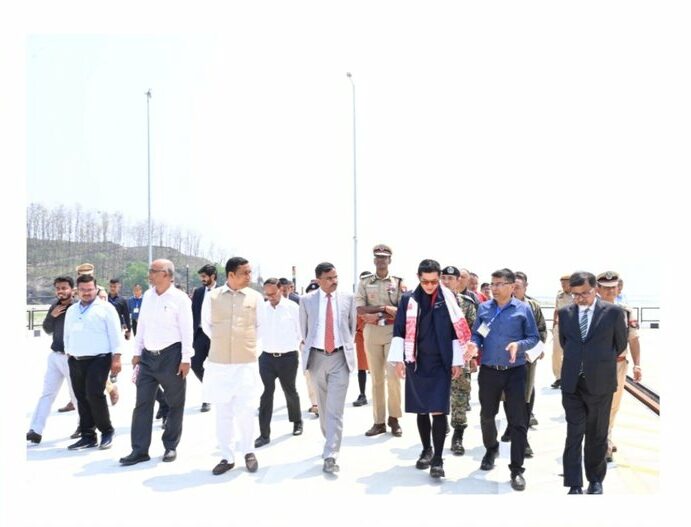
Bhutan King visits India’s First International Multimodal Logistics Park in Assam

BONGAIGAON : King Jigme Khesar Namgyel Wangchuk of Bhutan arrived at Jogighopa in Assam’s Bongaigaon district to inspect India’s inaugural International Multimodal Logistics Park (MMLP) on the last Saturday (19th April). The King traveled by royal helicopter, landing directly at the MMLP, where he was welcomed by Assam’s Minister for Public Health and Engineering, Jayanta Malla Baruah.

In an X post, Baruah stated his pride in hosting the King, adding that the visit was in accordance with instructions from Chief Minister Shri Himanta Biswa Sarma. The MMLP, which is now almost complete under the Bharatmala Project, is meant to connect different modes of transport, such as road, rail, air, and waterways.

The King during his visit also visited the Inland Water Transport (IWT) project under development on the Brahmaputra River. Baruah highlighted the importance of the MMLP, which covers 317 acres of land along the riverbanks, saying it would increase trade possibilities with neighboring nations like Bhutan and Bangladesh.

The minister also pointed to the strategic value of Bhutan’s Gelephu Mindfulness City, which is seen to complement the success of the MMLP.  In light of the royal visit, Security arrangements were tightened around and within the logistics park, with local police and Bhutanese security deployed for safety measures.

Commerce Dept pushing to expedite export promotion mission amidst global uncertainty

NEW DELHI : To lend support to exporters as they face greater global uncertainty, the Commerce Department is trying to expedite Expenditure Finance Committee (EFC) clearance for the export promotion mission announced in Budget 2025 with an annual allocation of ₹2,240 crore.

The mission will include a number of schemes, such as interest equalisation and market promotion funds for exporters, especially taking care of the needs of the MSME sector, sources said.

“The Commerce Department is seeking a term of five years for the exports promotion mission as continuity in the schemes announced under the mission will provide stability to exporters in the uncertain global environment. Now it is for the EFC to decide what the term of the scheme will be,” an official tracking the matter told businessline.

APEDA facilitates First Commercial Sea shipment of Indian pomegranates from Maharashtra to USA

MUMBAI : In a historic initiative towards introducing Indian Pomegranates to distant markets, a landmark commercial sea shipment of the prized Indian Bhagwa variety of Pomegranate has successfully arrived in New York, marking a significant milestone for India’s Fresh Fruits exports. With growing international demand for premium quality of Fresh Fruits, the arrival of this shipment heralds the potential of Indian Pomegranates becoming a preferred choice in the competitive U.S. market.

The Pomegranate season, which traditionally saw air freight as the primary mode of transportation, shifted gears in recent weeks to embrace the cost-effective and sustainable sea freight mode.

After India had been granted market access by USA for Pomegranates, during the season in 2023, the Agricultural and Processed Food Products Export Development Authority (APEDA) in collaboration with United States Department of Agriculture’s Animal and Plant Health Inspection Service (USDA APHIS), National Plant Protection Organization (NPPO – India) and National Research Centre for Pomegranate, Solapur (NRCP) successfully conducted the trial shipment of Pomegranate to USA by air.  

Owing to the success of the static trial to enhance the shelf life of Pomegranates for up to 60 days by APEDA in collaboration with ICAR-National Research Centre for Pomegranate, India had successfully flagged off its first trial commercial sea shipment of Pomegranates comprising of 4200 boxes i.e. 12.6 tons to the U.S. in collaboration with InI Farms from Irradiation Facility Center (IFC), Maharashtra State Agricultural Marketing Board (MSAMB), Vashi, Navi Mumbai in February, 2024.

APEDA facilitated the USDA pre-clearance program for Pomegranates in December, 2024 which played a pivotal role in easing the logistical and regulatory hurdles for Indian agriculture exporters and enabled them to enter the U.S. market. APEDA’s proactive approach in inviting the USDA inspectors for the pre-clearance process three months in advance ensured the smooth and timely arrival of the shipment

The inaugural sea shipment of 4,620 boxes of Indian Pomegranates, weighing approximately 14 tons reached the U.S. East Coast in the second week of March, well within five weeks of the point of departure. The shipment was met with exceptional enthusiasm in New York. The arrival quality was reported as “excellent” and customers were captivated by the remarkable visual appeal and the superior eating quality of the Indian Bhagwa variety of Pomegranates.

Chairman, APEDA, Shri Abhishek Dev remarked, “Government of India has been at the forefront in promoting Indian fresh fruits for the global market. APEDA has been supporting the export of Indian fruits like Mangoes and Pomegranates to USA by funding the pre-clearance program. Indian farmers will achieve better realisation when their fruit gets exported to premium international markets like USA. Indian mangoes have already reached annual exports of around 3500 tons and we hope that Pomegranates will also reach such strong numbers in the years to come”.

This consignment was sent by Kay Bee Exports, a leading exporter of fruits and vegetables from Mumbai and a registered exporter with APEDA. The Pomegranates in this consignment were directly sourced from the farms of Kay Bee Exports, ensuring that the benefits of this export reach Indian farmers at the grassroots level.

“We are thankful to APEDA for facilitating exports of Indian Pomegranates to USA. APEDA’s efforts have ranged from securing market access to setting up export protocols, co-ordinating with multiple stake-holders and organising the pre-clearance program in conjunction with USDA. Kay Bee is specialised in Pomegranates and hope to offer the best fruit that India has to offer. Our customers expect the best fruit quality and we always strive to do so” said Mr. Kaushal Khakhar, CEO, Kay Bee Exports on the successful shipment.

“While Indian Pomegranates have always been recognized for their taste, this shipment has proven that with the right quality and consistency, Indian fresh fruits can meet the discerning tastes of the American consumer,” said a representative from the Indian export consortium. “We are delighted with the reception in the market and are confident that this successful arrival will pave the way for an increase in volumes in the coming seasons.”

Looking ahead, the industry is optimistic that with continued marketing efforts and strategic promotional campaigns, Indian Pomegranates can carve a niche for themselves in the premium U.S. market. In light of the growing success, industry stakeholders sought APEDA’s continued support in launching promotional campaigns for the Indian Pomegranate in the coming year, with the aim of educating U.S. consumers on the fruit’s exceptional eating quality and diverse culinary applications.

India, being the second-largest producer of horticulture crops, sees major Pomegranate production in states like Maharashtra, Gujarat, Karnataka, Rajasthan and Andhra Pradesh. APEDA has established Export Promotion Forums (EPF) specifically for Pomegranates, aimed at boosting exports and removing supply chain bottlenecks. These EPF forums include representatives from the Department of Commerce, Department of Agriculture, state governments, national referral laboratories and the top ten leading exporters, ensuring a collaborative effort in promoting Pomegranate exports.

In the financial year 2023-24, India exported 72,011 metric tons of Pomegranates worth USD 69.08 million. This year, there has been a significant growth in Pomegranate exports from India registering a growth of 21% with a value of USD 59.76 million in the period April – January, 2024-2025. Key export destinations include the United Arab Emirates (UAE), Bangladesh, Nepal, Netherlands, Saudi Arabia, Sri Lanka, Thailand, Bahrain, Oman and USA.

Indian Pomegranates, particularly the Bhagwa variety, are renowned for their rich flavour, deep red colour and high nutritional value. These Pomegranates are packed with antioxidants and vital nutrients, making them a popular choice among health-conscious consumers worldwide.

The Government of India’s commitment to promoting the export of fresh fruits and vegetables, despite their perishable nature, is evident in their development of sea protocols to retain product attributes when exporting to long-distance destinations. This initiative not only reinforces India’s position in global markets but also directly supports Indian farmers by creating sustainable export opportunities.

The steady supply of high-quality fruit, coupled with continued marketing initiatives, will undoubtedly position Indian Pomegranates as a desirable choice for American consumers, ensuring their place on the U.S. retail shelves in years to come.

India’s pharma exports cross $30 billion in FY25, March sees highest surge

NEW DELHI : In a significant achievement, India’s annual drug and pharmaceutical exports touched an unprecedented record $30 billion in Fiscal Year 2025 bolstered by a 31 percent year-on-year surge in March.

Pharma exports in March rose 31.21 percent YoY to $3681.51 million ($2805.71 million). The next best performance during the fiscal came in January when the exports rose 21.47 percent to $2590.88 million ($2132.92 million).

According to official trade data, the pharmaceutical exports reached $30,467.32 million in FY25, more than 9 percent increase than $27,851.70 million in FY24.

Pharmaceutical exports touched $30 billion for the first time, according to a report.

The exports to the US (in value terms) increased 14.29 percent at $8,953.37 million in FY25. Other countries on top of India’s pharma exports were the UK, Brazil, France and South Africa last fiscal.

The March performance stood out in a fiscal that will be remembered for the developments in the mainstay US market even as India continued with efforts to tap into and build on the initial gains from new markets. If a shortage of generic prescription drugs in the US raised hopes initially in the fiscal year, toward the year-end, the reciprocal 26 percent tariff President Donald Trump threatened to introduce had exporters scramble to ship more. Pharma, however, did not figure in the list of goods for which the levy was announced and put on hold for 90 days.

Beyond the US factor, the FY25 exports came in the face of geopolitical tensions, economic slowdown and logistical challenges.