Home Blog Page 891

Baltic Index rises on Strong Rates across Vessels

LONDON : The Baltic Exchange’s Dry Bulk Sea Freight index, which monitors rates for vessels moving dry bulk commodities, rose on Friday as demand increased across all vessel segments.

The main index, which tracks rates for capesize, panamax and supramax shipping vessels, gained 20 points, or 1.6%, to 1,261. But the index was down 1% for the week, set for the fifth weekly loss in a row.

The capesize index rose by 22 points, or 1.3%, to 1,678; the index fell 7% during the week.

Average daily earnings for capesize vessels, which typically transport 150,000-ton cargoes such as iron ore and coal, increased by $179 to $13,913.

The panamax index added 35 points, or 2.8%, to 1,273. The index was set for weekly gains of 2.8%.

Average daily earnings for panamax vessels which usually carry 60,000-70,000 tons of coal or grain, was up $322 at $11,460.

Among smaller vessels, the supramax index added seven points, or 0.7%, to 950 points and was on track for its second straight week of gains.

The Baltic Exchange will not be trading on Friday and Monday in observances of Good Friday and Easter.

Source: Reuters

Landmark IMO deal set to shake up shipping

LONDON : Adecisive moment for global shipping regulation unfolded last week as the International Maritime Organization’s (IMO) Marine Environment Protection Committee (MEPC) concluded its 83rd session, which culminated in the approval of draft amendments establishing the ‘IMO Net-Zero Framework’.

This global mechanism will combine mandatory greenhouse gas (GHG) limits with carbon pricing for the maritime sector and represents a move towards achieving the goals laid out in the IMO’s 2023 GHG Strategy, which targets net-zero emissions from international shipping by or around 2050, supported by interim reduction goals for 2030 and 2040.

Hailed by the IMO as a world-first for any industry sector, the measures are set to apply to large vessels over 5,000 gross tonnage – the segment responsible for about 85% of shipping’s CO2 emissions.

IMO secretary-general Arsenio Dominguez was in a celebratory mood at the end of proceedings: “The approval of draft amendments to MARPOL Annex VI mandating the IMO net-zero framework represents another significant step in our collective efforts to combat climate change, to modernize shipping and demonstrates that IMO delivers on its commitments.”

Framework mechanics
The Net-Zero Framework, to be integrated into MARPOL Annex VI, Chapter 5, is built upon two key pillars: a global fuel standard and an economic measure. MARPOL Annex VI, with its wide ratification covering 97% of global tonnage, provides the existing legal foundation.

The Global Fuel Standard requires ships to progressively decrease their annual greenhouse gas fuel intensity (GFI). Calculated on a well-to-wake basis, the GFI measures GHG emissions per unit of energy used. Ships must meet increasingly stringent GFI reduction targets over time, driving the adoption of lower-emission fuels and technologies.

Complementing this is the Global Economic Measure, introducing a GHG emissions pricing mechanism. Vessels exceeding the permitted GFI levels will need to acquire “remedial units” to cover their emissions deficit. Conversely, high-performing ships using zero or near-zero (ZNZ) GHG technologies, achieving emissions below a tighter ‘Direct Compliance Target’, can earn financial rewards and tradable “surplus units”.

Compliance incorporates flexibility. Ships can meet their obligations by acquiring surplus units from others, using previously banked units, or purchasing remedial units via contributions to a new central fund.

A cornerstone of the economic measure is the establishment of the IMO Net-Zero Fund.

This fund will pool the contributions generated by the emissions pricing. Its revenues are strategically allocated to support the sector’s decarbonisation: rewarding low-emission vessels, funding innovation, research, and infrastructure development (especially in developing nations), supporting training and capacity building under the GHG Strategy, and, critically, mitigating adverse impacts on vulnerable states like SIDS and LDCs, underpinning a just and equitable transition.

Ambition under scrutiny

However, the framework’s approval was met with caution from environmental advocacy groups. Transport & Environment (T&E) acknowledged the step forward but argued the current draft “will fall short of delivering” the IMO’s own 2030 and 2040 targets, and is insufficient for the Paris Agreement’s 1.5°C goal.

T&E’s analysis suggests projected annual revenues of around $10 billion until 2035 will be inadequate to properly incentivise the crucial uptake of scalable ZNZ fuels like green e-fuels.

They estimate funding for ZNZ support could run out by 2032 without additional measures.

Furthermore, T&E raised concerns about the framework’s neutrality on fuel types, warning it could unintentionally favour cheaper, first-generation biofuels from feedstocks like palm oil or soy. They argue reliance on these could undermine genuine emissions savings due to deforestation impacts.

Faig Abbasov, T&E’s shipping director, offered a balanced view: “Multilateralism isn’t dead… the IMO deal creates a momentum for alternative marine fuels.” But he added: “Unfortunately it is the forest-destroying first generation biofuels that will get the biggest push for the next decade. Without better incentives for sustainable e-fuels from green hydrogen, it is impossible to decarbonise this heavy polluting industry.” He concluded that national policies are now needed to support truly sustainable options.

Cleaner air milestone

MEPC 83 also marked progress on regional air pollution, approving a new Emission Control Area (ECA) for the North-East Atlantic. This designation enforces stricter limits on SOx, NOx, and particulate matter emissions, yielding significant air quality, health, and ecosystem benefits.

As the world’s largest ECA, it covers waters off the Faroe Islands, France, Greenland, Iceland, Ireland, Portugal, Spain, and the UK, connecting existing ECAs in Northern Europe and the Mediterranean. The proposal, based on research by the International Council on Clean Transportation (ICCT) and Porto University, was submitted jointly by the EU27, UK, and European Commission. ICCT senior researcher Liudmila Osipova said that the approval “reflects a strong international commitment to cleaner shipping.

It’s a crucial step toward improving air quality and protecting public health and marine ecosystems for the long term.”

The journey for the Net-Zero Framework now enters its formalisation phase. The draft MARPOL amendments will be circulated to Member States before a planned extraordinary MEPC session in October 2025 (MEPC/ES.2) for final adoption. Detailed implementation guidelines are slated for approval at MEPC84 in Spring 2026. Following the standard MARPOL timeline, the regulations are anticipated to enter into force 16 months after adoption, likely in 2027.

While the approved framework provides a structure, its ultimate success will hinge on the detailed negotiations ahead – refining targets, finalising economic measure mechanics, ensuring robust fund governance, and addressing sustainability concerns around fuel pathways. Global shipping will need to watch closely as the final details emerge, as the industry starts to prepare for a markedly different operational landscape.

Source: Baltic Exchange

PM Modi to inaugurate Vizhinjam International Seaport on May 2


THIRUVANANTHAPURAM : Prime Minister Shri Narendra Modi will likely inaugurate the Vizhinjam International Seaport on May 2. Kerala Governor Rajendra Arlekar and Chief Minister Pinarayi Vijayan will attend the function with other dignitaries. Official sources said the Prime Minister’s Office (PMO) had sent a letter to the Kerala government confirming Mr. Modi’s visit.

The port which is being developed and run by Adani Ports already began commercial operations last December and has been awaiting Prime Minister’s date for formal commissioning.

The port—which is considered as a game changer in Kerala’s development—caters to 263 ships and handles 5.36 lakh TEU of containers.

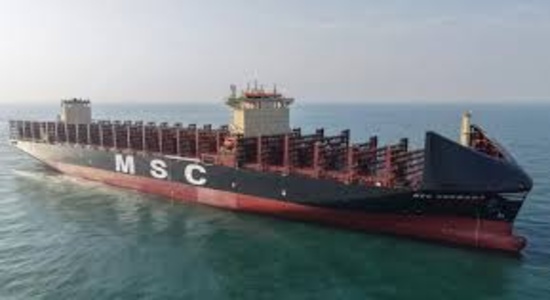
The largest cargo vessels including MSC Turkiye, which is one of the world’s largest and most fuel-efficient container ships, is already docked at Vizhinjam thereby proving the capability of the port to handle big vessels.

The Vizhinjam port is the first mega transshipment container terminal in the country.

Proximity to the international shipping route that connects Europe, the Persian Gulf, Southeast Asia and the Far East by just ten nautical miles is considered as the biggest attraction of the port. A natural depth of 20 metre also makes it ideal for large mother ships.

The port is already equipped with modern cargo handling facilities and already offered around 800 direct jobs

The formal inauguration of the seaport had been delayed due to technical issues. However, it has since resolved several pending matters, clearing the path for future development. The Centre and the state government have also resolved disagreements over the sharing of the Viability Gap Fund (VGF) for the project, culminating in an agreement signed on April 9. Before this, in March, the Ministry of Environment, Forest and Climate Change (MoEFCC) granted environmental clearance for the second and third phases of the port’s development.

As part of the agreement, the Centre has committed to contributing Rs 817.80 crore as its share of the VGF to Adani Vizhinjam Port Private Limited (AVPPL), the project’s concessionaire. A tripartite agreement was signed among the Centre, AVPPL, and the consortium of banks involved. Additionally, the state government has agreed to share 20% of the port’s revenue with the Centre

The port has already proven to be economically significant, contributing Rs.32 crore in taxes to the Kerala government and generating Rs. 181 crore in revenue for Adani Vizhinjam Port Pvt Ltd (AVPPL). Its strategic positioning boosts its relevance in international maritime trade.

IMEC to reduce logistics costs by up to 30% and transportation time by 40%, boosting global trade : Piyush Goyal

NEW DELHI : Union Minister of Commerce and Industry, Shri Piyush Goyal addressed the India-Middle East-Europe Economic Corridor (IMEC) High-Level Roundtable on Connectivity and Economic Growth in New Delhi .

Shri Goyal said that the IMEC is a powerful endorsement of the leadership and partnership of India and Middle East and East Europe a very forward and visionary concept that has caught the fancy of the world, he noted.

The Minister stated that IMEC is not merely a trade route, but a modern-day Silk Route — a partnership of equals — that fosters synergy, connectivity, and inclusive prosperity. “It will bring down logistics costs by up to 30%, reduce transportation time by 40%, and create seamless trade linkages across continents,” he said. “We will not only be linking trade; we will be linking civilizations and cultures — from Southeast Asia to the Gulf, from the Middle East to Central Europe.”

Highlighting its potential reach, Shri Goyal added that IMEC could even enhance connectivity to Africa through the Middle East. The corridor would include railways, roadways, energy pipelines, and clean energy infrastructure, including undersea cables. “India is already in discussions with Singapore on clean energy transmission. We are also engaged in dialogue with Saudi Arabia and the UAE,” he shared.

Shri Goyal underscored the corridor’s emphasis on sustainability and digital connectivity. “This initiative respects sovereignty and territorial integrity. It is not about dominance or creating economic unions. It is a partnership built on mutual trust, inclusivity and sustainability,” he said.

He further outlined five key suggestions as a way forward for the IMEC initiative. First, Shri Goyal stressed the importance of viewing IMEC through the lens of a Public-Private Partnership (PPP). He emphasized that leaving the initiative solely to the government would limit its efficiency and financial viability. Instead, he called for a collaborative model where the private sector leads, bringing to the table its real-world expertise, needs, and innovative capabilities. This approach, he noted, would ensure smarter and more cost-effective planning, as the private sector can propose solutions that reflect practical utility. It would also allow policymakers to think systematically while the private sector introduces flexibility and innovation, ensuring the corridor remains viable, efficient, and sustainable in its execution.

Second, he highlighted the need to focus on Regulatory Connectivity, going beyond just physical infrastructure. Shri Goyal advocated for greater alignment in trade processes, customs procedures, and paperwork among participating nations. He cited India’s ongoing regulatory collaboration with the UAE as an example and pointed out that successful implementation of the corridor would require seamless cross-border movement without excessive checkpoints. Interoperable systems, digitization, electric vehicle charging ecosystems, and synchronized regulations would be key to unlocking economies of scale. He suggested that common digital payment systems, such as India’s Unified Payments Interface (UPI), could serve as a model for enabling seamless financial transactions. With periodic settlement in globally accepted reserve currencies, such mechanisms could reduce transactional friction and banking costs. He proposed that such innovations, combined with virtual trade corridor frameworks like the India-UAE initiative, could be extended through IMEC. These would support broader agreements such as FTAs with GCC and EU countries and bolster joint work in green hydrogen, renewable energy, and supply chain resilience.

Third, Shri Goyal underlined the need for Innovative Financing Models to support both the development of the corridor and the trade it will generate. He called for active involvement of multilateral financial agencies and suggested exploring instruments like green bonds and the creation of long-term “IMEC Bonds”, to fund this transcontinental infrastructure in a sustainable and future-proof manner.

Fourth, he recommended active engagement with industry bodies and trade associations, asserting that their insights are essential for designing a corridor that aligns with the real needs of businesses. Such collaboration would help identify existing bottlenecks, promote best practices, and better integrate economies by removing trade frictions.

Lastly, Shri Goyal proposed bringing in Think Tanks and Academia to the visioning and design process. These institutions, he noted, bring creativity, research strength, and long-term thinking. Their involvement would support policy advocacy, contribute to out-of-the-box solutions, and assist in capacity-building efforts along the corridor. He called this a well-rounded package of five initiatives that could help IMEC evolve into a robust, viable, and inclusive project. Reiterating India’s clear and committed vision, he said the country is ready to act as a trusted, reliable bridge connecting regions and catalyzing global cooperation, under the guiding spirit of Vasudhaiva Kutumbakam — the world is one family.

India to expand trade ties with nations offering fair, balanced FTAs : Piyush Goyal

NEW DELHI : India will expand its trade ties with nations that will offer fair, balanced and equitable Free Trade Agreements (FTAs), Commerce Minister Shri Piyush Goyal said on Wednesday, stressing that the country’s gains must match its offer of accessing a 1.4 billion-strong, and fast-growing consumer market.

He said that India is negotiating FTAs with different countries and regions, including the European Union (EU) and Oman.

The remarks also assume significance as India is negotiating a bilateral trade agreement with the US. The aim is to finalise the first phase of the pact by the fall (September-October) this year.

“So we will be expanding our trading relations with countries where we get a fair deal, where we can have equitable and balanced free trade agreements, where India’s gains commensurate with what we are offering, a large market of 1.4 billion people, growing market, the world’s fastest growing economy,” he said here at India-Middle East-Europe Economic Corridor (IMEC) Conclave 2025.

He added that this corridor would help promote trade, seamless movement of goods and people, and cut down logistics costs.

Billed as a pathbreaking initiative, the IMEC envisages vast road, railroad and shipping networks among India, Saudi Arabia, the US and Europe with an aim to ensure integration among Asia, the Middle East and the West.

The IMEC was formed on the sidelines of the G20 Summit in September last year in Delhi. An agreement was signed by India, Saudi Arabia, the European Union, the United Arab Emirates (UAE), the US and some other G20 partners for the corridor.

Goyal said that it can also open up opportunities for the financial world.

“We could have multilateral financing agencies along this corridor to help promote both the setting up of the corridor and at some stage…we should explore innovative financing models and see how this could finally be financed. For example, we have had green bonds in the past…long-term, 50-year, 100-year bonds to finance this kind of infrastructure,” he said.

He added that the countries can look at harmonising regulatory practices, and enhanced alignment on process, procedures, trade practices, customs union and paperworks within these nations.

“For example, the UAE and we are already engaged to bring some alignment in our regulatory practices. If this region has to really be successful, we can’t have border checkpoints at every level, so we’ll have to look at regulatory connectivity also. So procedures, processes, regulation, all will have to be aligned to make this corridor a bigger success,” Goyal said.

He emphasised that there would be a need for a railway system also.

“So we’ll have to have more interoperable systems going forward. If you have highways, then we need some interoperable charging infrastructure across highways if we are promoting electrical mobility. So we’ll have to think through all of these possibilities and bring nations together,” he said adding these measures would ultimately add to scale.

The member countries will have to look at a multi-faceted dimension that this project offers.

“For example, like UPI, you could have common payment systems, enabling money flow to be easier, and could be settled periodically, monthly or quarterly, in the reserve currency of the globe, or in dollars. But on a day to day basis, every transaction will not need to go through several iterations, only making the banks richer and adding to the cost of transport or cost of trade,” the minister said.

He informed that India and the UAE have been in a dialogue for a virtual trade corridor.

“Can we extend that through the IMEC corridor?” he wondered.

India, he said, is also in dialogue with Singapore to look at the possibility of having an undersea cable for transporting clean energy.

“I’ve had a conversation with Australia…Singapore is also talking to Australia to see if the Singapore, Australia leg could be connected. We are in dialogue with Saudi Arabia and UAE to see if this leg could be connected,” he said.

Further he said that this project needs to be seen from the lens of public-private partnership as it will help in making it financially viable and it should not be only the government’s initiative.

“I do believe that initiatives will not only reduce the time to transport goods significantly…estimated to be about 40 per cent…bring down transport time, bring down cost of logistics, and therefore make trade seamless across continents, faster, more efficient,” he said adding “I think this can become a new global access of the 21st century”.

The good part of the project, he said, is that it respects sovereignty and it is not trying to foist one idea on everything. “It’s not trying to create an economic union. It’s not trying to dominate any of the region, something which the Belt and Road Initiative is now being recognized as becoming a political tool to try and dominate certain regions and their economic future,” he added.

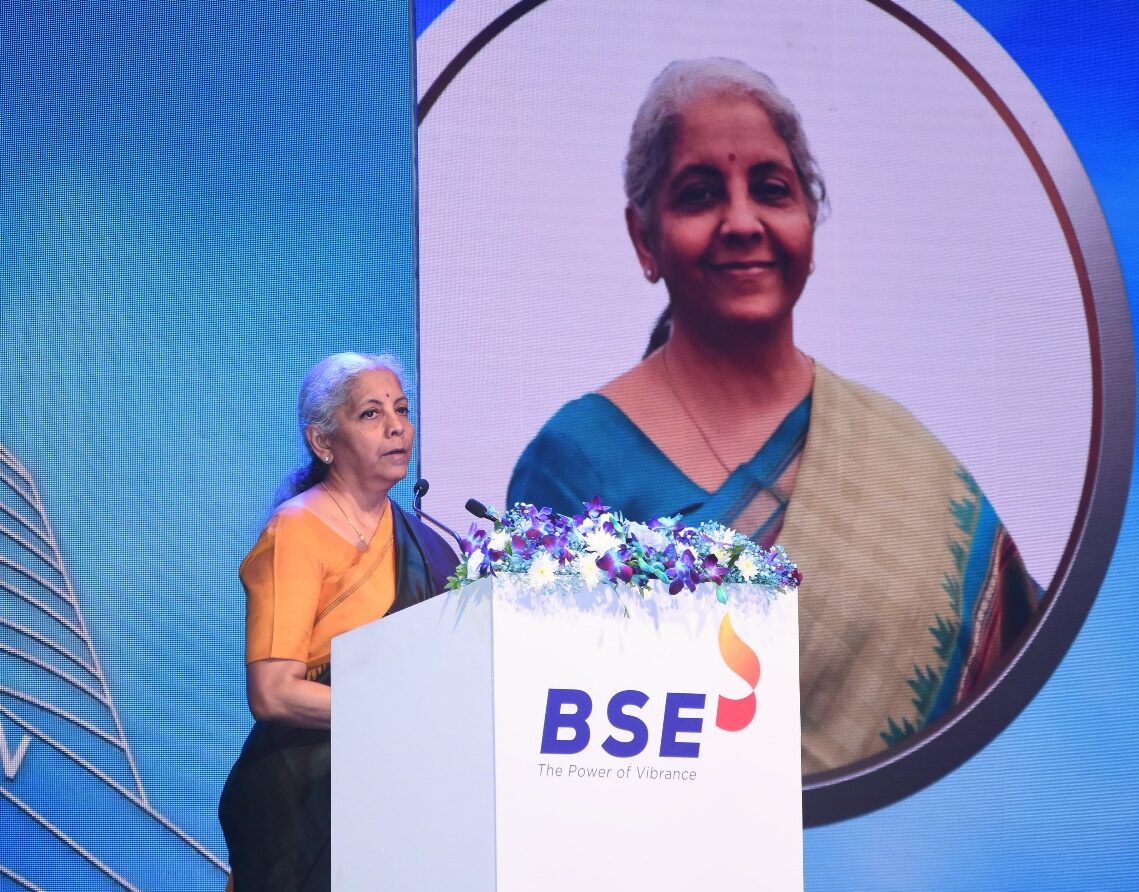
Tariff wars can disrupt supply chains, cloud investment decisions: FM Sitharaman

The escalating tariff wars and growing protectionism can disrupt global supply chains, clouding investment decisions around the world, Finance Minister Smt. Nirmala Sitharaman said on Thursday.

“We recognize that the global landscape is changing and changing rapidly… the recalibration efforts on trade are very, very challenging. It is worrisome, but it is also going to be very challenging. The intensification of tariff wars and the rise of protectionist policies have the potential to disrupt global supply chains, increase production costs and create uncertainty in investment decisions across borders as well,” Sitharaman, who speaking at an event marking the 150th anniversary of BSE, said.

Sitharaman said that uncertainty induced by the tariff wars has had a “ripple effect” on financial markets across the world, including on Indian markets.The US on Wednesday slapped a steep 245% import tax on a wide range of Chinese goods, which could lead to a rerouting of Chinese exports to India. The hostility between the world’s top two economies has worsened since the US imposed 145% tariffs on Chinese goods earlier this month. China retaliated with a 125% levy on American imports and also tightened exports of rare earth metals critical to high-tech and defence sectors.

First batch of custom documentation course launched as part of Vadhvan Port skilling initiative in association with BCBA

MUMBAI : Vadhvan Port Project Ltd. (VPPL), the 13th major port of India, has launched the first 1-month course under the Vadhvan Port Skilling Program on Custom Documentation in association with BCBA on Wednesday, April 16th, 2025, by Shri Unmesh Sharad Wagh, IRS, Chairman, JNPA and CMD, VPPL, in the presence of Shri Rajeev Sinha, Advisor, JNPA and VPPL, Shri Sanjeev Harale, President, BCBA, Shri Paresh Thakkar, Senior Vice President, BCBA, Shri Dushyant Mulani, Chairman, FFFAI and Past President BCBA, and other senior officials from BCBA.

The course, designed in collaboration with the Brihanmumbai Custom Brokers Association (BCBA), is set to equip participants with comprehensive knowledge of customs processes, documentation, and procedures vital for the functioning of ports.

Shri Unmesh Sharad Wagh, Chairman, JNPA, and CMD, VPPL, shared, “The launch of this course is a key step in enhancing the employability of our local youth, providing them with skills that are vital for the growth of Vadhvan Port and the broader maritime industry. We believe in moving beyond conversations to meaningful action that equips young people for tomorrow’s opportunities. This is just the beginning, and we are committed to expanding this program and many other programs across various sectors to further empower the community.”

The Custom Documentation course is designed to equip candidates from Palghar and nearby areas of Vadhvan Port with foundational knowledge and practical skills required in the field of customs clearance and logistics. Spanning 4 weeks with 100 hours of training, the course is conducted in a classroom setting at the BCBA office in Nariman Point, Mumbai, and includes hands-on practical inputs. The curriculum covers key areas such as import-export procedures, customs documentation, clearance processes, and compliance requirements, offering participants a real-world understanding of port and logistics operations.

The Vadhvan Port Skilling Program was launched with a vision to provide meaningful opportunities for the local youth. In an effort to reach out to a wider audience, VPPL introduced a WhatsApp Chatbot to interact with the youth of Vadhvan and encourage their participation. This innovative initiative has made it easier for potential candidates to access information and register for the program. The Vadhvan Port Skilling Program has already garnered an overwhelming response, with over 30,800 registrations to date, reflecting the region’s eagerness to participate in these career-building initiatives.
The Vadhvan Port Skilling Program will continue to evolve with additional batches to cater to the growing demand, ensuring that the youth of Vadhvan are well-equipped to contribute to the port’s development and the nation’s maritime growth.

About VPPL :
Vadhvan Port Private Limited (VPPL) is the 13th major port of India, a special purpose vehicle (SPV) formed between Jawaharlal Nehru Port Authority (JNPA) and the Maharashtra Maritime Board (MMB). Strategically located in Palghar district, near Dahanu, Maharashtra, VPPL is poised to be among the top 10 ports globally. The foundation stone for the port was laid on August 30th, 2024, by the Hon’ble Prime Minister of India, Shri Narendra Modi. Committed to sustainability, VPPL will be 100% green from inception, ensuring minimal environmental impact. The port is set to enhance trade efficiency with the capacity to handle 24 million TEUs, stimulate economic growth, and contribute to regional development. Through initiatives like the Vadhvan Port Skilling Program, VPPL focuses on empowering local communities.

DG Shipping welcomes Sushil Mansing Khopde

NEW DELHI : The Directorate General of Shipping welcomes Shri Sushil Mansing Khopde, IPS (BH: 1995), on his joining as Additional Director General of Shipping, 17.04.2025.

The DG Shipping and the team extended a warm welcome to Shri Khopde as he assumes his new role and responsibilities in the Directorate, bringing with him a wealth of administrative experience and proven leadership.

WhatsApp Image 2025 04 17 at 11.52.11 PM DG Shipping welcomes Sushil Mansing Khopde

MSC makes History with Fleet of 900 Vessels

GENEVA : The Mediterranean Shipping Company (MSC) has made history by becoming the first global container carrier to operate a fleet of 900 vessels. This remarkable milestone was celebrated with the delivery of the LNG-powered MSC GERMANY, a state-of-the-art 16,000 TEU “maxi-neo-panamax” containership. The MSC GERMANY is the fifth unit in a series of twelve sister ships ordered from a Chinese shipyard in October 2022, marking a significant achievement for the company.

According to Alphaliner, a leading liner industry analyst, MSC’s current fleet comprises 609 owned vessels and 291 chartered ships. This extensive fleet allows MSC to maintain a total capacity of approximately 6.47 million TEU, which puts them nearly one million TEU slots ahead of their closest competitor, Maersk. The company’s ambitious growth strategy could see its fleet expand to 1,000 ships in the coming years, with 132 vessels currently on firm order.

The liner industry analyst reports that MSC’s milestone achievement was marked by the delivery of the LNG-powered MSC GERMANY, a 16,000 TEU “maxi-neo-panamax” containership. This newest addition represents the fifth unit in a series of twelve sister ships ordered from a Chinese shipyard in October 2022.

Looking ahead, MSC’s fleet could potentially expand to 1,000 ships in the coming years, with 132 vessels currently on firm order.

The MSC GERMANY’s delivery comes at a time when the container shipping market is experiencing unprecedented volatility, often referred to as “tariff madness.” Industry experts predict that this chaotic environment will lead to a wave of renegotiations for ocean shipping contracts, as companies grapple with fluctuating rates and minimum quantity requirements. The situation is further complicated by the ongoing challenges in global supply chains, which have been exacerbated by the COVID-19 pandemic and geopolitical tensions.

MSC’s fleet expansion is not just about numbers; it reflects the company’s strategic vision to enhance its operational capabilities and improve service delivery amid rising demand for shipping services. The MSC Group, which also includes subsidiaries like Medlog, Log-In Logistica, and WEC Lines, has positioned itself as a dominant player in the shipping industry. With the addition of the MSC GERMANY, the company solidifies its leadership in the global container shipping market.

Alphaliner’s fleet calculations include vessels under ‘quasi-owned’ arrangements, such as long-term bareboat charters with purchase obligations, provided these ships are managed in-house by MSC.

Merchandise & Services exports FY 2024-25 (April-March) is estimated to grow by 5.50% at US$ 820.93 Billion than in FY 2023-24 (April-March)

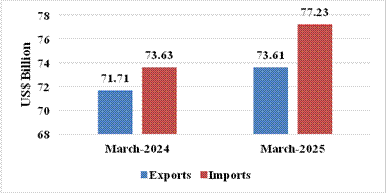
NEW DELHI : India’s total exports (Merchandise and Services combined) for March 2025* is estimated at US$ 73.61 Billion, registering a positive growth of 2.65 percent vis-à-vis March 2024. Total imports (Merchandise and Services combined) for March 2025* is estimated at US$ 77.23 Billion, registering a positive growth of 4.90 percent vis-à-vis March 2024.

Table 1: Trade during March 2025*

  March 2025(US$ Billion)March 2024(US$ Billion)
MerchandiseExports41.9741.69
Imports63.5157.03
Services*Exports31.6430.01
Imports13.7316.60
Total Trade(Merchandise +Services) *Exports73.6171.71
Imports77.2373.63
Trade Balance-3.63-1.92

* Note: The latest data for services sector released by RBI is for February 2025. The data for March 2025 is an estimation, which will be revised based on RBI’s subsequent release. (ii) Data for FY 2023-24 (April-March) and April-December 2024 has been revised on pro-rata basis using quarterly balance of payments data.

Fig 1: Total Trade during March 2025*

image001C9UF Merchandise & Services exports FY 2024-25 (April-March) is estimated to grow by 5.50% at US$ 820.93 Billion than in FY 2023-24 (April-March)
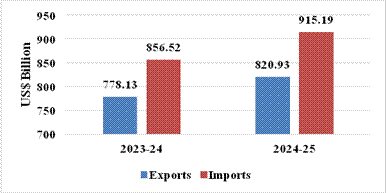
  • India’s total exports during FY 2024-25 (April-March)* is estimated at US$ 820.93 Billion registering a positive growth of 5.50 percent. Total imports during FY 2024-25 (April-March)* is estimated at US$ 915.19 Billion registering a growth of 6.85 percent.

Table 2: Trade during FY 2024-25 (April-March)*

  FY 2024-25 (US$ Billion)FY 2023-24 (US$ Billion)
MerchandiseExports437.42437.07
Imports720.24678.21
Services*Exports383.51341.06
Imports194.95178.31
Total Trade(Merchandise +Services) *Exports820.93778.13
Imports915.19856.52
Trade Balance-94.26-78.39

Fig 2: Total Trade during FY 2024-25 (April-March)*

image0026HNT Merchandise & Services exports FY 2024-25 (April-March) is estimated to grow by 5.50% at US$ 820.93 Billion than in FY 2023-24 (April-March)

MERCHANDISE TRADE

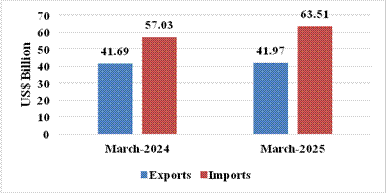
  • Merchandise exports during March 2025 were US$ 41.97 Billion as compared to US$ 41.69 Billion in March 2024.
  • Merchandise imports during March 2025 were US$ 63.51 Billion as compared to US$ 57.03 Billion in March 2024.

Fig 3: Merchandise Trade during March 2025

image003JONN Merchandise & Services exports FY 2024-25 (April-March) is estimated to grow by 5.50% at US$ 820.93 Billion than in FY 2023-24 (April-March)
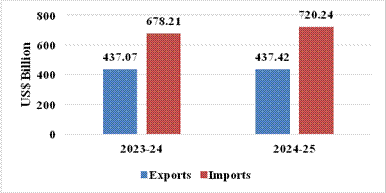
  • Merchandise exports during FY 2024-25 (April-March) were US$ 437.42 Billion as compared to US$ 437.07 Billion during FY 2023-24 (April-March).
  • Merchandise imports during FY 2024-25 (April-March) were US$ 720.24 Billion as compared to US$ 678.21 Billion during FY 2023-24 (April-March).
  • Merchandise trade deficit during FY 2024-25 (April-March) was US$ 282.83 Billion as compared to US$ 241.14 Billion during FY 2023-24 (April-March).

Fig 4: Merchandise Trade during FY 2024-25 (April-March)

image0045AK8 Merchandise & Services exports FY 2024-25 (April-March) is estimated to grow by 5.50% at US$ 820.93 Billion than in FY 2023-24 (April-March)
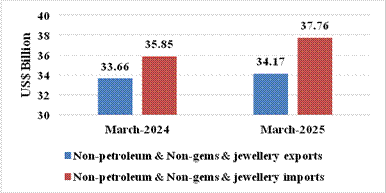
  • Non-petroleum and non-gems & jewellery exports in March 2025 were US$ 34.17 Billion compared to US$ 33.66 Billion in March 2024.
  • Non-petroleum, non-gems & jewellery (gold, silver & precious metals) imports in March 2025 were US$ 37.76 Billion compared to US$ 35.85 Billion in March 2024.

Table 3: Trade excluding Petroleum and Gems & Jewellery during March 2025

 March 2025(US$ Billion)March 2024(US$ Billion)
Non- petroleum exports37.0736.28
Non- petroleum imports44.5040.68
Non-petroleum & Non-Gems & Jewellery exports34.1733.66
Non-petroleum & Non-Gems & Jewellery imports37.7635.85

Note: Gems & Jewellery Imports include Gold, Silver & Pearls, precious & Semi-precious stones

Fig 5: Trade excluding Petroleum and Gems & Jewellery during March 2025

image005NMCQ Merchandise & Services exports FY 2024-25 (April-March) is estimated to grow by 5.50% at US$ 820.93 Billion than in FY 2023-24 (April-March)
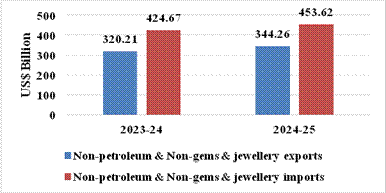
  • Non-petroleum and non-gems & jewellery exports in FY 2024-25 (April-March) were US$ 344.26 Billion, compared to US$ 320.21 Billion in FY 2023-24 (April-March).
  • Non-petroleum, non-gems & jewellery (gold, silver & precious metals) imports in FY 2024-25 (April-March) were US$ 453.62 Billion, compared to US$ 424.67 Billion in FY 2023-24 (April-March).

Table 4: Trade excluding Petroleum and Gems & Jewellery during FY 2024-25 (April-March)

 FY 2024-25 (US$ Billion)FY 2023-24 (US$ Billion)
Non- petroleum exports374.08352.92
Non- petroleum imports534.46499.48
Non-petroleum & Non Gems & Jewellery exports344.26320.21
Non-petroleum & Non Gems & Jewellery imports453.62424.67

Note: Gems & Jewellery Imports include Gold, Silver & Pearls, precious & Semi-precious stones

Fig 6: Trade excluding Petroleum and Gems & Jewellery during FY 2024-25 (April-March)

image006DECR Merchandise & Services exports FY 2024-25 (April-March) is estimated to grow by 5.50% at US$ 820.93 Billion than in FY 2023-24 (April-March)

SERVICES TRADE

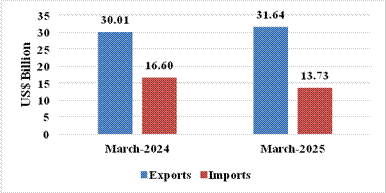
  • The estimated value of services export for March 2025* is US$ 31.64 Billion as compared to US$ 30.01 Billion in March 2024.
  • The estimated value of services imports for March 2025* is US$ 13.73 Billion as compared to US$ 16.60 Billion in March 2024.

Fig 7: Services Trade during March 2025*

image007CQGR Merchandise & Services exports FY 2024-25 (April-March) is estimated to grow by 5.50% at US$ 820.93 Billion than in FY 2023-24 (April-March)
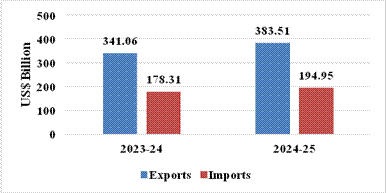
  • The estimated value of service exports during FY 2024-25 (April-March)* is US$ 383.51 Billion as compared to US$ 341.06 Billion in FY 2023-24 (April-March).
  • The estimated value of service imports during FY 2024-25 (April-March)* is US$ 194.95 Billion as compared to US$ 178.31 Billion in FY 2023-24 (April-March).
  • The services trade surplus for FY 2024-25 (April-March)* is US$ 188.57 Billion as compared to US$ 162.75 Billion in FY 2023-24 (April-March).

Fig 8: Services Trade during FY 2024-25 (April-March)*

image008YMXC Merchandise & Services exports FY 2024-25 (April-March) is estimated to grow by 5.50% at US$ 820.93 Billion than in FY 2023-24 (April-March)
  • Exports of  Coffee (39.2%), Drugs & Pharmaceuticals (31.21%), Electronic Goods (29.57%), Marine Products (28.56%), Jute Mfg. Including Floor Covering (21.67%), Meat, Dairy & Poultry Products (16.62%), Tobacco (13.95%), Tea (11.25%), Gems & Jewellery (10.62%), Fruits & Vegetables (8.57%), Rice (7.62%), Carpet (6.52%), Mica, Coal & Other Ores, Minerals Including Processed Minerals (6.35%), Rmg Of All Textiles (3.97%), Leather & Leather Products (3.48%), Cereal Preparations & Miscellaneous Processed Items (3.35%), Cotton Yarn/Fabs./Made-Ups, Handloom Products Etc. (2.16%), and Plastic & Linoleum (1.56%) record positive growth during March 2025 over the corresponding month of last year.
  • Exports of Tea (11.84%), Coffee (40.37%), Rice (19.73%), Tobacco (36.53%), Spices (4.78%), Fruits & vegetables (5.67%), Cereal preparations & miscellaneous processed items (8.71%), Marine products (0.45%), Meat, dairy & poultry products (12.57%), Mica, coal & other ores, minerals including processed minerals (6.95%), Leather and leather products (2.06%), Drugs and pharmaceuticals (9.39%), engineering goods (6.74%), Electronics goods (32.47%), Cotton yarn/fabs/makeups etc (3.19%), Man-made/ yarn/Fabs/made ups etc (4.07%), RMG of Textiles (10.03%), Jute Mfg. including Floor Covering (13.35%), Carpet (10.46%), and Plastic & Linoleum (10.23%) registered positive growth during FY 2024-25 over the previous FY 2023-24.
  • Imports of Project Goods (-87.25%), Silver (-85.39%), Coal, Coke & Briquettes, Etc. (-30.18%), Transport Equipment (-25.53%), Pulses (-23.45%), Newsprint (-17.99%), Pearls, Precious & Semi-Precious Stones (-13.77%) and Pulp and Waste Paper (-11.8%) record negative growth during March 2025 over the corresponding month of last year.
  • Imports of Fertilisers, Crude & Manufactured (-2.21%), Coal, coke & briquettes (20.03%), Dyeing/tanning/colouring materials (-13.42%), Newsprint (-2.71%), Pearls, precious & semi-precious stones (-24.41%), Iron & Steel (-4.61%), Project goods (-18.45%), and Silver (-11.24%) registered negative growth during FY 2024-25 over the previous year FY 2023-24.
  • Services exports is estimated to grow by 12.45 percent during FY 2024-25 (April-March)* over FY 2023-24 (April-March).
  • Top 5 export destinations, in terms of change in value, exhibiting positive growth in March 2025 vis a vis March 2024 are U S A (35.06%), Australia (70.81%), Kenya (98.46%), Togo (46.52%) and             U K (8.43%).
  • Top 5 export destinations, in terms of change in value, exhibiting positive growth in FY 2024-25 (April-March) vis a vis FY 2023-24 (April-March) are U S A (11.59%), U K (12.08%), Japan (21.12%), U Arab Emts (2.84%) and France (11.42%).
  • Top 5 import sources, in terms of change in value, exhibiting growth in March 2025 vis a vis March 2024 are U Arab Emts (57.25%), China P Rp (25.02%), Saudi Arab (44.03%), Kuwait (93.8%) and Ireland (208.09%).
  • Top 5 import sources, in terms of change in value, exhibiting growth in FY 2024-25 (April-March) vis a vis FY 2023-24 (April-March) are U Arab Emts (32.06%), China P Rp (11.52%), Thailand (43.99%), U S A (7.44%) and Russia (4.39%).