LONDON : Technology group Wärtsilä has introduced a new methane slip reduction solution for its Wärtsilä 50DF dual-fuel engine. The new technology, which converts Wärtsilä 50DF dual-fuel (DF) engines to spark gas (SG) operation, enables a more optimised combustion process, thereby improving efficiency and lowering methane emissions. Whilst operating on LNG, the new ‘Spark Gas Conversion for Wärtsilä 50DF’ is designed to reduce methane emissions up to 75 percent more than the standard Wärtsilä 50DF engine.
The Spark Gas Conversion for Wärtsilä 50DF minimises methane emissions by introducing an electrically controlled pre-combustion chamber valve for a more optimised combustion process. The estimated result is that, on an IMO weighted (E2-cycle) average, the new solution reduces methane emissions down to 1.1 percent of fuel use.
“The use of LNG and cutting methane emissions is one of the most effective ways to decrease overall greenhouse gas (GHG) emissions from marine engines over the next decade, complementing other efforts to reduce CO2 emissions,” comments Roger Holm, President of Wärtsilä Marine & Executive Vice President at Wärtsilä Corporation.“As the shipping industry strives for more sustainable operations, this new solution represents an important milestone on the road to advancing lower carbon fleets.”
The development of the solution, which consists of converting one-to-two of the total DF engines to SG, was made possible through extensive collaboration between Wärtsilä and Chevron Shipping Company. It was announced earlier that one engine on six Chevron LNG Carriers will be converted from DF to SG as part of Chevron’s aim to reducing the carbon intensity of its operations.
The solution is now available to all vessels in the industry with existing Wärtsilä 50DF engines diesel-electric propulsion, the majority of which are LNG carriers.
The new solution is optimised for LNG as fuel, therefore producing a better energy output per unit of fuel. This means fuel gas savings of up to 4.6 percent, as well as lower methane emissions.
Holm continues: “Wärtsilä has an extensive track-record in reducing methane slip from LNG-fuelled engines, not only as newbuild solutions, but also through retrofitting existing installations. This latest technology complements our extensive portfolio of solutions aimed at reducing methane emissions from vessels.”
With three decades of experience in LNG technology, Wärtsilä is providing market leading performance – both with the dual fuel flexibility provided by the DF engine, as well as with the single fuel SG engine.
LONDON : The Baltic Exchange’s Dry Bulk Sea Freight index on Wednesday fell for the thirteenth straight session to a more than one-month low due to lower demand across vessels amid a global trade war.
The main index, which monitors rates for capesize, panamax and supramax shipping vessels, dropped 83 points, or 6.2%, to 1,259, its lowest since March 5.
The capesize index dropped to 1,732, its lowest level in six weeks.
Average daily earnings for capesize vessels, which typically transport 150,000-ton cargoes such as iron ore and coal, decreased $1,514 to $14,367.
A combination of low demand from commodities, mainly coal transported to China, iron ore and also grains is weighing down on earnings, said Yiannis Parganas, head of Intermodal’s research department.
Investors are dumping U.S. assets they usually favour in times of turmoil as fear over the economic impact of U.S. President Donald Trump’s reciprocal tariffs shakes confidence in traditional safe havens.
China is the largest importer of both coal and iron ore, which is used in its massive steel production industry.
“With U.S. port fees proposal, it will potentially make charterists avoid the U.S. regions at the moment,” Parganas added.
Trump’s administration is considering softening its proposed fee on China-linked ships visiting U.S. ports after widespread negative feedback from industries that said the idea could be economically devastating.
The panamax index shed 75 points, or 5.9%, to 1,203, lowest since March 12.
Average daily earnings for panamax vessels, which usually carry 60,000-70,000 tons of coal or grain, was down $677 at $10,824.
Among smaller vessels, the supramax index fell to a nearly one-month low, shedding 6 points, or 0.6%, to 948. Source: Reuters
NEW DELHI : Prime Minister, Shri Narendra Modi met with His Highness Sheikh Hamdan bin Mohammed bin Rashid Al Maktoum, the Crown Prince of Dubai in New Delhi. Shri Modi reaffirmed commitment to strengthen India-UAE Ties. He also said that Dubai has played a key role in advancing the India-UAE Comprehensive Strategic Partnership.
The Prime Minister wrote on X;
“Glad to meet HH Sheikh Hamdan bin Mohammed bin Rashid Al Maktoum, the Crown Prince of Dubai. Dubai has played a key role in advancing the India-UAE Comprehensive Strategic Partnership. This special visit reaffirms our deep-rooted friendship and paves the way for even stronger collaboration in the future.
NEW DELHI : Union Minister of Ports, Shipping and Waterways (MoPSW) Shri Sarbananda Sonowal inaugurated 26 projects worth ₹67.77 crore across six Indian Maritime University (IMU) campuses nationwide, marking a significant push toward strengthening maritime education and empowering women in the sector. The ceremony also included the foundation stone laying for a Girls’ Hostel-cum=Library building at IMU’s Kochi campus.
Calling the event a “very special occasion,” the Union Minister said it reflected the Government’s collective commitment to transform maritime education. “The maritime sector is the backbone of global trade and economic growth. Under the visionary leadership of Hon’ble Prime Minister Shri Narendra Modi ji, India is making rapid strides to emerge as a global maritime powerhouse. These 17 projects mark a significant step in our mission to strengthen India’s maritime education landscape. With modern infrastructure and advanced facilities, we are enabling students to excel and meet global maritime standards,” Shri Sarbananda Sonowal said.
Shri Sonowal inaugurated 17 key infrastructure projects across IMU campuses in Chennai, Kolkata, Navi Mumbai, Mumbai Port, and Visakhapatnam, including advanced simulators, solar power plants, improved sports facilities, and hostel upgrades—aimed at enriching academic and campus life. The ₹13.11 crore Girls’ Hostel at IMU Kochi will enhance residential facilities for female students, reinforcing Government’s commitment to gender inclusion in maritime education.
Shri Sarbananda Sonowal highlighted flagship initiatives like the Maritime India Vision 2030, the Sagarmala Programme, and the ‘Maritime Amritkaal Vision 2047’, describing them as central to modernising ports and developing sustainable infrastructure. He pointed out that between 2014-15 and 2023-24, India’s major ports doubled their cargo-handling capacity.
Highlighting India’s Maritime sector’s growth, the Union Minister said, “Nine Indian ports are now ranked among the top 100 globally”. He also emphasised the rise in maritime employment, stating that the number of Indian seafarers increased by 170% in the past decade — from 1.17 lakh in 2014 to over 3.17 lakh in 2024. “Our target is to reach five lakh active seafarers by 2030, and we are firmly on that path,” Shri Sarbananda Sonowal said.
The Union Minister further hailed the progress made in women’s participation in maritime careers, noting a 700% increase in women seafarers—from 1,699 in 2014 to 13,756 in 2024. “This foundation stone for the Girls’ Hostel at IMU Kochi is a step forward in promoting gender equity in the maritime sector. ‘Nari Shakti’ and ‘Yuva Shakti’ are the backbone of our nation as well as for our aspiration to become a global maritime major. Their active role as nation builders will propel our country to become ‘Viksit Bharat’,” Shri Sonowal said, adding that the IMU actively supports women students through scholarships offered by corporate houses and government agencies.
The Indian Maritime University (IMU) also received praise from the Minister for expanding its footprint and contributions to workforce development. “With a current enrolment of 7,156 students and over 21,000 alumni since its inception in 2008, IMU has seen an 80% rise in admissions over the past decade. With our rich talent pool, our endeavour to become a global maritime nation is going to be a reality soon. This is very inspiring towards realisation of Atmanirbhar Bharat — the vision of PM Narendra Modi ji,” the Union Minister said.
Among the newly inaugurated projects are flood mitigation structures, RFID-enabled libraries, solar power installations, and simulators at multiple campuses. These upgrades aim to provide students with a holistic, environmentally sustainable, and technologically advanced learning environment. “The future of global shipping lies in automation, Artificial Intelligence, and green technologies. IMU must incorporate these innovations into its curriculum to prepare our youth for a rapidly evolving industry,” suggested Shri Sonowal, during the event at IMU. He further urged IMU to integrate emerging domains such as shipbuilding, ship recycling, inland water transport, and advanced sailing technologies like hydrofoils into its training programmes. “We want a dedicated, professional human resource base to drive India’s maritime ecosystem forward. IMU must lead this transformation,” he added.
The Union Minister also commended the faculty and staff of IMU for their unwavering commitment. “Your efforts are invaluable in shaping the future of India’s maritime sector and ensuring we remain at the forefront of global maritime education,” the Union Minister said. In a message to students, Shri Sarbananda Sonowal said, “You are the future of India’s maritime vision. The knowledge and skills you gain here will not only shape your careers but also contribute to the growth and prosperity of the nation. With the guidance and experience of our educators, combined with the passion and dedication of our youth, India, under the dynamic leadership of Prime Minister Shri Narendra Modi ji, is on course to become a leading global maritime power by 2030,” said Sarbananda Sonowal.
Expressing hope that the newly inaugurated infrastructure would catalyse further excellence in training, research, and industry collaboration, the Union Minister concluded, saying, “this is just the beginning, may this milestone lead to many more achievements for India’s maritime sector”.
The ceremony was graced by the presence of several dignitaries, including Hibi Eden, Member of Parliament (Lok Sabha) from Ernakulam, and Dr. Malini V. Shankar, Vice Chancellor of the Indian Maritime University (IMU). The event concluded with an engaging interactive session that brought together experts, faculty, and policymakers to explore the future of maritime education, innovations in seafarer training, and the development of sustainable infrastructure across IMU campuses.
KOCHI : Union Minister of Ports, Shipping and Waterways Shri Sarbananda Sonowal reviewed operations of the Kochi Water Metro during a ride across key terminals in the city. The visit marked a step toward assessing the viability of replicating the water-based transit model in 24 cities across India, including Guwahati, Dibrugarh and Tezpur in Assam. The Ministry has approved for conducting Technical Feasibility Study in these 24 cities.
Speaking on the occasion, the Union Minister said, “The success of the Kochi Water Metro is a shining testament to India’s ability to blend tradition with innovation. It demonstrates how clean, comfortable, and efficient water-based transport can transform the way people commute in urban spaces. Inspired by this achievement, our ministry has approved technical feasibility studies in 24 cities across the country—including Guwahati, Dibrugarh, and Tezpur in Assam—to explore the replication of this model.”
After the ride aboard Kochi Water Metro, Shri Sarbananda Sonowal lauded Prime Minister Shri Narendra Modi’s transformative leadership in reviving India’s long-neglected national waterways. “Before 2014, our rivers were overlooked and left in ruins. It is under the visionary leadership of Prime Minister Modi that we have reclaimed the lost glory of India’s riverways,” he said. “The Water Metro is a testament to this transformation—it provides an economical, comfortable, environmentally friendly, and modern travel experience that reflects the government’s commitment to green and inclusive growth.”
The Union Minister boarded the Water Metro at the High Court Junction terminal and travelled to Fort Kochi and Vypeen before returning. He was accompanied by senior government officials, including Joint Secretary Sri Nath, as well as representatives from Kochi Metro Rail Ltd., and other maritime agencies.
Elaborating on the Water Metro project, Shri Sarbananda Sonowal said, “This initiative will pave the way for a modern and sustainable public transport system that not only reduces traffic congestion and pollution but also reconnects our people with the country’s historic waterways. Rooted in our civilisational legacy of river navigation, the Water Metro concept is designed to meet the demands of today—with cutting-edge technology, top-notch safety protocols, and commuter-friendly amenities that make every journey efficient and enjoyable. The expansion of Water Metro services aims to provide last-mile connectivity, ease of travel, and an environmentally friendly alternative to traditional transport—setting the stage for a greener and more inclusive future of urban mobility in India.”
During the visit to Kochi Water Metro, the Union Minister was accompanied by Loknath Behera, Managing Director of Kochi Metro Rail Ltd.; B. Kasiviswanathan, Chairperson of Cochin Port Trust; Dr. Divya S. Iyer, Managing Director of Vizhinjam International Seaport; directors of Kochi Metro Rail Ltd.; the Chief Operating Officer of Kochi Water Metro Ltd.; and Dr K K Nath, Advisor, Inland Waterways Authority of India (IWAI) among other senior officials.
In a message penned in the visitor’s book, Shri Sonowal described the Kochi Water Metro as “unique,” noting that “it makes a real difference to water travel—more exciting, comfortable, and enjoyable.”
The Water Metro, the first of its kind in India, integrates water transport with the city’s urban mobility systems and is being considered a model for future projects across the country. The proposed expansion through techno-feasibility studies aims to boost connectivity, reduce road congestion, and promote sustainable transit in key urban centres.
MUMBAI : Union Minister of Commerce & Industry, Shri Piyush Goyal addressed the Dubai-India Business Forum organised by Dubai Chambers in Mumbai on Monday. The event was graced by His Highness Sheikh Hamdan bin Mohammad Al Maktoum, Crown Prince of Dubai, Deputy Prime Minister and Minister of Defence of the UAE.
Welcoming His Highness on his first official visit to India, Shri Goyal said the presence of Sheikh Hamdansymbolises the deep historical connect and generational continuity between Mumbai and Dubai. Recalling that this year marks the centenary of the visit of Sheikh Saeed, the grandfather of Sheikh Hamdan, to India, the Minister noted that both cities share a welcoming spirit rooted in centuries-old cultural and commercial ties.
Shri Goyal lauded Dubai’s contributions to social welfare, including the establishment of the first hospital for Indian workers in Dubai. “This is a heartwarming initiative, and we thank you on behalf of all Indians,” he added.
Highlighting the special relationship between India and the UAE, Shri Goyal said it is built on trust and personal rapport between the leadership of both nations. “There have been six high-level visits between India and the UAE in just two years—three by Prime Minister Narendra Modi and three by top leaders of the UAE. This reflects the intimacy and strategic importance of our partnership,” he stated.
Shri Goyal placed on record India’s appreciation for the UAE’s support in building the iconic Swaminarayan Hindu Temple in Abu Dhabi, calling it a symbol of mutual respect and shared values.
The Minister acknowledged the UAE’s pivotal role in India’s outreach to Africa, investments in logistics and infrastructure, and efforts to build digital and commercial connectivity. He particularly appreciated the role of DP World in transforming India’s logistics ecosystem.
Referring to the Comprehensive Economic Partnership Agreement (CEPA) between India and the UAE as a defining moment, Shri Goyal said, “Our goal to take non-oil trade to $100 billion is within reach. The speed and scale at which our partnership is growing is truly inspiring.”
The Minister also spoke of new avenues of collaboration in education. “We have already launched an IIT campus in Dubai and are now planning campuses of Indian Institute of Management and Indian Institute of Foreign Trade. These initiatives reflect our commitment to deeper engagement in education and skill development,” he said.
Shri Goyal said Dubai serves as a vital gateway for India’s trade and cultural exchange with the Middle East and expressed gratitude for the UAE’s support to the Indian diaspora, especially during the COVID-19 pandemic. “Over 2 million Indians call the UAE home, and you have cared for them like your own family,” he noted.
Quoting Prime Minister Narendra Modi, Shri Goyal said, “India is not just a workforce, we are a world force.” He pointed out that India is the fastest-growing major economy and is poised to become the fourth-largest economy by the end of 2025 and third-largest by 2027. “From a $4 trillion economy today, we aim to reach $30-35 trillion by 2047,” he said, inviting Dubai to partner in India’s journey towards becoming a developed nation by its centenary of independence.
Shri Goyal encouraged businesses from both countries to tap the immense potential in sectors such as nuclear energy, critical minerals, renewable energy, green hydrogen, fintech, AI, food security, and advanced manufacturing. He said, “This is just the tip of the iceberg. We have many mountains yet to climb, and I’m confident that the leadership and business communities of both nations will continue to inspire even greater achievements.”
NEW DELHI : Union Minister Shri Piyush Goyal has announced the launch of a dedicated Startup India desk within the ministry to serve as a helpline for budding entrepreneurs across India.
The announcement comes days after Goyal sparked debate at the Startup Mahakumbh 2025, where he urged investors and entrepreneurs to focus on high-impact innovation – particularly in sectors like deep tech, robotics, and AI-over lifestyle and D2C brands.
His comments stirred both praise and criticism across India’s startup ecosystem, highlighting a growing concern about the direction and depth of innovation in the country.
Startup India Helpdesk
Minister Piyush Goyal stated in a government press release that the helpline would be available via a straightforward four-digit toll-free number in local languages.
A startup can report issues, if they exist, and offer suggestions for how to further enhance the ecosystem through this helpline.
“Whenever any officer troubles you (startups) or if you want to make any suggestion regarding any changes in the laws or if you want to flag any product or technology which may not fall under the current legal boundaries of India, you will be able to reach out to that helpline,” said Union Minister Goyal during his address.
The minister further stated that the Small Industries Development Bank of India (SIDBI) will receive ₹2,000 crore as the first installment of the second Fund of Funds for Startups, which has a capital of ₹10,000 crore and was approved by the Centre this year.
Minister Piyush Goyal said a significant portion of the fund will be reserved for seed funding of small startups and to support deep-tech innovation. “We aim to foster the development of cutting-edge technologies like AI, robotics, quantum computing, machine learning, precision manufacturing, and biotech,” he said.
NEW DELHI : According to data presented by Union Minister Shri Sarbananda Sonowal in the Lok Sabha, cargo throughput at major ports touched 819 million tonnes in FY24, while non-major ports recorded 724 million tonnes—together crossing the 1.5 billion tonne mark for the first time. The Ministry of Ports, Shipping and Waterways has significantly ramped up efforts to boost India’s maritime and inland waterway sectors through infrastructure development, modernization, and state collaboration.
India’s 12 major ports, under the Centre’s administrative control, have seen steady investment-driven growth. Meanwhile, non-major ports—governed by states—are receiving focused funding under the Sagarmala Scheme. As of now, Rs 49.25 billion has been committed to 71 non-major port projects, including coastal infrastructure, ferry terminals, and community development.
The Inland Waterways Authority of India (IWAI) is advancing the Jal Marg Vikas Project (JMVP) on National Waterway-1 between Varanasi and Haldia, aimed at enhancing freight movement across Uttar Pradesh, Bihar, Jharkhand, and West Bengal. Bihar alone has seen Rs 8 billion worth of projects under JMVP, generating over 1,030 jobs.
In terms of direct employment, major ports employed over 16,600 people in 2024, while non-major ports saw workforce numbers rise to 13,381—reflecting an increasing focus on decentralised port development.
To ensure long-term growth and policy coordination, the Maritime States Development Council (MSDC)—established in 1997—continues to serve as the apex advisory body. Twenty meetings have been held so far, aligning Centre-State efforts for balanced maritime growth.
With a 7,500 km coastline and 14,500 km of navigable waterways, India is positioning port-led development as a key engine for logistics efficiency and coastal prosperity.
NEW DELHI : Union Commerce Minister Shri Piyush Goyal on Monday said the “applied tariffs” to the US are only 7-8 per cent, which he described as not humongous. Declining to disclose details on the ongoing negotiations with the US, which has slapped a 26 per cent “reciprocal tariff” on the country, Goyal said India believes it can have bilateral trade pacts with countries that exercise fair trade practices.
Lashing out at China, the minister said the northern neighbour’s unfair practices have brought the world to the current juncture, and made it clear that car maker BYD’s entry to India is not welcome at the current juncture. Asserting that we are not in an era of de-globalisation but one of re-globalisation, Goyal said the current turmoil could provide a good opportunity for India if countries respecting fair practices come together.
On the US tariff predicament, Goyal explained that India’s tariffs are a protection against unfair trade and a shield against economies indulging in aspects like dumping. Acknowledging that the overall Indian tariffs on the US work out at 17 per cent, Goyal said that a lot of them pertain to goods which India doesn’t import at all.
“Our applied tariff to the United States is probably seven or eight per cent. It’s not humongous,” he said. To a question on how the US applied tariffs on India despite the close ties and the personal equations between President Donald Trump and Prime Minister Shri Narendra Modi, Goyal said it is not about a friend or a foe and the levies have been announced in a formula-based manner.
The minister wondered how the US would be able to implement the recently announced reciprocal tariffs, pointing out that we have seen episodes of the barriers being circumvented by means like goods entering a third country with lower tariffs for entry into the US as it happened in the case of Vietnam after Trump imposed higher tariffs on China in his first stint.
We have not heard the end of the story yet, Goyal said, adding that one cannot be sure how trade diversion will be safeguarded.
Goyal said the ongoing changes in the US trade policy will not impact domestic growth so much because India is not an export-dependent economy.
The rupee is not as volatile as peer emerging market currencies, the minister said, adding that Indian equities are “fortunate” to be at the bottom of the table of markets impacted by Trump’s disruptive policies.
Blaming China for the current challenges, he said the issues started in the mid-1990s with efforts to admit it into the WTO and rued that the world was “convinced” that Beijing is transforming itself.
Instead, China used unfair practices to gain undue advantage in trade, Goyal said, pointing out that the world got “carried away”, and did not realise the long-term impact till we got to the current pass. The issues the world faced included predatory pricing, large or hidden subsidies, and unfair labour practices, Goyal said, blaming the world for being “myopic”.
“The current state of play is a culmination of three decades of attacks on several economies,” Goyal said, adding that the world has to act in a concerted manner in support of fair, equitable and honest trade. India can turn this phase into an opportunity like it did during the Covid pandemic and the Y2K problem, he said, asking India Inc. to inform the government when it sees dumping.
The government has received a representation from the steel industry on dumping and is considering ways to safeguard it, Goyal told reporters later.
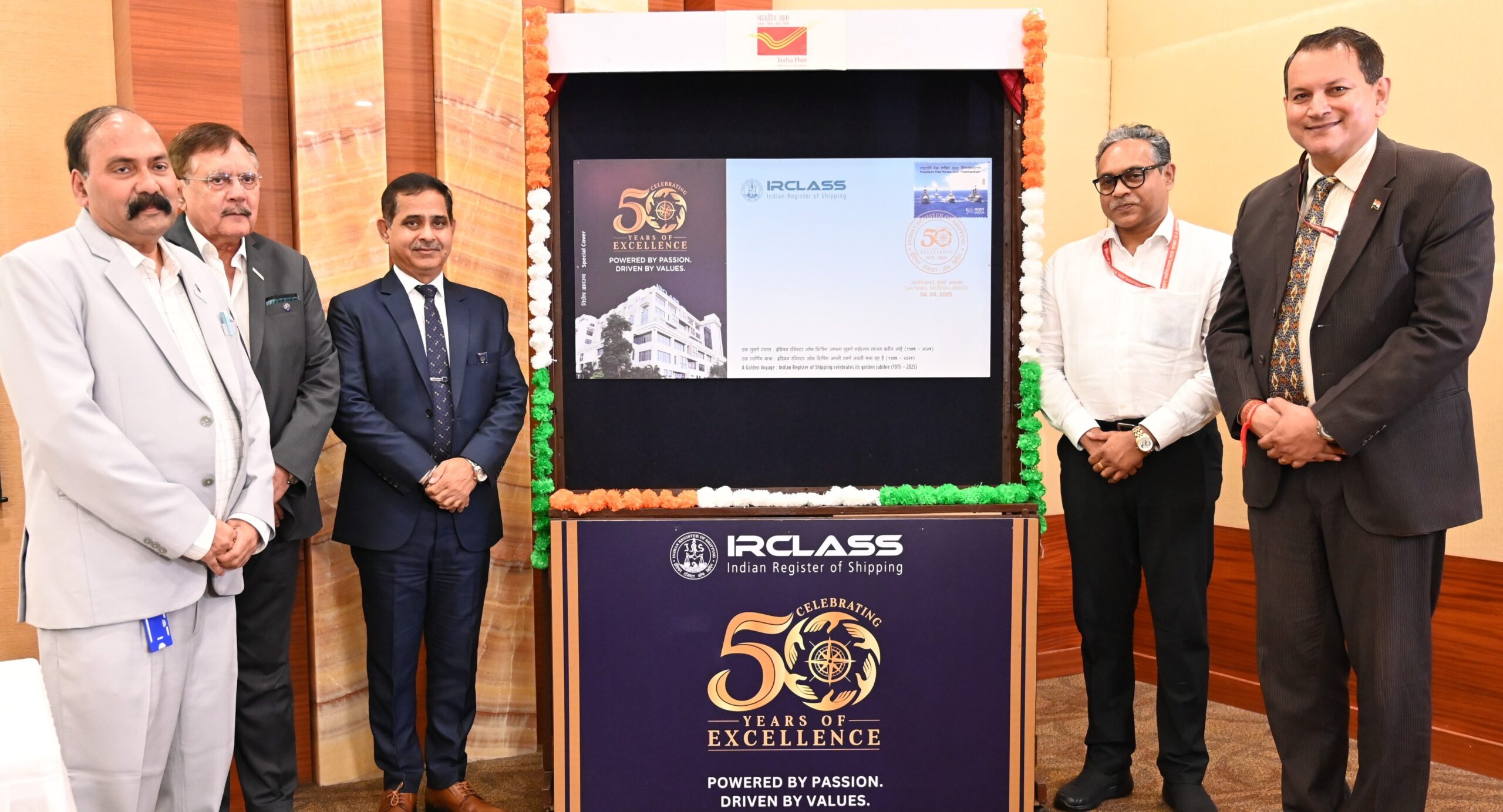
MUMBAI : On its 50th Foundation Day – 4th April 2025, Indian Register of Shipping (IRS) marked a historic milestone as India Post released a Special Cover commemorating 50 years of IRS’s excellence in the maritime industry. This prestigious philatelic tribute highlights IRS’s contributions to maritime safety, environmental sustainability, and regulatory compliance, symbolising its significant impact on the global maritime sector.
The special cover was released by Chief Guest Shri Shyam Jagannathan, IAS, Director General of Shipping along with Shri Amitabh Singh, Chief Postmaster General Maharashtra Circle, India Post and Capt B K Tyagi CMD, Shipping Corporation of India who graced the occasion.
To further mark this momentous day, IRS also released the Touch of Class Golden Jubilee Edition – Volume 3 and announced the forthcoming launch of its newly updated website, which reflects the organisation’s continued evolution and commitment to innovation.
Commenting on the milestone, Mr. Arun Sharma, Executive Chairman of IRS, said, “This Golden Jubilee is not just a celebration of our past, but a reaffirmation of our commitment to the future. The Special Cover is symbolic of IRS’s enduring legacy and reflects our readiness to embrace the opportunities of tomorrow.”
This event also marked the formal conclusion of the year-long Golden Jubilee celebrations, which saw a series of commemorative activities and stakeholder engagements across the country.