Home Blog Page 904

GRSE and SWAN Defence and Heavy Industries sign strategic MoU to boost Indigenous Commercial Shipbuilding Capabilities

KOLKATA : Garden Reach Shipbuilders & Engineers Ltd. (GRSE), has signed a Memorandum of Understanding (MoU) with SWAN Defence and Heavy Industries Ltd. On 07 Apr 25 at , Kolkata. The strategic partnership marks a significant step towards strengthening indigenous shipbuilding capabilities in the commercial segment and supports the national vision of “Aatmanirbhar Bharat” in the maritime sector. Under the terms of the MoU, both shipyards will collaborate on a non-exclusive basis for the construction of commercial vessels and offshore structures, with a focus on global customers and national maritime interests. This alliance will enable GRSE and SWAN Defence to leverage each other’s strengths in infrastructure, expertise, and design capabilities.

MoU 2 GRSE and SWAN Defence and Heavy Industries sign strategic MoU to boost Indigenous Commercial Shipbuilding Capabilities

The partnership will focus on jointly scouting for commercial shipbuilding projects and developing standard platform designs to cater to market needs. By sharing infrastructure and evolving effective build strategies, the two entities aim to ensure faster and more efficient project execution. Additionally, the collaboration will work towards optimizing costs through the development of a mutually beneficial vendor ecosystem. Furthermore, the MoU lays a strong emphasis on building skilled manpower to support the long-term growth of the shipbuilding sector. Both companies have agreed to work together not only on the construction front, but also in areas such as vessel trials, ship repair—laying the foundation for a sustainable and comprehensive model of industrial cooperation.

A significant emphasis will also be placed on training and nurturing a skilled local workforce. Furthermore, both parties will cooperate in the trials, commissioning, and future repair of vessels and offshore structures, thereby establishing a comprehensive and sustainable model for commercial shipbuilding in India.

The MoU between SDHI and GRSE signifies a shared vision to advance India’s shipbuilding capabilities and create future-ready infrastructure that supports maritime innovation, economic development, and job creation, and is poised to catalyze the growth of a robust vendor ecosystem and generate employment through skill development in the shipbuilding sector. This collaboration is a testament to the growing capabilities of Indian shipyards in meeting both national and international maritime demands through innovative, cost-effective, and high-quality solutions.

India’s exports to US may fall $5.76 billion in 2025 due to Trump tariffs : GTRI

NEW DELHI : India’s exports to the US could fall by an estimated $5.76 billion in 2025 to $84 billion owing to the reciprocal tariffs announced on April 2 by US President Donald Trump, per a report by research body GTRI. It would translate into a 6.45 per cent decline compared to India’s exports to the US valued at $89.81 billion in 2024 (US data).

Items that could witness a significant decline in exports to the US include fish and crustaceans (20.2 per cent), iron or steel articles (18 per cent), diamonds, gold, and related products (15.3 per cent), vehicle and parts exports (12.1 per cent), electrical, telecom and electronic products (12 per cent), the report noted.

However, there are sectors that may make modest gains due to their competitive position, the report added. These include textiles made-up, apparel, ceramic products, inorganic chemicals and pharmaceuticals.

Other categories such as plastics, carpets, petroleum products, organic chemicals and machinery are also expected to be negatively impacted, it added.

“While the overall effect of the new tariffs points toward a decline in trade, India’s competitive position in select product segments may help cushion some of the losses,” the report said.

The report noted that items such as energy products (including petroleum and solar panels), pharmaceuticals and copper had been exempted from country-specific tariffs.

These high-value items accounted for $20.4 billion or 22.7 per cent of India’s exports to the US in 2024. They will continue to face only the standard MFN (Most Favoured Nation) tariff.

Key industrial goods such as steel, aluminum, automobiles and auto parts will face a 25 per cent tariff. “However, the largest impact falls on the remaining basket of goods. These exports, valued at $ 67.2 billion or 74.8 per cent of total trade, will be hit with a 26 per cent tariff. While MFN tariffs still apply, this sweeping hike is expected to reshape trade dynamics across a wide range of industries,” the report said

OCP Group and Maersk partner for sustainable supply chain innovation

COPENHAGEN : OCP Group, through its Specialty Products & Solutions (SPS) Strategic Business Unit, and Maersk, a global leader in integrated logistics, have signed a global Memorandum of Understanding (MoU) to strengthen their long-standing collaboration and jointly advance innovative, resilient, and sustainable supply chain solutions.

This new milestone in the OCP Group – Maersk partnership builds on years of successful cooperation and shared commitment to excellence in logistics and marks a new chapter in the longstanding partnership between both companies, with a focus on delivering agile, digitalized, and sustainable logistics solutions to support OCP’s international growth – particularly through its SPS business unit.

Maersk OCP Group OCP Group and Maersk partner for sustainable supply chain innovation

The agreement includes ocean and inland transportation, logistics services, digitalised supply chain management, educational programs, and ambitious sustainability initiatives.

This groundbreaking agreement is designed to forge a world-class, resilient, and robust supply chain, capable of withstanding uncertainties in an ever-changing world. It aligns with the strategic ambitions of OCP’s global business operations, particularly fostering the growth of specialty product solutions in international markets.

Anass HASSAINATE

Head of Supply Chain & Logistics, SPS SBU at OCP Group

Strategic Areas of collaboration :

  • Ocean and logistics services: Enhancing ocean freight capacity, expanding to new destinations, and establishing flexible global storage and distribution networks in Morocco and transit operations worldwide.
  • Supply chain innovation: digitalizing supply chain operations and implementing best-in-class practices, particularly in support of the specialty businesses international development.
  • Education & Research: Launching joint academic and training initiatives with Mohammed VI Polytechnic University (UM6P) to advance knowledge in logistics, supply chain, and sustainability.
  • Sustainability: A core pillar of the MoU, sustainability will be addressed through joint efforts to decarbonise logistics operations, evaluate sustainable fuel solutions, and implement energy-efficient practices. Both companies reaffirm their shared commitment to achieving net zero emissions by 2040.

We are very pleased to see that our partners at OCP Group share our commitment to innovation and making supply chains more resilient and future-proof. Through our joint initiatives in the area of research and education, we also aim to increase the competencies in logistics and supply chain among the next generation of professionals in Morocco – one of our key markets in the Mediterranean.

Emilio De La Cruz

South West Europe and Maghreb Area Managing Director at A.P. Moller – Maersk

About OCP Group

OCP Group helps feed a growing global population by providing it with the essential elements for soil fertility and plant growth. With over a century of expertise and a turnover of more than US$ 9 billion in 2024, OCP is the world leader in plant nutrition solutions and phosphate-based fertilizers. Headquartered in Morocco and present on five continents, OCP Group has over 17,000 employees and works closely with more than 350 customers around the world.

OCP recently launched a green investment strategy, dedicated to increasing fertilizer production and investing in renewable energy. The strategy foresees an overall investment of approximately USD13 billion over the period 2023-2027, which now enables the Group to use 100% non-conventional water since early 2025 (to ensure its complete autonomy, including a water desalination capacity of 560 million m3 per year by 2027), 100% clean energy by 2027 and achieve full carbon neutrality by 2040 (Scopes 1 and 2 by 2030, and Scope 3 by 2040), while increasing the production of green fertilizers.

The Group is firmly convinced that leadership and profitability are synonymous with social responsibility and sustainable development. Its strategic vision sits at the junction of these two dimensions.

About SPS

Launched in 2022 by OCP, the Specialty Products & Solutions (SPS) Strategic Business Unit is dedicated to sustainably unlocking the infinite potential of phosphate rock underlining OCP Group commitment to the sustainable utilization of phosphorus rock reserves and expansion into new industries.

By leveraging technology, customization, and competitiveness, SPS aims to transform OCP Group’s phosphate resources into powerful catalysts for global sustainability. SPS SBU encompasses the endless applications & uses of phosphorus bedrock elements and addresses sustainability goals in food security, e-mobility & clean energy.

SPS is committed to developing pioneering solutions that drive progress, accelerate the sustainability transition, and set new standards in the world of phosphate specialties.

About Maersk

A.P. Moller – Maersk is an integrated logistics company working to connect and simplify its customers’ supply chains. As a global leader in logistics services, the company operates in more than 130 countries and employs around 100,000 people. Maersk is aiming to reach net zero greenhouse gas (GHG) emissions by 2040 across the entire business with new technologies, new vessels, and reduced GHG emissions fuels.

Trump tariffs on China set to rise to 104% Wednesday : White House 

WASHINGTON D.C. : The Trump administration will hit China with 104% tariffs starting at 12:01 a.m. Wednesday, the White House said Tuesday.

President Donald Trump had threatened an extra 50% on tariffs against China − in addition to an initial 20% that was supplemented by 34% “reciprocal” levies Wednesday − after Beijing said it would respond with a 34% tax of its own.

On Tuesday, White House Press Secretary Karoline Leavitt told reporters the full package of more than 100% in levies would kick in overnight.

“It was a mistake for China to retaliate,” she said. “When America is punched, (Trump) punches back harder, and that’s why there will be 104% tariffs going into effect on China tonight at midnight.”

Leavitt said Trump wanted her to tell reporters that if China “reaches out to make a deal he will be incredibly gracious, but he’s going to do what’s best for the American people.”

Leavitt declined to say what it would take for Trump to pull back on the tariffs, saying it would be imprudent for her to share those conditions from the podium.

Source ; USA Today

IMO opens global talks to secure net-zero deal for shipping

LONDON : The International Maritime Organization (IMO) opened a critical round of negotiations aimed at finalizing new binding regulations to steer international shipping towards net-zero emissions over the next 25 years. 

Speaking at the opening of the 83rd session of the Marine Environment Protection Committee (MEPC 83) on Monday, 7 April, in London, IMO Secretary-General Arsenio Dominguez welcomed the progress made towards agreement on the draft IMO Net-Zero Framework, which will bolster maritime action on climate change. 

This includes proposed regulations for mandatory reductions in ships’ greenhouse gas (GHG) fuel intensity, a global emissions pricing mechanism, and the establishment of an IMO Net-Zero Fund. The fund would incentivize the use of zero and near-zero emission fuels and technologies, while also supporting developing countries through promoting a just and equitable transition. 

These measures will be included in Annex VI (Prevention of air pollution from ships) of the International Convention for the Prevention of Pollution from Ships (MARPOL), which covers 97% of the world’s merchant shipping fleet by tonnage. 

“I have no doubt you will achieve the necessary compromise so that, by the end of the week, we can take another significant step forward in delivering the goals of the IMO GHG Strategy,” Secretary-General Dominguez told more than 1200 international delegates. He praised Member States for their efforts to find common ground, while noting that key issues remain under negotiation. 

“The work is not yet done. But we are nearly there – and I am sure in the coming days we will reach that point. What we do here will have a global impact on an industry that continues to demonstrate its essential role in the world,” he added. 

Talks continue through Friday 11 April, with a draft legal text expected to be approved by the end of the session. Following the legal processes for amending the MARPOL treaty, the draft amendments would then be circulated to Parties to MARPOL Annex VI and all IMO members, for adoption in October 2025 at an extraordinary session of the Committee.

Plastic litter and key environmental issues 

On Monday, MEPC 83 took the following decisions: 

  • adopted a new 2025 Action Plan to combat marine plastic litter from ships 
  • approved Interim guidance on the carriage of blends of biofuels and MARPOL Annex I cargoes by conventional bunker ships  
  • approved Guidance on in-water cleaning of ships’ biofouling  
  • adopted Amendments to the 2023 Guidelines for the development of the Inventory of Hazardous Materials 

Throughout the week, the Committee will consider other key environmental issues, including the establishment of new Emissions Control Areas and Particularly Sensitive Sea Areas for marine protection, and the continuation of the review of the Ballast Water Management Convention. 


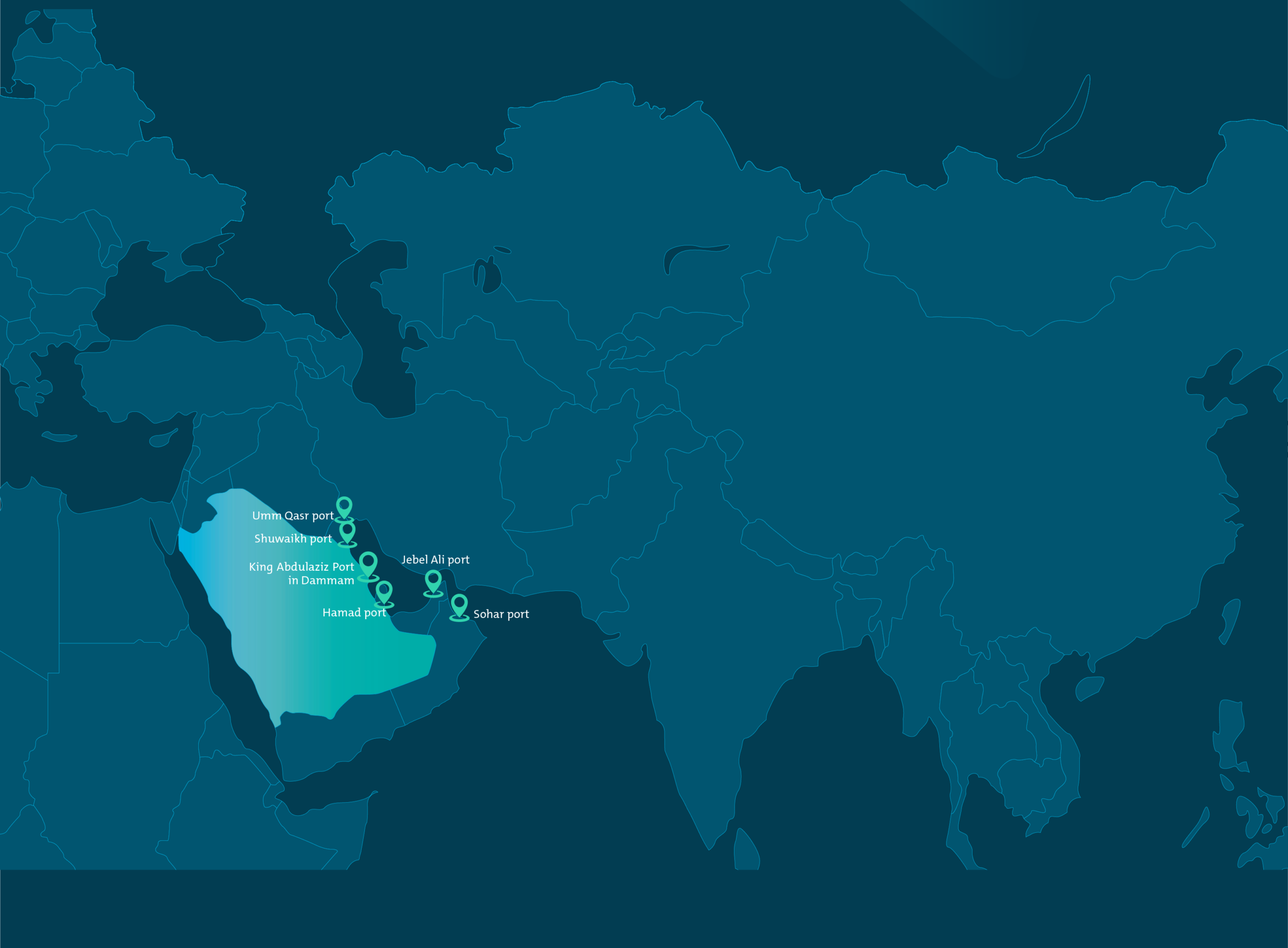
MAWANI: Adding the Shipping Service “MILAHA INTA GULF EXPRESS”by Milaha to King Abdulaziz Port in Dammam

RIYADH : The Saudi Ports Authority (Mawani) has announced the addition of the new shipping service, “MILAHA INTA GULF EXPRESS,” by Milaha to King Abdulaziz Port in Dammam. This initiative aims to enhance maritime connectivity between the Kingdom and the world while supporting national exports and imports. 

This development is part of Mawani’s ongoing efforts to strengthen strategic partnerships with major regional and global shipping lines, aligning with the objectives of the National Transport and Logistics Strategy to establish the Kingdom as a global logistics hub connecting the three continents. 

The new shipping service links King Abdulaziz Port in Dammam with the ports of Umm Qasr in Iraq, Hamad in Qatar, Shuwaikh in Kuwait, Jebel Ali in the UAE, and Sohar in Oman, with a total capacity of 1,015 TEUs. 

Notably, King Abdulaziz Port in Dammam serves as the Kingdom’s primary port on the Arabian Gulf. It is connected to the Riyadh Dry Port by railway and acts as a vital gateway for goods arriving from around the world to the Eastern and Central regions of Saudi Arabia.

Sarbananda Sonowal unveils advanced machinery to enhance shipbuilding capacity at Cochin Shipyard

KOCHI : Union Minister of Ports, Shipping and Waterways (MoPSW), Shri Sarbananda Sonowal visited the Cochin Shipyard as he unveiled advanced machinery to enhance shipbuilding capacity of the country. 

Shri Sonowal remarked that this is a movement towards realising the vision of PM Shri Narendra Modi’s ‘Atmanirbhar Bharat’.

The Union Minister inaugurated the ProArc CNC Plasma Cum Oxy Fuel Plate Cutting Machine, an advanced, Industry 4.0-ready facility that will significantly enhance CSL’s shipbuilding capabilities. Fully IoT-enabled, the system allows real-time monitoring, predictive maintenance, and increased production efficiency, directly aligning with the objectives of the Shipbuilding Financial Assistance Policy (SBFAP) 2.0.

Speaking on the occasion, Shri Sonowal said, “The launch of Industry 4.0-ready facilities and the Green Tug Transition Programme marks a transformative leap in India’s shipbuilding and green maritime journey. Under PM Shri Narendra Modi ji’s vision of Atmanirbhar Bharat, these initiatives reinforce our commitment to innovation, sustainability, and global competitiveness in the maritime sector. The indigenous development of hybrid and electric propulsion tugs is not just a technological advancement, but a symbol of India’s growing capability to lead the global green maritime movement.”

The Union Minister also presided over the steel cutting ceremony for two Green Tugs being developed under the Green Tug Transition Programme (GTTP), a flagship sustainability initiative by the Ministry. 

CSL is the first Indian company to undertake the construction of these hybrid and electric propulsion tugs, with a total of 16 vessels planned across major ports in India. The project is being executed in collaboration with Robert Allan Ltd., the Indian Register of Shipping, and other global experts, marking a major step in India’s green maritime transition.

Speaking during the visit, the Union Minister said, “Cochin Shipyard Limited stands as the Pride of India, a testament to our indigenous shipbuilding excellence and self-reliance. From building the iconic INS Vikrant to delivering over 175 vessels and completing more than 2,500 ship repair projects, CSL reflects the transformative vision of Prime Minister Shri Narendra Modi ji towards self-reliance. Under his leadership, India’s maritime sector is scaling new heights — through world-class infrastructure, national expansion, and institutions like METI that are shaping the skilled maritime workforce of tomorrow.”

The Union Minister also reviewed the progress of the construction of India’s largest Trailer Suction Hopper Dredger (12,000 cu.m), being built by CSL for the Dredging Corporation of India in partnership with IHC Holland. The dredger is a strategic national asset that will reduce dependency on foreign services while enhancing coastal access and maritime infrastructure in line with the ‘Maritime Amritkaal Vision, 2047’.

Highlighting the immense importance of human resources in the maritime sector, the Union Minister Shri Sarbananda Sonowal said, “Cochin Shipyard Limited’s innovation-led initiatives like the USHUS Marine Startup Programme reflect the spirit of ‘Aatmanirbhar Bharat’ and PM Shri Narendra Modi ji’s vision for a tech-driven maritime sector. With investments in AI, deep-tech, and renewables, these startups are fuelling job creation and maritime innovation. CSL’s strong focus on skilling—through partnerships with Maersk and initiatives like ASAP Kerala—is building a future-ready workforce and strengthening India’s global leadership in shipbuilding and marine excellence.”

The Union Minister’s visit comes at a pivotal time, first after the Union Budget of 2025–26 with its transformational scope of the budget, including the ₹25,000 crores Maritime Development Fund (MDF) expected to mobilise ₹1.5 lakh crore in maritime investments by 2030. Other budget initiatives such as the revamped SBFAP 2.0, infrastructure status for large ships, and targeted support for shipbuilding clusters are poised to revolutionise the sector.

Shri Sonowal highlighted the importance of new policies like, Merchant Shipping Bill, 2024, the Coastal Shipping Bill, 2024 among others aimed at simplifying maritime regulations, promoting Indian-flagged vessels, ensuring environmental sustainability, and enhancing seafarer welfare. With a 46% increase in the Ministry’s budget allocation and a 143% surge in R&D funding. The Minister called this a historic moment for the Indian maritime industry.

The visit concluded with a renewed call to accelerate India’s maritime journey—driven by bold ambition, anchored in Atmanirbhar Bharat, guided by Maritime India Vision 2030, and propelled by the transformative spirit of Maritime Amritkaal.

DPA Kandla felicitated the stakeholders for their exemplary contributions in crossing the historic 150+ million tons cargo handling mark

GANDHIDHAM : Marks the highest-ever volume handled in the history of Deendayal Port, with a stellar 13% year-on-year growth, the best among all major ports in the country, DPA hosted a Stakeholders Felicitation Ceremony at Dr. Babasaheb Ambedkar Convention Centre, Gandhidham, where a wide spectrum of top-performing stakeholders were honoured for their outstanding contribution across various operational domains.

Special Recognition Awards were given to:

  • Shri B.K. Mansukhani – Special Recognition for his unwavering dedication, visionary leadership and extraordinary service to the maritime industry.
  • Shri Sukhraj Singhvi –for his dedication, and a deep-rooted connection to the growth of Kandla Port and the maritime sector.

Award Categories & Recipients

I. Stevedores (Cargo-wise)

  • M/s. Rishi Shipping India Pvt. Ltd. – Best Overall Performer
    • 1st position in handling Break-bulk Cargo
    • 1st position in handling Fertilizer
    • 1st position in handling Coal
    • 1st position in handling Timber Logs
    • 2nd position in handling Dry Bulk Cargo
  • M/s. Gautam Freight Pvt. Ltd.
    • 1st position in handling Dry Bulk
    • 1st position in handling Salt
    • 1st position in handling Food Grain
  • M/s. Shree Ashapura Stevedores (A unit of Shree Ashapura Shipping Group)
    • 2nd position in handling Salt
    • 2nd position in handling Agri Products
    • 3rd position in handling Dry Bulk
  • M/s. Mihir & Company
    • 2nd position in handling Break-bulk
    • 2nd position in handling Timber
  • M/s. Shiv Shipping & Logistics
    • 2nd position in handling Coal
  • M/s. Arvind V. Joshi & Co.
    • 2nd position in handling Fertilizer
  • M/s. Shantilal Shipping
    • 1st position in Handling Agri Product (Exports)
  • M/s. Aditya Marine Ltd.
    • 1st position in handling Windmill

II. Ship’s Vessel Agents

  • Maximum Overall Vessels Handled (Kandla + Vadinar)

1st Position – M/s. Atlantic Global Shipping Pvt. Ltd.

2nd Position – M/s. Interocean Shipping

  • Highest Number of Dry Cargo Vessel calls at Kandla

1st Position – M/s. DBC & Sons

2nd Position – M/s. Cross Trade Shipping

  • Highest Capsize Dry Cargo Vessels & Tonnage Handled at Kandla

1st Position – M/s. Dariya Shipping

2nd Position – M/s. Sea Scape Shipping

  • Highest Tonnage Handled by Vessel Agents at Kandla (Including Tuna- Tekra)

1st Position – M/s. Cross Trade Shipping

2nd Position – M/s. Chowgule Brothers Pvt ltd

  • Highest 24 hrs. Cargo Tonnage Handling Record (Productivity) Handled by Stevedores During FY 2024-25

COAL – M/s. Shree Ashapura Stevedores

Salt – M/s. Shree Ashapura Stevedores

Gypsum – M/s. Shiv Shipping & Logistics

Mil Scale – M/s. RCC Limited

  • Highest Volume of Liquid Cargo Handled at Kandla

1st Position – M/s. Nayara Energy Ltd.

  • Highest number of Containerized Vessels by Shipping Lines at Kandla

1st Position – M/s TCI Seaways

2nd Position – M/s. United Liner Shipping Services LLP

Importers/Exporters at Kandla (excluding Tuna-Tekra berths)

  • Highest Quantity of Sugar – Imports & Exports:

1st Position – M/s Shree Renuka Sugars ltd

2nd Position – M/s. Shree Dutt India Pvt Ltd

  • Highest Quantity of Coal – Imports:

1st Position – M/s Ultratech Cement Ltd

2nd Position – M/s. Agarwal Coal Corporation Pvt. Ltd.

  • Highest Quantity of Coal – Imports (Kandla & Tuna-Tekra)

1st Position – M/s JSW Minerals Trading Pvt Ltd

  • Highest Quantity of Salt – Exports:

1st Position – M/s Friends Group (5 Exporters)

2nd Position – M/s. Rankers International Pvt. Ltd.

  • Highest Quantity of Finished Fertilizers – Imports:

1st Position – M/s Indian Potash Ltd

  • Highest Quantity of Steel – Imports:

1st Position – M/s Mann Industries India Ltd

Adani Port’s Colombo West International Terminal commences operations

COLOMBO : The opening of Colombo West International Terminal (CWIT) marks a proud moment in the enduring partnership between India and Sri Lanka. Developed by Adani Ports through a visionary public-private partnership, CWIT strengthens Colombo Port’s role as a leading South Asian transshipment hub. A shining example of regional collaboration, economic growth, and the deep bonds between neighbours

The development assumes significance, coming months after the multinational conglomerate withdrew another investment in Sri Lanka, a controversial wind power project of Adani Green.

Monday’s announcement marks the beginning of commercial operations at the port, but the inaugural call by a vessel is expected in May 2025, sources in Colombo indicated. The CWIT project — coming up next to the China-backed Colombo International Container Terminal (CICT) in Sri Lanka’s strategic port — is to be executed through a 35-year-long build-operate-transfer (BOT) contract among the three parties. While Adani Ports holds majority stakes of 51%, John Keells holds 34%, and the SLPA, 15%. 

Gn8z0rzXwAAr3Go Adani Port's Colombo West International Terminal commences operations

Issuing a statement on Monday, Adani Ports said the terminal project represents “a significant investment” of $ 800 million and features a 1,400-metre quay length and 20-metre depth, enabling the terminal to handle approximately 3.2 million Twenty-foot Equivalent Units (TEUs) annually. “The facility is the first deep-water terminal in Colombo to be fully automated, designed to enhance cargo handling capabilities, improve vessel turnaround times and elevate the port’s status as a key transshipment hub in South Asia,” the company said.

Chairman Gautam Adani termed it “a milestone” in India-Sri Lanka regional cooperation and said the terminal placed Sri Lanka “firmly on the global maritime map”, according to the company’s statement. Krishan Balendra, Chairperson, John Keells Group said the project “strengthens Sri Lanka’s position as a regional maritime hub.” The Sri Lanka Ports Authority has not commented.  

Past controversies

The Adani Ports-led Colombo West International Terminal (CWIT) or the West Container Terminal project has been in focus for four years now. The agreement for the project was signed in September 2021, when President Gotabaya Rajapaksa was in office. It was months after he unilaterally cancelled the East Container Terminal project that the governments of Sri Lanka, India, and Japan had agreed to jointly develop. His decision caused considerable strain in bilateral ties. Subsequently, Mr. Gotabaya offered the West Container Terminal to India, in a move that Sri Lankan officials described a “compromise” deal with India, with ‘Adani Ports’ coming in as the Indian government’s “nominee”.

The project was back in the spotlight last year, after Federal prosecutors in New York indicted Adani Group Chairman and seven others on multiple counts of fraud. The U.S. International Development Finance Corporation (DFC), which had earlier pledged over half a billion dollars in the project, said it had not disbursed any funds as it was “continuing to assess the situation”.  Meanwhile, Adani Ports withdrew the $553 million loan request from the DFC, instead deciding to fund the Colombo West International Terminal (CWIT) from internal sources.

Despite past controversies surrounding the terminal project, the ruling Anura Kumara Dissanayake government has expressed keenness to take it forward, seeing opportunity to “boost revenue” at the Colombo Port. Sri Lanka’s Minister of Transport, Highways, Ports and Civil Aviation Bimal Rathnayake described the CWIT project a “foster child” from two past governments [Presidents Gotabaya and Ranil Wickremesinghe who succeeded him]. “It was an unsolicited investment that came in without any competitive bid. But we cannot delete it like a computer programme, especially after considerable amount of infrastructure work has been done,” he told The Hindu, adding that the National People’s Power [NPP] government would try its best to follow due process in all future investments. “Also, more than 95 % of those employed at the terminal are young Sri Lankans,” Rathnayake added.

Capt Rajesh Unni receives India’s Highest Maritime Honour

NEW DELHI : Captain Rajesh Unni, founder of Synergy Marine Group, has been honoured with the National Maritime Varuna Award—India’s highest individual recognition in the maritime sector—by the Government of India, during the 62nd National Maritime Day celebrations held on 5 April 2025.

The award was presented in Mumbai by Shri Shyam Jagannathan, IAS, Director General of Shipping and Chairman of the National Maritime Day Celebrations (Central) Committee, during the official ceremony commemorating India’s rich and enduring maritime legacy.

The National Maritime Varuna Award recognises sustained and extraordinary contributions that have significantly shaped the country’s maritime landscape.

Accepting the award with gratitude and humility, Captain Unni reflected on his journey and paid tribute to the wider maritime fraternity: “This honour reflects not just one person’s work, but the shared commitment of every seafarer, colleague and mentor who has walked this journey with me. I am deeply grateful for the privilege of serving the shipping industry—a sector that has given me everything: opportunities, lifelong learning, and the chance to contribute meaningfully to the lives of others. If this award inspires even a few youngsters to consider a life at sea or reminds us of what we can achieve when we work together, then it has served its greatest purpose.”

Looking ahead, he continued: “I hope we can keep on with building a maritime world that champions human sustainability—one that is inclusive, empowering and anchored in high standards. Our seafaring and shore-based professionals are capable of far more than operating ships—we can help design, build and optimise them, and we can lead the future of shipping. The true opportunity lies in how we use technology to drive systemic impact—enhancing efficiency, empowering seafarers, and strengthening resilient supply chains that support the global economy.”

Over the past two decades, Synergy Marine Group has played a key role in reshaping the global footprint of ship management—bringing technical and operational expertise closer to India and away from traditional centres such as Hong Kong, Glasgow, and Singapore. Through its centres of excellence in Chennai, Mumbai, Cochin, Pune and Noida, Synergy has contributed significantly to generating diverse, high-value employment and advancing India’s status as a trusted global hub for maritime services.

This recognition comes at a pivotal moment for Indian shipping, as the Government of India accelerates maritime reform in line with its USD 5 trillion economy vision. The Ministry of Ports, Shipping and Waterways has announced plans to complete 150 critical infrastructure projects by September 2025. Key initiatives include the development of India’s first coastal green shipping corridor between Kandla and Tuticorin, increased investment in inland water transport—particularly across key National Waterways—and the expansion of domestic shipbuilding capacity. Additionally, the Government has proposed a Maritime Development Fund of approximately USD 3 billion (₹25,000 crore) to support shipbuilding and ship repair. Together, these efforts reflect a strategic and long-term commitment to positioning India as a global maritime leader.

India’s growing leadership in digital innovation—particularly in sectors like artificial intelligence and multilingual accessibility through initiatives such as the IndiaAI Mission and Digital India Bhashini—offers a compelling framework for inclusive, technology-enabled transformation. These national efforts complement the maritime sector’s push toward smart shipping, operational efficiency, and human-centred design.

As a maritime nation, India stands at a highly promising inflection point. With a mix of policy foresight, public-private collaboration, and sustained investment in people, the country is well positioned to lead in areas such as sustainable shipping, digital transformation, and global supply chain resilience.

Jesper Kristensen, Synergy’s Group CEO, reaffirmed the Group’s alignment with India’s maritime ambitions: “We see India as central to the future of global shipping, and as the largest third-party ship manager of Indian-flagged vessels, we are proud to contribute as much as we can to that journey.”

“At Synergy, we remain committed to aligning our technical, operational and human capital strengths with the country’s long-term maritime priorities—particularly in areas such as ship design, newbuilding supervision, technical management, digitalisation and decarbonisation R&D, and advancing human sustainability,”

“We are also pleased to serve as a worldwide platform for promoting Indian maritime expertise and innovation on the global stage,” he added. 

The National Maritime Varuna Award is presented annually as part of India’s National Maritime Day celebrations, which honour the country’s rich maritime heritage. The occasion commemorates the historic voyage of S.S. Loyalty—the first Indian-owned ship to sail internationally under the Indian flag—widely regarded as the symbolic beginning of modern Indian shipping.

About Synergy Marine Group  

Synergy Marine Group is renowned for its through-life asset management approach and innovative partnership strategies with leading shipowners. Managing over 700 vessels, including LNG carriers, LPG vessels and container ships, Synergy employs more than 28,000 seafarers across its global network. With a focus on crew wellbeing, digitalisation and sustainability, Synergy is redefining the ship management landscape.

For more information, visit https://www.synergymarinegroup.com/