Home Blog Page 134

Indian community in Japan playing key role in strengthening India-Japan ties: Piyush Goyal

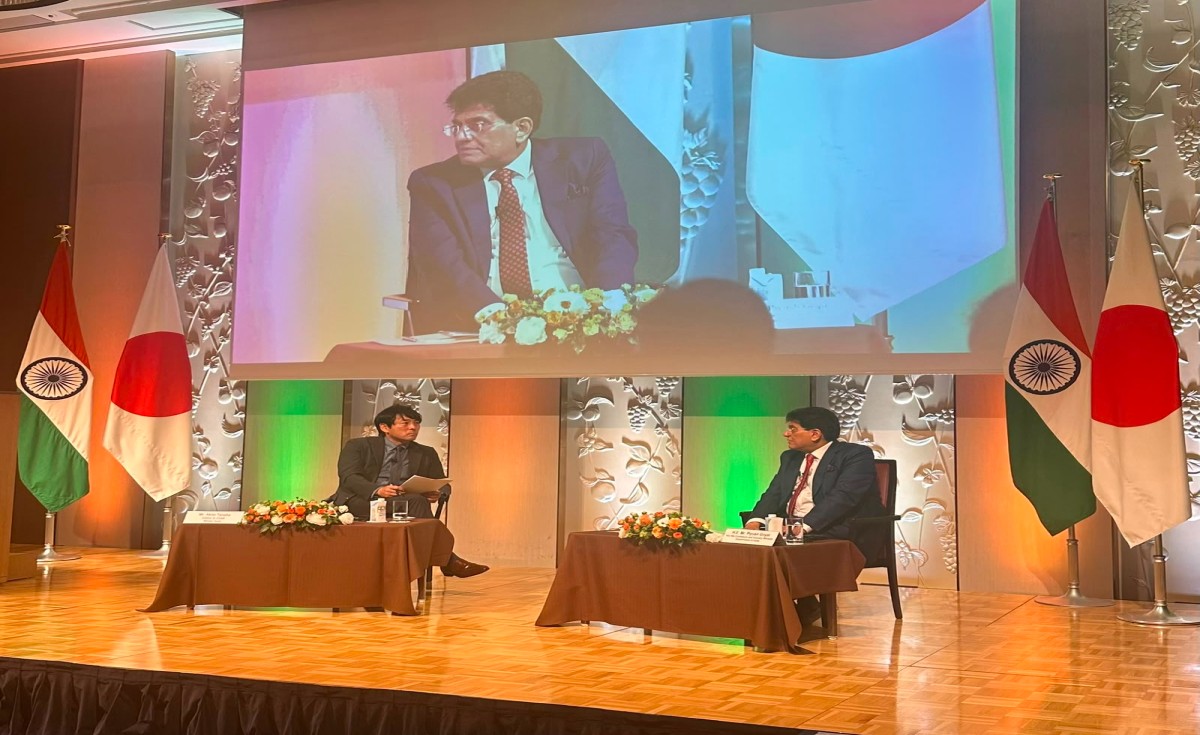
TOKYO: Union Minister of Commerce and Industry Shri Piyush Goyal addressed the Indian community in Tokyo, Japan, today and appreciated the contribution of the Indian diaspora in strengthening India-Japan ties. He described the nearly 60,000-strong Indian community in Japan as “Brand Ambassadors of India”, noting that their conduct, professionalism and contribution across different fields serve as an important introduction to India among the Japanese people.

Shri Goyal said that the energy, enthusiasm and confidence witnessed during his visit to Japan reflected the growing strength of India-Japan relations. He expressed gratitude to the Indian community for “opening the doors of Japan” for India and for building goodwill through their work and engagement with Japanese society.

He noted that more than 200 representatives from Indian industry and business were part of the delegation accompanying him during his visit to Japan. Describing it as the largest business delegation he had led to Japan, he said the strong participation reflected substantial interest on both sides in expanding business-to-business engagement and investment opportunities.

The Minister highlighted the transformation in India’s global standing over the past decade. He said that India’s growth, the country’s rising global profile and the leadership of Prime Minister Shri Narendra Modi have contributed to greater confidence and respect for India and its citizens across the world.

Shri Goyal said that India’s vision of becoming a developed nation by 2047 is founded on self-reliance, self-respect and self-confidence. He emphasised that this transformation is a collective commitment of 140 crore Indians, including the Indian diaspora across the world.

Highlighting India’s demographic advantage, Shri Goyal said that India’s young population, with an average age of around 29 years, represents a significant strength. He noted that India’s hardworking, aspirational and technology-savvy youth are increasingly creating opportunities rather than merely seeking employment.

The Minister underlined the growing attractiveness of India as an investment and business destination. He said that India’s expanding economy, young population, startups, technological capabilities and entrepreneurial ecosystem are creating significant opportunities for global businesses and investors.

Shri Goyal also highlighted India’s expanding network of trade agreements. He said that India has made significant progress in concluding trade agreements with several countries in recent years, reflecting the growing confidence of global partners in the Indian economy and its future potential.

The Minister said that discussions with Japanese companies, including those working in advanced technologies, semiconductors and artificial intelligence, demonstrated the growing interest in India. He noted that Japanese businesses are keen to expand their engagement with India and are looking at opportunities across emerging and high-technology sectors.

Shri Goyal also highlighted the opportunities for Indian professionals in Japan. He said that there is significant demand for skilled workers across sectors, including caregivers, nurses, welders, carpenters, electricians, plumbers, drivers, engineers, artificial intelligence professionals, chartered accountants and seafarers. He encouraged members of the Indian community to understand local requirements, learn the Japanese language and culture, and contribute to strengthening people-to-people and economic ties between the two countries.

The Minister urged the Indian diaspora to retain a strong connection with India while respecting the laws, regulations and way of life of Japan, which is their “Karmabhoomi”. He suggested that members of the community could also contribute to the development of their hometowns and villages in India through initiatives such as digital education, online training and knowledge-sharing.

Shri Goyal highlighted the important contribution of the Indian diaspora to India’s economy through remittances. He said that remittances support families, generate economic activity and contribute to savings and investment, thereby making the diaspora an important partner in India’s development journey.

He also emphasised the Government’s commitment to the welfare and safety of Indians abroad. Referring to India’s efforts to evacuate and assist citizens during crises in different parts of the world, he said that the Government remains committed to ensuring the safety and well-being of Indian citizens wherever they may be.

Recalling India’s evacuation efforts during the Ukraine conflict, Shri Goyal said that the Government had worked across countries and coordinated extensive efforts to bring Indian students and other citizens safely back to India.

The Minister also recalled the efforts made to assist Indian fishermen stranded in the region during the recent conflict in West Asia. He highlighted the role of Indian diplomatic missions, local authorities and members of the Indian diaspora in registering citizens, coordinating their movement and facilitating their safe return to India.

Shri Goyal said that these efforts demonstrate the strong bond between India and its diaspora. He reiterated that Indians living abroad remain an integral part of India’s development journey and that the Government will continue to stand with them during times of need.

“Never forget India, and neither will we ever forget you,” Shri Goyal said, while expressing his appreciation for the contribution of the Indian community in Japan and across the world.
India-Japan investment partnership gains momentum; Piyush Goyal invites Greater Japanese Institutional Capital

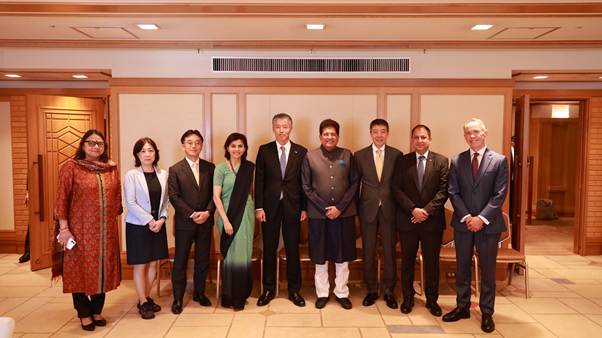
TOKYO: Union Minister of Commerce and Industry, Shri Piyush Goyal, on Tuesday held discussions in Tokyo with senior leaders of leading Japanese financial and investment institutions on strengthening long-term capital flows, deepening investment partnerships and expanding Japanese participation in India’s growth story.

The meeting brought together senior representatives of MUFG, Development Bank of Japan (DBJ), Mizuho, Morgan Stanley, Nomura and Nippon Life. The discussions focused on India’s economic outlook, emerging investment opportunities and measures to further facilitate Japanese institutional investment in India.

Shri Goyal highlighted the strength and resilience of the Indian economy, noting that India recorded 7.7 per cent growth last year despite global uncertainties and is working towards becoming a USD 30 trillion economy by 2047. He underlined the strength of India’s banking sector, robust capital adequacy, low levels of non-performing assets, expanding middle class and rising disposable incomes as key drivers of sustained economic growth.

The Minister highlighted significant opportunities for Japanese investors in semiconductors, artificial intelligence, data centres, renewable energy, green hydrogen, advanced manufacturing and digital infrastructure. He noted that India’s expanding renewable energy capacity and national power grid provide a strong foundation for the growth of energy-intensive digital industries, while the India Semiconductor Mission is creating new opportunities across manufacturing and technology.

Highlighting the strategic and comprehensive nature of India-Japan relations, Shri Goyal said India regards Japan as a trusted partner in its journey towards becoming a global manufacturing, technology and investment hub. He emphasised India’s commitment to intellectual property protection, availability of high-quality talent, policy reforms and creating an increasingly conducive business environment.

The Japanese financial institutions shared their growing engagement with India and expressed strong confidence in the country’s long-term growth prospects. MUFG highlighted its investment of around USD 4 billion in Shriram Finance and its expanding interests in areas including renewable energy and hydrogen. DBJ outlined its dedicated India strategy and growing interest in property development, venture capital and other long-term investment opportunities.

Mizuho highlighted the improving profitability of Japanese companies operating in India and the expansion of its India operations, including its Global Capability Centre in Pune. Morgan Stanley described India as one of its most important global locations, with more than 19,000 employees, and highlighted the evolution of its India operations towards higher-value capital markets and financial services activities.

Nomura highlighted its long-standing presence in India and its role in connecting Japanese companies and global industries with Indian opportunities, including through technology capabilities in areas such as artificial intelligence and cybersecurity. Nippon Life emphasised the importance of long-term “patient capital” and noted the strong returns generated by its Indian operations.

The discussions also covered measures to further facilitate the flow of Japanese institutional capital into India. Participants highlighted the importance of simplifying processes for profit repatriation, improving access to Indian capital markets and ensuring greater regulatory predictability for long-term investors.

The Japanese institutions reiterated that their long-term strategic outlook on India remains strongly positive, while noting that currency movements and certain regulatory and policy considerations can influence short-term investment decisions. Shri Goyal welcomed the feedback and reiterated the Government’s commitment to continuously improving the ease of doing business and creating a more seamless investment environment.

The meeting also explored the potential of GIFT City as a gateway for international capital into India and as a platform for facilitating greater cross-border investment flows between Japan and India.

Shri Goyal emphasised that India is seeking not merely capital but long-term partnerships that bring technology, innovation, manufacturing capabilities, employment and integration with global value chains. He highlighted opportunities in both new and emerging sectors and established businesses requiring modernisation and technological upgrading.

The discussions assume significance in the context of the India-Japan objective of mobilising 10 trillion yen of Japanese private investment into India over the next decade. The interaction reaffirmed the strong confidence of leading Japanese financial institutions in India’s long-term growth prospects and highlighted the considerable potential for expanding bilateral investment, technology and business linkages.

The meeting marked another important step towards deepening the India-Japan economic partnership and unlocking greater flows of long-term Japanese institutional capital into India’s next phase of growth.

Piyush Goyal chairs India-Japan industry roundtable on semiconductors and AI in Tokyo

TOKYO: Union Minister of Commerce and Industry, Shri Piyush Goyal, on Tuesday chaired a roundtable with leading Japanese and Indian industry representatives on Semiconductors and Artificial Intelligence (AI) in Tokyo, underlining the growing importance of these sunrise sectors in strengthening India-Japan economic and technological cooperation.

Shri Goyal highlighted that Semiconductors and AI are emerging as key areas of cooperation and constitute an important pillar of the economic security partnership envisaged by Prime Minister Shri Narendra Modi and Prime Minister Sanae Takaichi during the Annual Summit. He assured the participating industry representatives of the Government of India’s wholehearted support in deepening and expanding collaboration between India and Japan in these strategic sectors.

The Minister highlighted the rapidly expanding opportunities in India’s semiconductor sector, with domestic semiconductor demand projected to reach USD 150 billion by 2032. He outlined the Government’s comprehensive semiconductor strategy covering chip design, semiconductor machinery and materials, fabrication, ATMP/OSAT, research and development, and talent development. He also highlighted the Government’s commitment of USD 10 billion under Semicon India 1.0 and an additional USD 15 billion under Semicon India 2.0 to catalyse large-scale investments and build a comprehensive semiconductor ecosystem in the country.

Shri Goyal emphasised the significant potential for combining India’s vast pool of skilled and talented professionals with Japan’s advanced technology, engineering capabilities and industrial expertise. He noted that such complementarities can create new opportunities for investment, innovation, manufacturing and technology partnerships between the two countries.

The roundtable was attended by representatives of around 21 leading Japanese companies, including Tokyo Electron, Daifuku, Preferred Networks, ABEJA, MinebeaMitsumi, Tanaka Precious Metals Technologies, Fujifilm Holdings, Toray Industries, Nippon Express Holdings, Mizuho Financial Group, Kyocera Corporation, Fuji Electric, TOK, Air Water Inc., ROHM, Tomoegawa Corporation, MUFG Bank Ltd., NEC Corporation, Yamaya Electronics, ANA Trading and JETRO. The roundtable also saw participation from various Indian business chambers and business delegations.

The participating Japanese companies expressed confidence in the growing opportunities in India’s semiconductor and AI sectors and reaffirmed their commitment to Make in India, Design in India and Develop in India. The companies also briefed the Minister on their operations, capabilities and project execution in the relevant sectors.

Responding to suggestions and concerns raised by Japanese industry representatives, Shri Goyal assured that the Government of India would proactively address the issues raised. He emphasised that India is fully cognisant of the significant potential of the India-Japan partnership in these strategic sectors and will proactively engage with industry through the Embassy of India in Tokyo and the concerned Ministries and Departments in New Delhi to facilitate fruitful outcomes in a fast-tracked manner.

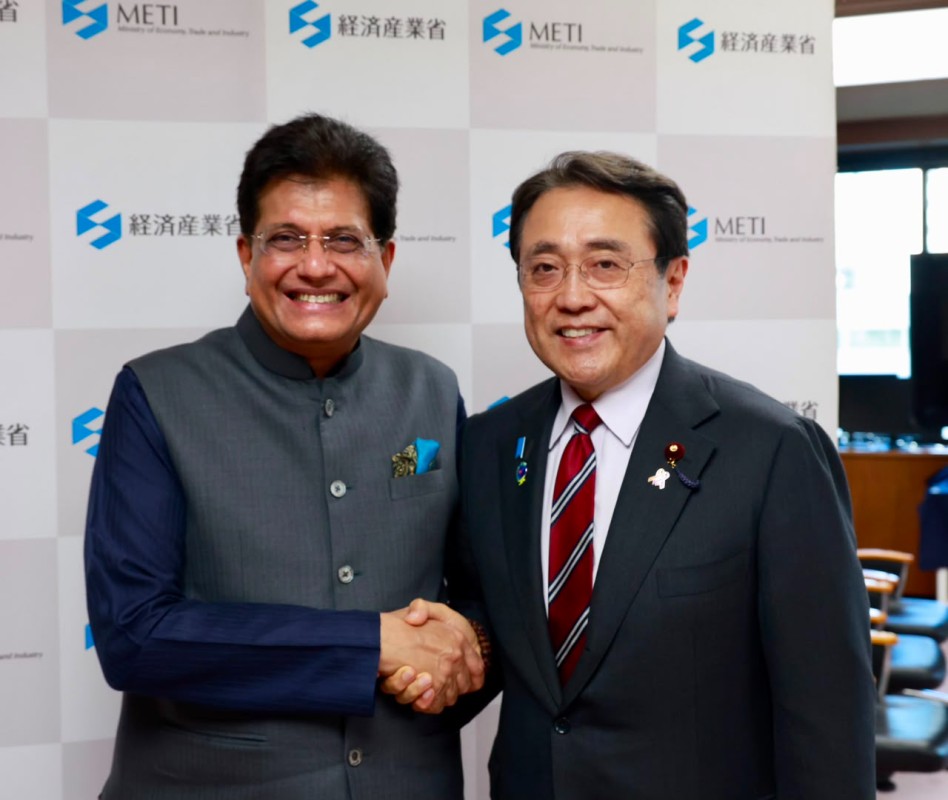
Earlier, Shri Goyal held a bilateral meeting with Japan’s Minister of Economy, Trade and Industry, H.E. Mr. Akazawa Ryosei, on 25 August 2026 in Tokyo.

During the meeting, the two Ministers took stock of bilateral economic cooperation, including bilateral trade and investment, and discussed the need to accelerate the review of the Comprehensive Economic Partnership Agreement (CEPA) to make it more forward-looking and responsive to emerging economic opportunities.

The Ministers also discussed bilateral cooperation in new and emerging sectors, next-generation industries, manufacturing, technology and innovation. They noted the steady progress towards achieving the target of JPY 10 trillion in private investment from Japan to India, further strengthening the India-Japan Special Strategic and Global Partnership.

Goa Shipyard Ltd hands over ICGS Ajit to Indian Coast Guard

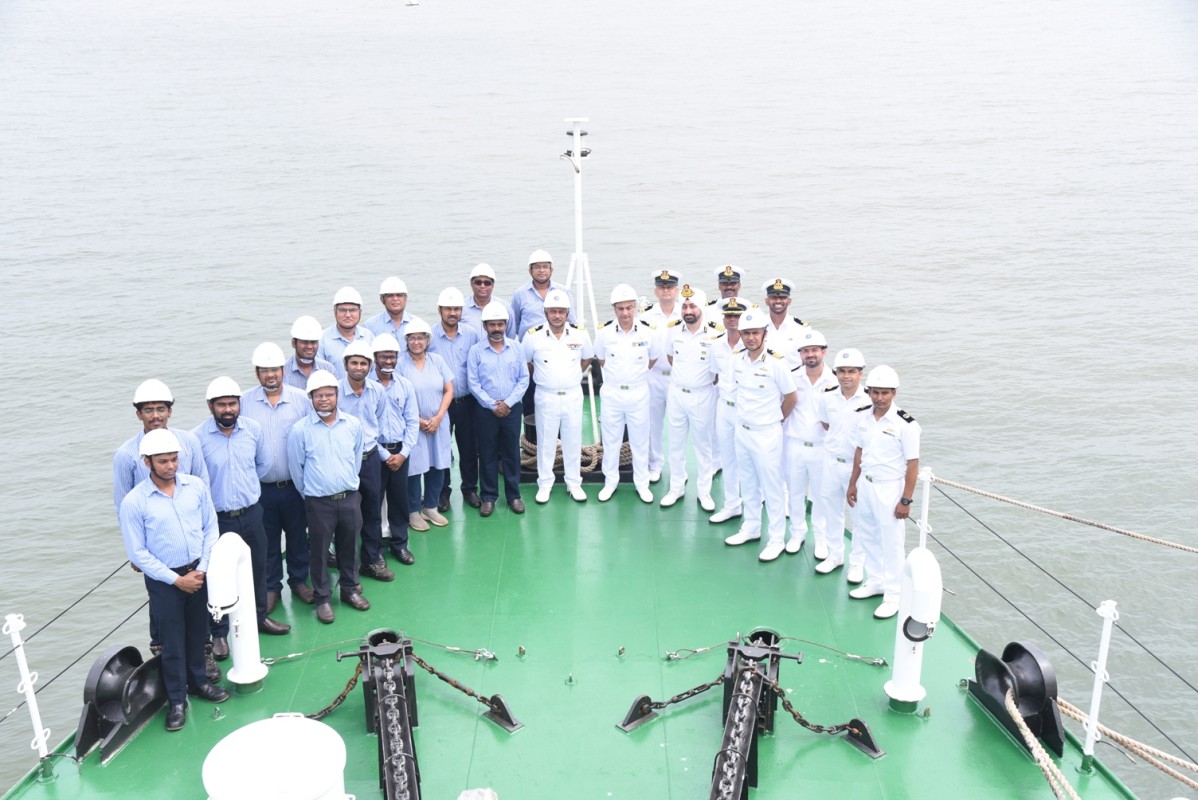
GOA: Goa Shipyard Limited (GSL), a leading Defence Public Sector Undertaking, achieved another milestone in indigenous shipbuilding with the formal handing over of ICGS Ajit (Yard 1277), a state-of-the-art Fast Patrol Vessel (FPV), to the Indian Coast Guard on Tuesday.

The handing-over ceremony was preceded by the First Reading Ceremony and was attended by GSL Chairman and Managing Director Shri Brajesh Kumar Upadhyay, Director (Operations) RAdm Nelson D’Souza, NM, IN (Retd), Director (Finance) Shri Jahangeer Alam Ansari, Director (CPP&BD) Shri Nagesh Das Pai, DIG V. K. Parmar, TM, PD (MAT), and Commanding Officer of ICGS Ajit Comdt (JG) Manish Talan, along with senior officials of the Indian Coast Guard and GSL.

Built with more than 65 per cent indigenous content, ICGS Ajit reflects the growing capabilities of India’s domestic defence shipbuilding industry and the Government’s vision of Atmanirbhar Bharat.

The 51.43-metre-long and 8-metre-wide vessel has a displacement of 330 tonnes at a draught of 2.5 metres. It is powered by twin marine diesel engines driving controllable pitch propellers (CPP), a first-of-its-kind feature in this class of Fast Patrol Vessels, providing improved propulsion efficiency and operational performance.

With a top speed of more than 27 knots and an endurance of 1,500 nautical miles, the vessel is equipped with an advanced integrated machinery control system to enhance operational readiness, efficiency and sustainability.

ICGS Ajit will be operated by a crew of 6 officers and 35 sailors. The vessel has been designed to undertake a range of critical maritime security missions, including fisheries protection, Exclusive Economic Zone (EEZ) surveillance, coastal patrolling, anti-smuggling and anti-piracy operations, as well as search and rescue missions.

The induction of ICGS Ajit will strengthen the Indian Coast Guard’s capabilities in safeguarding India’s coastal and offshore areas and contribute to the country’s maritime security architecture.

The handing over of the vessel further underlines Goa Shipyard Limited’s commitment to delivering advanced, high-performance platforms for India’s defence forces. It also reinforces GSL’s role in advancing indigenous shipbuilding, promoting defence self-reliance and supporting India’s ambition to emerge as a global shipbuilding hub under the Make in India initiative.

With continued focus on technology, innovation and indigenisation, GSL remains committed to strengthening India’s maritime capabilities and contributing to the growth of the country’s blue economy.

CBIC extends customs facilitation for international cargo disrupted by Strait of Hormuz closure till 31 October 2026

NEW DELHI : The Central Board of Indirect Taxes and Customs (CBIC), Department of Revenue, Ministry of Finance, has issued Circular No. 36/2026-Customs dated 20 August 2026 prescribing facilitative measures for international cargo affected by disruption of maritime routes and uncertainties in the Gulf region.

The Circular has been issued in the context of the return/diversion of export and international cargo from international waters due to the closure of the Strait of Hormuz, and under the facilitative framework provided under Section 143AA of the Customs Act, 1962. It also refers to the earlier Circular No. 12/2026-Customs dated 17 March 2026, Circular No. 15/2026-Customs dated 27 March 2026 and Circular No. 25/2026-Customs dated 14 May 2026, issued in connection with the ongoing West Asia crisis.

The Board noted that representations have been received from trade and industry highlighting that operational challenges arising from disruption of maritime routes and uncertainties in the Gulf region continue to persist. These circumstances have necessitated continuation of the facilitative framework for transhipment of international cargo through Indian ports.

To facilitate uninterrupted international trade, CBIC has clarified that international transhipment of both Full Container Load (FCL) and Less than Container Load (LCL) cargo shall be permitted from all seaports and international airports, including cases involving transhipment through other Customs stations, subject to compliance with the Customs Act, 1962 and the rules made thereunder.

The Circular has also prescribed temporary measures for the transhipment of Liquid Bulk, Break Bulk and Solid/Dry Bulk international cargo. Jurisdictional Principal Commissioners/Commissioners of Customs may permit the temporary unloading, storage and transhipment of such cargo destined for foreign ports where vessels are compelled to divert to an Indian port owing to maritime security concerns, disruption of international shipping routes or other logistical exigencies.

Such cargo may be temporarily stored in Customs areas, bonded warehouses, bonded tanks, silos, yards or other approved storage facilities solely for the purpose of onward international transhipment or re-export.

Permissions may be granted on a case-to-case basis and will be subject to Customs supervision during discharge, ullage survey and quantity determination. The cargo will be required to remain under the custody of an approved custodian under Section 45 of the Customs Act, 1962, with proper inventory records, suitable bond or undertaking, testing of cargo and continued Customs control.

The Circular makes clear that such cargo shall not be cleared for home consumption or diverted into the Domestic Tariff Area.

For Solid/Dry Bulk Cargo, the same operational framework applicable to Break Bulk Cargo will apply, particularly in respect of weighment, quantity verification and safeguards against diversion. Repacking of bulk cargo, wherever operationally necessary, may also be permitted within the Customs area on a case-to-case basis under Customs supervision, subject to maintenance of proper accounts and compliance with applicable statutory provisions.

CBIC has further directed that the procedures prescribed under Circular No. 14/2007-Cus dated 16 March 2007, Circular No. 12/2026-Customs dated 17 March 2026 and Circular No. 15/2026-Customs dated 27 March 2026 for international transhipment of FCL/LCL cargo from ports and airports shall continue to be followed.

The designated Nodal Officer shall ensure that permissions for international transhipment are granted on priority by the jurisdictional Assistant/Deputy Commissioner of Customs, duly authorised by the jurisdictional Commissioner, after necessary verification.

For transhipment involving multiple Customs stations, the existing procedure under Circular No. 15/2026-Customs will continue to apply. The Nodal Officer at the originating Customs station will obtain prior consent through official email from the concerned transit or destination Customs station.

The transit or destination Customs station will convey its consent after verifying the availability of sufficient, safe and secure storage space, adequate infrastructure and logistics support, and its readiness to handle and supervise the transhipment cargo. Once such consent is received, permission for transhipment may be granted at the originating Customs station on priority. Movement of cargo will take place under appropriate Customs control, including sealing of containers wherever required.

The Custodian at the originating, transit and destination Customs stations will remain responsible for the safe custody, secure storage, proper handling and accounting of transhipment cargo throughout the period for which the cargo remains under their charge. Custodians are also required to maintain proper records, facilitate Customs supervision and immediately report any discrepancy, damage or irregularity in the cargo.

The provisions of Circular No. 36/2026-Customs shall remain in force up to 31 October 2026.

UN Secy-Gen urges for immediate end to attacks on commercial shipping amid threats to global trade routes

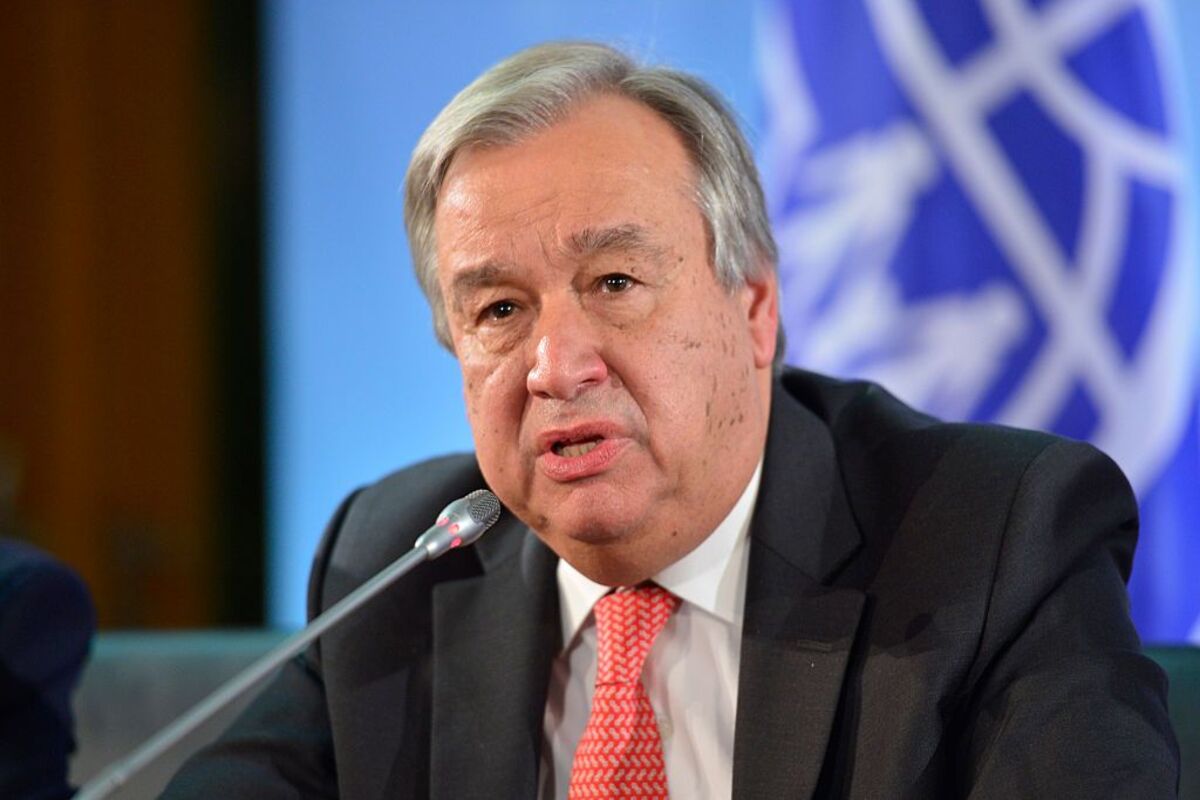
NEW YORK: United Nations Secretary-General Antonio Guterres has called for an immediate end to attacks on commercial shipping and civilian infrastructure as conflicts threaten key global trade routes.

Guterres urged all parties to respect international law and including the law of the sea and international humanitarian law, along with protection for civilian shipping, infrastructure and civilian seafarers in the Black Sea, Strait of Hormuz and Red Sea.

The United Kingdom Maritime Trade Operations reported that an oil tanker was hit by an unknown projectile near Oman and advised vessels to exercise caution.

Meanwhile, the US has said that it had redirected 71 commercial vessels, disabled three and boarded two as part of its blockade of Iran. Washington also imposed sanctions on nearly 60 entities, individuals and vessels linked to Iran’s military and energy sectors.

UNSC should act immediately to mitigate humanitarian fallout of conflicts: India

NEW YORK: Highlighting that conflicts present one of the most severe threats to global food security, India has asserted that the United Nations Security Council‘s immediate priority must be to take action to mitigate the humanitarian fallout of hostilities.

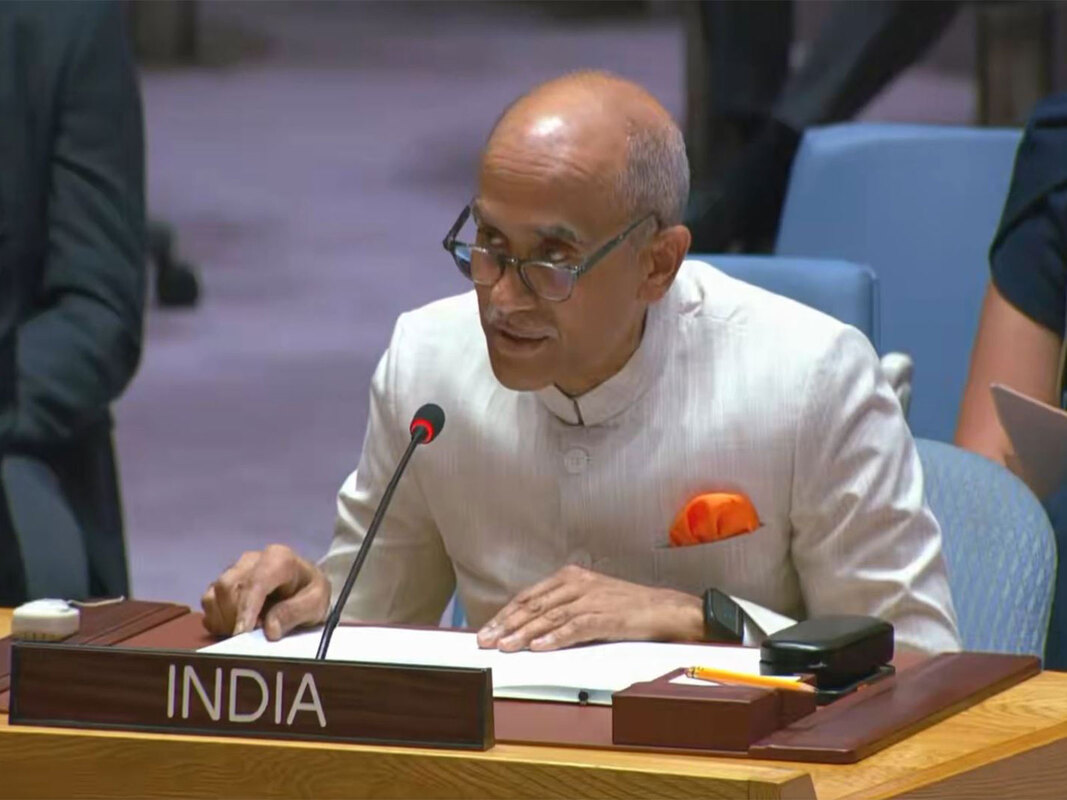
Addressing a Council open debate titled “Food Under Fire: The Security Council’s Role in Mitigating Global and Local Food Crises” on Tuesday, India’s Permanent Representative P Harish noted, “Today’s conflicts increasingly generate ripple effects far beyond the immediate theatre of hostilities.”

“Disruptions to energy markets, fertiliser supplies, maritime transport, humanitarian logistics and agricultural trade have demonstrated how regional conflicts can threaten food security across the world,” Harish said.

Pointing out that developing nations with high import dependency bear a disproportionate burden of such disruptions, the Indian envoy stated, “The Council’s immediate priority should be to mitigate the humanitarian consequences of conflict. This requires facilitating safe, rapid and unimpeded humanitarian access, supporting de-confliction arrangements.”

He further urged that the Security Council must ensure its measures, including sanctions, “do not inadvertently impede humanitarian assistance or legitimate food and agricultural trade.”

Harish, however, underlined that “building resilient, food-secure societies remains primarily the responsibility of national governments, supported by the UN development system and the Rome-based agencies”, rather than the Security Council.

While speaking broadly on the risks posed to food security by disruptions across commercial shipping lanes and maritime trade routes, Harish did not explicitly name specific conflict zones.

In contrast, UN Secretary-General Antonio Guterres directly cited three major geopolitical flashpoints jeopardising global food supplies, pointing to the Black Sea, the Strait of Hormuz, and the Red Sea.

“The war in Ukraine is affecting grain and energy exports in the Black Sea, both from Ukraine and Russia,” Guterres stated.

The UN chief observed that closures and restrictions in the Strait of Hormuz, a crucial maritime passage handling a fifth of global oil supplies and a third of world fertiliser trade, “have driven up commodity prices, and made availability plummet.”

“Attacks on commercial vessels in the Red Sea are further threatening supply chains for food and other commodities”, Guterres added.

To address the bottleneck, Guterres revealed that the UN has put forward practical frameworks to facilitate the passage of fertilisers and foodgrains through a protected corridor in Hormuz.

“This time-bound confidence-building effort would focus initially on fertilisers and related raw materials, but with the ability to be extended to other products”, he said.

Building on initial proposals framed in March, Guterres announced on Monday that a task force spearheaded by the Office for Project Services (UNOPS) has formulated an operational structure to register and verify vessels transporting fertiliser and associated products to ease transit.

“What is needed now is the cooperation and political will of the parties”, Guterres said, urging, “I urge all concerned to engage seriously and constructively.”

Echoing similar concerns, World Food Programme Acting Director Carl Skau warned that “serious disruptions to maritime trade now threaten to push tens of millions more people into food insecurity.”

Source: ANI

MSC returns to the red sea with 7 container ships

TRIESTE: MSC has resumed shipping its container ships passing through the Red Sea and the Bab el-Mandeb Strait. At least seven ships The company’s vessels have been sailing eastbound on this route over the past two weeks, even though the world’s leading container carrier has not announced the resumption of its services via the Suez Canal.

The situation therefore still appears to be different from a structural return. On MSC’s official website, the East-West network continues to be labeled “Network via Suez (on hold).” The transits recorded in August therefore seem to represent, at least for now, an operational decision regarding individual ships and services rather than a general change to the network.

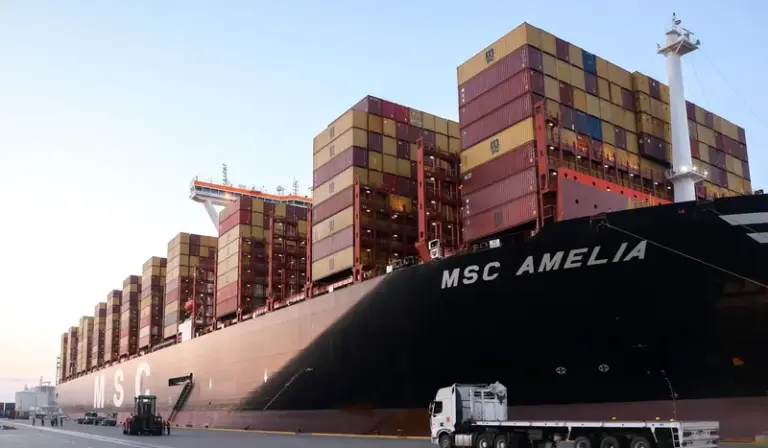
Linerlytica reported these movements, noting that the seven eastbound crossings involved various routes from Europe and the Mediterranean to China. Among the vessels listed is the 23,782-TEU MSC Amelia, which operates on the Tiger service between the Mediterranean and Asia. The analyst also forecasts additional transits through the Red Sea over the next two weeks.

MSC’s caution contrasts with the more explicit approach adopted in recent weeks by Maersk and Hapag-Lloyd. On August 10, the two partners in the Gemini Cooperation officially announced the rerouting of the AE19 service from the route around the Cape of Good Hope to the route through the Suez Canal. The change began with the Berlin Maersk and applies to both directions of travel. The AE19 service connects Asia, the Mediterranean, Saudi Arabia, and Europe.

In this case as well, however, the two companies are talking about a gradual return. Maersk clarified that no further changes to the other Gemini services are currently planned and that there is no timeline for returning the entire East-West network to the Suez route. The process had already begun in the preceding months. In July, Maersk had resumed the MECL service—operated independently by the company—across the Red Sea, as well as the WAF6 service between the Middle East, the Mediterranean, and West Africa. On the MECL, the carrier estimated that the new route would save approximately seven days on westbound voyages and 14 days on eastbound voyages compared to the detour around Africa.

Some Gemini services had also already been gradually shifted back to the corridor. Maersk and Hapag-Lloyd have made structural changes to the AE15 service and, starting in August, have also added a stop in Jeddah. However, the companies have explicitly retained the option to return to the Cape of Good Hope route should security conditions in the Red Sea deteriorate.

Hapag-Lloyd confirms that the situation is still far from the pre-crisis normalcy. In its latest official update, revised on August 14, the German group states that the vast majority of its services continue to be routed around the Cape of Good Hope. Only the SE3 and SE4 services of the Gemini network currently transit through the Red Sea and Suez, using vessels operated by Maersk. The group anticipates a gradual return to the route, but not an immediate one

Maersk sends 17,200-TEU Bangkok Maersk through Suez for first time

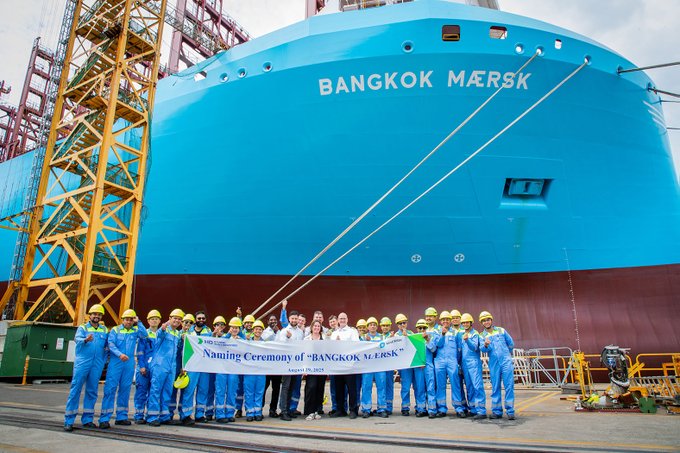
COPENHAGEN: Maersk’s 17,200-TEU Bangkok Maersk made its first Suez Canal transit on 22 August, joining the northbound convoy on a voyage from Italy to Singapore as the liner’s traffic through the waterway increased, according to the Suez Canal Authority.

The 190,000-ton containership is 350 metres long with a beam of 56 metres. It is equipped with a dual-fuel engine capable of running on green methanol to reduce carbon emissions.

Bangkok Maersk is deployed on Maersk’s AE7 service, which directly connects major Asian ports with northern European and Mediterranean ports.

The ship was one of two Maersk-affiliated containerships in the northbound convoy that day. Mathilde Maersk led Canal traffic at 200,000 tons, followed by Bangkok Maersk.

SCA chairman and managing director Ossama Rabiee said navigation records were showing a considerable increase in daily traffic by Maersk-affiliated containerships and that several Europe-Asia maritime services had returned to the Canal.

Bangkok Maersk master Pata Radu said choosing the Suez Canal instead of sailing around Africa saves about 14 days, cutting voyage time and costs while supporting customers’ interests.

Radu also highlighted the New Suez Canal Project, the recently completed southern sector development project and the role of SCA pilots in vessel transits.

Under SCA protocol for ships making their first Canal transit, Distinguished Chief Pilot Hesham Helmy and Chief Pilot Galal Shabaka boarded Bangkok Maersk to welcome the crew and present a commemorative gift to the master.

A total of 57 vessels transited the Suez Canal that day, with combined net tonnage of 2.8m tons.

A.P. Moller – Maersk A/S is a Danish transport and logistics group with operations spanning ocean shipping, terminals, warehousing and other supply-chain services. The group operates in 130 countries and deploys more than 700 containerships.

The Suez Canal Authority is an Egyptian public authority with independent legal personality. Established in 1956, it manages, operates, maintains and develops the Suez Canal and sets the waterway’s navigation rules.

Iran threatens 45 tankers with fines, confiscation in Hormuz escalation

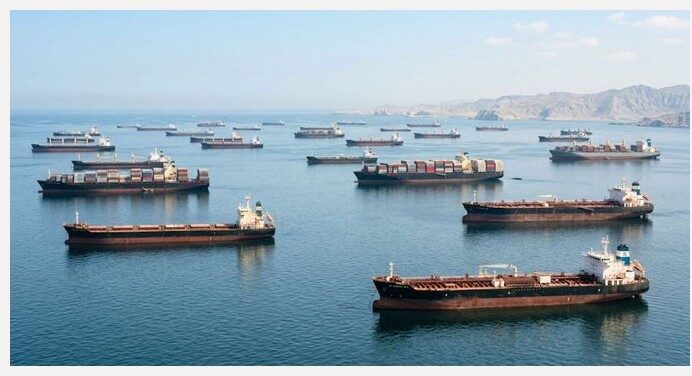
TEHRAN: Iran said it had blacklisted 45 tankers that had broken its rules for crossing the Strait of Hormuz, and would take action against ​any vessels transferring loads with them, escalating its threats over the key waterway six months into the ‌war.

The named vessels could be fined, detained and have their cargoes confiscated, according to an X post late on Sunday from the Persian Gulf Strait Authority, a new body set up by Iran to manage the strait.

The warning was issued within days of the ​U.S. threatening Iran with “the toughest sanctions in history”, and Iran saying its response to any new U.S. ​threats would be “devastating”. The restricted list includes very large crude carriers, liquefied natural gas and liquefied ⁠petroleum gas tankers, and clean product vessels, among others.

Some of the named ships are owned by the United Arab ​Emirates’ ADNOC Logistics and Shipping (ADNOC L&S), ADNOC’s subsidiary Navig8 Tankers, and Saudi Arabia’s national shipping carrier Bahri. Any vessels involved ​in ship-to-ship transfers with the named vessels could be added to the blacklist, the Iranian X post added.

The post did not spell out what it meant by Iran’s rules, but Tehran has in the past said ship-owners should get its clearance to transit the ​strait and said ships should pay for security and other services.

The U.S. has also imposed a naval blockade ​against Iran-related shipping.

The Gulf supplied about 20% of the world’s daily crude oil and liquefied natural gas before the Iran conflict disrupted ‌tanker ⁠traffic.

U.S.-coordinated efforts to shuttle tankers quietly through the Strait of Hormuz to fill supertankers waiting just outside it are helping restore some of those export volumes.

U.S. Secretary of Energy Chris Wright said on X on Friday that the “7-day average of oil leaving the Strait is over 8 million barrels a day. Make no mistake, thanks to the U.S. ​Navy, oil is flowing ​through the Strait of Hormuz.”

Ships ⁠owned by Klaveness Ship Management, Stolt Tankers and South Korea’s Sinokor were also included on the blacklist.

ADNOC declined to comment, while other shipping firms did not immediately respond ​to Reuters’ requests for comment.

The Persian Gulf Strait Authority has said cargo owners should ​refer to an ⁠updated list of vessels deemed non-compliant for voyages relating to the Gulf.

Ships seeking the removal of their names from the non-compliant vessels’ list must submit a request with relevant explanations to Iran’s maritime authorities, the post said.

Source: Reuters