Home Blog Page 19

Sarbananda Sonowal lays foundation stones for projects worth Rs 560 crore at Visakhapatnam Port

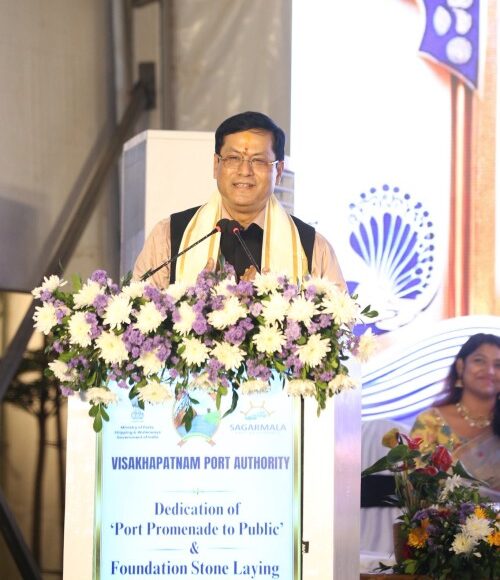
VISAKHAPATNAM: Union Minister of Ports, Shipping and Waterways (MoPSW), Shri Sarbananda Sonowal, in Visakhapatnam, dedicated a waterfront promenade at the Visakhapatnam Port to the public and laid foundation stones for four new projects, bringing the port’s package of new works to about Rs 560 crore.

The Rs 19 crore Port Promenade runs about 710 meters (2,330 feet) along the water from the Venkateswara Temple to the International Cruise Terminal and covers about 5.5 acres. The promenade gives residents a regulated, safe place to watch ships and port operations for the first time. “It opens up the port to the city,” Sonowal said. “This project is dedicated to the people of Visakhapatnam.”

The promenade has a waterfront walkway and two view decks, one a Titanic-style viewpoint, along with a park, a public plaza, a children’s play area, a food court and visitor parking. It was built on existing port land without affecting cargo operations. Its location beside the cruise terminal is also meant to add to the terminal’s appeal for cruise passengers.
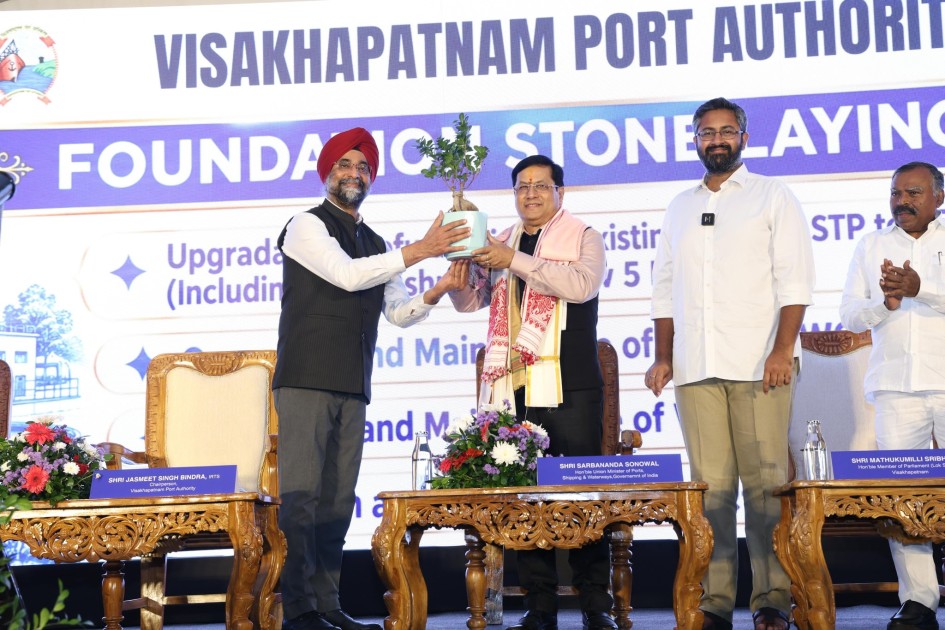

Sonowal tied the project to Prime Minister Shri Narendra Modi‘s vision of inclusive development, in which citizens are not just beneficiaries but active partners in building the nation. A port that was once closed to outsiders now invites residents in, he said, and the new terminal contracts will give about 500 local people jobs running its berths.

“Prime Minister Narendra Modi’s vision is a development in which every citizen has a place and a part to play,” Sarbananda Sonowal said. “A port that opens its gates to the people, and gives local youth the work of running its berths, is that vision in action.”

Sonowal also laid foundation stones for three contracts to operate and maintain existing cargo terminals, together worth about Rs 580 crores. They cover the WQ-1 and WQ-1RE berths; WQ-2 and WQ-3; and EQ-3. Operators must mechanise the berths with cranes and conveyors, with environmental controls, and will employ about 500 local people. “Through these projects, VPA will secure assured cargo throughput and achieve optimum capacity utilisation in these berths,” Sarbananda Sonowal said.

The Union Minister also laid the foundation stone for upgrading the port’s sewage treatment plant from 10 million liters a day to 15 million liters, including a new 5 million-liter plant, at an estimated cost of about Rs 11 crores. Treated water is used for dust suppression, wetting roads and sprinkling at stockpile yards, and the upgrade supports the ministry’s Harit Sagar green port initiative.

Sonowal said the port handled a record 91.17 million metric tons of cargo in the 2025-26 fiscal year, about 10% more than a year earlier and its fourth straight year of growth. From April 1 to Oct. 31, cargo rose by 4.44 million metric tons, or 8.88%, over the same period last year. “You must beat last year’s target of 10% growth,” Sonowal encouraged the port employees as he spoke and interacted with them.

The initiatives were launched as Sonowal is going to speak at the 31st CII Partnership Summit–2026, which the Andhra Pradesh government is hosting on November 12 and 13, which is themed under ‘Navigating New World Order: Trade, Technology, Trust.’

The port has taken up four Public-Private Partnership (PPP_ projects worth about Rs 800 crores, which are under construction and expected to be commissioned by 2027. It has one of the deepest container terminals among India’s major ports, with a permissible draft of 16 meters, and is shifting to a landlord-port model to cut vessel turnaround time and logistics costs.

Sonowal credited Prime Minister Shri Narendra Modi’s leadership for transforming Indian ports into world-class facilities as the country works toward becoming a developed nation by 2047. He described the day’s projects, from a public promenade to a cleaner sewage system, as examples of the Prime Minister’s call for development that includes every section of society.

“When citizens are partners and not spectators, development lasts,” Sonowal said. “That is the spirit of Sabka Saath, Sabka Vikas, Sabka Vishwas, Sabka Prayas, and it is the surest road to a Viksit Bharat by 2047.”

Sonowal also thanked Andhra Pradesh Chief Minister N. Chandrababu Naidu and the state government for their support.

Visakhapatnam Lok Sabha member M. Sribharat, Rajya Sabha member Golla Babu Rao, Andhra Pradesh BJP president P.V.N. Madhav, legislators Ch. Vamsi Krishna Srinivas and P. Vishnu Kumar Raju, and Port Chairperson Jasmeet Singh Bindra attended among other officials and employees of the port.
Paradip Port discuss measures with East Coast Railways, to strengthen port-rail Connectivity and Operational Efficiency

PARADIP: Paradip Port Authority (PPA) is stepping up efforts to strengthen port-rail connectivity and enhance coordination with East Coast Railway (ECoR) to ensure seamless cargo movement and improve overall operational efficiency.

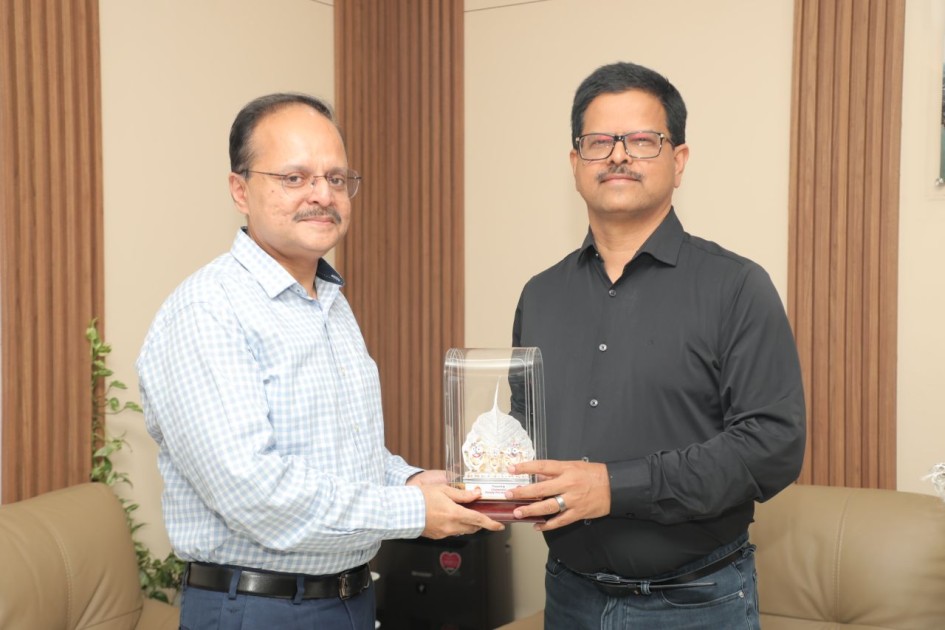
In this regard, a delegation from East Coast Railway, led by Shri A. Rastogi, Principal Chief Mechanical Engineer (PCME), and Shri Vinaya Kujur, Chief Workshop Engineer, visited Paradip Port Authority and held discussions with Shri Susanta Kumar Purohit, Chairperson, Paradip Port Authority.

The interaction focused on strengthening workshop support, improving rolling stock management and streamlining rail freight operations to facilitate smoother and more efficient transportation of cargo to and from the port.

Discussions also highlighted the importance of closer coordination between the port authority and the railway administration in addressing operational requirements, enhancing the availability and maintenance of railway assets, and improving the efficiency of rail-linked cargo evacuation and transportation.

As one of India’s major maritime gateways, Paradip Port relies on an efficient rail network for the seamless movement of bulk and other cargo. Stronger coordination between the port and railway authorities is expected to further improve logistics integration, support higher cargo-handling efficiency and strengthen the port’s overall operational capabilities.

The initiative reflects the continued commitment of Paradip Port Authority and East Coast Railway towards building a more efficient, reliable and integrated multimodal logistics network in support of India’s growing maritime trade.

Paradip Port Records 156.45 MMT Cargo in FY26, Marks Five Years of Growth

Five Years of Sustained Growth Reinforce Paradip Port’s Position as a Leading Maritime Gateway on India’s East Coast

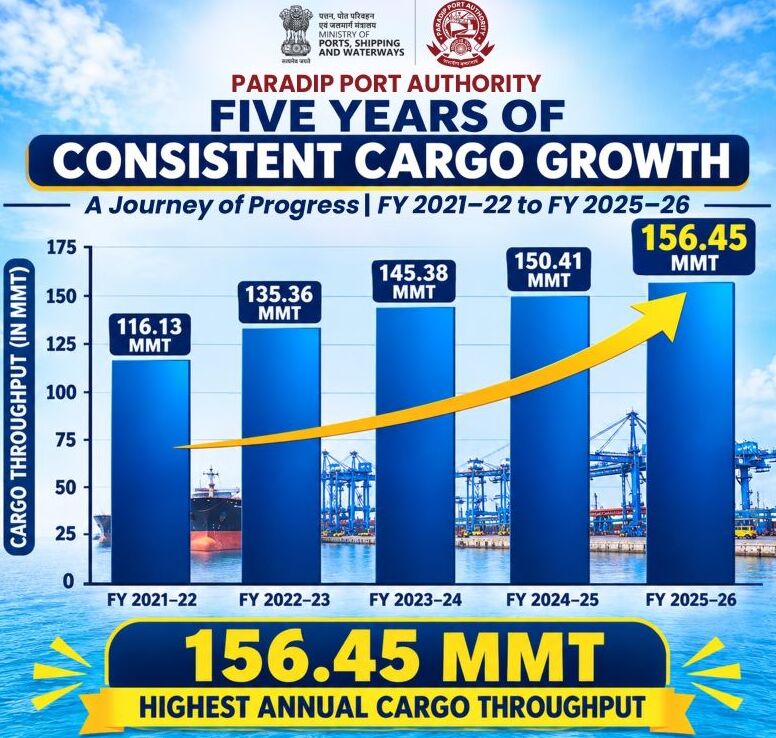
PARADIP: Paradip Port Authority (PPA) has achieved a significant milestone in India’s maritime sector by registering five consecutive years of growth in cargo handling, culminating in its highest-ever annual cargo throughput of 156.45 million tonnes (MMT) in FY 2025–26.

The port’s consistent growth trajectory reflects its strengthening operational capabilities, expanding cargo-handling capacity and sustained efforts towards enhancing efficiency across its maritime and logistics operations.

Paradip Port handled 116.13 MMT of cargo in FY 2021–22. Over the subsequent five financial years, the port maintained an upward growth trajectory, reaching 156.45 MMT in FY 2025–26. This represents an impressive increase of 40.32 MMT, or approximately 34.7%, over the five-year period.

The achievement marks another important chapter in Paradip Port’s growth story and reinforces its position as one of India’s major cargo-handling ports and a strategically important maritime gateway on the eastern coastline.

The sustained performance reflects the collective contribution of the port’s workforce, terminal operators, trade partners, shipping lines and other stakeholders. Their continued cooperation, coupled with the Port Authority’s focus on operational excellence and infrastructure development, has played an important role in strengthening the port’s cargo-handling performance.

As India’s maritime sector continues to expand under the vision of a globally competitive and efficient logistics ecosystem, Paradip Port’s consistent growth underscores the increasing importance of eastern India’s maritime infrastructure in supporting domestic industries, international trade and the country’s economic development.

With five successive years of cargo growth and a record annual throughput of 156.45 MMT, Paradip Port Authority has further strengthened its position in India’s maritime growth story, setting a strong foundation for its next phase of expansion and operational excellence.

Mundra Port sets new records in October 2026, handles 20.27 MMT of cargo and 8.59 lakh Teus

MUNDRA: Adani Ports and Special Economic Zone (APSEZ)-operated Mundra Port has once again demonstrated its operational strength by registering multiple all-time highs across key performance parameters in October 2026, marking another significant milestone in its growth journey.

The port achieved an impressive 20.27 million metric tonnes (MMT) of cargo handling during the month, while container throughput reached a record 8.59 lakh TEUs, reflecting its growing role in facilitating India’s international trade and strengthening EXIM logistics connectivity.

Mundra Port also registered a new milestone in rail operations, handling an unprecedented 1,870 trains during October 2026. The achievement highlights the port’s robust multimodal logistics infrastructure and its ability to efficiently manage large cargo volumes through integrated port, rail and terminal operations.

The simultaneous achievement of record volumes across cargo, containers and rail movements underscores the scale, efficiency and operational capabilities of Mundra Port. It also reflects the importance of seamless coordination between terminal operations, cargo handling facilities and hinterland transportation networks in supporting India’s expanding trade requirements.

As one of India’s major gateways for international commerce, Mundra Port continues to play a pivotal role in strengthening the country’s maritime infrastructure, facilitating EXIM trade and enhancing supply chain efficiency.

The October 2026 performance marks another important chapter in Mundra Port’s growth story, setting new benchmarks in port operations and reinforcing its position as a key driver of India’s maritime and logistics sector.

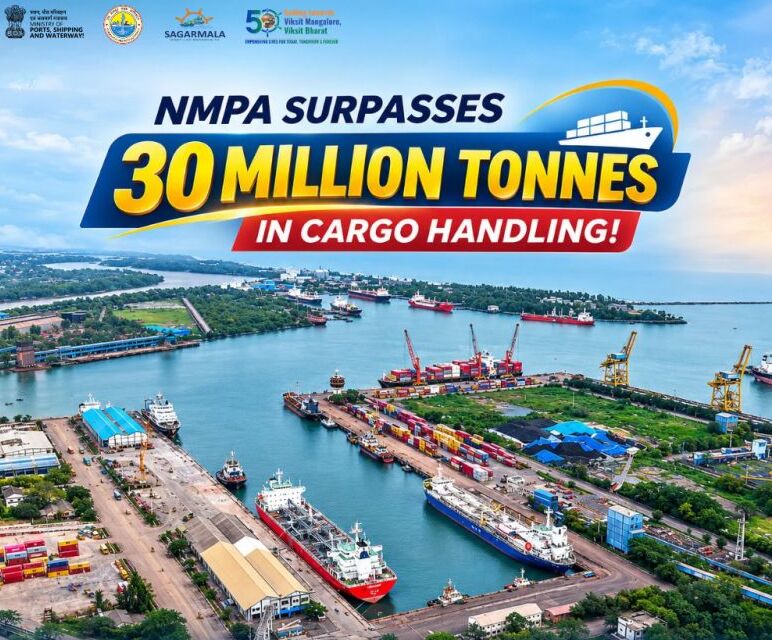
New Mangalore Port crosses 30 MMT cargo handling milestone, registers 5.82% growth

MANGALURU: New Mangalore Port Authority (NMPA) has achieved a significant operational milestone by surpassing the 30-million-tonne mark in cargo handling during the current financial year, reinforcing its position as an important maritime gateway on India’s west coast.

The port handled a total cargo volume of 30.02 Million Metric Tonnes (MMT) as of November 10, 2026, registering an impressive 5.82% growth compared to 28.37 MMT handled during the corresponding period of the previous financial year. The port handled 1,17,131 TEUs containers in the current financial year.

This performance reflects the sustained momentum in cargo movement through the port and highlights its continued contribution to India’s maritime trade and logistics network.

The latest achievement underscores the collective efforts of the entire port fraternity, including port authorities, terminal operators, shipping lines, trade partners, logistics service providers and other stakeholders who play an important role in ensuring efficient port operations and smooth cargo movement.

The milestone also highlights the importance of New Mangalore Port in facilitating EXIM trade and strengthening maritime connectivity for Karnataka and the wider hinterland. With its strategic location along the Karnataka coastline, the port serves as a key gateway for regional industries and international trade.

The year-on-year growth in cargo throughput reflects the port’s continued focus on operational efficiency, stakeholder coordination and capacity utilisation, supporting the evolving requirements of India’s trade and logistics ecosystem.

Crossing the 30 MMT mark well into the financial year is an encouraging development for NMPA and provides further momentum towards achieving higher cargo volumes in the months ahead.

As India continues to strengthen its maritime infrastructure and pursue its ambitions of becoming a leading global maritime and logistics hub, the performance of ports such as New Mangalore will remain vital to enhancing trade competitiveness and supporting the country’s economic growth.

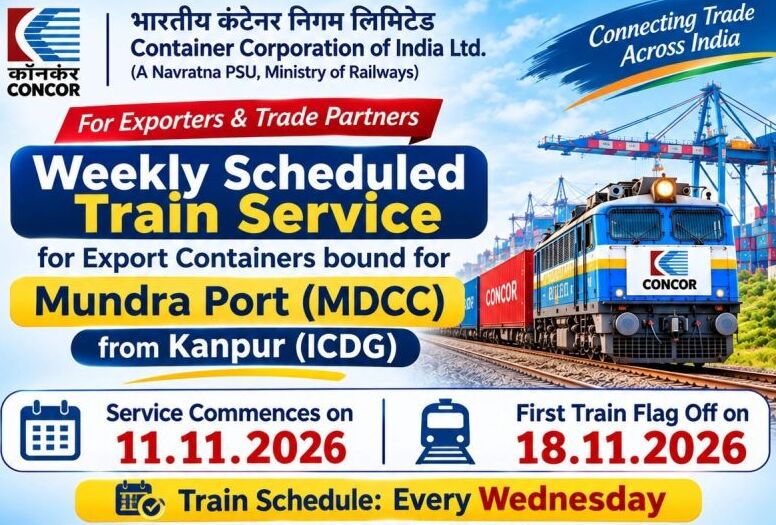
CONCOR launches Weekly Scheduled Train Service connecting Kanpur to Mundra Port to boost Export connectivity

New Rail Logistics Service to Provide Reliable, Time-Bound and Cost-Efficient Connectivity for Export Containers from Kanpur to Mundra Port

NEW DELHI: In a significant step towards strengthening India’s export logistics network, Container Corporation of India Ltd. (CONCOR) has announced the introduction of a weekly scheduled train service for export containers from Kanpur (ICDG) to Mundra Port (MDCC), Gujarat.

The new rail service is aimed at providing exporters and trade partners in and around Kanpur with a reliable, time-bound and cost-efficient transportation solution for moving export containers to one of India’s major container gateways on the western coast.

According to CONCOR’s announcement, the service commenced on 11 November 2026, with the first train scheduled to be flagged off on 18 November 2026. The train will operate every Wednesday, offering exporters a regular and predictable rail connectivity option for their export cargo movements to Mundra Port.

The introduction of this dedicated weekly service is expected to facilitate smoother cargo evacuation from the Kanpur region, improve access to international shipping services through Mundra Port and support greater efficiency across the export supply chain.

The initiative is particularly significant for exporters seeking dependable inland transportation solutions and improved connectivity with major seaports. By strengthening the rail-based movement of export containers, CONCOR aims to offer a seamless EXIM logistics solution while supporting cost-efficient and timely cargo transportation.

As a Navratna Public Sector Undertaking under the Ministry of Railways, CONCOR continues to play an important role in developing integrated rail-based logistics infrastructure and facilitating India’s domestic and international trade.

The Kanpur–Mundra weekly scheduled train service represents another step towards improving hinterland connectivity, expanding exporters’ logistics options and strengthening the integration of India’s inland markets with global trade routes.

Exporters and trade partners interested in utilising the new service can contact their nearest CONCOR office for bookings and further operational details.

With this new connectivity initiative, CONCOR is reinforcing its commitment to providing efficient, dependable and trade-friendly logistics solutions while contributing to India’s growing export ambitions.

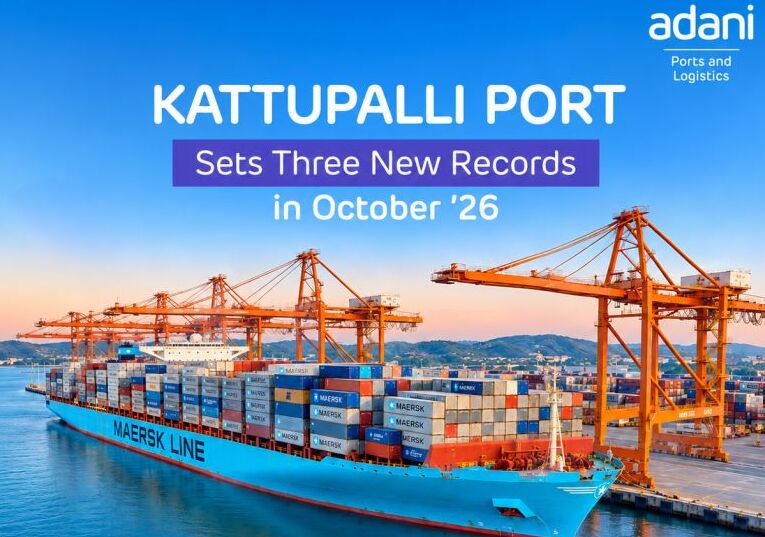
Adani’s Kattupalli Port sets Three All-Time Records in October 2026, Registers Strong Growth in Container Operations

KATTUPALLI: Kattupalli Port, operated by Adani Ports and Special Economic Zone (APSEZ), has achieved three significant operational milestones in October 2026, setting new all-time records in monthly container handling, single-vessel container volume and Container Freight Station (CFS) throughput.

The impressive performance underscores the port’s growing operational capabilities, enhanced cargo-handling efficiency and its increasing role in strengthening India’s maritime logistics infrastructure.

During October 2026, Kattupalli Port recorded an unprecedented 89,222 TEUs in monthly container throughput, marking its highest-ever monthly container volume. Adding to this achievement, the port also established a new record for container handling on a single vessel, registering 8,293 TEUs aboard M.V. Maersk Salalah.

In another significant milestone, the port’s Container Freight Station (CFS) operations also reached an all-time high, handling 8,809 TEUs during the month, reflecting the growing strength of its integrated port and logistics operations.

The three records achieved in a single month highlight Kattupalli Port’s continued focus on operational excellence, infrastructure utilisation and efficient coordination across its maritime and logistics ecosystem.

The achievements reflect the collective efforts of the port’s workforce, operational teams, shipping line partners and other stakeholders, whose contribution has been instrumental in delivering improved performance and maintaining operational efficiency.

Strategically located in Tamil Nadu, Kattupalli Port is an important maritime gateway for the region, supporting containerised trade and providing connectivity to domestic and international markets.

With these record-breaking achievements, Kattupalli Port further reinforces its commitment to delivering reliable, efficient and competitive port services while contributing to the continued development of India’s port-led logistics and trade ecosystem.

Moody’s raises India’s growth forecasts to 7% on strong demand, investment

NEW DELHI: Moody’s Ratings has raised India’s GDP growth forecasts to 7 per cent for the fiscal year ending March 2027 from its earlier projections of 6.5 per cent, citing strong domestic consumption, improving investment and the economy’s resilience to higher global energy prices.

In its Global Macro Outlook 2027-28 report released, the ratings agency said India’s economic growth is expected to remain near 7 per cent over the medium term, with sustained private investment potentially pushing growth even higher.

“India’s broad-based economic momentum and demonstrated resilience to the energy supply shock warrant upward revisions to our 2026-27 growth forecasts to 7% from 6.5%,” Moody’s said.

The report added, “Robust consumption, improving investment dynamics and strong macroeconomic fundamentals imply that the economy appears well positioned to sustain growth near 7% over the medium term.”

Moody’s has also projected India’s GDP growth at 7 per cent in 2028.

The agency said a sustained rise in private investment, particularly in manufacturing, could support employment and productivity, potentially lifting economic growth above its current projections.

It noted that India has handled the global energy price shock better than previously expected, helped by its ability to diversify crude oil and gas supplies.

According to the report, state-backed oil marketing companies and tax cuts have helped protect consumers from the immediate impact of higher fuel prices.

Moody’s also pointed to stronger capital goods production and imports, faster industrial credit growth and improving capacity utilisation as signs of a recovery in private investment.

The report said these indicators “suggest that India may be at the cusp of a new private capex cycle after several years of corporate and banking-sector balance sheet repair.”

However, the agency cautioned that risks to growth remain, particularly from rising inflation, weaker agricultural output and higher interest rates.

It said a deficient southwest monsoon and strengthening El Niño conditions could affect rural demand, while further monetary tightening by the Reserve Bank of India could delay the recovery in private investment.

“With the RBI on track to raise rates further, tighter monetary policy could delay the recovery in private investment,” Moody’s said.

Source: ANI

DGFT prohibits export of Lithium-Ion Battery Black Mass to strengthen domestic recycling and critical mineral recovery

NEW DELHI : The Directorate General of Foreign Trade (DGFT), Department of Commerce, has prohibited the export of Lithium-Ion Battery Black Mass falling under ITC(HS) Code 85491400. Vide Notification No. 49/2026-27 dated 10 November 2026, the export policy of the item has been amended from ‘Free’ to ‘Prohibited’ with immediate effect and until further orders. The transitional arrangements under Para 1.05 of the Foreign Trade Policy (FTP), 2023, will apply.

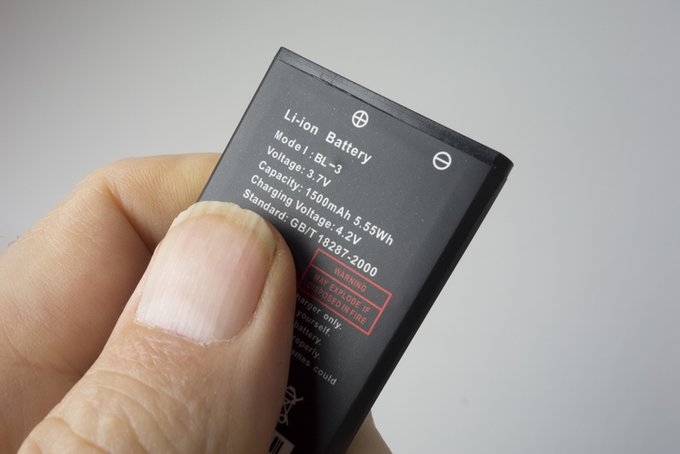
ITC(HS) Code 85491400 covers waste and scrap of primary cells, primary batteries and electric accumulators, as well as spent cells, batteries and accumulators, which are unsorted and do not contain lead, cadmium or mercury. The Notification specifically describes the item as Lithium-Ion Battery Black Mass. Black Mass is the powdery material obtained from shredding end-of-life lithium-ion batteries and battery manufacturing waste. It contains recoverable quantities of critical minerals, including lithium, cobalt, nickel and manganese.

Critical minerals are essential inputs for electric mobility, advanced chemistry cell batteries, energy storage, electronics and renewable energy. India depends substantially on imports for several of these minerals. Recycling battery waste is among the quickest and most sustainable ways of developing a domestic supply of these resources. While the country’s capacity to recycle battery waste and refine critical minerals from it has grown considerably, it is not being fully utilised due to inadequate feedstock availability. Exports of Black Mass generated in India divert this valuable secondary resource abroad, while domestic recyclers have, in some cases, had to import material to meet their requirements.

The export prohibition is intended to ensure that Black Mass generated in India is recycled and refined within the country. The measure is expected to assure feedstock availability for domestic recycling and refining units, improve their capacity utilisation and encourage further investment and employment in the sector. It will increase domestic recovery of lithium, cobalt, nickel and other critical minerals, thereby reducing import dependence and the associated foreign exchange outgo. It will also strengthen supply chains for battery manufacturing, electric vehicles, energy storage and clean-energy technologies, in line with the vision of Aatmanirbhar Bharat. Further, the measure will advance the circular economy and ‘urban mining’, reducing reliance on primary mining, while supporting environmentally sound recycling of this hazardous material within the country in accordance with applicable environmental regulations.

The measure complements the Government’s initiatives under the National Critical Mineral Mission (NCMM), including the ₹1,500 crore Incentive Scheme approved by the Union Cabinet in September 2025 to develop recycling capacity for the separation and production of critical minerals from secondary sources such as battery waste and e-waste. Retaining Black Mass within the country will help ensure that the recycling capacity being developed under the Scheme has access to adequate domestic feedstock.

The step is also in keeping with measures adopted by several major economies to retain critical mineral-bearing battery waste and Black Mass for domestic processing.

Commerce, Finance ministries meet to resolve liquor firms’ customs dispute over Scotch imports: Sources

NEW DELHI: The Commerce and Finance ministries on Wednesday held a meeting to resolve the issue faced by liquor companies over the classification of imported Scotch whisky, people familiar with the matter told ANI on condition of anonymity.

Officials from both ministries discussed the issue in detail, and they are hopeful that the matter may be resolved soon, the sources said.

Last Monday, the International Spirits and Wine Association of India (ISWAI) and the Confederation of Indian Alcoholic Beverage Companies (CIABC) met Commerce Secretary Shri Rajesh Agarwal and raised the issue of a duty difference because of which customs officials have held the stock of companies such as Pernod Ricard India, Diageo, Radico Khaitan and Allied Blenders and Distillers, the sources said.

The industry objected to the Directorate of Revenue Intelligence’s (DRI) classification of imported Scotch whisky as alcoholic beverage concentrate rather than finished whisky, and the resulting dispute over the HS code and duty. The concern was also described as a technical issue affecting how the India-UK free trade agreement (FTA) was being applied.

Agarwal reportedly assured the industry that the government would work to resolve the matter, the sources said.

The HS code determines which duty rate and rules apply. According to the sources, the DRI’s position is that the imported product should be classified as alcoholic beverage concentrate, not finished Scotch whisky, because it was imported at a higher strength and diluted later. This could change the duty calculation and raise a question over whether the original declaration was correct.

As per the DRI, the concentrate being imported ranges between 62 and 66 per cent alcohol strength, while Scotch ranges between 42 and 46 per cent. The two fall under different HSN codes, whereas the companies are claiming the imports fall under the HSN code covered by the FTA.

Officials of the Department of Revenue are examining whether some bulk Scotch whisky imports by Pernod Ricard and Diageo, ABD and Radico Khaitan were classified in a way that allowed them to get lower customs duties under the India-UK trade pact, according to five industry sources familiar with the matter.

The inquiry does not amount to a new tariff increase and does not establish any violation by either company, the sources said. It centres on which types of Scotch imports qualify for the reduced duty that took effect after the bilateral trade agreement came into force on July 15, 2026. For eligible imports, the tariff fell to 75 per cent from 150 per cent, a cut of 75 percentage points, or 50 per cent of the duty rate.

However, the DRI has maintained that the reduced tariff applies only to finished products, such as bottled, ready-to-drink Scotch, and not to bulk Scotch concentrates used in the manufacture of whisky brands.

A confidential DRI memorandum dated November 4, reviewed by Reuters, reportedly instructed customs commissioners across India to continue applying the 150 per cent duty on bulk Scotch imports. The memorandum described the importers’ claims for benefits under the India-UK trade pact as incorrect and said the products were concentrates or compound preparations subjected to further manufacturing. It also flagged potential large-scale and recurring revenue implications arising from misclassification.

DRI officers visited the offices of Pernod Ricard India, Diageo, Radico Khaitan and Allied Blenders and Distillers last week and questioned executives about their Scotch imports, the sources said.

The central issue is whether duty relief under the India-UK agreement applies to bulk Scotch concentrates brought into India in containers and later blended with other ingredients for locally sold brands. One source said officials are concerned that some bulk imports may have been classified in a way that made them eligible for the lower tariff when, in the authorities’ view, they may not qualify.

The dispute has also led to containers of imported Scotch being held at Indian ports. According to Reuters, Pernod Ricard and Diageo each have more than 40 containers held up at ports, while Bacardi has five containers on hold. The companies have reportedly been unwilling to pay the higher 150 per cent duty, with prolonged delays potentially disrupting supplies.

Around 80 per cent of Scotch whisky imports from Britain by volume arrive in bulk and are subsequently used to produce Indian-Made Foreign Liquor (IMFL), a category in which Scotch is blended with other spirits and ingredients. Scotch exports to India totalled USD 335 million in 2024, while the Scotch Whisky Association has projected that the India-UK trade agreement could increase the value of the trade by USD 1.34 billion over five years.

The industry has privately cautioned the government that the dispute risks undermining a market-access benefit negotiated under the India-UK trade agreement. The pact came into force on July 15, 2026, and the disagreement over the classification of bulk Scotch imports has emerged as a major issue in its implementation.

Source: ANI