BHUJ : In a landmark moment for India’s maritime sector, Shri Narendra Modi, Hon’ble Prime Minister, virtually inaugurated and laid the foundation stone for several transformational projects of Deendayal PortAuthority (DPA), Kandla, worth over ₹1,100 crores, during a grand event held at Bhuj, Kutch on 26th May, 2025. Recognized as one of the three Major Ports designated as a “Green Hydrogen Hub” under the National Green Hydrogen Mission, DPA is swiftly emerging as a beacon of clean energy adoption, infrastructure modernization and regional economic growth, aligning with the vision of Viksit Bharat @2047. Projects worth Rs. 532 Crore inaugurated:
• Oil Jetty No. 8 at Old Kandla: With a capacity of 3.5 MMT per annum, the newly inaugurated jetty is equipped with telescopic gangways, indigenously developed quick-release mooring systems, and an automated firefighting system, enabling safe handling of large liquid cargo vessels up to 1 lakh DWT. • Connectivity to Container Terminal at Tuna-Tekra: Boosting container traffic efficiency. • Expansion of Port Area for EXIM Cargo Storage: Supporting faster cargo evacuation. • & other development initiatives to strengthen port operations, enhance community infrastructure, and generate employment opportunities.
Foundation stone laid for projects worth Rs. 602 Crore. • 10 MW Green Hydrogen Production Facility at Kandla: Enabling clean energy and establishing DPA as an emerging leader in the Green Hydrogen sector. • Construction of 3 Road Over Bridges & Upgradation to 6-Lane at Kandla: Modernizing port logistics and easing city-port connectivity
With these landmark initiatives, Deendayal Port Authority reaffirms its commitment to building a green, efficient, and globally competitive maritime ecosystem. Through the adoption of clean energy, cutting-edge cargo handling solutions, and smart infrastructure, DPA continues to play a pivotal role in realizing India’s aspirations of becoming a logistics powerhouse.
DAHOD : The Prime Minister Shri Narendra Modi laid the foundation stone, inaugurated and dedicated to the nation multiple development projects worth over Rs 24,000 crore in Dahod, Gujarat on Monday. Addressing the gathering, he remarked that May 26 holds special significance as it marks the day he first took the oath as Prime Minister in 2014. He acknowledged the unwavering support and blessings of the people of Gujarat, who entrusted him with the responsibility of leading the nation. The Prime Minister highlighted that this trust and encouragement have fueled his dedication to serving the country day and night. Over the years, India has taken decisions which were unprecedented and unimaginable, breaking free from decades-old constraints and advancing across every sector. “Today, the nation has emerged from an era of despair and darkness into a new age of confidence and optimism”, he added.
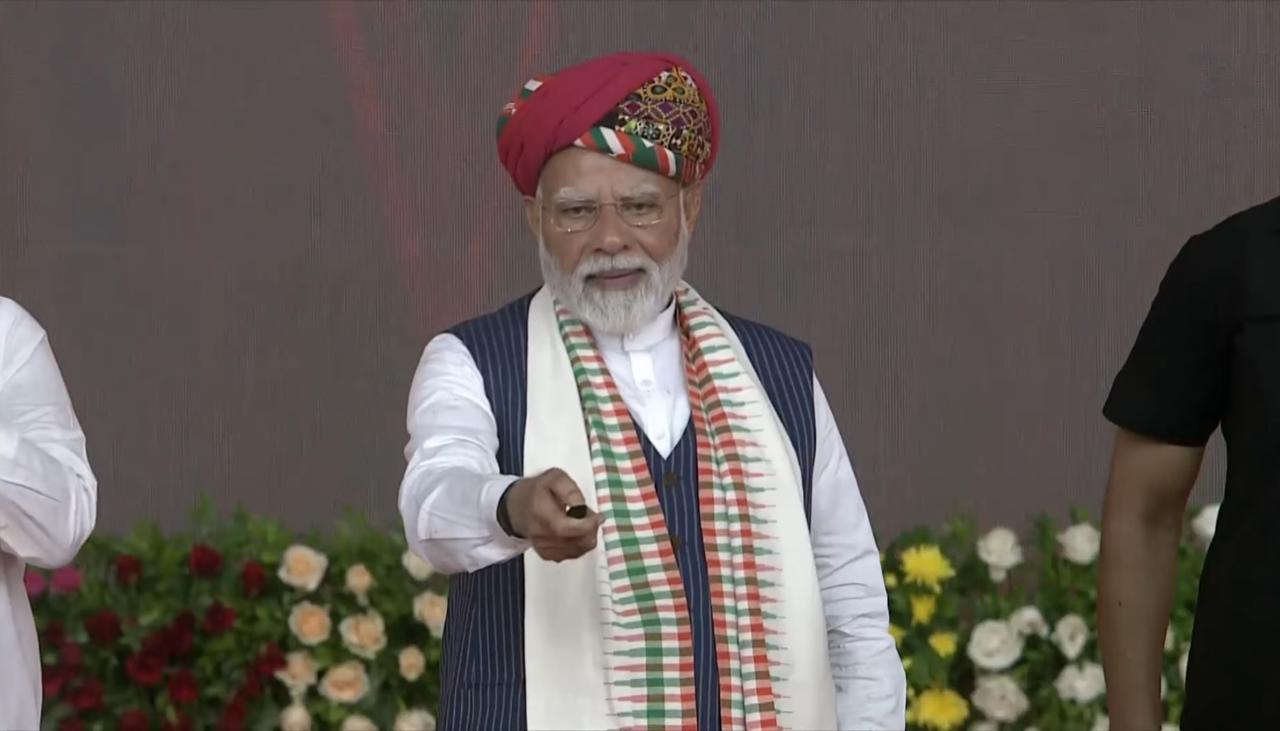
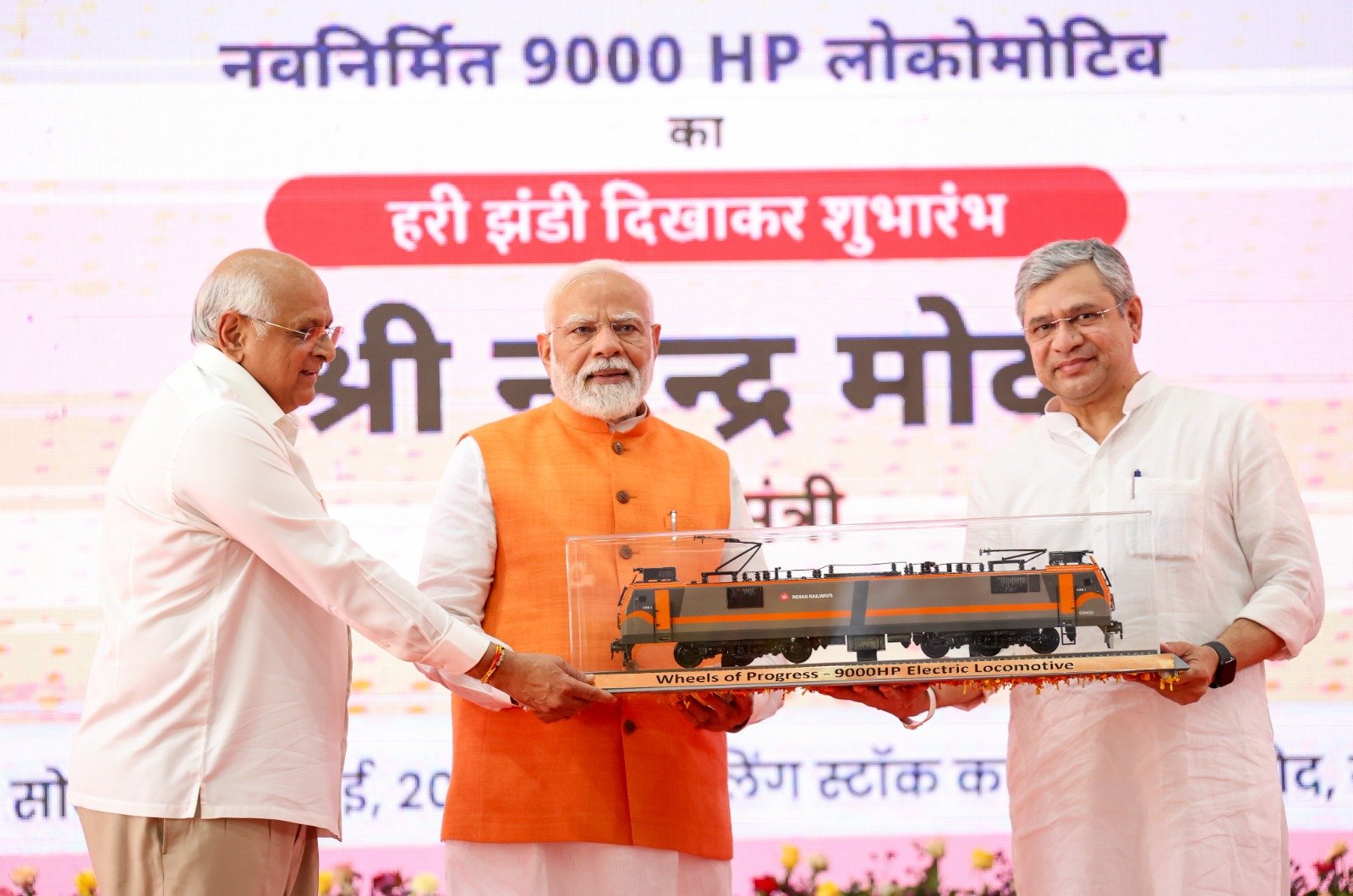
“140 crore Indians are united in building a Viksit Bharat”, exclaimed Shri Modi, emphasising the importance of manufacturing essential goods within India, stating that self-reliance is the need of the hour. He remarked that India is advancing rapidly in the global manufacturing sector, noting that both domestic production and exports are increasing consistently. India is now exporting a wide range of products, including smartphones, automobiles, toys, defense equipment, and medicines. He further stated that India is not only manufacturing rail and metro technology but also exporting it globally. Citing Dahod as a prime example of this progress, where major projects worth thousands of crores were inaugurated and launched, Shri Modi highlighted the Dahod Electric Locomotive Factory as a significant achievement. He recalled laying its foundation stone three years ago and expressed pride that the first electric locomotive has now been successfully manufactured. He flagged off the locomotive, marking a moment of pride for Gujarat and the entire nation. Additionally, he announced that Gujarat has achieved 100% electrification of its railway network, calling it a remarkable milestone and congratulated the people of Gujarat for this achievement.
Highlighting the rapid development of India’s railway sector over the past 10-11 years, Shri Modi emphasized the expansion of metro services and the introduction of semi-high-speed trains, transforming connectivity across the country. He remarked that Vande Bharat trains now operate on nearly 70 routes, further strengthening India’s transportation network. He announced the commencement of a new Vande Bharat Express between Ahmedabad and Veraval. Shri Modi further stated that the rise of modern trains in India is due to the country’s advancements in technology. He emphasized that coaches and locomotives are now manufactured domestically, reducing reliance on imports. “India has emerged as a leading exporter of railway equipment”, stated Shri Modi, noting that India exports metro coaches to Australia and train coaches to England, Saudi Arabia, and France. He added that Mexico, Spain, Germany, and Italy also import railway-related components from India. Shri Modi further remarked that Indian passenger coaches are being used in Mozambique and Sri Lanka, and ‘Made in India’ locomotives are being exported to multiple countries. He stated that this reflects the continuous expansion of the ‘Make in India’ initiative, reinforcing national pride.
“A strong railway network enhances convenience and boosts industries and agriculture”, remarked the Prime Minister, highlighting that several regions in India received railway connectivity for the first time in the past decade. He remarked that many areas in Gujarat previously had only small, slow-moving trains, but several narrow-gauge routes have now been expanded. Announcing the inauguration of multiple railway routes, including the new express train between Dahod and Valsad, which will greatly benefit the tribal belt, the Prime Minister stated that factories create large-scale employment opportunities for youth. He highlighted that Dahod’s rail factory will manufacture 9,000-horsepower locomotives, significantly enhancing the power and capacity of India’s trains, noting that every locomotive produced in Dahod will bear the name of the city. The Prime Minister remarked that hundreds of locomotives will be built in the coming years, generating substantial employment for local youth. He emphasized that the factory will also support small-scale industries producing railway components, leading to economic growth in surrounding areas. He stated that employment opportunities extend beyond the factory, benefiting farmers, livestock owners, shopkeepers, and laborers, ensuring widespread economic progress.
Shri Modi highlighted that Gujarat has made remarkable progress across multiple sectors, including education, IT, semiconductors, and tourism. He emphasized that the state has established itself as a leader in various industries. He remarked that a major semiconductor plant is being set up in Gujarat with an investment of thousands of crores, further strengthening India’s position in the global semiconductor industry. He stated that these initiatives are creating new employment opportunities for lakhs of youth in Gujarat, contributing to the state’s economic growth and development.
Underlining that Dahod, Vadodara, Godhra, Kalol, and Halol have collectively established a high-tech engineering and manufacturing corridor in Gujarat, the Prime Minister remarked that Vadodara is rapidly advancing in aircraft manufacturing, with the Airbus assembly line inaugurated a few months ago. He noted that Vadodara is also home to India’s first Gati Shakti University. He emphasized that Savli already has a major rail-car manufacturing factory, while Dahod now hosts a facility producing India’s most powerful locomotives—9,000-horsepower engines, marking a moment of pride for the nation. The Prime Minister stated that Godhra, Kalol, and Halol have a significant presence of manufacturing units, small industries, and MSMEs, contributing to Gujarat’s industrial growth. Envisioning a future where this region of Gujarat will be known for producing everything—from bicycles and motorcycles to railway engines and aircraft, the Prime Minister remarked that such a high-tech engineering and manufacturing corridor is rare globally, reinforcing Gujarat’s position as an industrial powerhouse.
Highlighting the immense potential of Dahod, stating that the event is just a glimpse of its capabilities, Shri Modi expressed full confidence in the hardworking people of Dahod, emphasizing that they will make the best use of the newly developed facilities and transform Dahod into one of the most developed districts in the country. He concluded by congratulating the people of Dahod once again, reaffirming his belief in their dedication and progress.
The Chief Minister of Gujarat, Shri Bhupendrabhai Patel, Union Minister for Railways, Information and Broadcasting & Electronics and Information Technology, Shri Ashwini Vaishnaw were present among other dignitaries at the event.
Background
In line with his commitment to enhancing connectivity and building world-class travel infrastructure, Prime Minister inaugurated the Locomotive Manufacturing plant of the Indian Railways in Dahod. This plant will produce electric locomotives of 9000 HP for domestic purposes and for export. He also flagged off the first electric locomotive manufactured from the plant. The locomotives will help in increasing freight loading capacity of Indian Railways. These locomotives will be equipped with regenerative braking systems, and are being designed to reduce energy consumption, which contributes to environmental sustainability.
Thereafter, the Prime Minister laid the foundation stone and inaugurated multiple development projects worth over Rs 24,000 crore in Dahod. The projects include rail projects and various projects of the Government of Gujarat. He also flagged off Vande Bharat Express between Veraval and Ahmedabad & Express train between Valsad and Dahod stations.
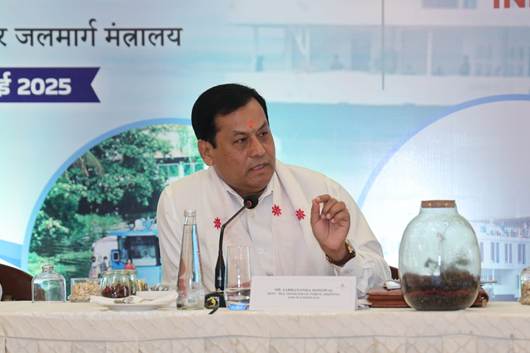
MUMBAI : Union Minister of Ports, Shipping & Waterways, Shri Sarbananda Sonowal, on Monday chaired a meeting of the Consultative Committee on Inland Waterways Transport here, where it was revealed that 76 waterways are targeted to be made operational by 2027, with cargo volume expected to surge by 156 million tonnes per annum (MTPA) by end of FY 2026. The Inland Waterways Authority of India (IWAI), the nodal agency under the Ministry, presented a comprehensive review of major projects, future projections, and the roadmap ahead. Members of Parliament attending the meeting acknowledged and appreciated the progress made and supported increased budgetary allocations to boost the sector’s growth.
The footprint of inland water transport is expected to expand significantly—from 11 states in FY 2024 to 23 states and 4 Union Territories by FY 2027. To support this growth, projects worth ₹1,400 crore were launched or announced during the Inland Waterways Development Council (IWDC) meeting held on January 10, 2025. Additionally, the Inland Waterways Authority of India (IWAI) is conducting 10,000 km of longitudinal survey each month to assess Least Available Depth (LAD) for improved navigability. Cargo Volume is likely to make an incremental growth up to 156 MTPA by March, 2026 inching closer towards the Maritime India Vision 2030 target of 200 MTPA.
Speaking on the occasion, the Union Minister Shri Sarbananda Sonowal said, “Inland waterways are emerging as the watershed moment in India’s logistics and transport ecosystem. Under the visionary leadership of Prime Minister Shri Narendra Modi ji, we are witnessing a transformational shift with policy interventions like the National Waterways Act, 2016, the Inland Vessels Act, 2021 and supplemented by multiple programmes like Jal Marg Vikas Project, Arth Ganga, Jalvahak scheme, Jal Samriddhi scheme, Jalyan & Navic among others. Through Maritime India Vision 2030 and the Maritime Amrit Kaal Vision 2047. These roadmaps are not just policy documents—they are catalysts driving India toward becoming a global maritime powerhouse. Today’s meeting with esteemed Members of Parliament reflects a unified commitment to boost infrastructure and unlock the immense economic potential of our rivers and coasts. With enhanced budgetary support and cooperative federalism, we are building a greener, more efficient, and future-ready waterway network across the country.”
The Regional Waterways Grid aims to boost economic activity by ensuring seamless vessel movement from Varanasi to Dibrugarh, Karimganj, and Badarpur via the IBP route, creating a 4,067 km economic corridor. A traffic study and DPR for renovating the Jangipur navigation lock are underway. The project’s cargo potential is estimated at 32.2 MMTPA by 2033.
On NW 1 (Ganga), a dedicated waterway corridor spanning 1,390 km is being developed to enable seamless movement of vessels, enhancing the efficiency of inland transport. As part of this initiative, capacity augmentation of NW-1 is underway to support the navigation of 1,500–2,000 DWT vessels, alongside the creation of key cargo handling facilities at Varanasi (MMT), Kalughat (IMT), Sahibganj (MMT), and Haldia (MMT).
Inland Waterways has major projects in the Northeast. A ₹5,000 crore roadmap is planned over the next five years. On NW-2 (Brahmaputra), four permanent terminals—Dhubri, Jogighopa, Pandu, and Bogibeel—and 13 floating terminals are supported by fairway and navigation upgrades. A ₹208 crore ship repair facility at Pandu and a ₹180 crore alternative road are set for completion by 2026 and 2025, respectively. On NW-16 (Barak), terminals at Karimganj and Badarpur are active, while NW-31 (Dhansiri) is being developed to support NRL’s expansion.
Adding further, Shri Sarbananda Sonowal said, “In line with the Harit Nauka Guidelines, the Inland Waterways Authority is committed to green and sustainable transport solutions, including the procurement of electric catamarans and hydrogen fuel cell-powered vessels. By strengthening urban water transport through water metro projects and promoting eco-friendly cruise tourism, we are paving the way for a cleaner, greener future in inland waterways transportation. The Regional Waterways Grid aims to seamlessly connect Assam and the Northeast with the rest of India through an integrated network of inland waterways. This will boost regional trade, tourism, and connectivity while unlocking economic potential across the Brahmaputra and Barak River systems. Government is also working on a ₹5,000 crore roadmap for Inland Waterways Development in Northeast Over Next 5 Years.”
The committee also reviewed the ongoing works on NW -1 (river Ganga), NW 2 (Brahmaputra) among other states like Odisha, Jammu & Kashmir, Goa, Kerala, Maharashtra, Andhra Pradesh, Gujarat, Madhya Pradesh, Karnataka, and Tamil Nadu.
India’s river cruise tourism is witnessing robust growth, with 15 river cruise circuits now operational across 13 National Waterways (NWs) spanning nine states. The number of NWs supporting river cruises has risen from just three in 2013-14 to 13 in 2024-25, while luxury river cruise vessels have increased significantly from three to 25 during the same period. To further boost inland water-based tourism, 51 additional cruise circuits have been identified on 47 NWs for development by 2027. Three World class river cruise terminals are also planned, with construction underway at Kolkata. Feasibility studies for terminals at Varanasi and Guwahati are being conducted by IIT Madras, while four more terminals at Silghat, Bishwanath Ghat, Neamati, and Guijan are set to be developed by 2027.
Speaking on the occasion, Minister of State for Ports, Shipping and Waterways, Shri Shantanu Thakur said, “Special efforts are underway to advance river cruise tourism across India by developing modern cruise terminals and related infrastructure. Through strategic partnerships and MoUs with private enterprises, we are boosting luxury river cruises on the Ganga and Brahmaputra, while also expanding cruise tourism on the Yamuna, Narmada, and key rivers in Jammu & Kashmir. These initiatives not only promote tourism but also contribute to sustainable economic growth in the regions we serve.”
The Consultative Committee meeting was chaired by the Union Minister of Ports, Shipping & Waterways, Shri Sarbananda Sonowal while Minister of State for Ports, Shipping & Waterways, Shri Shantanu Thakur was also present. The meeting was attended by Shatrughan Prasad Sinha, Lok Sabha MP (Asansol, West Bengal), Bibhu Prasad Tarai, Lok Sabha MP (Jagdispur, Odisha), Hibi Eden, Lok Sabha MP (Ernakulum, Kerala), M.K. Raghavan, Lok Sabha MP (Kozhikode, Kerala), Naba Charan Majhi, Lok Sabha MP (Mayurbhanj, Odisha), Abhimanyu Sethi, Lok Sabha MP (Odisha) and Seema Dwivedi (Rajya Sabha MP from Uttar Pradesh).
MUMBAI : Minister of Ports, Shipping, and Waterways Shri Sarbananda Sonowal held a detailed review with DG Shipping, Secretary (Shipping) and other senior officials to assess the urgent measures being undertaken his ministry to address the situation arising from the capsizing of Liberian-flagged ‘MSC ELSA III‘ container ship off the Kerala coast near Kochi.
All 24 crew members of the Liberia-flagged container vessel have been rescued, which capsized around 38 nautical miles southwest off the Kochi coast on Saturday. The 184-metre-long ship had departed from Vizhinjam Port on May 23 and was expected to reach Kochi on May 24.
“We are fully committed to ensuring the complete salvage of marine fuel and other hazardous materials being transported in 13 IMDG containers. All crew members have been safely evacuated with the assistance of the Indian Coast Guard,” wrote Sarbananda Sonowal on X. “Three ships – ICG Samarth, ICG Saksham and ICG Vikram have been deployed to the affected area. Additionally, the pollution response vessel Sagar Prahari departed from Mumbai today and is en route to the site,” the minister wrote.
Regular aerial surveillance is being carried out using Dornier aircraft equipped with the MSS 6000 system to monitor any oil spillage. All four company representatives of MSC have arrived in Kochi and have been advised to visit both the Indian Coast Guard and MMD offices. The minister informed that MSC has initiated tracking of all beached containers and is deploying personnel to secure them in place. “Salvors have been engaged and have arrived in Kerala. T&T Salvage is now in Kochi to coordinate the salvage operations. Coordination for container retrieval is ongoing between the salvor’s expert team and the local administration,” Sonowal said.
“We are continuously monitoring the situation through DG (Shipping), Indian Coast Guard, Kerala State Disaster Management Authority, @ndmaindia, MSC & the Salvage Team. All possible measures are being taken to ensure immediate action is taken to protect the coastal environment from oil spills and any risks arising from the breached containers. @dgshipping_IN,” the X post added.
A few containers from the sunken ship were spotted on the Kollam coast on Monday. The containers, red in colour, were spotted ashore, highlighting potential environmental and navigational hazards.
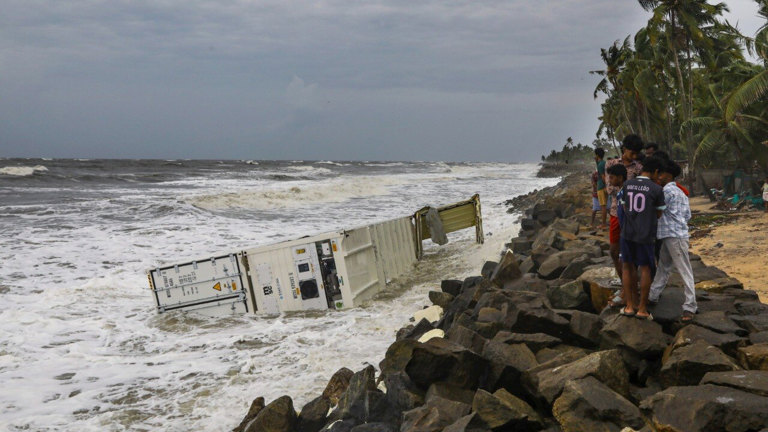
KOCHI : Authorities in Kerala are on high alert after containers from a cargo ship MSC ELSA 3,that sank off the Kochi coast began washing ashore along the coast in Kollam and Alappuzha districts. The sunken Liberian vessel was carrying over 640 containers, including 13 with hazardous materials, according to the IndianCoast Guard (ICG) and Customs officials.
Early on Monday, two containers were spotted at Thurayil Kadavu in Arattupuzha, Alappuzha. Locals discovered one of them around 6.30 am. The floating container later collided with the seawall and burst open, spilling packets onto the shore. The two containers remained joined together. In Kollam district, containers were found near Cheriazheekal, Karunagappally, where one was seen crashing into the seawall. Three containers each were located in Neendakara Parimanam, Sakthikulangara, and along the Chavara coast.
Authorities have confirmed that a total of 29 containers from the ship have washed up along the Kerala coast. Of these, 27 containers have been found along the Kollam coast, while 2 have been located near Alappuzha. Most of the containers are empty, but some are marked yellow with visible plastic contents inside.
Police have been deployed across the affected coastal areas to secure the sites and prevent public interference. The affected areas have been cordoned off by local officials, and the public is not allowed within 200 metres of the site to ensure safety.
Some of the hazardous containers reportedly contain calcium carbide, a chemical that reacts with seawater to release acetylene gas, which is highly flammable.
The public has been strongly advised to stay away from any containers or debris found on the shore. “The public is strongly advised not to approach or interact with any floating or beached containers or debris, as they may contain dangerous substances,” the Office of the Chief Commissioner of Customs, Thiruvananthapuram Zone, said in a statement.
The Customs Department, which would be the first to inspect these containers, noted that all goods on the vessel were non-duty paid at the time of the incident, and any unauthorised removal or pilferage of these goods is illegal. Customs Marine and Preventive Units have been deployed across the Kerala coast, and surveillance is underway in coordination with other agencies.
According to the ICG, the vessel overturned and sank early on Sunday, resulting in a major oil spill. The ship capsized swiftly “due to flooding in one of the holds”, which are compartments below the deck used for storing cargo.
The vessel was carrying 84.44 metric tonnes of diesel and 367.1 metric tonnes of furnace oil, now leaking into the sea. Officials have raised a statewide alert, noting that the spill is moving at approximately three kilometres per hour and could impact the ecologically sensitive Kerala coastline.
The ICG is leading pollution response efforts and is currently monitoring the spread of the oil slick. Officials have stressed that public cooperation is critical for ensuring safety and assisting ongoing recovery operations.
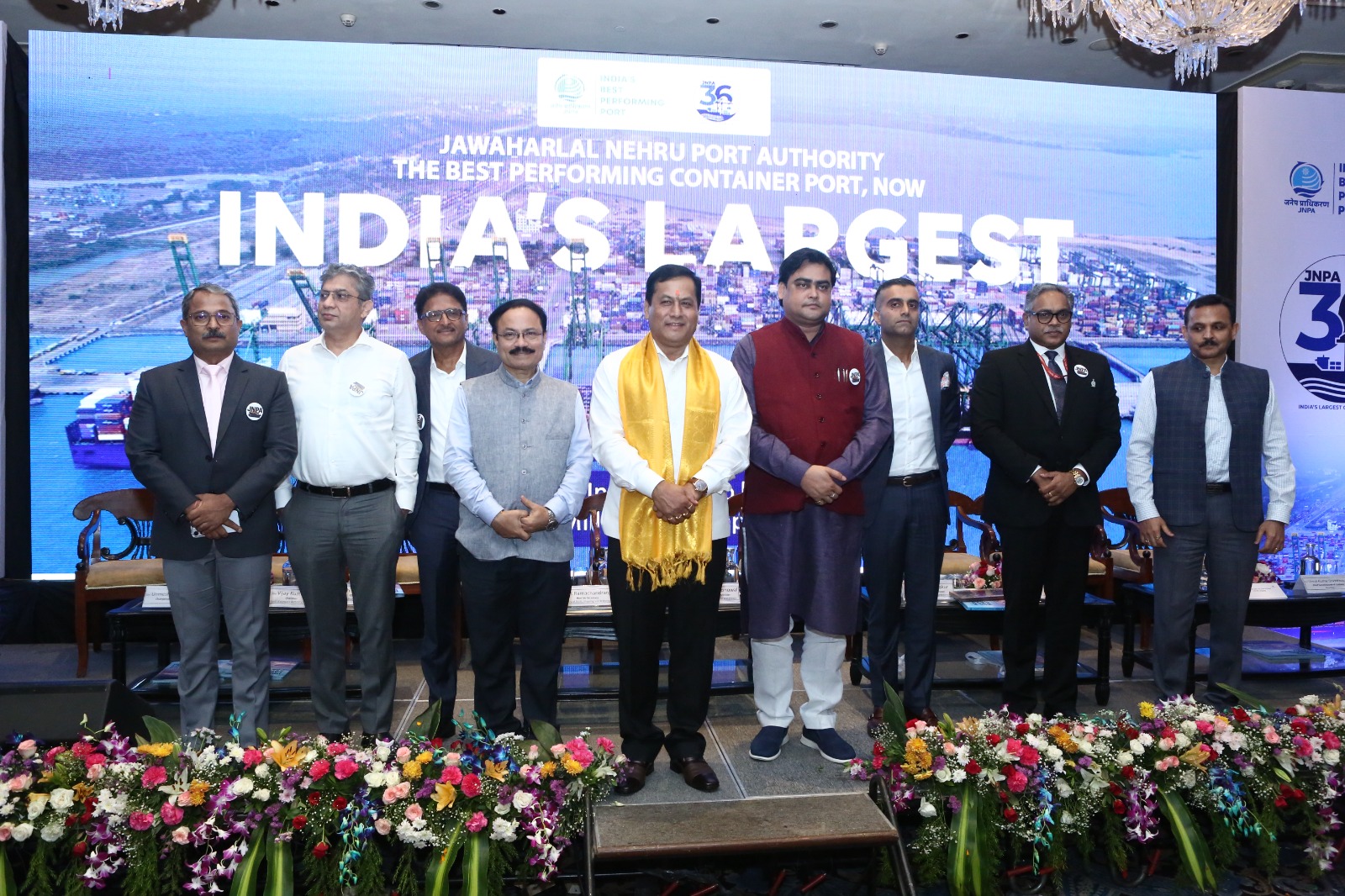
MUMBAI : Jawaharlal Nehru Port Authority (JNPA), India’s Best Performing Port, redefined its stature in India’s port landscape as India’s Largest Container Port as it celebrated its 36th Foundation Day on Monday, May 26, 2025. The commemorative event was held in the august presence of Shri Sarbananda Sonowal, Hon’ble Union Cabinet Minister for Ports, Shipping and Waterways, Government of India. The occasion brought together key dignitaries, including the Guest of Honour, Shri Shantanu Thakur, Hon’ble Union Minister of State, Ports, Shipping and Waterways, Shri T K Ramachandran, IAS, Hon’ble Secretary, Ministry of Ports, Shipping, and Waterways, Shri Shyam Jagganathan, IAS, Director General of Shipping, Shri Vimal Kumar Srivastava, IRS, Chief Commissioner of Customs, Mumbai, Shri Vijay Kumar, IAS, Chairman, IWAI, Shri Shashi Kiran Shetty, Chairman, Allcargo Group, Shri Dhruv Kotak, MD, JM Baxi Group, industry professionals, and JNPA employees to celebrate the port’s journey of becoming India’s Largest Container Port and continued commitment to India’s maritime growth.
All the dignitaries received a warm welcome from Shri Unmesh Sharad Wagh, IRS, Chairperson, JNPA and CMD, VPPL. As part of the celebration, the dignitaries addressed the gathering, highlighting JNPA’s remarkable transformation over the last three and a half decades. The event also featured the unveiling of the JNPA 36 Years Journey Coffee Table Book, chronicling the port’s evolution and achievements since its inception. A special screening of the JNPA Corporate Film showcased the port’s infrastructure, innovations, sustainability efforts, and its vision for the future.
The event also witnessed, two significant Memorandum of Understanding (MoUs) were signed for the Vadhvan Port Skilling Program. The first MoU, signed between VPPL and Sahyadri Farms, is intended to develop the skills of rural youth, farmers, and farm produce companies through targeted training under the skilling program. This collaboration aims to strengthen the agri-logistics value chain and prepare local communities for emerging opportunities. The second MoU, signed between VPPL and Rural Enhancers Projects Pvt. Ltd., outlines their intent to participate in the development of a terminal at Vadhvan Port for handling container, bulk, and liquid cargo. It also includes plans to build supporting infrastructure for marine services, intermodal connectivity, and to ensure the sustainability of the ecosystem through digital solutions, robust IT infrastructure, and structured manpower training and skill development. These partnerships reflect JNPA’s vision of building Vadhvan Port as a modern, inclusive, and future-ready maritime gateway.
During the event Shri Sarbananda Sonowal, Hon’ble Union Cabinet Minister, Ports, Shipping and Waterways, stated, “My heartfelt congratulations to the JNPA family on completing 36 years of dedicated service. Guided by the Hon’ble Prime Minister’s vision of ‘Vocal for Local’ and ‘Local to Global,’ JNPA has transformed from a port into a powerful engine of national development. Its rise as India’s largest container port reflects the strength of its ecosystem, driven by leadership, innovation, and strong private sector participation. With projects like Vadhvan Port set to place India among the world’s top 10 maritime hubs, JNPA stands as a role model in building a self-reliant, globally competitive maritime sector. This growth also brings greater responsibility — to lead, inspire, and raise the bar for the entire maritime industry. The time to act is now — with unity, planning, and purpose, India can become a top 5 maritime nation in the world.”
Shri Shantanu Thakur, Hon’ble Union Minister of State, Ports, Shipping and Waterways, said, “The 36th Foundation Day of JNPA is not just a celebration — it reflects the nation’s growing interest in the port sector and the vital role it plays in our economic journey. With a 10 million TEU capacity, JNPA is delivering on the Hon’ble Prime Minister’s vision and Hon’ble Minister Shri Sarbananda Sonowal ji’s guidance for a brighter, future-ready India. As 70% of trade moves through our ports, clarity of vision and strength in execution are critical. India’s rise as the world’s 4th largest economy is a result of decisive leadership and visionary thinking, values embodied by JNPA’s team under the leadership of its Chairman. This is the spirit of Viksit Bharat.”
Shri T K Ramachandran, IAS, Hon’ble Secretary, Ministry of Ports, Shipping and Waterways, expressed, “JNPA has stood out as a shining example in the port sector. Aligned with the Hon’ble Prime Minister’s Amrit Kaal vision, JNPA has ticked every box — from capacity enhancement and sustainability to digitalisation and port-led industrialisation. With 100% PPP cargo handling, the upcoming Vadhvan Port, the SEZ, and international linkages like IMEEC and the digital corridor, JNPA truly represents a safe, smart, secure, and sustainable model for the future of Indian ports.”
Speaking at the event, Shri Unmesh Sharad Wagh, IRS, Chairperson, JNPA, and CMD, VPPL said, “At 36, JNPA stands not at a destination, but at a point of deeper responsibility. Becoming the country’s largest container port isn’t just about numbers — it reflects years of disciplined planning, coordination across sectors, and the quiet resolve of teams. Our journey has been shaped by the tireless efforts of our employees, the trust of our trade partners, and the consistent support of the Government of India.” “Our next phase will demand sharper systems thinking, faster decision cycles, and closer alignment with global trade dynamics. We are designing a port ecosystem that can anticipate, adapt, and absorb the complexity of modern logistics. This anniversary is a chance to look back briefly, but more importantly, to recalibrate for the long road ahead,” he added.
The celebration was followed by an Award Ceremony, where professionals from the maritime and logistics industry, as well as JNPA employees, were felicitated for their outstanding contributions and service excellence. The awards aimed to recognise the dedication and efforts that have helped JNPA reach this stature. As JNPA moves forward with its expansion plans and smart port initiatives, it continues to strengthen India’s maritime trade, reaffirming its position as a pivotal gateway to global commerce.
SPECIAL RECOGNITIONS FOR THE YEAR – 2024-25
Sr. No.
Name of Award
Awardee
1
CONTAINER TERMINAL FOR HANDLING HIGHEST CONTAINER TRAFFIC AT JN PORT IN A YEAR DURING 2024-25
CONTAINER TERMINAL FOR BEST INNOVATIVE INITIATIVES AT JN PORT IN A YEAR DURING 2024-25
M/s. APM Terminals-Mumbai (APMT)
3
CONTAINER TERMINAL FOR BEST VESSEL PRODUCTIVITY AT JN PORT IN A YEAR DURING 2024-25
M/s. Nhava Sheva International Gateway Terminal (NSIGT)
4
CONTAINER TERMINAL FOR BEST GREEN INITIATIVES AT JN PORT IN A YEAR DURING 2024-25
M/s. Nhava Sheva Freeport Terminal (NSFT)
5
SHIPPING LINE FOR HIGHEST CONTAINER TRAFFICHANDLED AT JN PORT IN A YEAR DURING 2024-25
M/s.Maersk Line India Pvt Ltd.
6
SHIPPING COMPANY FOR HIGHEST CONTAINER VESSELSHANDLED AT JN PORT IN A YEAR DURING 2024-25
M/s.MSC Agency India Pvt Ltd.
7
CONTAINER FREIGHT STATION (CFS) FOR HIGHEST CONTAINERS HANDLED AT JN PORT IN A YEAR DURING 2024-25
M/S. Allcargo Terminals Ltd.
8
CONSIGNEE FOR HIGHEST DRY BULK CARGOHANDLED AT JN PORT IN A YEAR DURING 2024-25
M/s. UltraTech Cement Ltd.
9
CONSIGNEE FOR HIGHEST LIQUID CARGOHANDLED AT JN PORT IN A YEAR DURING 2024-25
M/s. Indian Oil Corporation Ltd. (IOCL)
10
TANKFARM OPERATOR FOR HIGHEST LIQUID CARGOHANDLED AT JN PORT IN A YEAR DURING 2024-25
M/s. Ganesh Benzoplast Ltd.
11
SHIPPING LINE FOR HIGHEST LIQUID CARGO TRAFFICHANDLED AT JN PORT IN A YEAR DURING 2024-25
M/s.Samsara Shipping Pvt. Ltd.
TERMINAL FOR CONTRIBUTION TO MODAL SHIFT AT JN PORT IN A YEAR DURING 2024-25
M/s. Nhava Sheva Distribution Terminal (NSDT)
IMPORTER FOR HIGHEST IMPORT CONTAINERIZED CARGO INCLUDING DIRECT PORT DELIVERY (DPD) HANDLED AT JN PORT DURING 2024-25
M/s LG Electronics India Limited.
EXPORTER FOR HIGHEST EXPORT CONTAINERIZED CARGO INCLUDING DIRECT PORT ENTRY (DPE) HANDLED AT JN PORT DURING 2024-25
M/s Bajaj Auto Limited
JNPSEZ UNIT FOR HIGHEST EXIM CARGO HANDLED AT JNPA SEZ IN A YEAR DURING 2024-25
M/s. Nhava Sheva Business Park Pvt. Ltd. (NSBPPL)
GREEN CHAMPION FOR MOST PLANTATION BY AN AGENCY AT JNPA SEZ IN A YEAR DURING 2024-25
M/s. Forest Creators
About JNPA: The Jawaharlal Nehru Port Authority (JNPA) is one of the premier container-handling ports in India. Since its inception on May 26, 1989, JNPA has transformed from a bulk cargo terminal into the premier container port in the country. Currently, JNPA operates five container terminals – NSFT, NSICT, NSIGT, BMCT and APMT. The Port also has a Shallow Water Berth for general cargo. A Liquid Cargo Terminal present at the JNPA Port is managed by the BPCL-IOCL consortium and the additional liquid cargo terminal developed by JNPA will be operated by M/s JSW – JNPT Liquid Terminal Pvt. Ltd. . Additionally, the newly constructed coastal berth links other Indian ports and facilitates enhancing the traffic of coastal containers. Nestled across 277 hectares of land, JNPA also operates a meticulously designed multi-product SEZ, with state-of-the-art infrastructure, to boost export-oriented industries in India.
JNPA is also developing an all-weather, deep-draft, greenfield port at Vadhvan, the 13th Major Port of India in Maharashtra. It is poised to be among the top 10 ports globally and will be a 100% green port since its inception.
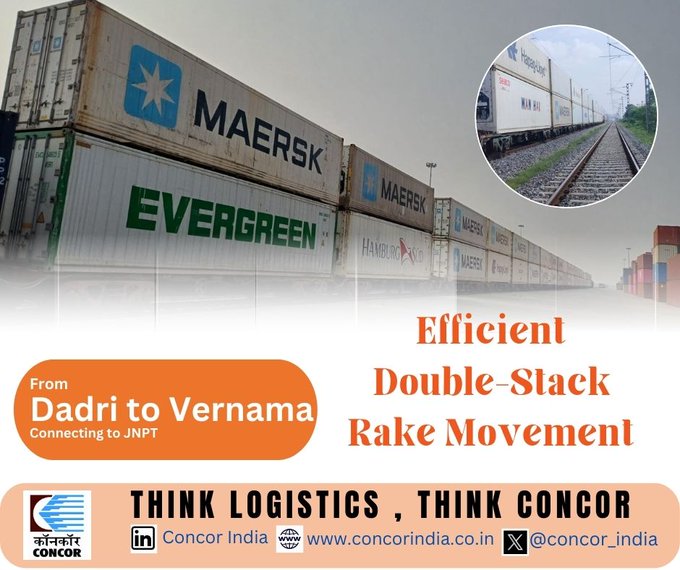
NEW DELHI : CONCOR is successfully operating double-stack services from its Mega Multi-Modal Logistics Park at ICDDadri to Varnama, Vadodara ensuring uninterrupted EXIM cargo movement even before the direct DFC link is commissioned.
These trains—carrying both reefer and dry containers—are reconfigured at Varnama for the final stretch to JNPT (Nava Sheva) and provides Faster cargo evacuation, Higher volume handling and Reliable port connectivity.
Total 2176 Export TEUs received at Varnama from ICD Dadri during Jan–Apr ’25.
MUMBAI : In a move that reaffirms its deep-rooted partnership and commitment to India’s logistics sector, CJ Logistics Corporation, South Korea’s largest logistics company, has further infused USD 32 million as a combination of Primary and Secondary transaction into CJ Darcl Logistics Ltd.(CJ Darcl), one of India’s leading integrated logistics service providers, increasing its equity stake from 50% to 56%.
The investment is aimed at strengthening CJ Darcl’s capital base and powering its next phase of growth. The funds will be strategically directed to accelerate its nationwide expansion across multimodal logistics infrastructure—spanning terminals, advanced warehousing, digital supply chain solutions, and alternative fuel platforms.
CJ Logistics and CJ Darcl forged their partnership in 2017 through a strategic partnership, when the KOSPI listed Korean logistics giant acquired 50% stake in DARCL Logistics Ltd., later rebranded as CJ Darcl Logistics Ltd. The remaining 44% stake continues to be held by the founding Darcl Promoters and affiliates, reflecting continued alignment and stability in ownership.
Mr. K.K. Agarwal, Chairman and Managing Director, CJ Darcl Logistics Ltd., commented, “This investment underscores CJ Logistics Corporation’s strong belief in our vision and performance. It is a testament to the trust we have built over the years and to our shared mission of transforming India’s logistics landscape. The capital will enable us to scale our integrated offerings, invest in next-generation technologies, and drive sustainable growth. We are creating a future-ready logistics enterprise that blends Indian depth with global excellence.”
Mr. Gwon Woong Kim, Head of APAC Headquarters, CJ Logistics Corporation added, “India is entering a transformative era in logistics and remains a cornerstone of CJ Logistics’ global strategy. Just as we witnessed a shift from unorganised to organised infrastructure in Korean markets during the 1990s, we see India poised for similar acceleration. Through deeper collaboration with CJ Darcl, we are committed to driving innovation and delivering high-efficiency logistics solutions that support India’s evolving supply chain ecosystem.”
Today, CJ Darcl commands a pan-India footprint with nearly 200 branches, serving over 2,000 customers across sectors through a team of 5,000+ professionals. The company provides end-to-end logistics services to a diverse customer base across industries, leveraging a strong mix of asset-based operations and technology-driven efficiencies.
This enhanced equity position comes amid a surge in investor interest in India’s logistics sector, driven by government-led infrastructure upgrades, policy reforms, and a growing emphasis on digitalization and green mobility.
About CJ Darcl Logistics Ltd.:
CJ Darcl is one of India’s leading multimodal logistics service providers, offering integrated transportation (including Road/FTL, Rail/Multimodal, Air, and Shipping/Coastal transportation) and value-added solutions across sectors. With a nationwide network and a fleet of 1,600+ owned vehicles (trucks, trailers, pullers, tippers, loaders, dumpers, hydraulic axles, etc), 2,500+ containers, and advanced capabilities in project logistics, warehousing & distribution, and freight forwarding, CJ Darcl plays a critical role in powering India’s industrial and supply chain ecosystem.
NEW DELHI : The Directorate General of Foreign Trade (DGFT), Ministry of Commerce & Industry, has issued a Notification No. 15/2025-26 dated May 26, 2026 removing key procedural restrictions applicable to the export of value-added leather products. This step is expected to reduce compliance burden and improve ease of doing business for exporters.
Port restrictions have been withdrawn, allowing export of Finished Leather, Wet Blue Leather, and EI Tanned Leather from any port or Inland Container Depot (ICD). Earlier, these exports were restricted to specific notified ports. The mandatory requirement for testing and certification by the Central Leather Research Institute (CLRI) for export of Finished Leather, Wet Blue Leather, Crust Leather, and EI Tanned Leather has also been dispensed with.
These procedural requirements were originally instituted to monitor export of value-added leather products and distinguish them from raw hides and dutiable items. However, with the removal of export duties on such leather categories and the clear physical distinction between processed and raw leather, the existing checks were considered redundant.
The decision follows consultations with stakeholders, including the Council for Leather Exports, Leather Exporters and Central Leather Research Institute (CLRI). It is expected to streamline export procedures, reduce transaction costs, and benefit MSME exporters in particular.
The reforms also support India’s efforts to enhance export competitiveness in the global leather value chain while maintaining transparency and quality standards under general customs provisions.
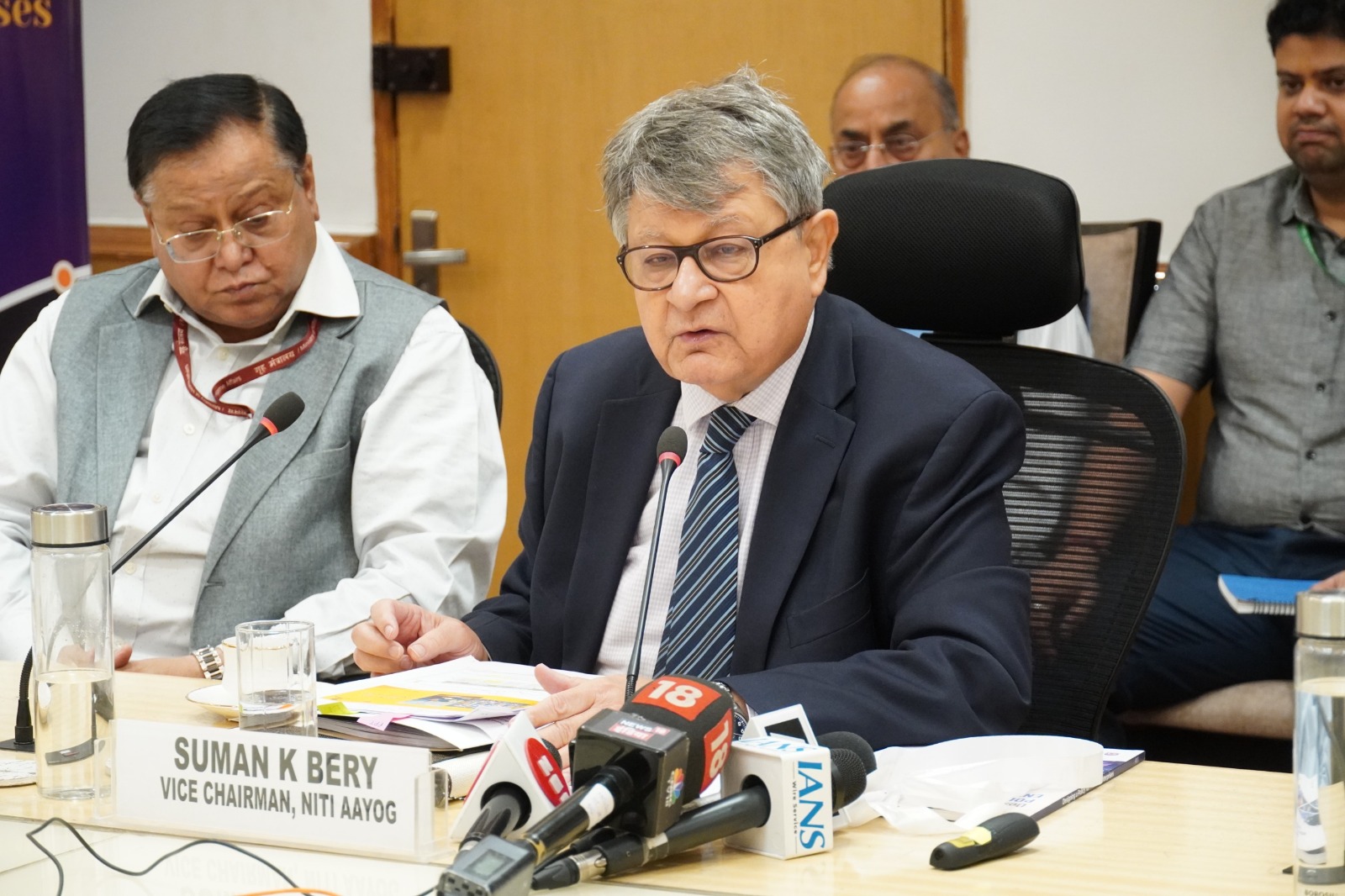
NEW DELHI : NITI Aayog on Monday released a report, “Designing a Policy for Medium Enterprises“, here, offering a comprehensive roadmap to transform medium enterprises into future growth engines of India’s economy.
Launched by Shri Suman Bery, Vice Chairman, NITI Aayog, in the presence of Dr. V.K. Saraswat, Member, NITI Aayog and Dr. Arvind Virmani, Member, NITI Aayog, the report highlights the critical, yet under-leveraged role played by medium enterprises and outlines targeted interventions to unlock their full potential.
The report examines the structural skew in the MSME sector, which contributes 29% to India’s GDP, 40% of exports, and employs over 60% of the workforce.
Additionally, the report also identifies medium enterprises as strategic actors in India’s journey toward self-reliance and global competitiveness under Viksit Bharat 2047.
This report underscores the need for inclusive policy design and collaborative governance to unlock the full potential of medium enterprises—positioning them as pivotal drivers of innovation, employment, and exports in India’s journey towards Viksit Bharat 2047.