Home Blog Page 910

AD Ports Group reports Record Revenue and Profit in 2024

ABU DHABI : AD Ports Group a leading global enabler of trade, transport, industry, and logistics, issued its 2024 Annual Report, which chronicled a year of record revenue and profit growth, as the Group consolidated two major acquisitions, and drove forward its profit-enhancing international expansion.

The report highlights the ongoing expansion of the Group, as it consolidated Noatum, a leading global logistics company, and Global Feeder Shipping (GFS), a Dubai-based regional container feeder shipping company, while securing multipurpose terminal concessions and intermodal facilities along some of the world’s fastest-growing trade corridors in Egypt, Pakistan, Angola, Tanzania, and Georgia.

All of AD Ports Group’s vertically integrated business clusters – Ports, Economic Cities & Free Zones, Maritime & Shipping, Logistics, and Digital – contributed to record 2024 Group revenue of AED 17.29 billion, and record Earnings Before Interest, Taxes, Depreciation and Amortisation (EBITDA) of AED 4.51 billion, up 48% and 69%, respectively, from 2023.

Revenue has risen five-fold and EBITDA nearly three-fold, since 2020, amid the Group’s “intelligent internationalisation’’ expansion strategy and its significant investments at home to support Abu Dhabi’s development into an international trade and industrial hub.

H.E. Mohamed Hassan Alsuwaidi, Chairman of AD Ports Group, said: “In a year marked by geopolitical instabilities and evolving global trade routes, AD Ports Group achieved record results, adeptly navigating dynamically changing markets, and seizing new opportunities to advance its value-enhancing international expansion. The integrated trade, transport, and logistics group, under the guidance of our wise leadership in the UAE, emerged as a truly global player in 2024, achieving a new level of geographic reach, international recognition, and financial strength.”

Captain Mohamed Juma Al Shamisi, Managing Director and Group CEO – AD Ports Group, said: “In 2024, AD Ports Group delivered on its primary mission to enable trade, supporting the vision of our wise leadership in the UAE. Through its operational agility, and expanding range of efficient, customer-centric, end-to-end solutions, the Group grew organically and by selectively adding new port terminals, and maritime, digital, and logistics assets, thereby positioned itself for a new phase of value-adding international growth.’’

Highlights included the December inauguration of CMA Terminals Khalifa Port, an AED 3.1 billion (USD 845 million) container terminal collaboration with strategic partner CMA CGM Group, which expanded the port’s capacity by 23%, securing Abu Dhabi’s position at the forefront of global trade, and underscoring the Group’s commitment to the Emirate and UAE.

During the year, the Group expanded through strategic acquisitions in Africa, Europe, and Central Asia, and added to its global ports and terminals network with new terminal concessions in Egypt, Pakistan, and Angola, as it restructured its growing global business around three new core brands – Noatum Ports, Noatum Maritime, and Noatum Logistics.

Reflecting the Group’s enhanced global role, Khalifa Port was ranked for the first time in the top 20 (position 19) of the world’s largest container ports by Drewry International. The Group also received prestigious international awards for its financial strength and performance, investor relations, employee workplace environment, and ESG programmes, among others.

Strategic Direction

The Group is following a focused, inorganic expansion strategy to acquire complementary investments that add value and strengthen the overall AD Ports Group business ecosystem. Inorganic investments primarily involve logistics, maritime, and port assets, to enhance customer relationships, influence trade routes, improve connectivity, expand the logistics footprint, and build on the Group’s Abu Dhabi-based core assets. 

Most investments are currently made in Abu Dhabi, which continues to anchor the global business and drive the Group’s expansion abroad. The growth strategy is intricately linked to leveraging Abu Dhabi’s international standing as a global trading hub. The international opportunities that are being added to the Group offer additional scale, and strong and stable management, while contributing to the Group’s bottom line.

Not only did the Group’s global footprint grow bigger and more diverse in 2024, but it also became more profitable as the five core business clusters leveraged the synergies of their expanding complementary portfolio. With multimodal global connectivity across sea, road, and, for the first time at Khalifa Port, rail, the Group’s multi-cluster business ecosystem delivered on its mission to enable increasing levels of trade in the Middle East and across its global footprint.

Market Overview

2024 was a positive year for container, bulk, Ro-Ro, tanker, and offshore segments, which benefited AD Ports Group, operator of the world’s third-largest pure independent feeder shipping service, according to industry group Alphaliner. The 2.2% growth in global seaborne trade volumes, according to Clarkson’s Research, coupled with Red Sea disruptions that elevated container shipping rates, and diverted Ro-Ro volumes to Autoterminal Khalifa Port, helped drive the Group’s record revenue and earnings. 
While global cargo demand may soften slightly in 2025, a new series of expected UAE bilateral trade deals, and a government strategy to double cumulative Foreign Direct Investment (FDI) by 2031, are seen as sustaining demand.

The UAE economy, boosted by higher oil production and rising exports, continued to outperform the global economy. The UAE economy grew 3.8% annually in the first nine months of 2024 from a year earlier, according to the UAE Ministry of Economy, with the pace expected to accelerate to 4% to 5% in 2025, amid increasing oil and non-oil based GDP growth.

2024 was a strong year across most cargo segments, as China remained a key driver of the world economy. General cargo volumes were up about 40% year-on-year, supported by the Group’s Karachi Bulk Terminal, which commenced operations in early 2024.

Keys to growth in 2024 were the full integration of Noatum and GFS, which transformed the Group’s reach and connectivity, generating savings and creating new cross-market routes,
products, and end-to-end solutions, which drove record results.

Bureau Veritas delivers final CMA CGM container ship in series

QINGDAO : Bureau Veritas Marine & Offshore (BV) has successfully delivered the CMA CGM TIGA, the last of ten 5500TEU container ships built for CMA CGM at CSSC Qingdao Beihai Shipbuilding. This marks the completion of a major project for which BV provided classification services and Bureau Veritas Solutions M&O provided advisory services, helping to ensure compliance with international safety, structural integrity and environmental protection requirements.

The CMA CGM TIGA, a new-generation, medium-sized container vessel, was designed by CSSC Qingdao Beihai Shipbuilding in collaboration with the Shanghai Ship Research & Design Institute (SDARI). With a length of 255.5 meters, a width of 40.0 meters, and a deadweight tonnage of 73,025.91 tons, the vessel incorporates technologies such as the world’s first WinGD7X82-2.0 main engine, along with Selective Catalytic Reduction (SCR) and Alternate Maritime Power (AMP) systems, reducing sulfur oxide (SOx) and nitrogen oxide (NOx) emissions. 

Providing classification services, BV worked closely with CMA CGM, CSSC Qingdao Beihai Shipbuilding, China Shipbuilding Trading Co., Ltd. (CSTC), and the engine manufacturer to help support the success of the series with design support, including plan approval to BV classification rules, statutory requirements and survey under construction services

BVS advisory services expertise has supported the optimization of each ship’s energy efficiency and performance. The series has achieved an Energy Efficiency Design Index (EEDI) 53.6% below the baseline, surpassing IMO Phase III standards for environmental performance. BVS contributed to the series’ design and operational efficiency, providing advisory services, also including springing vibration analysis in a global finite element model and reducing design cycles, while helping support structural integrity and helping ensure timely steel procurement

In addition, BV also conducted full-process precision monitoring to ensure that the vessels met required standards. This included successfully passing container hold tests and ensuring compliance with hull welding quality standards. Safety features such as the Fuel Oil Rapid Recovery System (FORS) notation and an insulation fault alarm and positioning system for low-voltage refrigerated container circuits were also incorporated, further enhancing the vessels’ operational safety and efficiency. The FORS notation ensures swift fuel recovery from tanks in emergencies. Crucially, elastic deformation of large hull structures was factored into shaft alignment calculations to prevent propeller shaft and bearing wear.

Maersk’s Logistics Trend Map analyses the top ten trends and game changers for global supply chains

COPENHAGEN : Tariffs, political tensions and conflicts, inflation and recession risks, changing consumer behaviour or underlying challenges like digitisation and AI: Most businesses globally are faced with unseen levels of unpredictability and uncertainty at the moment.

Navigating this complex environment and taking the right focus and decisions has become more difficult than ever across virtually all industries. When it comes to global supply chains Maersk’s new Logistics Trend Map helps now to focus on the most relevant trends and game changers for future supply chain management.

The report is based on comprehensive data analysis by the partner Statista as well as quality expert interviews and insights from more than 500 industry logistics leaders. To identify the trends, we have used AI-driven analytics to explore scientific studies, patents, earnings calls, and startup activities. With the objective of not only identifying the most important trends but also positioning them on the Trend Map, we assessed the data to determine the relevance and level of industry adoption of each trend.

From a list of 30 identified areas The Logistics Trend Map offers deep-dives into the ten most relevant topics such as Supply Chain Visibility, Internet of Things, Supply Chain Diversification, Financial Resilience, Circular Economy, AI, Cyber Security or the latest innovations in E-Commerce and Last-Mile Delivery.

These ten top rated topics and their impact on supply chain management vary significantly across the geographical regions and eight industry verticals (retail, automotive, chemicals, pharma & healthcare, lifestyle & fashion, perishables, technology and FMCG). Filtering the topics by region and industry vertical offers some surprising results: For instance, in retail the reverse logistics/return handling is by far the most pressing challenge for company logistics, said 53% of the interviewed decision-makers (mainly due to its complexity) – even bigger than geopolitical disruptions which were mentioned only by a comparatively low 38% in retail (versus max of 59% in fashion & lifestyle and pharma & healthcare).

In an increasingly complex and challenging world, staying ahead in logistics has never been more critical. The question is no longer whether companies will face disruption in their supply chains, but how they can constantly and effectively navigate them. Identifying and analysing trends therefore enables businesses to stay competitive in a dynamic industry.

Karsten Kildahl

Chief Commercial Officer (CCO) at Maersk

The Logistics Trend Map offers also actionable insights on how to leverage the trends to solve problems and unlock growth opportunities.

The Logistics Trend Map can be found and filtered by theme, industry and region here while the full 70 page report is available for download here.

About Maersk

A.P. Moller – Maersk is an integrated logistics company working to connect and simplify its customers’ supply chains. As a global leader in logistics services, the company operates in more than 130 countries and employs around 100,000 people. Maersk is aiming to reach net zero greenhouse gas (GHG) emissions by 2040 across the entire business with new technologies, new vessels, and reduced GHG emissions fuels.

MacGregor delivers its new electric heavy lift crane to Nordic

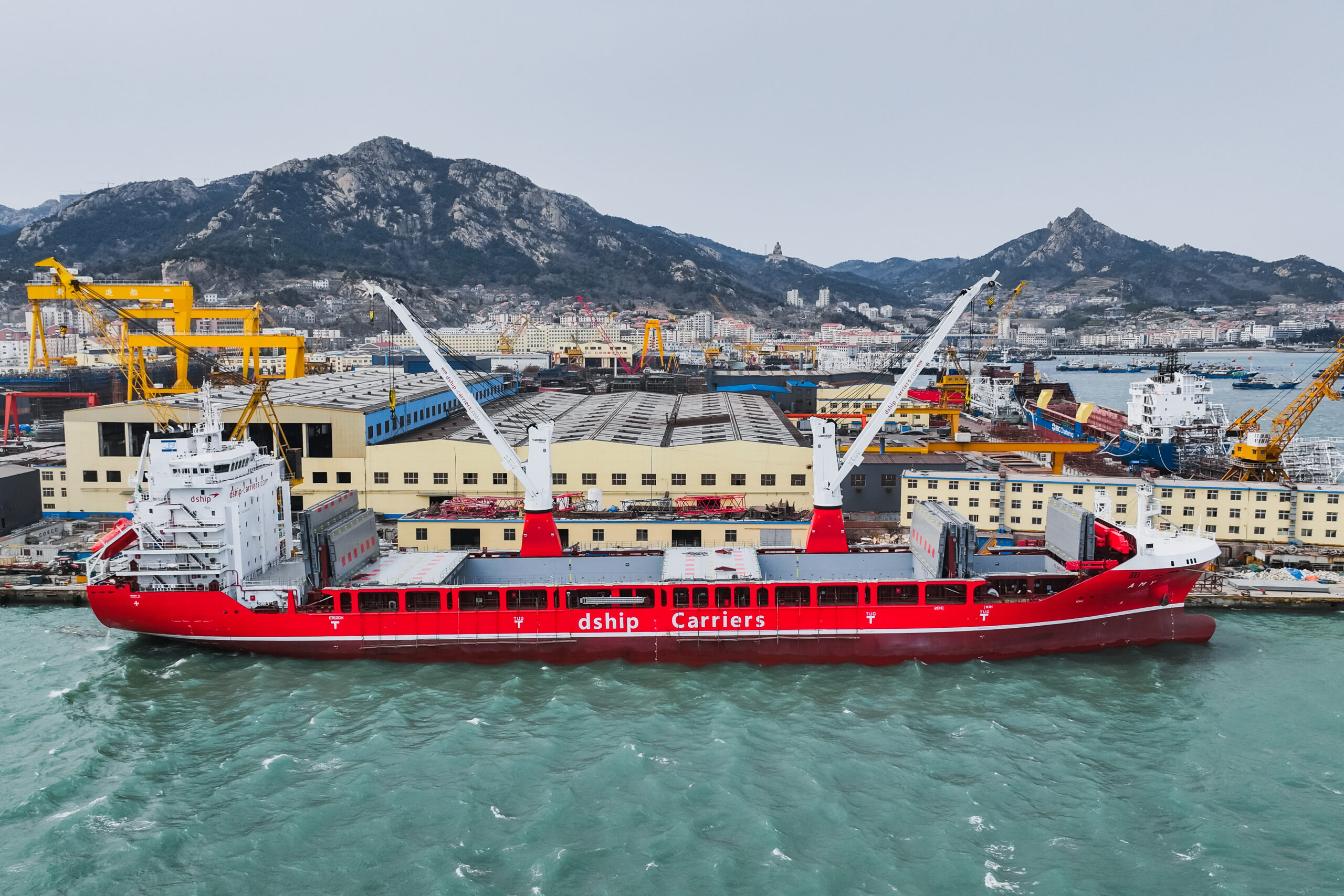
HELSINKI : MacGregor is proud to announce the successful delivery of its new type of SWL 250t electric heavy lift cranes to Nordic from Huanghai Shipbuilding Co., Ltd. The cranes mark a significant milestone in sustainable cargo handling solutions.
 
This next-generation heavy lift crane combines MacGregor and NMF’s extensive experience in the heavy lift industry. The crane is designed to enhance operational efficiency while significantly reducing emissions, energy consumption, and maintenance costs. By leveraging MacGregor’s advanced electric drive technology, the crane eliminates hydraulic oil usage, improving environmental performance and ensuring compliance with stricter industry regulations.
 
Soeren Hoessermann, Managing Director at Nordic Hamburg Shipmanagement (HK) Ltd., expressed enthusiasm about the delivery: “We are pleased to receive MacGregor’s electric heavy lift crane, which aligns with our commitment to improving efficiency and reducing our environmental impact. This innovative technology will help us optimize cargo handling operations while contributing to our sustainability goals.”

The delivery of this electric heavy lift crane reinforces MacGregor’s leadership in sustainable maritime solutions, supporting customers decarbonisation targets without compromising performance.
 
“At MacGregor, we are committed to delivering sustainable and innovative solutions that create lifetime value in cargo handling. The delivery of our new electric heavy lift crane is a testament to our dedication to reducing the environmental footprint of maritime operations while maintaining the highest standards of performance and reliability,” said Magnus Sjöberg, Senior Vice President, Equipment Solutions Division, MacGregor.
 
The crane will be installed on the vessel Amy, which will play a key role in a project cargo market.

ClassNK issues approval in principle (AiP) for retrofitted methanol dual fuel Kamsarmax bulk carrier

TOKYO : ClassNK has issued an approval in principle (AiP)*1 for the design concept of a retrofitted Kamsarmax bulk carrier, converting it from conventional fuel to methanol dual-fuel, jointly developed by TSUNEISHI SHIPBUILDING Co., Ltd. and Fonden Mærsk Mc-Kinney Møller Center for Zero Carbon Shipping*2. This certification demonstrates the regulatory feasibility of the ship, serving as a meaningful step in advancing the transition of the existing fleet to alternative fuels, as bulk carriers of this size are widely operated today.

The design concept was developed as part of a project exploring the conversion of Tsuneishi’s Kamsarmax bulk carrier standard design to a methanol dual fuel configuration. Aiming to establish a model that could pave the way for a broader green transition within the medium-sized bulk carrier sector the project is working through retrofit challenges, such as determining the location of the new methanol fuel tanks.

ClassNK carried out a design review of the design concept based on ‘Part A Guidelines for Ships Using Methyl/Ethyl Alcohol as Fuels (Edition 3.0.0)’ of the ‘Guidelines for Ships Using Alternative Fuels’ and examined the risk assessment through HAZID. ClassNK issued AiP upon confirming the feasibility of key design, including the arrangement of methanol fuel tanks and fuel supply systems, in terms of regulatory compliance.

ClassNK will continually strive to contribute to advanced decarbonization initiatives through safety assessments and more.

*1 At the initial stage of designing or before the specific target ship to be implemented is decided, the design is examined based on the existing regulations such as international conventions and ship classification rules, and an Approval in Principle (AiP) is issued as proof of conformity with requirements. It also prevents rework of regulatory aspects in the post-process, shortens the examination time at the time of class registration, and can be used as a technical basis for external appeal of the design status. For more information, visit our website.

*2 The Mærsk Mc-Kinney Møller Center for Zero Carbon Shipping is a not-for-profit, independent research and development center looking to accelerate the decarbonization of the maritime industry. Our organization participates as a Mission Ambassador. For more information, visit the website.

India signs 5 MoUs with Thailand to elevate ties of strategic partnership during Modi’s Bangkok visit

BANGKOK : India and Thailand on Thursday upgraded their relations to a strategic partnership as Prime Minister Shri Narendra Modi and his Thai counterpart Paetongtarn Shinawatra explored ways to enhance trade and investment and bolster cooperation in defence, security and countering cyber-crimes and human trafficking.

The two leaders met in Bangkok a day ahead of the Bimstec Summit to be hosted by Thailand on Friday. Thailand is among India’s key partners in the Association of Southeast Asian Nations (Asean) and bilateral defence and security cooperation has grown steadily within the framework of India’s “Act East” policy.

Modi conveyed India’s deepest condolences for the loss of lives in the earthquake that hit Myanmar and Thailand on March 28 at a joint media interaction with Shinawatra and said: “Thailand has a special place in India’s ‘Act East’ policy and our Indo-Pacific vision. Today we have decided to give our relations the form of a strategic partnership.”

Both leaders held talks on various areas of bilateral cooperation and later witnessed the signing of several key agreements that added new vigor and dynamism to the longstanding friendship between the two nations.

Besides the Joint Declaration on the establishment of the India-Thailand Strategic Partnership, a MoU was also signed between the Ministry of Digital Economy and Society of Thailand and the Ministry of Electronics and Information Technology of India on cooperation in the field of digital technologies.

A MoU between Sagarmala Division of India’s Ministry of Ports, Shipping and Waterways and Thailand’s Fine Arts Department, Ministry of Culture was signed for the development of the National Maritime Heritage Complex (NMHC) at Lothal, Gujarat.

Another MoU between India’s National Small Industries Corporation Ltd. (NSIC) and Thailand’s Office of Small and Medium Enterprises Promotion (OSMEP) was signed on cooperation in the field of micro, small and medium enterprises.

Two other key MoUs signed included between the Ministry of Development of North Eastern Region (MDoNER) and Thailand’s Ministry of Foreign Affairs and between North Eastern Handicrafts and Handlooms Development Corporation Limited (NEHHDC) of India and Creative Economy Agency (CEA) of the Government of Thailand.

In his remarks, PM Modi highlighted that India’s ‘Act East’ policy and Thailand’s ‘Act West’ complement each other very well and open up opportunities for bilateral cooperation in many fields.

“We have emphasised cooperation in the fields of tourism, culture and education between Thailand and the North-Eastern states of India. We discussed growing mutual trade, investment, and business exchanges. Agreements have also been made to foster cooperation in the areas of MSME, handloom and handicrafts,” PM Modi said during a joint press statement with the Prime Minister of Thailand.

“We have decided to strengthen cooperation in renewable energy, digital technology, e-vehicles, robotics, space, biotechnology and start-ups. In addition to enhancing physical connectivity, both the countries will work to boost FinTech connectivity,” he added.

The Prime Minister stated that the talks focused on ways to deepen the India-Thailand Strategic Partnership, including sectors in strategic areas such as defense, security, maritime safety and hydrography.

“We also reiterated our commitment to working together to overcome the challenges of terrorism, money laundering and more,” said PM Modi. During the discussions, Prime Minister Modi also expressed solidarity with the people of Thailand in the aftermath of the earthquake a few days ago. PM Modi also mentioned that India fully supports ASEAN unity and ASEAN centrality.

“In the Indo-Pacific, we both support free, open, inclusive and rule-based order. We believe in the policy of development, not expansionism,” said PM Modi.

Lok Sabha passes the Coastal Shipping Bill, 2024

NEW DELHI : The Lok Sabha passed the Coastal Shipping Bill, 2024, paving the way for a dedicated legal framework for coastal trade as the maritime sector aims to provide a economical, reliable and sustainable mode of transportation as it decongest road and rail network. “The Bill seeks to unlock the full potential of India’s vast and strategic coastline, providing dedicated legal framework for coastal trade,” asserted Shri Sarbananda Sonowal, Union Minister of Ports, Shipping and Waterways. 

The Coastal Shipping Bill, 2024 aims to make coastal trade easier, more competitive, and better integrated with PM Shri Narendra Modi Govt’s overall transport vision — the National Logistics Policy. With its manifold forward looking provisions, the bill provides a future ready legal framework while upgrading the dated provision of earlier legislations like Merchant Shipping Act, 1958. The proposed bill introduces key provisions for licensing and regulating foreign vessels in India’s coasting trade. It mandates the formulation of a National Coastal and Inland Shipping Strategic Plan and establishes a National Database for Coastal Shipping. The bill also regulates foreign vessels chartered by Indian entities and outlines penalties for violations, aligning with the government’s push for decriminalising laws. Additionally, it grants the Director General of Shipping authority to seek information, issue directions, and enforce compliance, while empowering the Central Government to provide exemptions and regulatory oversight, ensuring streamlined and efficient coastal shipping operations in India.

Speaking on the occasion, Union Minister Shri Sarbananda Sonowal said, “The Coastal Shipping Bill aligns local aspirations with national goals, and provides a framework for the next 25 years of coastal economic growth under the Maritime Amrit Kaal Vision 2047. The overarching goal of the Bill to develop a coastal fleet owned and operated by Indian entities will lead to reduced dependence on foreign vessels for critical areas relevant for our country’s coastal shipping. It will reduce logistics costs, promote green transport, support the vision of Prime Minister Shri Narendra Modi ji’s ‘Make in India’ initiative and create thousands of jobs in shipbuilding, port services and manning of vessels. The bill is in line with international best practices for adopting dedicated law for coastal trade but adopted to suit Indian conditions. This Bill provides a dedicated legal framework to boost coastal trade, propelling inland waterways and riverine economies while offering a low-cost, reliable, and sustainable alternative to overloaded road and rail networks.”

The Coastal Shipping Bill, 2024 aims to reduce logistics costs and promote sustainable transport. Coastal shipping, a cost-efficient and low-emission mode of transport, will play a key role in easing India’s overburdened road and rail networks. Key provisions of the Bill include the removal of the general trading license requirement for Indian ships (Clause 3), reducing compliance burdens and enhancing ease of doing business. Foreign vessels can engage in coastal trade only under a license issued by the Director General of Shipping (Clause 4), with conditions that support Indian shipbuilding and employment for seafarers. The Bill mandates a National Coastal and Inland Shipping Strategic Plan (Clause 8), revised biennially, to improve route planning, forecast traffic, and integrate coastal shipping with inland waterways. This strategic vision ensures long-term growth and sustainability in India’s maritime sector.

On the bill’s efficacy with present day realities as well as its role as a future ready framework, the Union Minister of Ports, Shipping and Waterways, Shri Sarbananda Sonowal said, “The new Coastal Shipping Bill modernises and streamlines coastal trade regulations, addressing gaps in the Merchant Shipping Act, 1958. Unlike its predecessor, which focused solely on vessel licensing, this Bill provides a forward-looking, holistic framework aligned with global cabotage practices. It simplifies procedures, promotes growth, & integrates coastal shipping into India’s modern logistics network, ensuring efficiency, sustainability and competitiveness in the maritime sector.”

The Coastal Shipping Bill, 2024 builds on key reforms, including prioritised berthing, green clearance channels, and GST reduction on bunker fuel. Coastal cargo traffic has surged 119% in the last decade, from 74 million tonnes in 2014-15 to 162 million tonnes in 2023-24, with a target of 230 million tonnes by 2030. The Bill ensures legal clarity, regulatory stability, and investment-friendly policies, strengthening India’s maritime security and advancing the vision of Atmanirbhar Bharat.

On the possibilities from strategic integration of coastal shipping with inland waterways, Shri Sarbananda Sonowal said, “The integration of coastal and inland waterways will promote regional development of riverine and coastal areas alike in the country. This Bill will also give impetus to the long-term vision of development of coastal and inland waterways transport in States such as Odisha, Karnataka and Goa among others. The integration of coastal shipping routes with inland waterways — which often traverse multiple states — calls for collective planning and coordinated execution. By recognising the role of States in this regard, this Bill ensures that the growth of coastal shipping is inclusive and participative.”

The Coastal Shipping Bill, 2024 introduces a National Database of Coastal Shipping to enhance transparency, coordination, and data-driven decision-making. It also expands the category of charterers allowed to hire foreign vessels, including Indian citizens, NRIs, OCIs, and LLPs. Ensuring cooperative federalism, the Bill provides active representation for States and Union Territories in key mechanisms, reinforcing India’s commitment to a streamlined, inclusive, and efficient maritime sector.

Allaying criticism of the Opposition parties, the Union Minister asserted, “The Coastal Shipping Bill, 2024 upholds cooperative federalism by ensuring active participation of States and Union Territories. Under Clause 8(3), a committee—comprising representatives from major ports, State Maritime Boards, and experts—will draft the National Coastal and Inland Shipping Strategic Plan. This guarantees States a direct role in shaping strategy, routes, and regulations. By integrating coastal shipping with inland waterways, the Bill enables collective planning, fostering inclusive growth aligned with Sabka Saath, Sabka Vikas.”

NMDC to host seminar on “Green Shipping Challenges”

MUMBAI : The National Maritime Day Celebrations (NMDC) Committee is hosting a seminar on “Green Shipping Challenges” at the Indian Register of Shipping (IRS) Powai, Mumbai. This event will bring together maritime professionals, industry leaders, and policymakers to discuss sustainable solutions for the shipping sector.

The seminar will focus on key topics such as alternative fuels, eco-friendly ship technologies, regulatory frameworks, and sustainable port operations. Experts will share insights on overcoming challenges and implementing green shipping practices to reduce the environmental impact of the maritime industry.

Hosted at IRCLASS, a leading ship classification society, this seminar aims to promote collaboration and innovation in advancing sustainability in shipping. Attendees can engage in insightful discussions, panel sessions, and networking opportunities with key stakeholders driving the future of green maritime practices.

Seafarer Seminar held to mark National Maritime Day Celebrations 2025

MUMBAI : The Seafarer Seminar, held as part of the National Maritime Day Celebrations (NMDC) 2025, successfully took place on 1st April 2025 at the SCI Auditorium, Nariman Point, Mumbai. The seminar focused on the theme: “Sustainable Shipping – Youth for Maritime Development.”

The event, brought together industry leaders, policymakers, and young maritime professionals to discuss the future of sustainable shipping and the vital role of youth in maritime development.

The Distinguished Guests including Shri Shyam Jagannathan, IAS – Director General of Shipping, Capt. B.K. Tyagi – Chairman & Managing Director, Shipping Corporation of India and Special Invitee Capt. D.C. Sekhar – Managing Director, AlphaMERS Ltd have attended the Seminar.

The seminar featured insightful discussions, expert perspectives, and interactive sessions, providing valuable takeaways for attendees. The event reinforced the importance of youth engagement in driving sustainability within the maritime sector and concluded on a positive note with key takeaways for future initiatives.

Thailand holds “special place” in India’s “Act East” policy, our “Indo-Pacific Vision”: PM Modi

BANGKOK : Prime Minister Shri Narendra Modi reaffirmed India’s commitment to ASEAN unity and the Indo-Pacific while strengthening ties with Thailand, stating that Thailand holds a “special place” in India’s strategic approach towards the region, playing a key role in both India’s ‘Act East’ policy and the broader Indo-Pacific vision. He also emphasised that India believes in “vikasvad, not vistarvad”

“India fully supports ASEAN unity and ASEAN centrality. In the Indo-Pacific, we both support a free, open, inclusive, and rule-based order. We believe in the policy of development-ism, not expansionism,” PM Modi said.

Underlining Thailand’s special place, the PM said, “Thailand has a special place in India’s ‘Act East’ policy and our Indo-Pacific vision. Today, we have decided to give our relations the form of Strategic Partnerships. We also discussed establishing a ‘Strategic Dialogue’ between security agencies.
“We expressed our gratitude to the Government of Thailand for the cooperation received from them in sending back Indian victims of cyber crime to India,” he added.

PM Modi and Thai Prime Minister Paetongtarn Shinawatra also held bilateral talks and discussed increasing cooperation in various sectors, including tourism, culture, and business.
“We have emphasised cooperation in the fields of tourism, culture, and education between the North-Eastern states of India and Thailand. We talked about increasing mutual trade, investment, and exchange between businesses. Agreements have also been made for cooperation in MSMEs, handloom, and handicrafts,” PM Modi said.

The Prime Minister also thanked Thailand for honouring his visit with a special postage stamp. “I am grateful to the Government of Thailand for issuing a special postage stamp based on the 18th-century ‘Ramayana’ mural paintings to commemorate my visit. Prime Minister Shinawatra just presented me with the Tripitaka. I accepted it with folded hands on behalf of the land of Buddha, India,” he stated.
Meanwhile, during his speech, PM Modi also highlighted the deep-rooted cultural and spiritual ties between India and Thailand. “The centuries-old ties between India and Thailand are linked by our deep cultural and spiritual threads. The spread of Buddhism has connected our people. There has been an exchange of scholars between Ayutthaya and Nalanda. The story of the Ramayana is deeply ingrained in Thai folk life, and the influences of Sanskrit and Pali are still visible in the language and traditions today,” he noted.

PM Modi expressed appreciation to his Thai counterpart for a warm welcome in the country. “Had a productive discussion with Prime Minister Paetongtarn Shinawatra in Bangkok a while ago. Thank you to the Thai people and government for the warm welcome, and I also expressed solidarity with the Thai people after the earthquake a few days ago. India’s ‘Act East Policy’ and Thailand‘s ‘Act West Policy’ complement each other very well and open up opportunities for bilateral cooperation in many fields,” he said in an X post.

He also outlined key areas of security and defence cooperation. “Our discussions focused on ways to further deepen the strategic partnership between India and Thailand. Areas of discussion included strategic issues such as defence, security, maritime security, and hydrography. We also reaffirmed our commitment to work together to overcome challenges related to terrorism, money laundering, and others,” PM Modi stated.

In the same X post thread, PM Modi stressed the importance of strengthening trade ties with Thailand.
“India and Thailand are keen to strengthen their economic and trade ties. Prime Minister Paetongtarn Shinawatra and I spoke about our two countries’ close collaboration in agriculture, small and medium-sized enterprises, maritime, fintech, and space. Cultural ties were also a key issue in our discussions,” he said.

Thailand PM also gifted PM Narendra Modi the holy scriptures: the World Tipitaka, in Pali. This special Tipitaka was published by the Thai Government in 2016 to commemorate the reign of King Rama IX and Queen Sirikit.

Following this, PM Modi, via a post on X, expressed his gratitude and said, “A very special gesture! I am grateful to Prime Minister Paetongtarn Shinawatra for giving me a copy of the Tipitaka in Pali. Pali is indeed a beautiful language, carrying within it the essence of Lord Buddha’s teachings. As you are all aware, our Government had conferred the status of Classical Language on Pali last year. People from all over the world have appreciated this decision, and it has also encouraged research as well as the study of this language.”

Earlier in the day, as per an official statement from the PMO, PM Modi witnessed an “enriching” performance of the Thai Ramayana, Ramakien, in Bangkok.
In a prior post on X, he wrote, “A cultural connect like no other! Witnessed a captivating performance of the Thai Ramayana, Ramakien. It was a truly enriching experience that beautifully showcased the shared cultural and civilisational ties between India and Thailand. The Ramayana truly continues to connect hearts and traditions across so many parts of Asia.”
PM Modi is in Bangkok at the invitation of Prime Minister Paetongtarn Shinawatra for an official visit and to attend the sixth BIMSTEC Summit. After completing his engagements in Thailand, he will visit Sri Lanka from April 4 to April 6. According to a statement from the PMO, PM Modi‘s upcoming visit to Sri Lanka follows Lankan President Disanayaka’s visit to India last December.

Source : ANI