Home Blog Page 114

Qatar exports first LNG shipment through Strait of Hormuz for weeks

OMAN: Qatar has sent an LNG tanker through the Strait of Hormuz for the first time since July. Qatar effectively suspended LNG shipments through the key energy waterway following an attack on one of its tankers in late July.

However, Qatari authorities have confirmed that a tanker loaded with LNG passed through the contested Strait of Hormuz at the beginning of September.

Qatar confirms LNG tanker crossed Hormuz
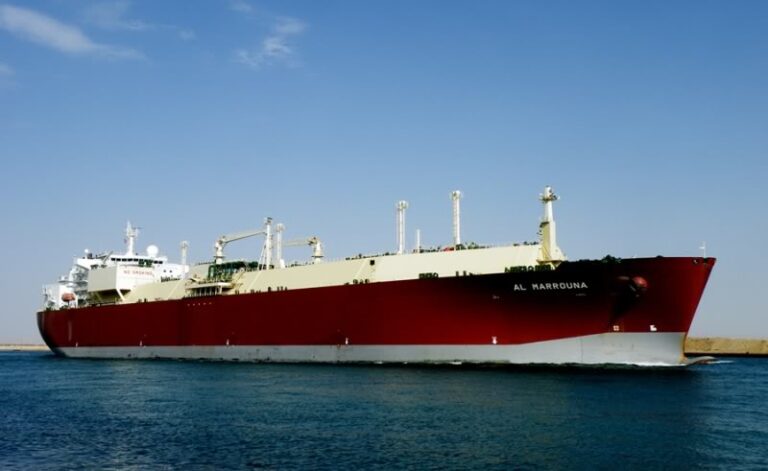
The Al Marrouna passed through the Gulf of Oman on Tuesday morning and signalled Port Qasim in Pakistan as its next destination, according to ship-tracking data compiled by Bloomberg. The transit is a welcome shot in the arm for the global LNG market.

Prior to the outbreak of war between the US and Iran, Qatar accounted for one fifth of the world’s LNG exports. The war inevitably put huge strains on the supply chain, and matters were further compounded when Qatari tankers were attacked in July.

That attack prompted Doha to issue a directive that instructed all Qatari tankers to avoid the Strait of Hormuz.

Fuel prices have soared across European and Asia markets, hitting their highest levels in over 3 years. Fresh strikes continue to be exchanged between Tehran and Washington daily across the region, and a conclusion to the war has never looked further away.

Iran has said that a deal to manage the Strait of Hormuz is very, very close.

That has peaked interest from oil traders to see what impact Tehran tightening their grip on the Strait of Hormuz will have on prices, and how the US would respond to a deal with Muscat.

Last month, Qatar extended force majeure on LNG deliveries to European and Asian buyers into October, helping keep prices elevated.

However, it has continued loading the fuel onto available empty tankers inside the Gulf and exporting it to Kuwait.

That strategy is allowing Doha to effectively manage storage and keep parts of its massive export complex running at minimum levels

APM Terminals deepens commitment to Nigeria during ministerial visit to Denmark

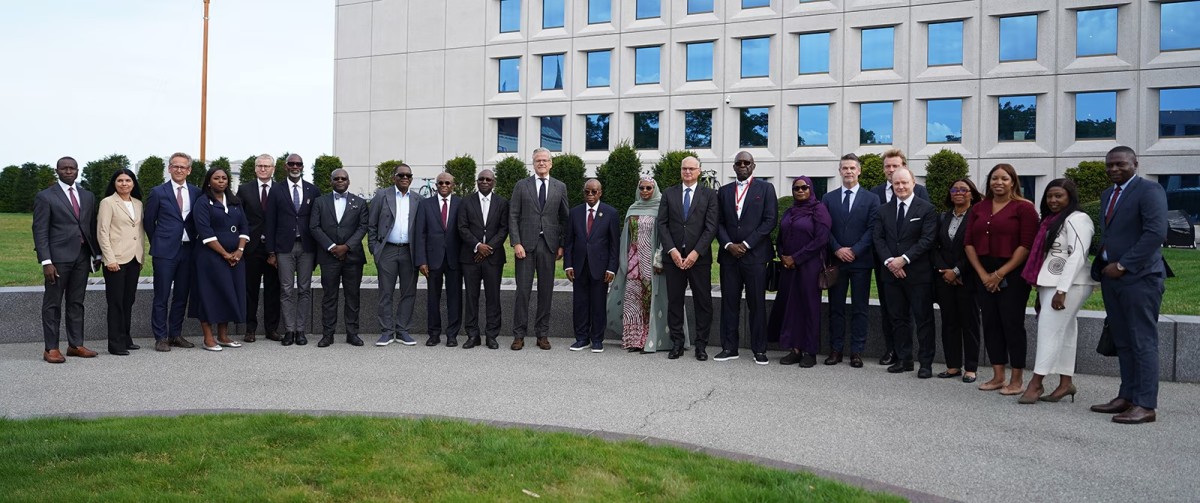
APAPA: This week, APM Terminals reinforced its longstanding commitment to Nigeria and its commitment to further investment to support the country in achieving its trade and economic development goals.

This took place during the visit by Nigeria’s Minister of Marine and Blue Economy, the Honourable Adegboyega Oyetola, and his delegation to Denmark. During the visit, the parties discussed the extension of APM Terminals’ port concessions at Apapa and the West Africa Container Terminal in Onne. And the visit included a signing of a Memorandum of Understanding (MoU) related to development of a greenfield project at Badagry. The MoU was signed in Copenhagen by Vincent Clerc, Group CEO of A.P. Moller – Maersk, on behalf of APM Terminals, and by Didi Ndiomu, Managing Director of Badagry Port Development Ltd and Quinn McGrath Marine and Environmental Services Ltd.

The agreement commits the parties to exclusive negotiations to explore the development of Badagry Port, where the deepwater capacity would be transformational in strengthening Nigeria’s role as a leading gateway port in West Africa and creating significant new transshipment opportunities. By enabling larger container vessels to call Nigeria, the project would support growth, greater supply chain resilience and new trade opportunities. APM Terminals is committed to carrying forward development of Badagry.

“APM Terminals is keen to contribute to Nigeria’s economic growth and position as a trade hub in West Africa. We believe further investing long-term in our concessions in Apapa and Onne helps doing that, and we were pleased to have a constructive dialogue about this today. Additionally, developing Badagry as a greenfield project will further ease congestions in city ports and further open new opportunities,” says Igor van den Essen, Managing Director of Africa & Europe for APM Terminals, part of the A. P. Moller – Maersk group.

The signing came against the backdrop of Minister Oyetola’s visit to Denmark, which included meetings with senior representatives of the Danish government and the wider Danish maritime sector.
“APM Terminals is encouraged by the Nigerian government’s ambition to expand trade, attract investment, and strengthen the country’s position as a leading maritime gateway in West Africa, and we are proud to play a part in that ambition. We strongly believe that public-private partnerships help us deliver results that support growth because they drive long-term investment, a better business environment and, thereby, competitiveness in a rapidly developing market,” says Igor van den Essen.

Mr Didi Ndiomu added “Investing in maritime infrastructure and especially in Badagry as a greenfield port project together with APM Terminals is the beginning of Nigeria becoming the true maritime capital of sub-Saharan Africa in full alignment with the government of President Bola Ahmed Tinubu’s ambitious maritime growth strategy.”

Smarter and safer navigation: new buoy begins operating near the Port of Klaipėda

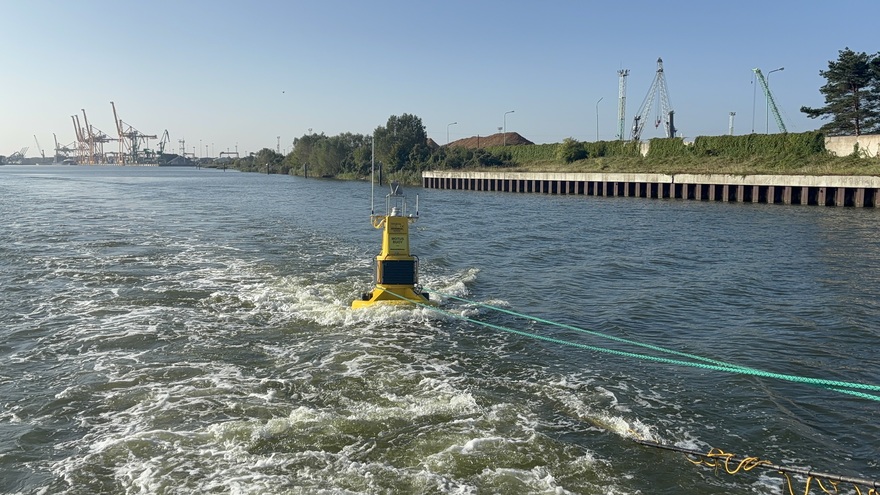
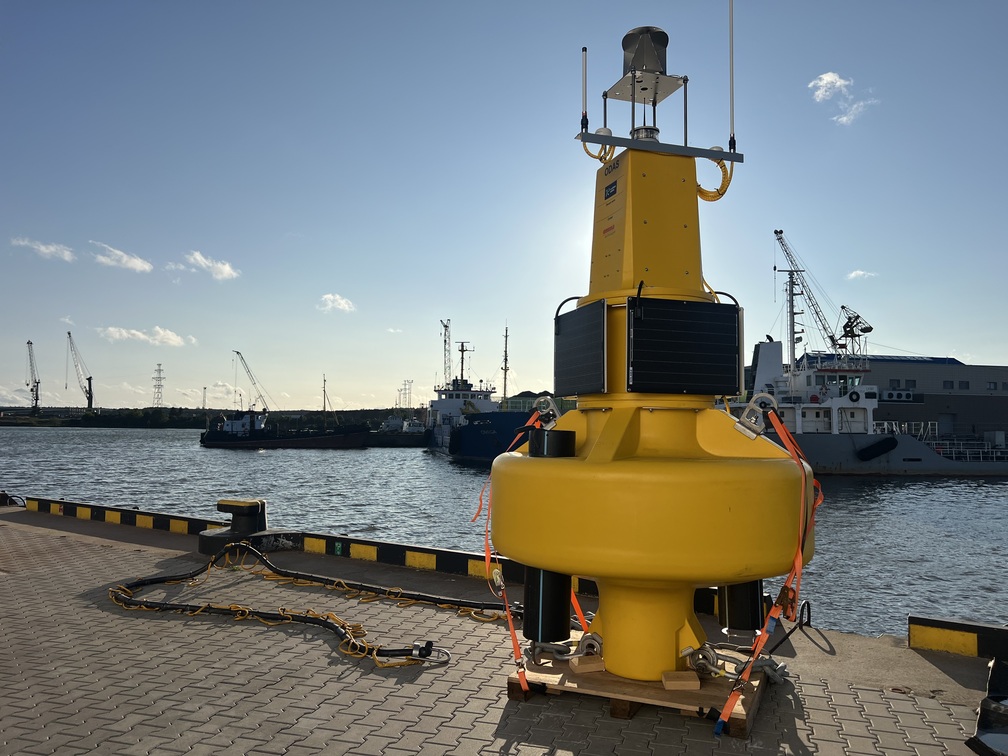
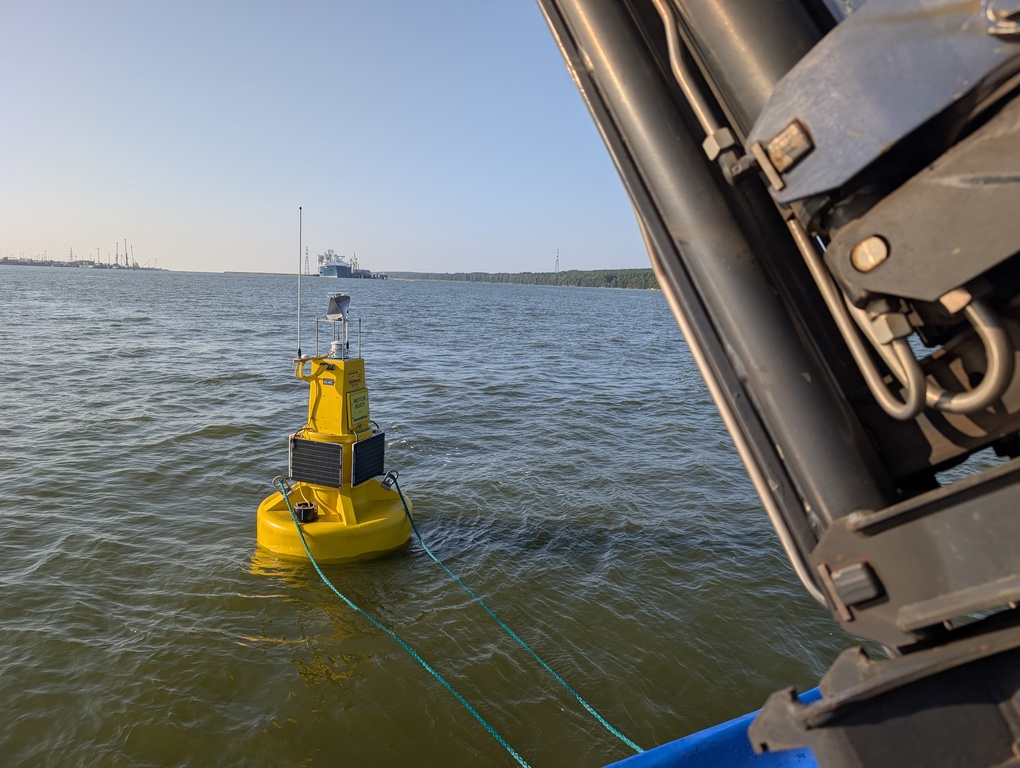
KLAIPEDA: The Port of Klaipėda is introducing smart navigation technologies, with a new buoy equipped with advanced sensors now operating near the port of Klaipėda. The innovative device will help improve cargo flow management, ensure safer navigation during GPS signal disruptions and contribute to more environmentally friendly port operations.

“The Port of Klaipėda is constantly looking for innovative solutions that can make its operations safer, smoother and more efficient. The smart buoy deployed in the Baltic Sea is already collecting important navigation data and transmitting it to shore. In the future, this information will help us plan vessel arrivals more flexibly, respond quickly to changing conditions and better prepare for vessels entering the port. Being one of the demonstration sites for advanced solutions developed under the MOVEO project gives us an opportunity to test and assess innovations that can improve navigational safety, help manage cargo flows more efficiently and support more environmentally friendly operations,” says Algis Latakas, CEO of the Klaipėda State Seaport Authority.

The buoy has been deployed in the Baltic Sea, four nautical miles from the port entrance. Its sensors collect and transmit real-time data on wave height, direction and period, current speed and direction, water and air temperature, atmospheric pressure, as well as GPS signal interference.

The data is already being stored at the Port Authority’s data centre. In the next stage of the project, Klaipėda State Seaport Authority.partner MC Baltics will use this information to develop a hydrometeorological forecasting algorithm based on a machine learning model. By combining real-time measurements with historical data, the system will provide more accurate forecasts of conditions in the Port of Klaipėda and its approaches.

In practical terms, the system will make it possible to adjust logistics plans in real time and optimise cargo and transport flows, helping make vessel traffic smoother and more efficient.

The new buoy and its advanced equipment will also be useful when vessels approaching the port experience GPS signal interference. In such situations, the buoy will serve as a reliable reference point, helping vessels navigate towards the area at sea where they are met by Port Authority pilots. The pilots then use specialised equipment designed to operate despite signal interference to guide vessels safely into and through the port.

The Port of Klaipėda is one of five demonstration sites where technological innovations developed under the MOVEO project are being tested. In total, 18 innovations will be developed and tested in Switzerland, Italy, France and Lithuania. The demonstration sites cover different types of infrastructure, climate conditions and stages of the infrastructure life cycle.

MOVEO is a European research and innovation project funded under the Horizon Europe programme. The project has a total budget of EUR 5,735,250. The budget allocated to the Port of Klaipėda is EUR 395,600, with 70% of the costs covered by project funding.

Inmarsat NexusWave earns Bureau Veritas Cyber Security Type Approval, Advancing Secure Multi-Network Connectivity for the Digital Vessel

LONDON: Inmarsat Maritime, a Viasat company, has received Cyber Security Type Approval from Bureau Veritas Marine & Offshore (BV) for NexusWave, its fully managed, bonded multi-network connectivity service.

The approval evaluated NexusWave’s compliance with the International Association of Classification Societies’ (IACS) Unified Requirement E27 (UR E27) and marks another significant milestone in Inmarsat Maritime’s strategy to deliver secure, resilient and future-ready connectivity for the increasingly digital maritime industry. It follows NexusWave’s ClassNK Cyber Security Type Approval against the same IACS requirement earlier this year, providing further independent review of the security controls embedded within the service.

Driven by customer requirements, BV’s Type Approval demonstrates Inmarsat Maritime’s ability to support ship operators across multiple classification frameworks, enabling consistent deployment of NexusWave across global fleets while meeting vessel-specific class requirements.

Inmarsat Maritime worked with BV to demonstrate that NexusWave architecture and security controls satisfy the requirements of IACS UR E27. BV’s assessment covered the NexusWave security controls and system scope previously reviewed against IACS UR E27, including the onboard ICT architecture, network equipment, orchestration processes and relevant managed service edge infrastructure.

Rather than assessing individual components in isolation, the review considered how these elements work together as an integrated system to support cyber resilience across the onboard connectivity environment.

Gert-Jan Panken, General Manager and Vice President, Inmarsat Maritime, said: “The maritime industry is becoming increasingly connected, and with that comes greater demand for cyber resilience across onboard operational and business environments. This approval reflects our commitment to helping customers confidently embrace digitalisation while maintaining the security, reliability and compliance expected of mission-critical maritime communications.

“Beyond validating NexusWave against IACS UR E27 requirements, the approval demonstrates the strength and flexibility of our approach. By working with multiple classification societies, we can help ship operators navigate evolving cyber security requirements while deploying a reliable and consistent connectivity platform across diverse fleets worldwide. Secure connectivity is now a strategic enabler of operational efficiency, safety, compliance and crew welfare.”

Christophe Chauviere, Marine & Offshore Technical & Operations Excellence Senior Vice-President at Bureau Veritas, commented: “Cyber resilience is becoming an increasingly important consideration as shipboard systems become more connected and digitally integrated. IACS UR E27 provides a consistent framework for assessing whether onboard systems and equipment have been designed with appropriate cyber security measures in place.

“Our assessment of NexusWave considered the relevant onboard ICT architecture and associated components as an integrated system. The Type Approval helps ensure that NexusWave meets the applicable requirements of UR E27 and provides ship operators with independent reasonable assurance that cyber resilience has been considered as part of the design and implementation of the solution.”

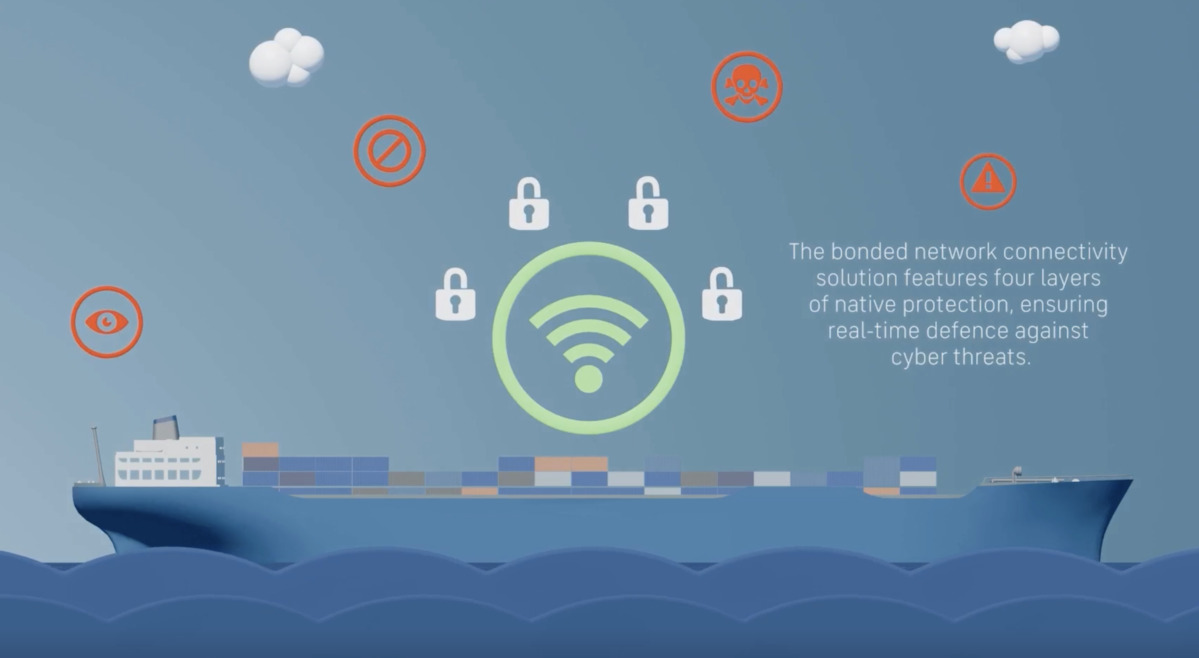
NexusWave intelligently bonds multiple connectivity underlays, including GEO, LEO, LTE and L-band, into a single managed service. Security is embedded within its architecture, including network segmentation, encryption and centrally managed security capabilities designed to support resilient corporate, operational and crew connectivity.

BV’s Type Approval adds to NexusWave’s growing portfolio of independent cyber security credentials and further reinforces Inmarsat Maritime’s position as a trusted partner for secure maritime digitalisation. As vessel connectivity ecosystems continue to evolve, Inmarsat Maritime remains focused on helping customers unlock the benefits of always-on, multi-network communications while supporting customers as cyber security and classification requirements continue to evolve across the maritime industry.

Lehmann Marine scales up Battery Production with New Automated Line in Xanthi, Greece

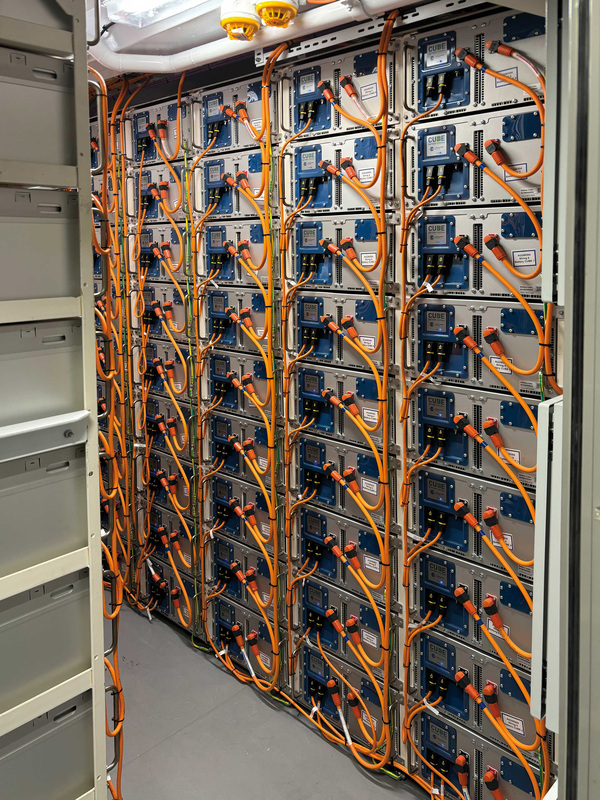
HITTFELD: Lehmann Marine, a specialist in maritime energy storage solutions and a subsidiary of Sunlight Group, has significantly expanded its global production capacity with the commissioning of a dedicated manufacturing line at Sunlight Group’s industrial complex in Northern Greece (Xanthi).

The expansion marks a strategic milestone for the company. Following the assembly and quality verification of the first 82 CUBE battery modules, the new Xanthi line is now fully operational. Modules will be shipped weekly from Greece to Lehmann Marine ís recently expanded headquarters in Hittfeld, Germany, for final system integration, testing, and distribution. Once fully ramped up, the specific automated line is targeted to produce up to 300MWh annually for maritime applications, with the option for additional production lines to be added in the future.

“With Sunlight Group, we have a strong industrial partner whose manufacturing scale perfectly complements our specialised engineering capabilities,” said Alexander Lehmann, Managing Director of Lehmann Marine. “Together, we have created the ideal platform to reliably meet growing customer demand for safe, high-performance maritime battery systems while securing supply chain stability.”

Labros Bisalas, CEO of Sunlight Group, stated, “Our role at Sunlight Group is to elevate Lehmann Marine´s leading marine capabilities with decades of industrial battery manufacturing experience at large scale and with significant vertical integration in critical components. This integrated European model gives our global maritime partners an unmatched advantage: cutting-edge technology, automated mass production, and stability of supply during global supply chain disruptions.”

Strategic Value for the Maritime Sector

To meet tightening environmental mandates, the maritime industry requires rapid, secure access to certified LFP battery systems. The Xanthi expansion combines high-volume industrial-scale production to cut project lead times with European supply chain security that insulates clients from global trade disruptions. Every battery system undergoes rigorous dual-stage quality assurance, starting with automated testing in Xanthi and concluding with final commissioning in Hittfeld, ensuring maximum safety and reliability at sea.

Asia’s First ICAO-Approved SAF Certification Scheme ‘ClassNK SCS’ enters Full Operation

TOKYO: The first certification has been issued under ‘ClassNK SCS’*¹, the sustainable aviation fuel (SAF) certification scheme operated by Nippon Kaiji Kyokai (ClassNK). This marks the entry into full-scale operation of ClassNK SCS, which in October 2024 became the first scheme in Asia to be approved by the International Civil Aviation Organization (ICAO). The certification was issued by Nippon Kaiji Kentei Quality Assurance Ltd.*² (N3KQA), acting as the certification body, to Kowanomori Co., Ltd. (Kowanomori)*³, a lumber producer.

As a result, SAF-related economic operators now have a new option—demonstrated through an actual certification case—of obtaining SAF certification based on ClassNK SCS from a certification body in a manner suited to regional circumstances. An environment is now in place to support the development of SAF supply chains in each region from a certification standpoint.

Applications for certification under ClassNK SCS are being accepted on an ongoing basis.

Background

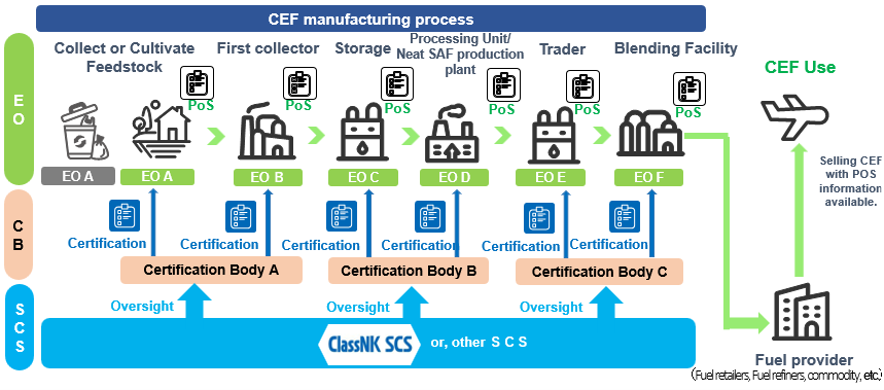
In the international aviation sector, the reduction of carbon emissions is required under CORSIA*⁴ (Carbon Offsetting and Reduction Scheme for International Aviation), implemented by ICAO. SAF can significantly reduce CO₂ emissions compared with conventional jet fuel. However, for SAF to be recognized as a CORSIA Eligible Fuel (CEF)*⁵, all economic operators subject to certification along the supply chain must obtain certification from a certification body operating under a SAF certification scheme (SCS) approved by ICAO.

Future Outlook

As the first ICAO-approved SAF certification scheme in Asia, ClassNK will continue to expand its network of certification bodies while leading the development of a SAF certification framework in Asia and beyond. Through these efforts, ClassNK will support the development of an international supply chain for CORSIA Eligible Fuel and the expansion of SAF supply, thereby contributing to the decarbonization of the international aviation sector.

SAF-related economic operators considering certification under ClassNK SCS are invited to contact us at the inquiry desk below.

  • Nippon Kaiji Kyokai (ClassNK)Business Assurance Division, Green Certification DepartmentTEL: 03-5226-3025E-mail: scs@classnk.or.jp

Notes

*¹ ClassNK SCS (SCS: Sustainable Certification Scheme)

Approved by the Council of ICAO (International Civil Aviation Organization), a specialized agency of the United Nations, in October 2024. It is the world’s third and Asia’s first SAF certification scheme, and commenced operation in August 2025. For more information about ClassNK SCS, please visit our website.

https://www.classnk.or.jp/hp/en/authentication/scs

*² Nippon Kaiji Kentei Quality Assurance Ltd. (N3KQA)

An inspection and certification body established in 1993, serving as the certification body for ClassNK SCS.

URL: https://www.nkkkqa.co.jp/

*³ Kowanomori Co., Ltd.

As a member of the Sumitomo Forestry Group, the company is engaged in the effective utilization of woody biomass resources. Alongside its lumber production operations, it promotes the cascade use of wood through the effective utilization of residues generated during the lumber manufacturing process.

URL: https://www.kowanomori.co.jp/#company

*⁴ CORSIA (Carbon Offsetting and Reduction Scheme for International Aviation)

A scheme introduced by ICAO aimed at curbing and reducing greenhouse gas (GHG) emissions in the international aviation sector.

*⁵ Example of the process by which SAF obtains recognition as a CORSIA Eligible Fuel (CEF)

The SCS (and its associated certification bodies) are responsible for certifying the sustainability of an economic operator along the supply chain, from feedstock to the blending point. (PoS (Proof of Sustainability): issued by a certified SAF-related economic operator to its shipment destination.)

About ClassNK

ClassNK is one of the world’s largest international ship classification societies, with a history of more than 120 years and 130 locations worldwide. In the maritime field, it has built trust over many years as a third-party organization that certifies ships and registers the “class” required for insurance coverage. Leveraging this track record, ClassNK is now engaged in supporting decarbonization across a range of fields, including aviation. ClassNK will support your initiatives toward the widespread adoption of SAF from the perspective of certification.

PM Modi to visit Gujarat and Maharashtra today

PM to dedicate three key sections of WDFC to the nation, marking completion of the project

PM to lay foundation stone for three railway projects and three highway projects

VADODARA: Prime Minister Shri Narendra Modi will visit Gujarat and Maharashtra on 8th September 2026. At around 12 noon, Prime Minister will lay the foundation stones, inaugurate and dedicate to the nation various development projects worth more than ₹35,000 crore in Vadodara. He will also address the gathering on the occasion.

At around 5:45 PM, Prime Minister will inaugurate Global Fintech Fest (GFF) 2026 in Mumbai and address the gathering as well.

PM in Vadodara

Prime Minister will dedicate to the nation three important sections of the Western Dedicated Freight Corridor (WDFC), covering 326 route kilometres and developed at a cost of more than ₹20,700 crore. These include the New Sanand (N)- New Makarpura, New Umbergaon-New Saphale and New Saphale- New JNPT sections.

The direct connectivity of Jawaharlal Nehru Port Authority (JNPA) will facilitate faster movement of EXIM cargo, strengthen connectivity between industrial centres and ports, reduce logistics costs and help decongest Mumbai’s railway network.

With the commissioning of these sections, the Dedicated Freight Corridor (DFC) network will stand fully operational across its entire length. The dedicated freight infrastructure will further strengthen the country’s logistics ecosystem by improving multimodal connectivity, reducing transit time and facilitating seamless movement of cargo across different regions.

Prime Minister will also flag off freight train services from New Sanand (North), New Makarpura, New Umbergaon and New JNPT, Mumbai. In addition, he will flag off a new passenger train service between Tanda Road and Vadodara (Pratapnagar).

Prime Minister will dedicate to the nation the Jobat–Tanda Road new rail line, developed as part of the Chhota Udepur–Dhar project. The new rail line will connect remote and tribal areas of Alirajpur with the national rail network.

Prime Minister will lay the foundation stone for three railway projects spanning 329 kilometres and costing more than ₹9,700 crore. These include the Vadodara-Ratlam third and fourth lines, Miyagam Karjan-Choranda–Malsar gauge conversion and the Vishwamitri-Dabhoi doubling project. The projects will enhance passenger and freight capacity, ease congestion and strengthen connectivity between Gujarat and Madhya Pradesh.

Prime Minister will lay the foundation stone for three National Highway projects costing around ₹1,780 crore. These include six-laning of the Kamrej-Chalthan section of NH-48; construction of additional structures, including major bridges over the Tapi and Narmada, on the Vadodara-Surat section of NH-48; and grade-separated structures at Abhava, Mindhola and Khajod junctions on NH-53.

Prime Minister will also lay the foundation stone for and inaugurate various Government of Gujarat projects worth around ₹2,600 crore. Major projects for which the foundation stone will be laid include Vadodara Urban Development Authority Ring Road Phase II and a 110 MW floating solar project at Kadana Dam, construction of new office of Vadodara Municipal Corporation, among others. Projects to be inaugurated include housing projects under the Pradhan Mantri Awas Yojana (PMAY) and a water-supply project for 11 villages in eastern Vadodara, among others.

PM in Mumbai

Prime Minister will inaugurate Global Fintech Fest (GFF) 2026, one of the world’s largest and most influential annual fintech conferences.

The seventh edition of the Global Fintech Fest is being held from 8th to 11th September 2026 in Mumbai. Since 2020, GFF has emerged as an international thought leadership platform bringing together policymakers, regulators, central banks, financial institutions, fintechs, technology companies, investors, academia and other global stakeholders to deliberate on shaping the future of finance.

The theme of GFF 2026 is “Potential to Impact: Agentic AI, Tokenisation, Quantum – Trusted, Connected, Global Systems for Inclusive Finance.”

GFF 2026 has been designed as a convergence point for policy, regulation, technology, capital and industry on a common platform. It seeks to build on India’s leadership in digital payments and financial inclusion and move from potential to impact. The discussions will focus on how Agentic AI, programmable finance, quantum technologies and other critical and emerging technologies can create trusted, inclusive and measurable outcomes for citizens, enterprises and economies globally.

GIFT City gets a Major Maritime Boost as India eases Foreign Vessel Chartering and Registration

New 2026 vessel-registration framework, coupled with the IFSC licensing exemption, strengthens IFSCA–GIFT City’s potential as a global ship-leasing, financing and maritime-services hub

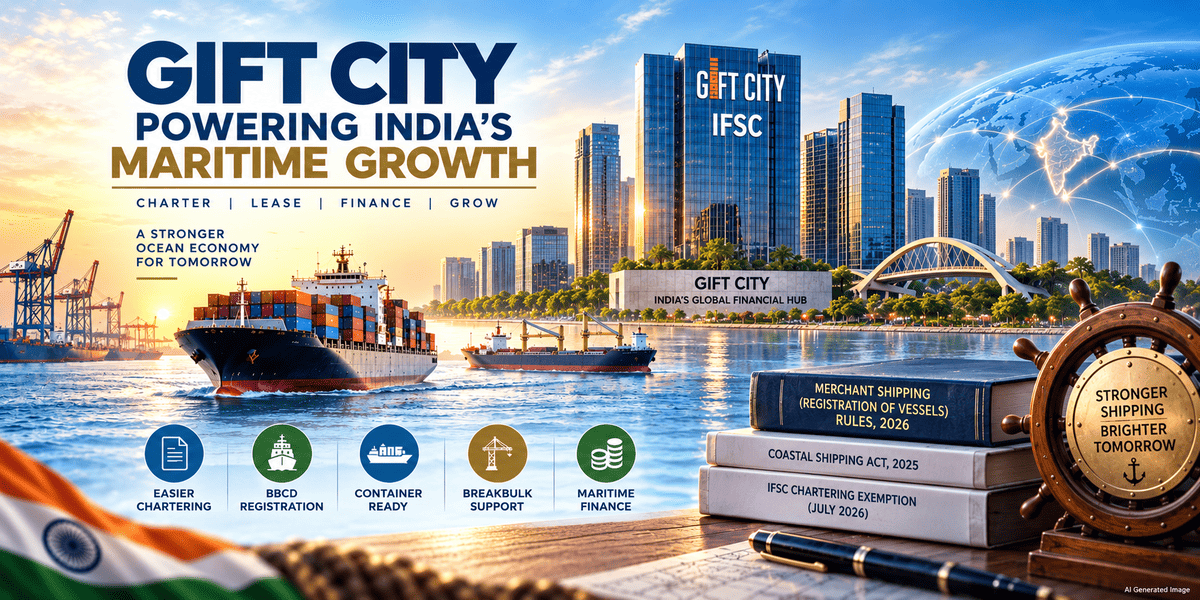
GANDHINAGAR: India’s evolving maritime regulatory framework is opening a more significant role for GIFT City and the International Financial Services Centre (IFSC) in ship chartering, leasing and maritime finance, leveraging the fact that the zone is free from FEMA restrictions and has tax holidays. Two developments in 2026 are particularly important: the Merchant Shipping (Registration of Vessels) Rules, 2026, which create a clearer route for bareboat charter-cum-demise (BBCD) registration of foreign vessels, and the Government’s July 2026 exemption allowing eligible IFSC units to charter foreign vessels for EXIM and international trade operations without the Section 11 licensing requirement under the Coastal Shipping Act, 2025.

A Stronger Chartering Platform for IFSCA–GIFT City

The July reform is especially significant for GIFT City. The Ministry of Ports, Shipping and Waterways exempted units established in the IFSC from the Section 11 licensing requirement for chartering foreign vessels. The Government said the measure is intended to strengthen GIFT City as a globally competitive maritime leasing and financing hub and facilitate ship-owning, ship-leasing, ship-financing and related maritime services.

This is separate from the 2026 Vessel Registration Rules. The exemption addresses the licensing requirement for eligible IFSC chartering activity, while the Registration Rules establish how qualifying foreign vessels can be registered in India under a BBCD arrangement. Together, the two measures create a more coherent regulatory pathway for maritime businesses operating from GIFT City.

BBCD Registration: A Practical Route for Foreign Vessels

Under Rule 15 of the 2026 Registration Rules, a foreign vessel chartered on bareboat charter-cum-demise to an eligible Indian charterer can seek Indian registration. The application requires the charter-party, confirmation from the vessel’s primary registry that its flag rights remain closed or suspended during the Indian registration, consent or no-objection from registered mortgagees or other encumbrance holders, and a certified extract of the primary registry.

Once registered under BBCD, the vessel must fly the Indian flag exclusively during the Indian registration period. The arrangement does not transfer legal ownership to the Indian charterer: title continues to be governed through the primary registry. The BBCD registration can run for the charter period, subject to the prescribed maximum and extension conditions.

The Rules also provide a Right of First Refusal for BBCD vessels over non-Indian vessels, although Indian controlled tonnage receives higher priority. This can improve the commercial positioning of qualifying chartered vessels in relevant Indian shipping opportunities.

Why This Matters for GIFT City’s Maritime Ecosystem

GIFT City already hosts India’s unified financial regulator for IFSC activities, the International Financial Services Centres Authority (IFSCA), and its permitted business activities expressly include ship leasing. IFSCA’s latest published highlights show 43 ship assets leased as of March 2026, underlining the growing asset-leasing ecosystem in GIFT IFSC.

The combination of financial-sector infrastructure in GIFT City and greater flexibility in vessel chartering can support a wider maritime value chain—ship leasing, structured finance, asset management, insurance, chartering and related professional services. For Indian and international maritime businesses, this could make GIFT City increasingly relevant as a location from which shipping assets are financed, leased and commercially managed.

Container Vessels: Greater Flexibility for Fleet Planning

The 2026 Registration Rules expressly capture container capacity in TEU in vessel particulars and registration documentation. The Rules also remove the need for a vessel to be physically present at an Indian port, or to call at an Indian port after registration, solely for registration. Surveys may also be undertaken outside India in the circumstances prescribed by the Rules.

For container shipping businesses, these provisions can reduce procedural friction and provide greater flexibility in structuring vessel acquisitions, chartering and fleet deployment. When combined with the GIFT City chartering and leasing framework, the reforms could support more internationally oriented asset and fleet structures.

Breakbulk and Multipurpose Vessels Also Stand to Benefit

The 2026 Rules do not create a separate registration category for breakbulk vessels. Instead, breakbulk and multipurpose vessels fall within the broader framework for sea-going vessels. The practical benefit is therefore regulatory flexibility rather than a special breakbulk regime.

For operators using chartered tonnage to move project cargo, machinery, steel, heavy-lift or other non-containerised cargo, the clearer BBCD pathway and the wider IFSC chartering reforms could provide additional options for fleet access and maritime asset structuring.

Indian Controlled Tonnage Adds Another Layer

The Rules also introduce a framework for Indian controlled tonnage. Foreign-flag tonnage owned or controlled by eligible persons cannot exceed their aggregate Indian-flag tonnage, while prescribed Indian-crewing requirements apply. A qualifying Indian controlled tonnage vessel operating under a charter arrangement and holding a licence under the Coastal Shipping Act, 2025 receives priority over non-Indian vessels and a Right of First Refusal immediately after Indian-flag vessels. ICT vessels owned from GIFT IFSC are exempt from these requirements of exceeding Indian-flag tonnage and crewing requirements.

This approach seeks to balance access to international tonnage with the policy objective of expanding Indian-controlled and Indian-flag shipping capacity.

A Potential Turning Point for India’s Maritime Finance Ambition

The significance of the 2026 reforms extends beyond vessel registration. By combining a modernised registration framework with a more enabling environment for IFSC-based foreign-vessel chartering, India is building stronger links between shipping operations and financial services. For GIFT City, this creates an opportunity to develop from a financial centre into a broader maritime business platform serving ship leasing, chartering, financing and asset-management needs.

For container, breakbulk and other commercial vessel operators, the message is equally important: India’s regulatory architecture is becoming more adaptable to internationally structured shipping businesses, with GIFT City positioned to play a growing role in that transformation.

Key Takeaways

The reforms could strengthen GIFT City’s role in ship leasing, financing, chartering and related maritime services.

GIFT City / IFSC units have received a major relaxation for chartering foreign vessels for EXIM and international trade operations under the July 2026 Section 11 exemption.

The 2026 Vessel Registration Rules provide a defined BBCD registration route for eligible foreign vessels chartered by Indian entities.

BBCD registration does not transfer legal ownership; the primary registry continues to govern title and related mortgage/encumbrance rights.

Container vessel capacity is expressly captured in TEU, while breakbulk vessels remain covered under the general sea-going vessel registration framework.

JM Baxi launches inaugural Rail Service connecting Delhi Inland Container Terminal with Nhava Sheva

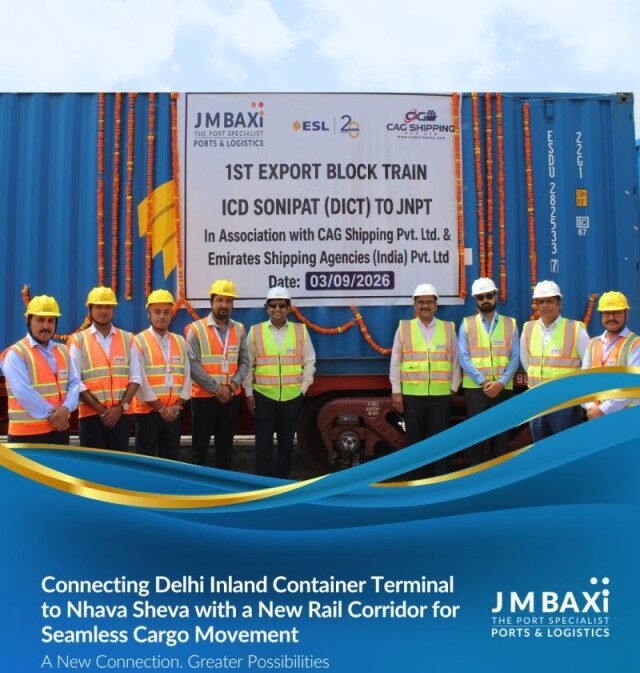
NEW DELHI: JM Baxi has announced the successful launch of its inaugural rail service connecting the Delhi Inland Container Terminal with Nhava Sheva, marking an important step towards strengthening rail-based container movement and integrated logistics connectivity between the National Capital Region and India’s leading maritime gateway.

The inaugural train carried 90 x 20-foot containers of rice, moved for Emirates Line on behalf of valued customer CAG Shipping, demonstrating the potential of the new rail corridor to support efficient and reliable movement of export cargo.

The launch represents a significant development in strengthening multimodal logistics solutions along the Dedicated Freight Corridor (DFC), enabling improved connectivity between inland production and consumption centres and major ports on India’s western coast.

By connecting the Delhi-NCR region with Nhava Sheva through an efficient rail corridor, the service is expected to offer exporters and logistics stakeholders enhanced reliability, streamlined cargo movement and competitive transportation solutions.

The initiative also supports the growing shift towards rail-based container transportation, helping reduce dependence on road-based logistics while improving supply chain efficiency and predictability. The DFC network is increasingly emerging as a key enabler of faster and more efficient freight movement, strengthening the integration of inland container terminals with major maritime gateways.

The inaugural service marks the beginning of JM Baxi’s efforts to develop a regular rail corridor between the NCR region and Nhava Sheva, creating stronger connectivity across key trade routes and supporting the growing requirements of India’s import-export ecosystem.

With increasing demand for dependable inland logistics and seamless port connectivity, such dedicated rail services can play an important role in reducing transit uncertainty, improving cargo planning and supporting the competitiveness of Indian exports.

The successful movement of the inaugural train demonstrates the potential for regular, scheduled rail services linking inland container terminals with Nhava Sheva and other major logistics hubs.

The new connection reflects JM Baxi’s continued focus on strengthening integrated logistics solutions and building efficient multimodal supply chains. As the service develops into a regular rail corridor, it is expected to create greater possibilities for exporters, shipping lines and logistics partners across the NCR and western India.

A new route. Stronger connectivity. Greater possibilities.

India and Hapag-Lloyd unveil new opportunities for Maritime and Logistics Collaboration at SMM Hamburg 2026

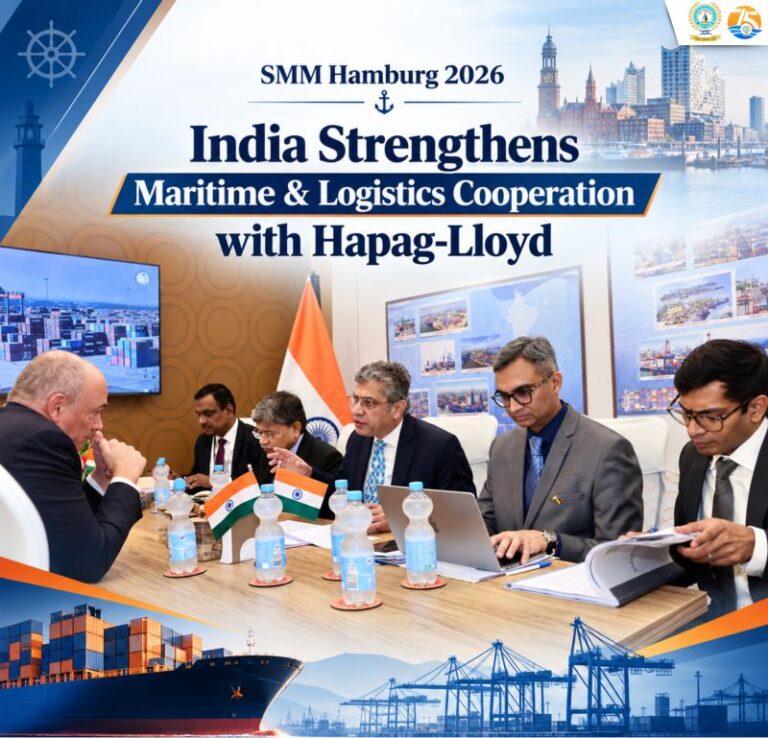
HAMBURG: India’s growing maritime and logistics capabilities took centre stage at SMM Hamburg 2026 in Hamburg, as Shri Vijay Kumar, Secretary, Ministry of Ports, Shipping and Waterways (MoPSW), along with representatives of the Directorate General of Maritime Administration (DGMA), held discussions with Mr. Rolf Habben Jansen, CEO of Hapag-Lloyd AG.

The meeting focused on strengthening collaboration across India’s rapidly expanding maritime, shipping and logistics ecosystem and exploring new opportunities for partnership between India and one of the world’s leading container shipping companies.

The discussions covered a broad range of areas, including maritime logistics, shipbuilding, ship repair and India’s growing role in global maritime trade. Both sides explored opportunities to deepen commercial linkages and identify new avenues for cooperation that could further connect India’s maritime capabilities with international trade and global supply chains.

India’s expanding port infrastructure, growing cargo volumes and focus on integrated multimodal logistics are creating significant opportunities for international shipping and logistics players. The engagement highlighted the potential for greater collaboration in strengthening logistics connectivity and supporting the development of efficient and resilient maritime supply chains.

The discussions also reflected India’s growing emphasis on strengthening its domestic shipbuilding and ship repair ecosystem. Collaboration with global maritime companies and industry leaders can support technology partnerships, knowledge exchange and greater integration of Indian capabilities with international maritime value chains.

As India advances towards building a globally competitive, technologically advanced and sustainable maritime ecosystem, partnerships with leading international players such as Hapag-Lloyd AG can play an important role in unlocking new commercial opportunities and enhancing India’s position in global shipping and logistics networks.

The engagement at SMM 2026 reaffirmed the increasing depth of India–Germany maritime cooperation and the strong potential for collaboration between the two countries across shipping, logistics, maritime technology and industrial development.

The meeting also underscored the significant opportunities emerging from India’s maritime growth story, driven by continued investments in port modernisation, logistics infrastructure, shipbuilding and trade connectivity.

The discussions mark another important step towards strengthening India’s engagement with global maritime leaders and creating new partnerships that can support the country’s journey towards becoming a major global maritime hub.