Home Blog Page 83

Pakistan capital Islamabad is now being called ‘containeristan

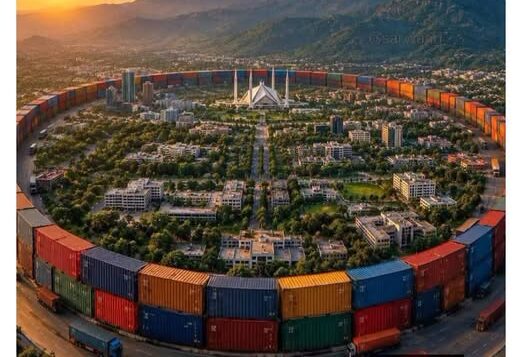
ISLAMABAD: Pakistan’s capital is being turned into a steel fortress ahead of a march on 27 September by supporters of jailed PTI leader and former Prime Minister Imran Khan. More than 20,000 police personnel from Punjab and Sindh are being deployed, with the Punjab government under Maryam Nawaz also calling in the federal paramilitary force Pakistan Rangers to Rawalpindi, Attock, Jhelum, and Mianwali, BBC Urdu reported Wednesday. Authorities have also turned to erecting barriers using a tool that is now pervasive in Pakistani politics: containers.

At least 2,000 shipping containers have been used to wall off parts of Islamabad, according to reports, with some welded together and fitted with outward-facing metal spikes.

Local police said Wednesday that the Islamabad-Peshawar Motorway, the Islamabad-Dera Ismail Khan Motorway, and the Grand Trunk Road would be closed at several points.

The planned marches are expected to set out from Karachi, Pakistan’s largest city, and Lahore. The last time containers went up on this scale, in 2024, Pakistanis turned the blockade into a backdrop. Viral videos showed a couple staging a wedding photoshoot in front of containers placed to block PTI supporters, while others climbed over the barriers to make their point. PTI’s UK handle shared one such video as promotion for the party itself, captioning it: “You might think this is a scene from a video game, but it’s not. This is the reality in Pakistan, where the illegal regime has blocked public protests by placing shipping containers on major highways. Undeterred, people are finding ways to climb over them to make their voices heard.”

The practice has become so familiar that Pakistanis have coined a term for it, “containeristan”, while journalists and officials call it “containerisation”.

“Islamabad is again being turned into ‘Containeristan’. Takes a really shaky regime to do this,” Pakistan’s former special representative to the UN, Maleeha Lodhi, posted on X.

Pakistan’s politics, behind a wall of containers
The use of shipping containers to control movement in Pakistan dates back almost 30 years. The first recorded use came in July 1996, when then-prime minister Benazir Bhutto used containers to block Jamaat-e-Islami leader Qazi Hussain Ahmad from entering Islamabad.

The tactic resurfaced in 2007 under military ruler Pervez Musharraf. Containers were used to seal off Karachi to prevent the sacked chief justice, Iftikhar Chaudhry, from addressing lawyers. Later that year, Rawalpindi was locked down with containers ahead of Nawaz Sharif’s attempted return from exile.

The practice became a regular feature of political protests from 2014, when Imran Khan and cleric Tahirul Qadri led a mass sit-in, or dharna, in Islamabad. During the sit-in, Khan and other leaders lived and worked from a container for weeks, The Guardian reported. Commentators have since credited Khan with helping popularise what came to be known as “container politics”—the structures serving as both barricades and stages from which politicians address protesters.

During protests against the government of Nawaz Sharif in 2016, transporters said as many as 4,000 containers had been seized.

The tactic has also been used to contain religious and sectarian marches. Routes were sealed ahead of Jamiat Ulema-e-Islam’s Azadi March in 2019, when transporters put the container count at more than 10,000. Bridges were blocked to contain local protests in Khyber Pakhtunkhwa, including one in 2021.

During the 2022 Azadi March, the government again used containers to block major roads, highways, and entry points into Islamabad, preventing PTI demonstrators from reaching the city centre.

Islamabad’s high-security Red Zone, which contains government buildings and foreign embassies, is routinely sealed with containers whenever a major march is expected.

The use of containers has also drawn criticism on civil-liberties grounds. The Islamabad High Court last week ruled that “no political party, leader, provincial government or public office holder has the legal right to occupy public roads, highways, interchanges, toll plazas or buildings during protests,” The Nation reported. The ruling came after a petition challenged PTI’s planned long march.

‘Great Wall of containers’
The containers are not purpose-built for security operations. They are ordinary freight containers, normally used to move commercial cargo, and are diverted from established shipping routes, particularly the Karachi-Islamabad corridor.

Police and paramilitary forces requisition containers from private transport and logistics companies. In some cases, the containers are still loaded with commercial goods, including food, medicine, chemicals and export shipments.

The latest blockade has also drawn attention on social media.

Pakistani X user Nighat Abbas described the measures as a ‘Great Wall of Containers’.

“Pakistan’s Government is welding more than 1,000 shipping containers together to build steel fortress across the capital to block PTI supporters from entering the city. This is how political dissent is being silenced in politically and democratically failed State Pakistan,” she wrote.

Another X user, Hussain Yaqub, questioned the government’s use of privately owned containers.

“Islamabad is not a shipping yard, and private property is not free state equipment,” he wrote, adding that with more than 2,000 containers reportedly deployed, the government should publish the requisition orders, compensation rates, and payment status.

“Bahut saare containers me thoda sa Islamabad reh gaya hai (Amid the many containers, a little Islamabad is left),” one user sarcastically remarked.

Source : PRINT
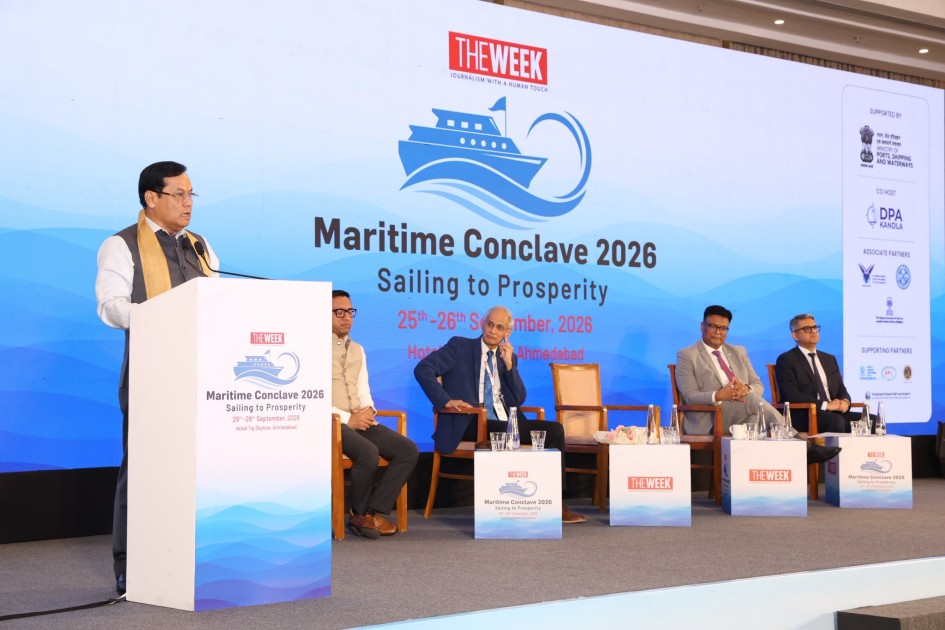
‘We have to go faster than bullet train to be global leader’: Sarbananda Sonowal

AHMEDABAD: Union Minister of Ports, Shipping and Waterways, Shri Sarbananda Sonowal declared that demonstrating excellence and performance will position India as a world leader in the maritime sector.

India’s port handling capacity has doubled to 1,728 million tonnes per annum, driven by the Sagarmala programme and modernisation ‘THE WEEK Maritime Conclave 2026‘ in Ahmedabad focuses on maritime strategy, security, port development, and supply chain management

“In all the sectors, if we could demonstrate our power of excellence and power of performance, then the global society will accept us as a world leader”, Shri Sarbananda Sonowal declared at the launch of THE WEEK Maritime Conclave 2026 in Ahmedabad, as he detailed the nation’s operational strides to transform India’s maritime sector into a global powerhouse.

Doubling down on the need for rapid execution and adherence to global standards, Sonowal urged stakeholders: “We cannot move slowly; we have to go faster than a bullet train! These will help India evolve into an efficient, world-class shipping hub,” he declared.

The two-day summit brings together maritime policymakers, defence personnel, shipping giants, shipbuilders, and seafarers.

The event began with the ceremonial lighting of the lamp by Union Minister Sarbananda Sonowal, along with Riyad Mathew, the Chief Associate Editor and Director, THE WEEK, The Malayala Manorama Group, former Indian Navy Chief Admiral Karambir Singh (Retd.), Deendayal Port Authority (DPA) Deputy Chairperson Nilabhra Dasgupta, and Vivek Sharma, Development and Regulatory Affairs head of AP Moller Maersk.

In his detailed keynote address at the Conclave, the Union Minister detailed on the capacity and logistical improvements across major Indian ports, where annual handling capacity expanded to 1,728 million tonnes from 873 million tonnes per annum a decade ago.

He pegged this growth on modern mechanisation and digitalisation under the Sagarmala programme. Looking ahead, Sonowal projected: “The Ministry is targeting more than 700 million tonnes per annum of additional port capacity by 2030.”

Critical juncture in maritime future
“We meet at a particularly interesting time in India’s maritime journey,” Shri Nilabhra Dasgupta of DPA remarked. “The sector is changing radically: Ports are modernising. Supply chains are integrating. Technology is transforming operations. This makes a forum such as this, organised by THE WEEK, particularly relevant—a platform to exchange ideas, challenge conventional thinking, and inspire excellence and innovation.”

“Ahmedabad is a special choice…,” Sanjib KR Baruah of THE WEEK explained the rationale behind choosing the city as the venue for the 2026 edition, “Once upon a time, Ahmedabad was called the ‘Manchester of India’. But looking at its enterprise, its industry, its spirit of innovation, and its global ambition, perhaps it is time we reverse that and call Manchester the ‘Ahmedabad of England’.”

The Union Minister also hailed Gujarat as a critical maritime hub of India.

The third edition of the conclave, following the success of the inaugural Chennai edition in 2024 and the Kochi edition in 2025, is set to host discussions on maritime strategy and security, port development, mariner upskilling, shipbuilding and recycling, and supply chain management with some of the best and brightest in the nation.

The legacy of THE WEEK Maritime Conclave
The genesis of THE WEEK Maritime Conclave back in 2024 in Chennai marked a fundamental shift in media engagement with national strategic assets.

What began as an inaugural forum on technological innovation evolved a year later through Kochi’s focus on industrial manufacturing, creating a legacy of multi-stakeholder governance across security, finance, logistics, and seafarer welfare.

The summit also spurred the system of translating stage consensus into actionable insights for maritime policymakers, as the platform demonstrated that journalism can serve as an engine for structural reform.

With the 2026 Ahmedabad edition, THE WEEK Maritime Conclave charts its forward course not merely as a chronicler of growth, but as an active partner steering India’s long-term trajectory toward Maritime Vision 2047.

Source: THE WEEK

Gujarat unveils Major Policy Reliefs to boost Alang Ship Recycling Industry

Gujarat CM Bhupendra Patel Highlights 15-Year Plot Permissions, Easier Plot Mergers and Simplified Ownership Transfers

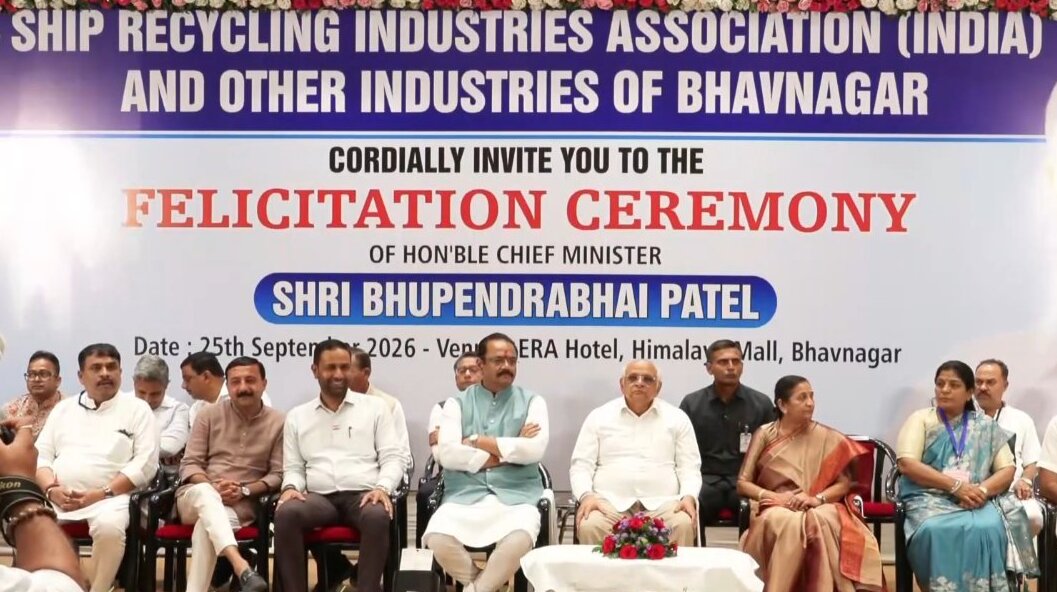
BHAVNAGAR: Gujarat Chief Minister Shri Bhupendra Patel has welcomed the new policy framework introduced by the Gujarat Maritime Board (GMB) for the development of the ship recycling industry at Alang-Sosiya, describing the latest measures as a positive step towards creating a more investor-friendly and business-oriented environment for the sector.

In a post shared on X on Friday, September 25, 2026, Chief Minister Bhupendra Patel said that he attended a special ceremony organised by the Ship Recycling Industries Association in Bhavnagar, where he received greetings from representatives and stakeholders of the ship recycling industry following the announcement of the new policy and the reliefs extended to the sector.

The Chief Minister highlighted several important provisions under the new framework, including the extension of plot utilisation permission to 15 years, easier facilities for merger of plots, simplification of ownership and related transfers, and relief in various charges applicable to ship recycling plot holders.

According to the Gujarat Maritime Board (Conditions & Procedures for Granting Permission for Utilizing Ship Recycling Plots) Regulations, 2026, the permission period for utilisation of ship recycling plots has been prescribed as 15 years from the date of issuance of the permission letter, with renewal possible thereafter subject to the prescribed provisions and Government approval.

Greater Operational Certainty for Alang Recyclers

The extension of the plot permission period is expected to provide greater long-term operational certainty to ship recycling enterprises, enabling them to plan investments, infrastructure upgrades and environmentally compliant recycling facilities over a longer horizon.

The 2026 regulations also provide for adjustment, re-adjustment, alignment, re-alignment and merger or shifting of eligible plots, with the Gujarat Maritime Board empowered to undertake such measures based on technical, safety, environmental and other recorded considerations.

These provisions are particularly significant for an industry where adequate plot configuration and efficient utilisation of available space are closely linked to operational efficiency and the ability of recycling yards to modernise their facilities.

Focus on Ease of Doing Business

Emphasising the broader objective behind the reforms, Chief Minister Patel said that, under the guidance of Prime Minister Narendra Modi, the Gujarat Government is working towards making governmental processes simple, transparent and time-bound for industrialists.

He stated that such measures are intended to encourage entrepreneurs, accelerate industrial activity and contribute to the growth of Gujarat’s economy.

The Chief Minister further emphasised that mutual trust between the government and industrialists is a key strength behind Gujarat’s industrial development, underlining the State Government’s approach of working closely with industry stakeholders while implementing policy reforms.

Alang-Sosiya: A Strategic Pillar of India’s Ship Recycling Sector

The policy measures assume added significance given the strategic role of Alang-Sosiya in India’s ship recycling ecosystem.

According to the Ministry of Ports, Shipping and Waterways, India accounted for 35.4% of global ship recycling volume in 2025, making it the world’s leading ship recycling nation that year. The Alang-Sosiya Ship Recycling Yard accounts for approximately 98% of India’s ship recycling activity, with 128 operational plots and a recycling capacity of around 4.5 million Light Displacement Tonnes (LDT) per annum.

Since its establishment, Alang has recycled more than 8,900 ships aggregating over 71 million LDT, according to Government of India data. The sector also provides direct employment to around 15,000 people and supports more than 1.5 lakh people indirectly through ancillary industries and allied services.

The Government has also highlighted Alang-Sosiya’s contribution to the circular economy through the recovery and reuse of steel and other materials, helping conserve resources and reduce carbon emissions.

Policy Reforms Could Strengthen Alang’s Competitiveness

The latest regulatory framework comes at a time when the global ship recycling industry is increasingly focused on safe, environmentally sound and compliant recycling practices.

The Gujarat Maritime Board’s 2026 regulations have been framed with reference to the Recycling of Ships Act, 2019, the Recycling of Ships Rules, 2021, the Recycling of Ships Regulations, 2026, and the principles of the Hong Kong International Convention for the Safe and Environmentally Sound Recycling of Ships, 2009.

By combining longer plot-use permissions with provisions facilitating plot restructuring and administrative processes, Gujarat is seeking to create conditions that can support continued investment and modernisation at Alang.

For the ship recycling community, the reforms represent an important policy development aimed at reducing procedural complexities while providing greater certainty for business planning.

As Alang continues to remain at the centre of India’s ship recycling industry, the effectiveness of these reforms and their implementation on the ground will be closely watched by ship recyclers, investors, shipowners and other stakeholders across the maritime value chain.

JNPA’s Digital Twin Project awarded to M/s Softtech Engineers Limited

MUMBAI: Jawaharlal Nehru Port Authority (JNPA) – India’s largest container port, has taken a significant step towards transforming its operations through the implementation of a state-of-the-art Digital Twin platform aimed at optimizing operational requirements and facilitating trade. A work order has been awarded to M/s Softtech Engineers Limited for the implementation of the Digital Twin project at JNPA at a cost of ₹92.95 Crores.

Providing information about the digital twin project, Shri Gaurav Dayal, IAS, Chairperson, JNPA, highlighted, “The core functionalities of the Digital Twin platform are targeted to be implemented by February 2027 and will be fully operational by February 2028. The initiative is expected to revolutionize port operations by creating a real-time digital replica of port assets, infrastructure, and operational activities, enabling proactive decision-making and enhanced operational efficiency.”

Further providing insights into the digital twin project, Shri Ravish Kumar Singh, Dy. Chairperson, JNPA, explained, “The Digital Twin will transform the way port operations are monitored, planned and optimised by bringing real-time data and predictive intelligence into a single operational environment. It will enhance vessel traffic management, improve cargo and logistics flows, support vehicular decongestion and enable predictive maintenance of critical infrastructure.”

Highlights of the Digital Twin Initiative:
• Predictive Maintenance of Infrastructure to minimize downtime, optimize asset performance, and extend the lifecycle of critical infrastructure.
• Safety & Security Enhancement through advanced surveillance, monitoring, and incident management capabilities.
• Monitoring of Green Cover, Air Quality & Water Quality to support sustainability objectives and strengthen environmental stewardship.
• Enhanced Decision-Making & Strategic Planning through data-driven insights, predictive analytics, and integrated operational dashboards.
• Regulatory Compliance & Reporting by enabling automated monitoring, reporting, and adherence to statutory requirements.

The Digital Twin initiative is expected to improve operational efficiency, asset utilization, environmental sustainability, safety, and overall service delivery, thereby strengthening JNPA’s position as a leading smart and future-ready port while facilitating seamless trade and logistics operations.

About Jawaharlal Nehru Port Authority (JNPA):

The Jawaharlal Nehru Port Authority (JNPA) is one of India’s premier container-handling ports and a key gateway for the country’s EXIM trade. JNPA currently operates five container terminals — NSFT, NSICT, NSIGT, BMCT and APMT. The port also has a shallow water berth for general cargo, operated by NSDT. Its liquid cargo facilities include a terminal managed by the BPCL-IOCL consortium and an additional liquid cargo terminal developed by JNPA and operated by M/s JSW-JNPT Liquid Terminal Pvt. Ltd. The port’s coastal berth further strengthens maritime connectivity with other Indian ports and supports the growth of coastal cargo and container movement.

Spread across 277 hectares, JNPA also operates a strategically located multi-product Special Economic Zone (SEZ) equipped with modern infrastructure and facilities to support export-oriented industries and promote trade and investment.

Looking ahead, JNPA is developing the Vadhvan Port, an all-weather, deep-draft, greenfield port in Maharashtra and the 13th Major Port of India.

GMU hosts LAWSEA Conference : Exploring maritime disputes in the Era of Contestation

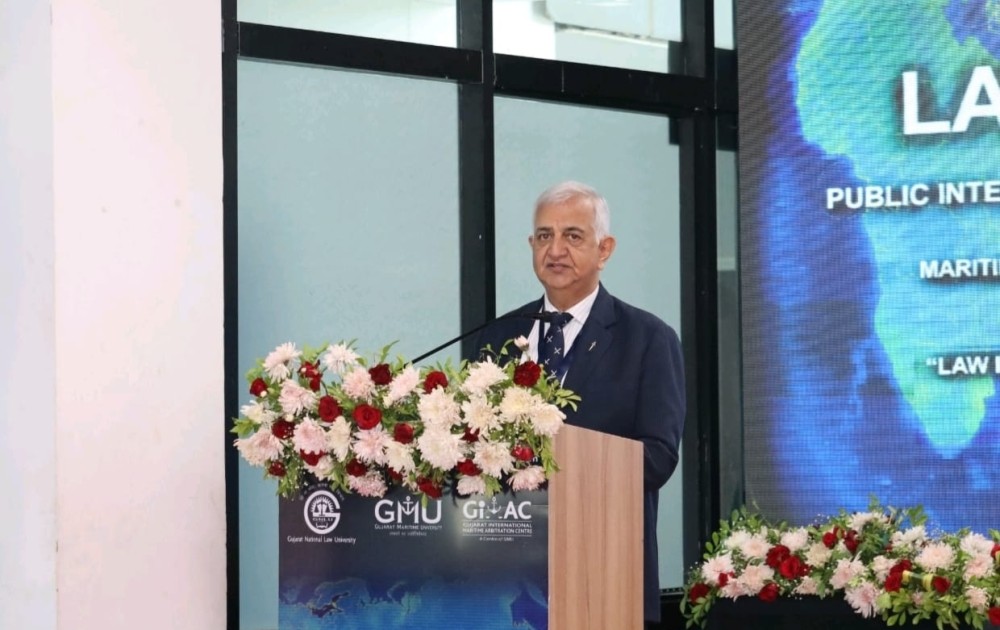
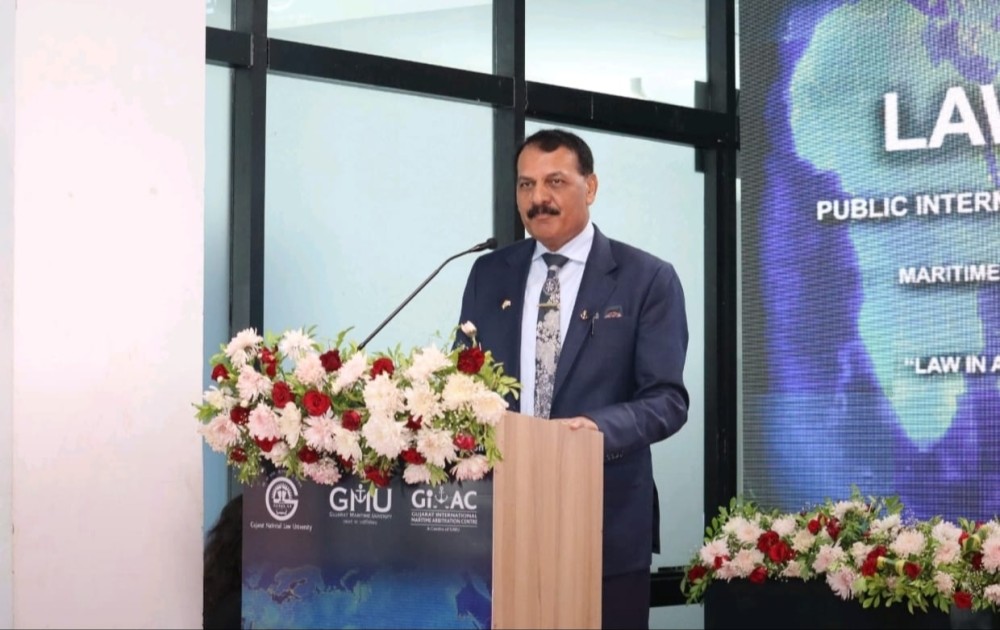
GANDHINAGAR : Gujarat Maritime University (GMU), Gujarat International Maritime Arbitration Centre (GIMAC), Gujarat National Law University (GNLU) and The National Maritime Foundation (NMF), New Delhi, in partnership with the Konrad-Adenauer-Stiftung (KAS) India, recently hosted the 2nd edition of the Public International Maritime Law Conference – LAWSEA 2026 at GNLU, Gandhinagar, Gujarat.

The conference examined the theme “Maritime Disputes in an Era of Contestation: Shifting Between ‘Law in Abstraction’ and ‘Law in Operation’,” bringing together maritime law scholars, naval and security experts, international lawyers, policymakers and practitioners to discuss how established maritime law is being tested by contemporary geopolitical, technological and operational developments.

802032681 1519886426819331 2599997652471533529 n GMU hosts LAWSEA Conference : Exploring maritime disputes in the Era of Contestation

Opening Session
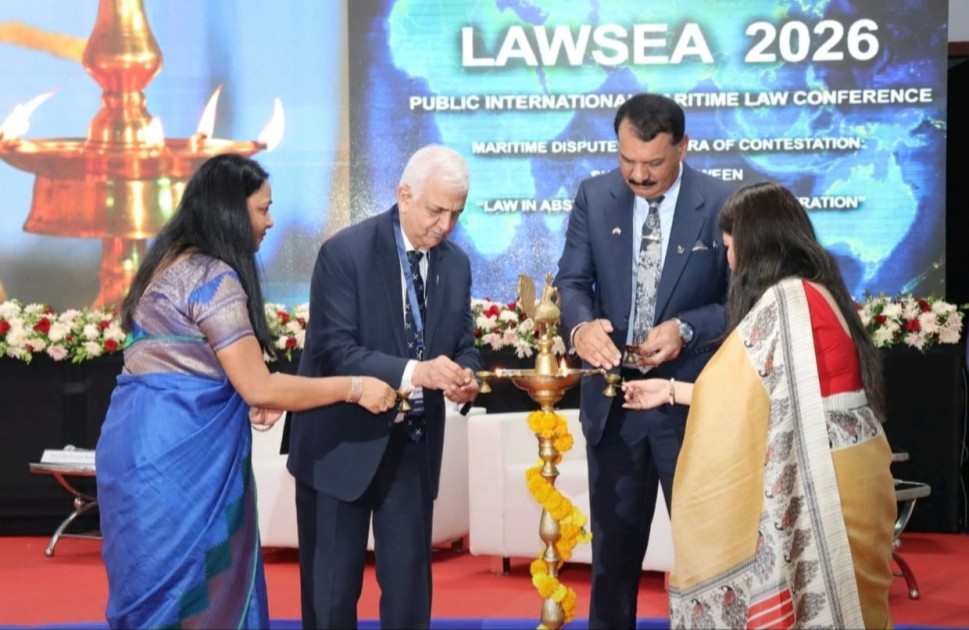
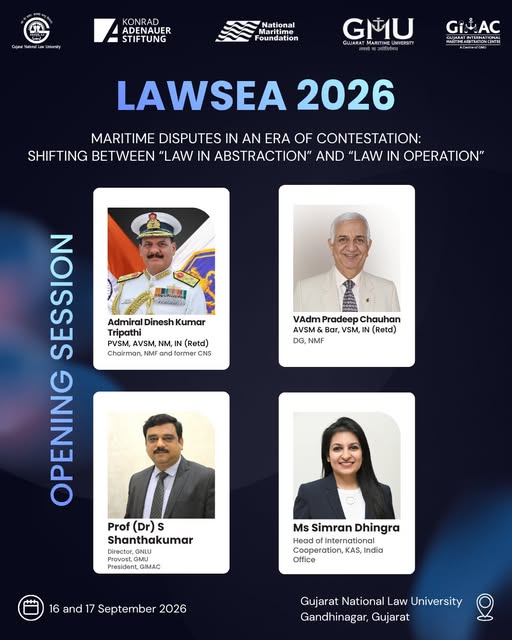
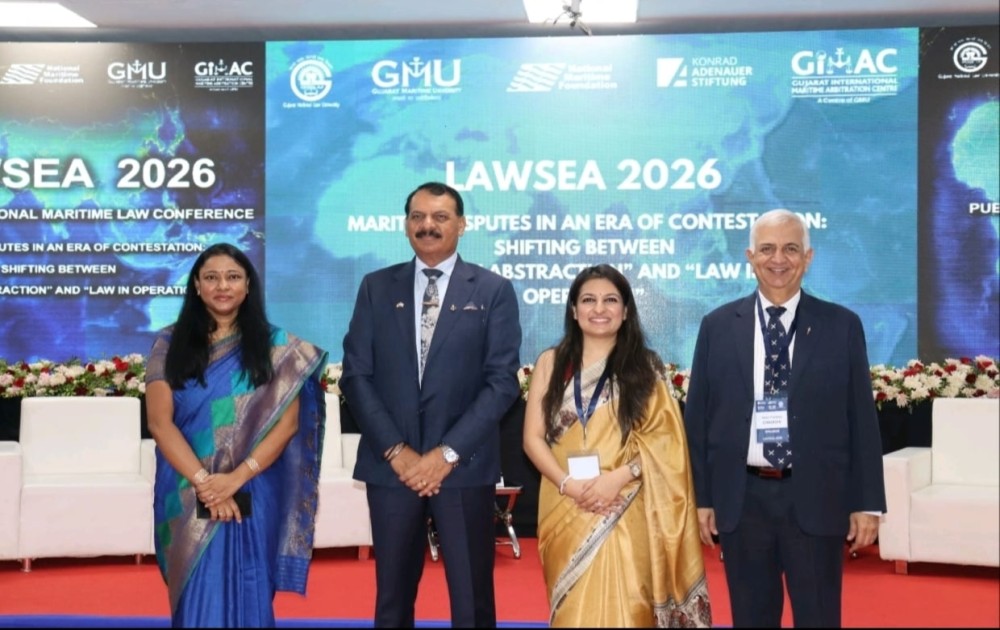
The conference was inaugurated by Admiral Dinesh Kumar Tripathi, PVSM, AVSM, NM, IN (Retd), Chairman, NMF and former Chief of the Naval Staff; Vice Admiral Pradeep Chauhan, AVSM & Bar, VSM, IN (Retd), Director-General, NMF; Prof. (Dr.) Tanuja Kaushik, Dean, Academic Affairs, GMU; and Ms. Simran Dhingra, Head of International Cooperation, KAS India. Speakers underscored the gap between established legal frameworks, particularly UNCLOS, and the realities of maritime operations, strategic competition and emerging technologies, and highlighted the changing character of maritime disputes and the need to translate legal principles into operational practice.

Conference Structure
The two-day programme comprised six professional sessions. Day One, themed “Legal Foundations & Emerging Fault Lines,” covered UNCLOS under pressure, maritime boundaries and sovereignty claims, military and scientific activities in the EEZ, and technology as a dispute multiplier. Day Two, themed “Dispute Management, Lawfare & Policy Choices,” focused on strategies for managing disputes and preventing escalation.

Session I – UNCLOS under Pressure
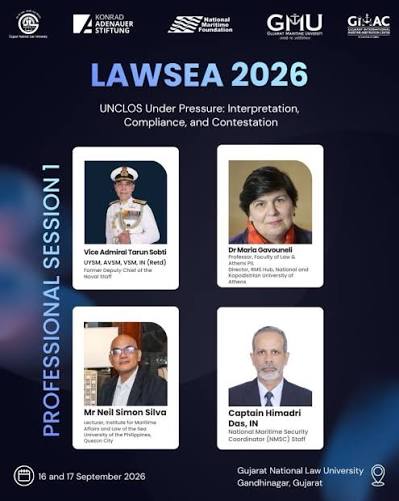
Moderated by Vice Admiral Tarun Sobti, UYSM, AVSM, VSM, IN (Retd), the session examined UNCLOS interpretation, compliance and contestation. Dr Maria Gavouneli (University of Athens) addressed boundary delimitation and State practice; Mr Neil Simon Silva (University of the Philippines) examined compliance in South and East Asia and grey-zone practices; and Captain Himadri Das, IN, discussed legal regimes beyond UNCLOS and capacity-building for Global South States.

Session II – Maritime Boundaries, Baselines and Sovereignty Claims
Moderated by Dr Abhay Singh (Director of School of Maritime Law and Policy, GMU), the session explored coastal geography, science and State practice. Speakers included Ms Fretti G. Ganchoon (Philippines Department of Justice) on contiguous-zone jurisdiction, Rear Admiral Peush Pawsey on hydrographic evidence, and Dr Nguyen Ba Cuong (Vietnam) on baseline systems and the evidentiary value of maps.

Session III – Military Activities, Marine Scientific Research and Surveillance in the EEZ
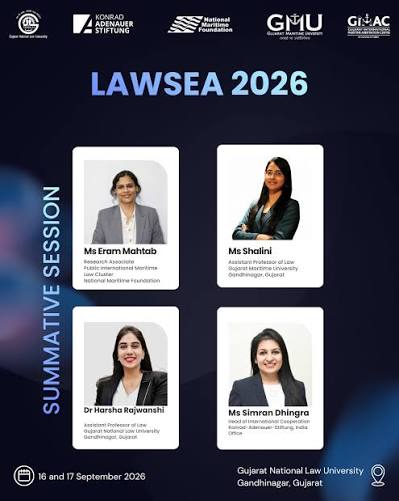
Moderated by Dr Harsha Rajwanshi (GNLU), the session examined coastal-State rights versus foreign military and scientific activity. Wg Cdr (Dr) U C Jha (Retd) discussed restrictions on foreign military activities; Mr Aristyo R. Darmawan (Australian National University) examined navigation freedoms versus security interests; and Mr Himanil Raina addressed reconciling operational necessity with legal restraint.

Session IV – Technology as a Dispute Multiplier
Moderated by Commodore Manish Kumar Sinha, IN (Retd), the session covered legal grey zones created by new technologies. Commander Abhimanyu Singh, IN, examined autonomous maritime systems; Ms Antara Jha addressed drones, jamming and spoofing; and Ms Shalini Singh (Assistant Professor, GMU) discussed grey-zone competition and maritime cyber vulnerabilities.

Day Two – Opening Address
Prof. Manimuthu Gandhi, Vice President, Indian Society for International Law, delivered a special address, “Law as Compass: Managing Maritime Disputes without Escalation,” examining UNCLOS’s role in navigation, interdiction, IUU fishing and pollution disputes.


Session V – Lawfare and Maritime Disputes
Moderated by Vice Admiral Pradeep Chauhan, the session explored law and strategic narrative as instruments of statecraft. Commodore Seshadri Vasan, IN (Retd), discussed “manufactured legitimacy” through narrative competition; Ms Raaga Manjari (MIMA) examined lawfare through legislation and cartography; and Dr Christian Schultheiss (Max Planck Institute) discussed combined legal strategies including negotiation and arbitration.

Session VI – Beyond Courts: Managing Maritime Disputes in the Indo-Pacific
Moderated by Commodore Jai Bedi, IN, the session examined provisional arrangements and cooperative mechanisms. Professor Yoshifumi Tanaka (University of Copenhagen) discussed conciliation and joint development under UNCLOS Articles 74(3) and 83(3); Dr Madhumita Kothari addressed what governments require from maritime lawyers; and Mr Martin Egknud Petersen (Embassy of Denmark) discussed Denmark-India cooperation on port State control and green shipping.

Closing Session
The conference concluded with summative remarks by Vice Admiral Pradeep Chauhan and closing remarks by Admiral Dinesh Kumar Tripathi, who reflected on translating maritime legal principles into effective maritime governance.

Conclusion
LAWSEA 2026 brought together legal scholarship, naval experience and policy perspectives across two days, progressing from UNCLOS, maritime boundaries and EEZ issues to technology, lawfare and Indo-Pacific cooperation – reinforcing the value of legally grounded dialogue and institutional cooperation in maritime governance.

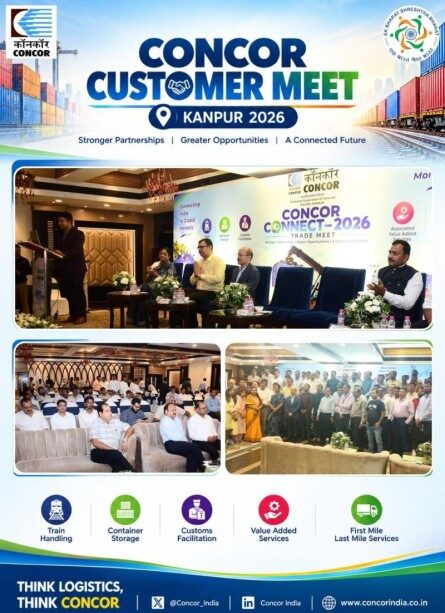
CONCOR Connect–2026 in Kanpur highlights expansion of rail-led logistics network

KANPUR: The Container Corporation of India Ltd. (CONCOR) organised CONCOR Connect–2026 Customer Meet in Kanpur, bringing together exporters, businesses and logistics stakeholders to discuss emerging opportunities and evolving supply-chain requirements.

Addressing customers and stakeholders, Shri Vijoy Kumar Singh, Director (International Marketing & Operations), CONCOR, reaffirmed the company’s commitment to providing economical, reliable and time-bound logistics solutions while developing customer-centric services to support India’s growing trade and logistics requirements.

A key focus of the interaction was CONCOR’s plan to expand its terminal network from the existing 68 terminals to 100 terminals, aimed at improving cargo accessibility and strengthening the company’s logistics footprint across key trade and industrial locations.

The customer meet also highlighted the growing importance of Dedicated Freight Corridors (DFCs) in enhancing rail connectivity and improving the efficiency of long-distance freight movement.

CONCOR also outlined its efforts to expand container train services from JNPT and Mundra Port, providing exporters and importers in the region with enhanced access to major gateways and international shipping networks.

The company discussed measures to strengthen logistics support for MSMEs and agricultural exporters, with an emphasis on improving market access, reducing logistics costs and facilitating more efficient movement of cargo.

Another area of discussion was the potential for air-cargo connectivity from Kanpur Airport, which could provide businesses with additional logistics options for time-sensitive and high-value shipments.

The meet also highlighted CONCOR’s readiness to operate daily container trains from ICD Kanpur to ports, subject to operational requirements and customer demand. Such services are aimed at providing greater frequency, predictability and connectivity for EXIM cargo moving between the Kanpur region and gateway ports.

The discussions underlined CONCOR’s focus on reducing logistics costs and transit time through integrated rail-based solutions, improved connectivity and closer engagement with customers.

The CONCOR Connect–2026 initiative provided a platform for direct interaction with industry stakeholders and reinforced the importance of collaboration in developing a more efficient, reliable and connected logistics ecosystem.

With its focus on expanding terminals, strengthening rail connectivity and developing customer-centric solutions, CONCOR continues to position rail-led logistics as an important component of India’s evolving multimodal supply chain.

Think Logistics, Think CONCOR.

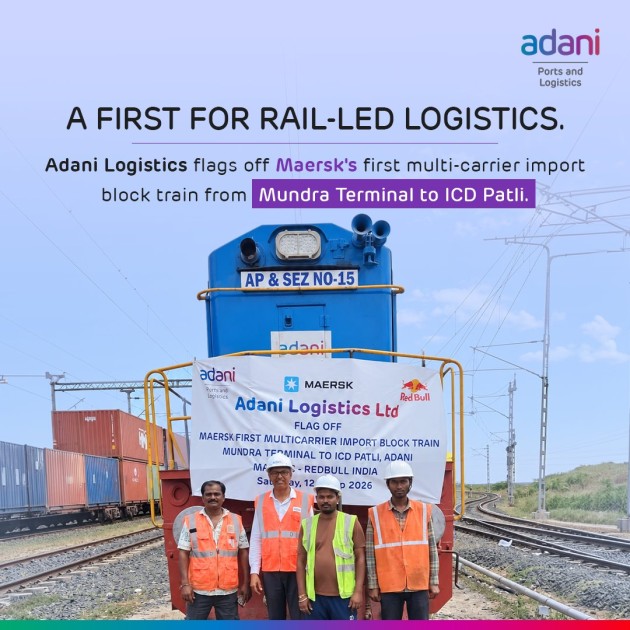
Adani Logistics flags off Maersk’s first multi-carrier import block train from Mundra to ICD Patli

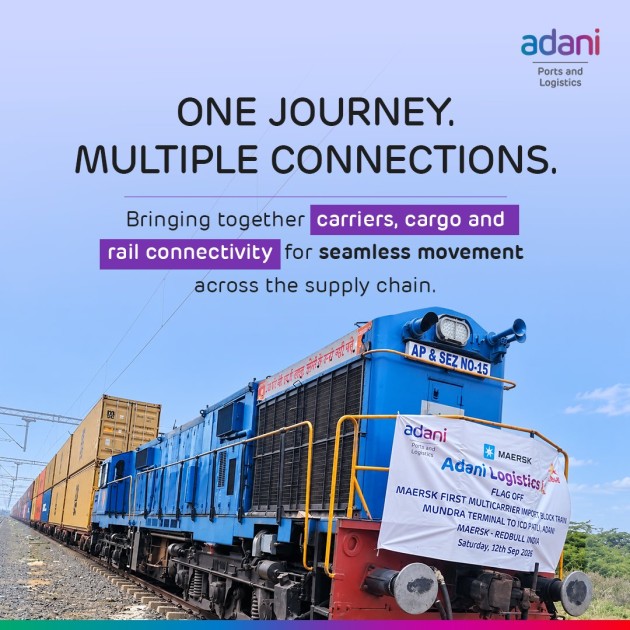
MUNDRA : Adani Logistics has achieved a new milestone in integrated rail logistics with the successful flag-off of Maersk’s first multi-carrier import block train from Mundra Terminal to ICD Patli, carrying consignments for Red Bull India.

The rail movement brings together multiple stakeholders across the logistics chain, creating a seamless rail-led connection between the gateway terminal and the inland container depot. The initiative is aimed at facilitating more efficient movement of imported cargo from the port to the hinterland while strengthening rail-based supply-chain connectivity.

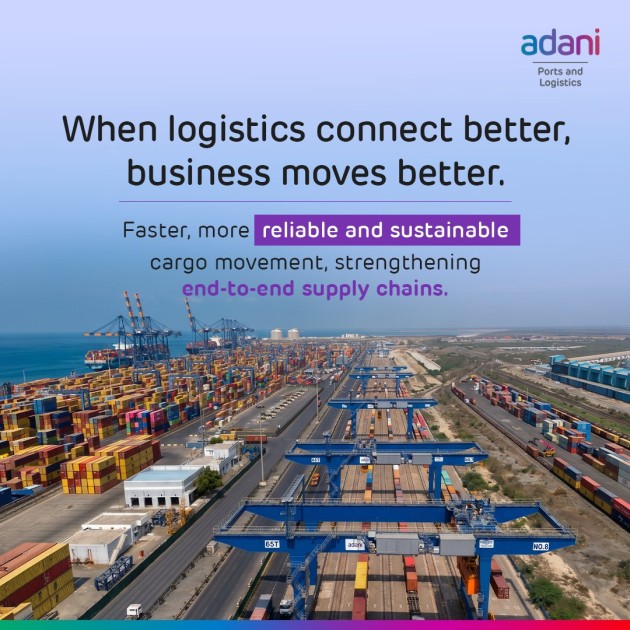
The movement highlights the growing role of rail-led logistics solutions in supporting faster, more coordinated and reliable cargo transportation. By connecting Mundra’s port infrastructure with ICD Patli, the service provides an integrated link between the maritime gateway and inland markets.

The multi-carrier block train also demonstrates the potential of collaborative logistics models, where shipping lines, logistics operators, cargo owners and terminal infrastructure work together to streamline cargo flows.

For Red Bull India, the movement provides a dedicated rail connection for its consignments, supporting the efficient transfer of cargo through the import supply chain.

The initiative further strengthens the role of Adani Logistics in providing end-to-end multimodal logistics solutions and expanding the use of rail for containerised cargo movement.

With increasing emphasis on efficient hinterland connectivity and integrated transportation networks, such rail-led services can contribute to reducing dependence on road-based cargo movement while improving supply-chain coordination.

The successful flag-off from Mundra Terminal to ICD Patli marks another step towards building a stronger and better-connected rail logistics network, creating greater efficiency and value for customers across the supply chain.

Key Highlights
Maersk’s first multi-carrier import block train flagged off by Adani Logistics.
Movement from Mundra Terminal to ICD Patli.
Train carries Red Bull India consignments.
Brings multiple logistics stakeholders together through a rail-led supply-chain connection.
Strengthens port-to-hinterland connectivity and multimodal logistics.
Reinforces the role of rail in developing efficient and integrated cargo movement solutions.

Chennai Port operationalises empty container yard to unlock additional capacity

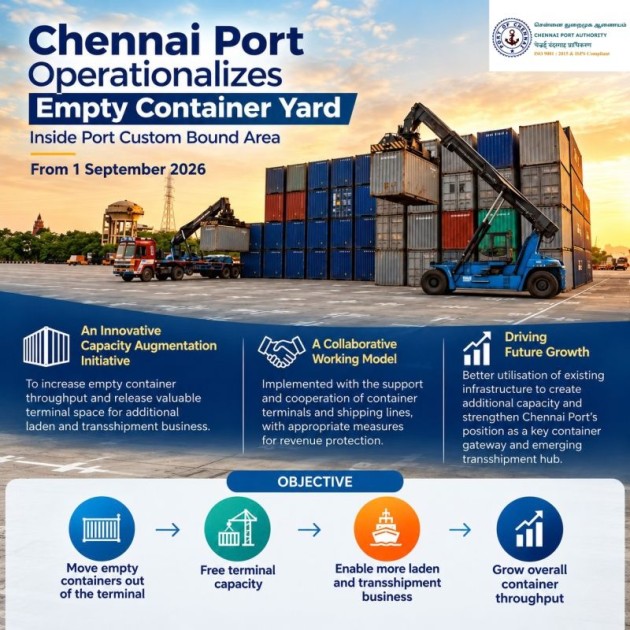
CHENNAI: Chennai Port has operationalised a dedicated Empty Container Yard within the Port’s Custom Bound Area, marking a significant step towards optimising existing infrastructure and augmenting container-handling capacity.

The initiative, which became operational from September 1, 2026, is aimed at improving the movement and handling of empty containers while releasing valuable space at container terminals for additional laden and transshipment cargo.

The initiative has been implemented through a collaborative working model involving the Chennai Port Authority, container terminals and shipping lines, with appropriate measures put in place to ensure revenue protection and operational efficiency.

By shifting empty containers out of terminal areas into the newly operationalised yard, Chennai Port seeks to create additional working space within the terminals. This will enable terminals to handle a greater volume of revenue-generating laden and transshipment containers without requiring major new infrastructure in the immediate term.

The initiative follows a simple operational approach:

Move empty containers out → free up terminal capacity → accommodate more laden and transshipment cargo → increase container throughput.

The Chairperson, Chennai Port Authority, has appreciated and thanked the container terminals and shipping lines for their support, cooperation and collaborative efforts in making the initiative operational.

The Empty Container Yard initiative reflects Chennai Port’s focus on smart capacity augmentation, demonstrating how existing port infrastructure can be utilised more efficiently through operational innovation, coordination and stakeholder collaboration.

Rather than relying solely on physical expansion, the initiative highlights the importance of improving the productivity of existing assets and creating additional capacity through better space utilisation.

With containerised trade continuing to play an important role in India’s logistics and international trade ecosystem, such measures can help ports improve operational flexibility, optimise terminal utilisation and support the growth of container throughput.

The initiative further underlines Chennai Port’s commitment to strengthening its role as an efficient and competitive gateway for containerised cargo while working closely with terminal operators and shipping lines to improve the overall logistics ecosystem.

Vizhinjam International Seaport sets new vessel-call record with 17,262 TEUs

0

MSC LORETO handles highest-ever container volume in a single vessel call at Vizhinjam, surpassing August benchmark

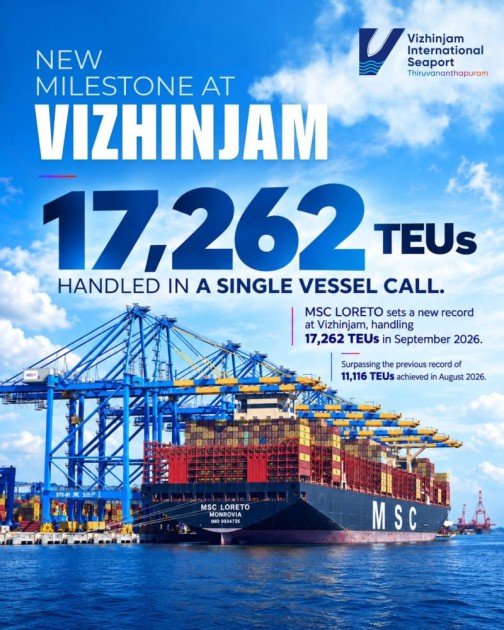
THIRUVANANTHAPURAM : Vizhinjam International Seaport has achieved a new operational milestone after handling 17,262 TEUs in a single vessel call by MSC LORETO during September 2026.

The latest achievement marks a significant increase over the port’s previous record of 11,116 TEUs, recorded during a vessel call in August 2026. The new benchmark highlights the growing operational capabilities and cargo-handling potential of the strategically located deep-water port.

The handling of 17,262 TEUs in a single call demonstrates Vizhinjam’s ability to accommodate high-volume container operations and efficiently manage large-scale transshipment movements.

With its advanced port infrastructure, high-capacity container-handling facilities and strategic location close to major international shipping routes, Vizhinjam is steadily strengthening its role in the global transshipment network.

The latest milestone also reflects the port’s expanding operational performance as it seeks to attract larger vessel calls and strengthen connectivity with international trade routes.

The record vessel call by MSC LORETO further reinforces Vizhinjam’s emerging position as a key transshipment hub on the international maritime map and underscores the potential of Kerala’s deep-water port to handle increasing container volumes.

17,262 TEUs in a single vessel call marks a new operational benchmark for Vizhinjam and another important milestone in the port’s journey towards becoming a major global transshipment gateway.

Cochin Port Authority receives Award for Excellence in Maritime Sector

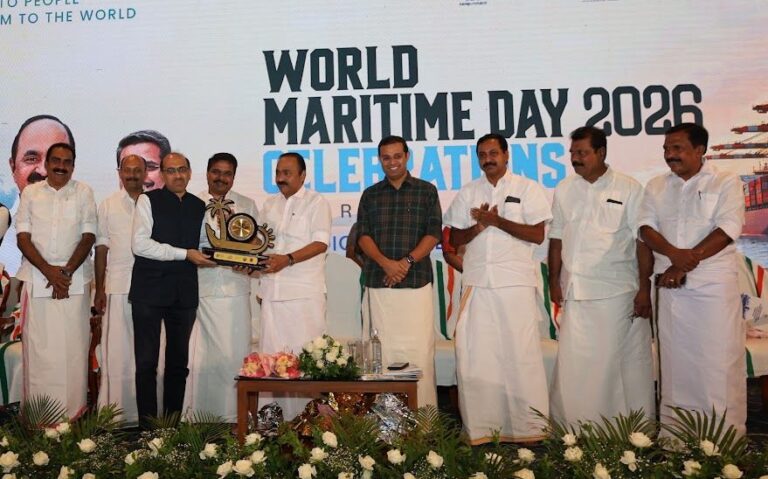
KOCHI : The Cochin Port Authority (CoPA) has been conferred with the Award for Excellence in the Maritime Sector in recognition of its contribution to the maritime industry and the development of Kerala’s port and maritime ecosystem.

The award was presented by Shri V. D. Satheesan, Hon’ble Chief Minister of Kerala, during the World Maritime Day celebrations organised by the Kerala Maritime Board in Kochi on September 24, 2026.

Shri Satish Honnakkatte, Deputy Chairperson, Cochin Port Authority, received the award on behalf of the Port Authority.

The recognition highlights the important role played by Cochin Port in supporting Kerala’s maritime sector and strengthening the state’s connectivity with national and international trade networks.

The World Maritime Day programme brought together leaders, officials and representatives from various segments of the maritime industry, providing a platform to recognise contributions to the sector and discuss the continued development of Kerala’s maritime ecosystem.

Cochin Port has been an important maritime gateway for Kerala, supporting containerised cargo, bulk and other maritime trade while contributing to the wider logistics and economic activities of the region.

The award adds another recognition to Cochin Port Authority’s ongoing efforts towards improving port operations, strengthening maritime connectivity and contributing to the growth of India’s maritime sector.