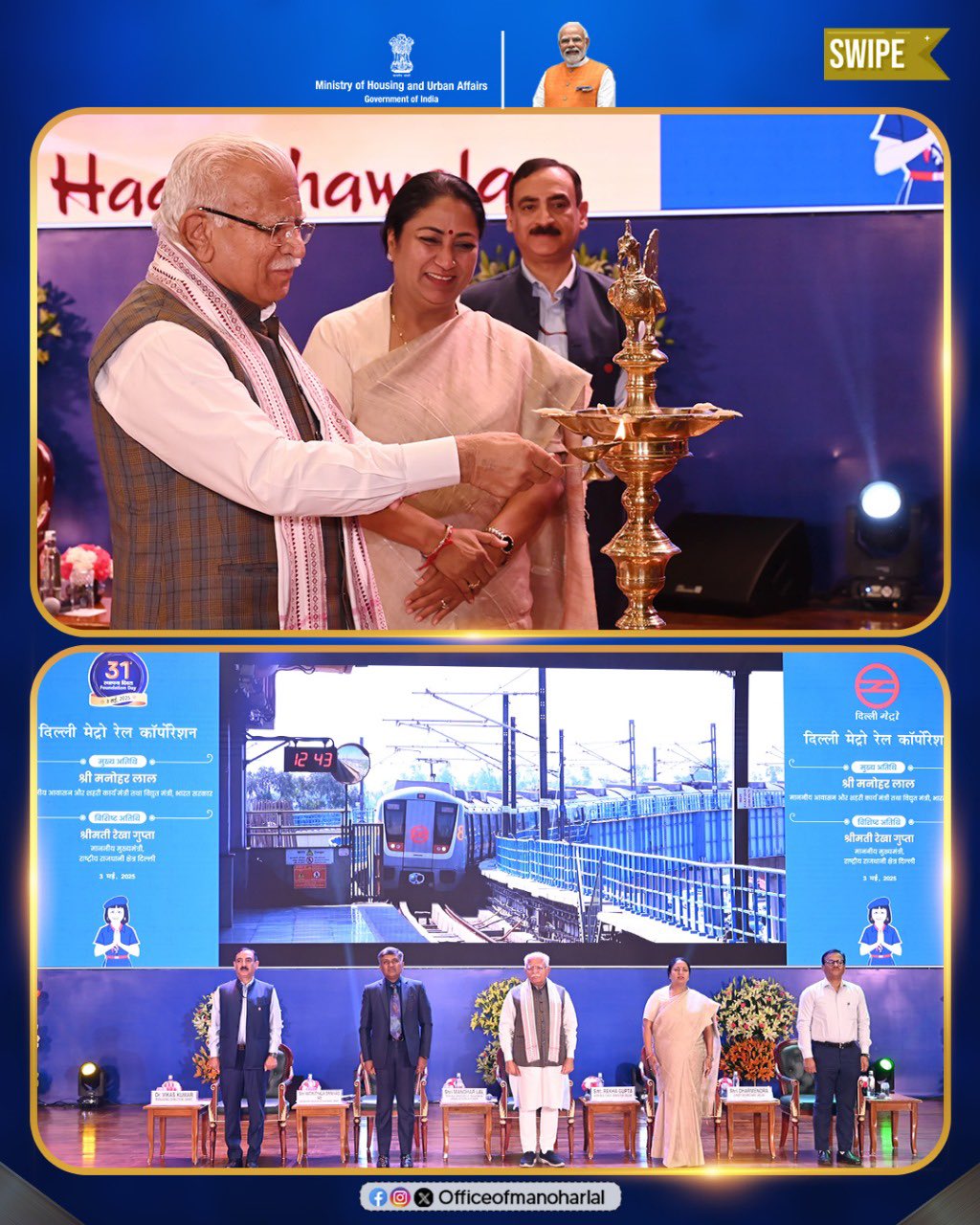
NEW DELHI : Union Housing and Urban Affairs Minister Shri Manohar Lal has called for the expansion of renewable energy use within metro operations, proposing even cargo compartments for small businesses, to help India’s energy transition goals.
peaking at the 31st Foundation Day of Delhi Metro Rail Corporation at Bharat Mandapam here, the minister highlighted the significant role that Delhi Metro plays in the daily life of the common citizen.
He emphasised that easy, reliable, and safe mobility is the fundamental right of every citizen, and that urban transport systems like the Delhi Metro have become an indispensable part of urban living.
Looking ahead, the minister underlined that by 2047, nearly 50 per cent of India’s population will reside in urban areas, making it imperative to plan and strengthen urban mobility infrastructure.
He shared a visionary idea of adding cargo compartments to metro trains, enabling small businessmen, vendors, and hawkers to seamlessly transport their goods across the city — a step that would save time, reduce energy consumption, and enhance business efficiency for the urban working class.
Furthermore, Manohar Lal emphasised the need to integrate green and renewable energy solutions in metro operations, aligning with the nation’s sustainable development goals.
He reiterated that metro systems will be the lifeline of every city in India, and their continued expansion and modernisation is key to building smart, inclusive, and future-ready urban centres.
During the programme, DMRC’s annual awards were presented to individuals and teams for their exemplary contributions to the organisation.
Delhi Chief Minister Smt. Rekha Gupta also congratulated Delhi Metro on the occasion.
“The place that Delhi Metro has made in the hearts of the people, it is indeed nothing less than the lifeline. There is a ‘feel-good factor’ when a passenger enters the Delhi Metro. They keep it clean, and they follow the rules as well. There has been a behavioural change,” she said during her address.
PARADIP : In a major crackdown on illegal maritime activities, Paradip Marine Police have busted a covert operation involving the unauthorised supply of goods to foreign ships anchored offshore.
According to reports, smugglers were operating under the radar of customs authorities and were involved in illegally transporting various materials, raking in crores in untaxed earnings.
How Were the Materials Supplied Illegally? The illegal supplies were reportedly being routed from the Nehru Bungalow Fishing Harbour in Paradip to foreign vessels anchored in the deep sea.
Goods, including large quantities of industrial pipes and motors, were being secretly loaded onto fishing boats and delivered mid-sea to the ships.
Further, these supplies were being made without customs clearance, leading to massive revenue loss for the exchequer.
Goods Worth Rs 10 Lakh Seized Acting on a tip-off, the Paradip Marine Police conducted a surprise late-night raid at the fishing harbour.
During the operation, they seized industrial equipment valued at around Rs 10 lakh, including pipes, motors, and a pick-up van used for transporting the items to the harbour.
Police confirmed that the goods were being illegally smuggled out via local fishing vessels.
Three Held, One Absconding Three individuals have been arrested so far in connection with the smuggling operation; one more accused is currently on the run.
Among those detained are the driver and owner of the pick-up van, as well as the owner of the boat used in the supply chain.
Till the last reports came in, all of those nabbed were being interrogated to uncover the full extent of the racket and identify other collaborators involved.
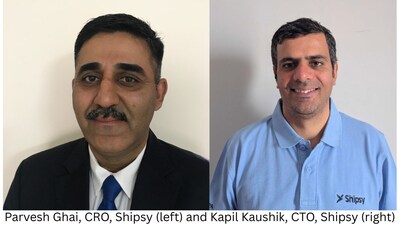
GURUGRAM : Shipsy, a Gartner recognized leading global provider of SaaS-based AI-powered logistics management platform, recently announced the onboarding of two industry stalwarts, Mr. Parvesh Ghai as the Chief Revenue Officer (CRO) and Mr. Kapil Kaushik as the Chief Technology Officer (CTO). Both leaders bring deep expertise in driving growth, technological innovation, and customer success at a global scale.
Mr. Parvesh brings over 3 decades of Industry experience in leading digital transformation and customer success across industries. He has a proven track record of growing revenue, building high-performance teams, and guiding clients through the adoption of Emerging technologies.
His leadership at SAP, Oracle, and Wipro showcases his ability to drive innovation, Process transformation, and customer satisfaction. At Shipsy, Parvesh will focus on accelerating global revenue growth, expanding global partnerships, and helping clients achieve impactful digital transformation using AI, ML, and automation.
“Parvesh’s wealth of experience and his strategic vision will be instrumental as we continue to scale globally and bring our cutting-edge logistics solutions to more industries,” said Mr. Soham Chokshi, CEO & Co-Founder, Shipsy.
Mr. Kapil brings nearly 20 years of technical leadership, in scaling high growth startups. He has played a pivotal role at Delhivery, where he led platform scaling efforts that supported billions of daily requests. At Simpplr, Kapil led the migration of a large enterprise SaaS platform, enabling the company to scale and support 700+ customers and 1.3 million users. His expertise in scaling teams and building robust technology platforms will be critical in driving the next phase of innovation at Shipsy.
“Kapil’s technical leadership will accelerate our technology roadmap and enable us to deliver even more innovative, scalable solutions to our global customers,” said Chokshi. “His ability to scale technology platforms aligns perfectly with our vision of driving ROI-driven innovation using AI at a truly global scale.” Together, Parvesh and Kapil will help drive Shipsy’s mission to lead the logistics industry with AI-powered innovation, ensuring that customers benefit from streamlined operations, real-time insights, and greater efficiency.
About Shipsy: Shipsy’s AI-powered supply chain platform helps shippers and logistics companies cut costs, reduce working capital, enhance resilience, and improve customer experience. Its intuitive, modular system uses predictive intelligence to optimize transportation, warehousing, and inventory operations, making deliveries faster, greener, and more profitable. With a 350+ team across India, Dubai, Australia, the UK, and the Netherlands, Shipsy serves 270+ global customers. It tracks 650,000+ containers, procures $150M+ in freight, and powers 60M+ parcels monthly. Shipsy integrates with 64+ shipping lines, 50+ 3PLs, 300+ freight forwarders, 50+ customs agents, and 20,000+ global shippers.
ByMs. Sanyukta Kulkarni, Senior Route Development Manager – Indian Subcontinent, DB Schenker Inc.
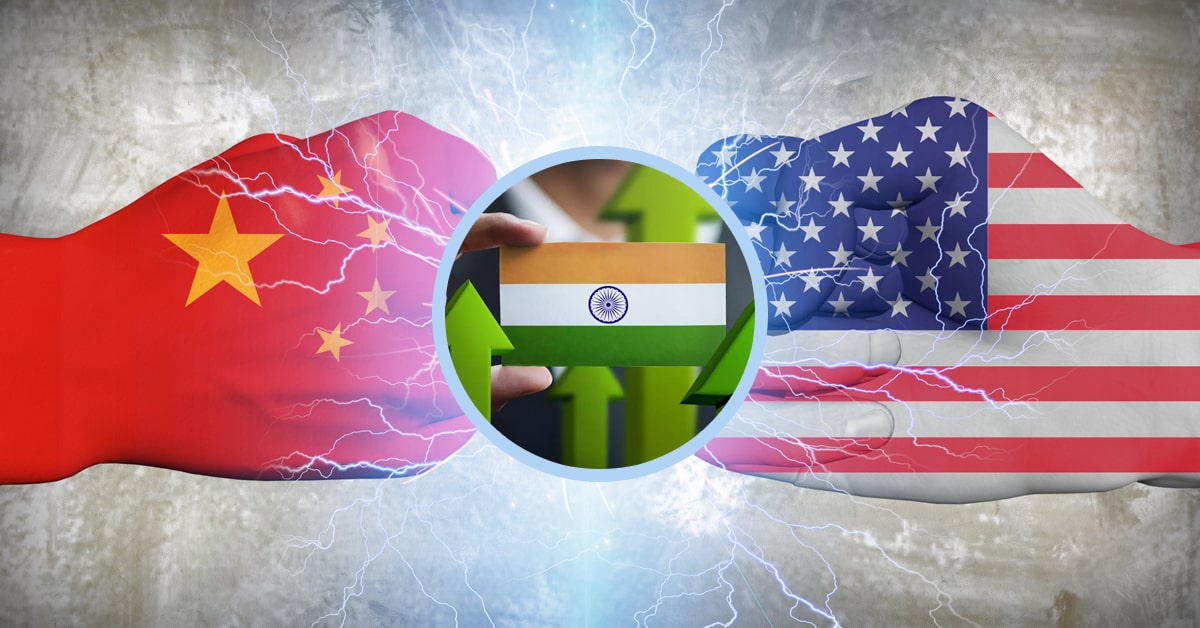
India, now the 5th largest Economy in the World, is rapidly scaling up its position in the Global Markets. With abundant Land available for Manufacturing, Cheap labor & growing infrastructure capabilities, its importance in the Matured Western markets is growing more than ever. Especially to the USA, due to its Escalating Trade War with China. Let’s look at how India can Rise up to compete with China and become a Superpower for Manufacturing.
India Advantage
India has abundant land & labor – something that is required for large scale manufacturing. It now has the largest population in the World, higher than China. India’s median age is 28 years, whereas China’s is 40 years, thereby implying that more people available to enter workforce and manufacturing. This is certainly to India’s advantage. Moreover, India’s Government launched its PLI Program (Production Linked Incentive) for 14 sectors including aerospace, automotive, electronics, pharmaceuticals and textiles, that aims to lift share of manufacturing.
India Infrastructure and Logistics
India now has the 2nd largest Road Network in the World, only second to USA. Government has launched ‘National Logistics Policy’ (NLP) that aims to modernize the logistics sector by promoting multi-modal transportation, digital integration, and skill development. The policy aims to bring logistics costs down from the current 13-14% of GDP to around 8% by 2030, which is close to the Average in Developed countries. China’s Logistics cost is also around 14% to GDP, so If India is able to achieve lower logistics costs, it becomes more competitive in the Export market v/s China.
India’s Current position on Bilateral Trade with USA.
On April 2, USA announced ‘Reciprocal tariffs’ on imports from 90 countries that are around 10% across-the-board tax applied to all imports to the U.S, with an Exception that Goods from China are averaging around 124% on All Goods & 145% on certain Goods. This is a huge disadvantage to China & there has been a reduction in supply of Chinese goods to USA in Q1 2025 since tariffs are announced. India has a definite advantage on this over China, because India & USA Government is working on a Bilateral Trade agreement by Q3 2025. They have also agreed to buy More American Goods, so as to amicably resolve the Trade tensions with USA.
India – USA in the Next Decade
India aims to become the 3rd Largest Economy by 2047. It also aims to Improve its Bilateral Trade with USA to $500 Bn from the current estimated $130 bn. India has become a global leader in pharmaceutical & mobile-phone production in recent years. Industry leaders like Apple now manufacture their newest and most sophisticated cellphones in India, moving away production from China & plans to do more due to recent Tariffs on China. Similarly, pharmaceutical exports nearly doubled to $27.85 billion in 2023-24 from a decade ago. Almost 40% of Generic Medicines that US imports come from India.
In Summary
For India, the Time is Now! India’s Growth Story can be similar to what China’s was in the 1990-2010 decades. If India continues its efforts on improving its Manufacturing Ecosystem & reducing Bureaucracies & Roadblocks, then it can give a strong competition to China & become the Next Superpower of Manufacturing.
Author:
Ms. Sanyukta Kulkarni, is a Senior Route Development Manager for Indian Subcontinent, based in USA. She has been working in the International Logistics Industry the last 18 years across India & USA. For the last 10 years, her Focus has been Building the Trade Corridor between India & USA and to Improve the Business Growth between India & USA Trade Corridor with DB Schenker.
LONDON : Whilst the liner industry waits to see what will happen between the 2 superpowers China and the USA in relation to tariffs that the USA has place on China, the market has remained fairly flat this week, as we wait hoping for some de-escalation between the 2 countries.
Many shippers are sitting on their hands and waiting to see what will happen, savvy shippers will have stockpiled stock ex China pre tariffs being imposed, so will be able to wait it out for a number of weeks/months before they need to pull the trigger on more shipments.
Carriers are naturally seeing much weaker demand and are cancelling/blanking services on many services in the key USA – China rotations.
FBX01 (China/East Asia – USA West Coast) ended the week at $2395/FEU up $68 on end last week, FBX03 (China/East Asia – USA East Coast) ended the week at $3397/FEU up just $2 on end last week. FBX11 (China/East Asia – Continent) was down $115 on the previous week at $2244/FEU and a similar story for FBX13 (China/East Asia – Mediterranean) ended the week at $2937/FEU down $129 on previous Friday.
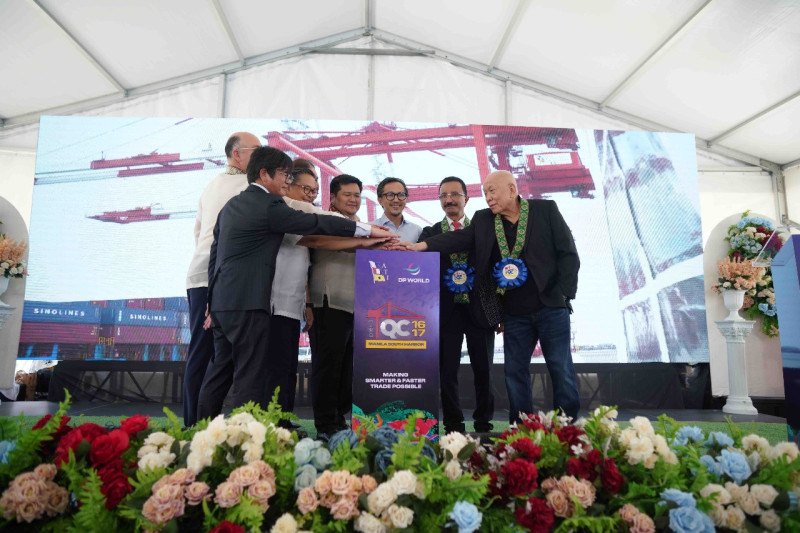
MANILA : The Manila South Harbour (MSH), the Philippines’ premier international trade gateway, received a major operational boost as DP World and its strategic partner, Asian Terminals Inc., have announced the completion of milestone projects, poised to promote long-term economic growth and trade for the Philippines and Southeast Asia growth corridor.
DP World and ATI invested approximately US$100 million on projects which include the extension of Pier 3 berth to over 600 metres, yard expansion to accommodate 20,000 TEUs, the addition of two new Ship-to-Shore (STS) cranes, and purchase of eco-friendly landside equipment.
An official ceremony was held earlier in the day at MSH to celebrate this significant development. Led by Department of Transportation Secretary Vince Dizon, the event was attended by DP World’s senior leadership led by His Excellency Sultan Ahmed bin Sulayem, Group Chairman and CEO, Philippine Ports Authority’s General Manager Jay Santiago, Bureau of Customs Commissioner Bienvenido Rubio, ATI President Eusebio Tanco as well as major stakeholders, customers, and industry partners.
In all, the recent development projects bring MSH’s annual throughput capacity to nearly two million TEUs, growing capacity by over 25% from 1.45 million TEUs previously. This enables the terminal to accommodate more cargo volume and bigger ships deployed by international carriers, providing faster and safer turnaround times to support the country’s international trade.
The two neo post-panamax STS cranes, manufactured by Shanghai Zhenhua Heavy Industries, are the largest among MSH’s 11 quay-side equipment and among the biggest ever deployed in the Philippines. With an outreach of 58 metres, each STS crane can handle vessels carrying up to 20 containers wide. Each crane is equipped with modern safety and operational features such as intelligent sensing systems for monitoring speed, vibration, temperature, trailer positioning, anti-collision, and automated diagnostics.
Plans are also underway to deploy electric and hybrid landside equipment, including yard tractors, container loaders and rubber-tired gantry cranes in support of MSH’s carbon reduction initiatives.
His Excellency Sultan Ahmed bin Sulayem, DP World Group Chairman & CEO, commented: “DP World is honoured to be partnering the Philippine government in modernising and advancing its critical trade infrastructure, by working closely with our local partner ATI. Investment in ports and logistics brings greater value down the value chain and prosperity to communities, a commitment which we embody in DP World as a trade enabler and leader in smart logistics.”
“Building on our strong partnership and seeing huge economic potential, we are lining up more investment projects in the coming years to future-proof the gateway terminals in Manila, Batangas, Cavite, and Laguna, in support of the resilient growth of the Philippine economy.”
Hon. Vince Dizon, Department of Transportation Secretary, commented: “The modernisation projects at MSH are a testament to the long-standing private-public-partnership to enhance the country’s trade facilities and capabilities, which are crucial in sustaining the country’s economic growth momentum. President Ferdinand Marcos Jr. values the importance of the role that the private sector plays as a driving force of the Philippine economy. We extend our gratitude to our partners from ATI and DP World for bringing in the operational knowledge, expertise, and resources, to make robust trade happen in the Philippines as an emerging economic powerhouse in the Asia Pacific region.”
Jay Daniel Santiago, Philippine Ports Authority General Manager, commented: “With bigger and more efficient facilities, through our partners in the private sector, we are elevating the capacity and capability of the country’s ports, particularly the Manila South Harbour, to connect the Philippines with the rest of the world, and serve as catalyst to long-term growth and prosperity, in support of port stakeholders.”
Eusebio H. Tanco, ATI President, commented: “We are very pleased to inaugurate these major development projects that collectively enhance our capacity and capability in delivering comprehensive and market-responsive services to our customers and stakeholders. ATI, alongside our partners from DP World, stands proud of our contribution to powering economic progress by ensuring supply chain efficiency through ATI’s strategic ports and logistics assets.”
In 2024, ATI handled almost 1.6 million TEUs in cumulative container volume, over 4% higher as compared to 2023. Of this, MSH handled around 1.3 million TEUs, nearly 8% higher than the total volume it handled the previous year, reflective of the expansion of the country’s economy.
For the first quarter of 2025 alone, MSH handled over 350,000 TEUs of international container boxes, over 25% higher compared to the same period in 2024, signalling the strong and resilient growth of the economy.
ATI is the local partner of DP World in the Philippines operating Manila South Harbour, the Integrated Batangas Port, Cavite Barge Terminal, and strategic inland logistics terminals which bring cargoes closer to beneficial cargo owners. The partnership leverages the local expertise of ATI and DP World’s global network and expertise to deliver comprehensive and innovative trade solutions for a more robust Philippine supply chain.
SINGAPORE : A comprehensive life cycle assessment (LCA) conducted by the Global Centre for Maritime Decarbonisation (GCMD) quantifies OCCS’s potential to provide GHG emissions savings.
The study, named COLOSSUS (Carbon capture, offloading, onshore storage, utilisation and permanent storage), provides an in-depth analysis of GHG emissions and costs associated with OCCS across the entire carbon value chain, accounting for emissions from fuel production, transport and use, to CO2 capture onboard the vessel and its final disposition.
LCAs facilitate an equivalent comparison of different decarbonisation measures; this comparison can help shipowners make informed decisions on solutions adoption based on their net abatement impact across the entire carbon value chain. This holistic quantification of emissions ensures that OCCS adoption does not lead to inadvertent increases in emissions in adjacent sectors because of decisions made downstream.
While LCAs are available for onshore carbon capture technologies in themselves, assessments of the overall GHG emissions from deploying these solutions onboard vessels across the associated value chains are limited. A full assessment would require the inclusion of the well-totank (WtT) emissions of the fuel, onboard tank-to-wake (TtW) emissions, including those associated with OCCS operations, the subsequent emissions from transporting captured CO2, and those associated with permanent storage or its utilisation.
What this study considers
The study used a WtW GHG emissions of 93.3 gCO2eq/MJ for Heavy Fuel Oil (HFO) as a baseline for comparison against other scenarios. This study explored five OCCS technologies, with six marine fuel options, and three post-capture scenarios. Among OCCS technologies, the study examined different post-capture scenarios with conventional monoethanolamine (MEA)- based OCCS, with it being the most mature of the OCCS technologies in the industry. Based on the practical limitations of storing large quantities of liquid CO2 onboard vessels, the study further assumed a 40% gross carbon capture for all scenarios explored, consistent with industry recommendations.
Key findings
Notably, the deployment of conventional MEA-based OCCS can result in a WtW GHG emissions savings of 29% for an HFO-fuelled ship.
Replacing HFO with biofuels presents a promising strategy for maximising GHG emissions savings. The WtW emissions savings for a vessel deploying MEA-based OCCS range from 69% to 121% when using bio-LNG and biodiesel from used cooking oil, respectively.
Among the post-capture scenarios evaluated, fixing the captured CO2 in concrete is most effective. This approach can increase GHG emissions savings from 29% to 60% across the carbon value chain by partially displacing the need for carbon-intensive cement in applications ashore.
Post-capture transport and permanent storage of CO2 add minimal emissions, approximately 1% to the WtW emissions of a vessel deploying MEA-based OCCS when the captured CO2 is transported 1,000 km. Captured CO2 can also be used to produce e-methanol with renewable electricity, allowing the vessel that consumes this e-methanol to claim a 17% GHG emissions savings.
The cost of avoided carbon for OCCS with permanent storage is between USD 269-405/tCO2 for a 40% gross capture on an MR tanker, considering a full-scale, Nth-of-a-kind installation of an OCCS system with full heat recovery.
Viability of OCCS to help shipowners reduce GHG emissions
While the recently articulated GHG Fuel Intensity (GFI) framework does not explicitly specify how emissions reduction from OCCS is taken into consideration, the study offers a structured basis for assessing the solution’s potential in helping shipowners and operators manage their emissions portfolio.
By calculating the abatement from OCCS based on the amount of CO₂ it removes per unit of energy (in gCO₂eq/MJ) on a WtW approach, an “equivalent” GFI can be derived. Extending this concept, the study shows an HFO-fuelled ship adopting MEA-based OCCS at 40% gross capture can, on a WtW basis, maintain an equivalent GFI below the direct compliance target until 2032. Similarly, LNG-fuelled ships equipped with the same OCCS can maintain an equivalent GFI below the direct compliance target until 2035. Further, when fossil fuels are completely replaced by their bio-counterparts, OCCS can lower the GFI enough for the ship to be compliant with the more stringent 2040 targets.
Professor Lynn Loo, CEO, GCMD said: “As we face an increasing array of decarbonisation solutions spanning different industries and value chains, coupled with the challenges of quantifying and elucidating carbon flows from source to sink including its re-use, there is a pressing need for a comparable means to understand their net abatement impact. We hope this LCA study for OCCS provides a foundation for the comprehensive understanding needed to shape robust regulatory frameworks surrounding OCCS, and supports decision makers in making informed, value chain-based decisions.”
To access the full study findings, please download the report here.
About the Global Centre for Maritime Decarbonisation
The Global Centre for Maritime Decarbonisation (GCMD) was established as a non-profit organisation on 1 August 2021 with a mission to support the decarbonisation of the maritime industry by shaping standards, deploying solutions, financing projects, and fostering collaboration across sectors.
Founded by six industry partners namely BHP, BW Group, Eastern Pacific Shipping, Foundation Det Norske Veritas, Ocean Network Express and Seatrium, GCMD also receives funding from the Maritime and Port Authority of Singapore (MPA) for qualifying research and development programmes and projects. Since its founding, bp, Hanwha Ocean, Hapag-Lloyd and NYK Line have joined as Strategic partners. To date, over 130 centre- and project-level partners have joined GCMD, contributing funds, expertise and in kind support to accelerate the deployment of scalable low-carbon technologies and lowering adoption barriers.
Since its establishment, GCMD has launched four key initiatives to close technical and operational gaps in: deploying ammonia as a marine fuel, developing an assurance framework for drop-in green fuels, unlocking the carbon value chain through onboard carbon capture and articulating the value chain of captured carbon dioxide as well as closing the data-financing gap to widen the adoption of energy efficiency technologies.
GCMD is strategically located in Singapore, the world’s largest bunkering hub and busiest transshipment port.
SINGAPORE : As the maritime industry moves towards zero-emission operations, ammonia and hydrogen are gradually emerging as suitable ship fuels due to their carbon-free emissions. These new fuels require a change of mindset in terms of design, operations and crew competence, all addressed in a new DNV paper. With no specific IMO regulation available, IMO’s alternative design approval (ADA) process is essential for approval, and the paper outlines how DNV rules provide structured, prescriptive requirements to simplify the procedure.
The paper – Safe introduction of alternative fuels: Focus on ammonia and hydrogen as ship fuels – offers a structured pathway for shipowners to achieve approval through IMO’s alternative design approval (ADA) process. Seven steps to obtain approval for ammonia- and hydrogen-fuelled ships
“We outline seven steps to assist shipowners and other stakeholders in obtaining approval and safely deploying ammonia- and hydrogen-fuelled ships in today’s immature regulatory environment,” says Linda Hammer, Principal Consultant, Environment Advisory at DNV and lead author of the white paper. “The regulatory path is certainly complex, but the steps and safety measures in the paper add up to a clear, achievable pathway to ship approval and safe operations. It also explains how DNV’s support can significantly ease this process through its tailored rule sets and learnings from pilot projects.”
Understanding ADA phases: From initial design to final approval IMO’s IGF Code (International Code of Safety for Ship Using Gases or Other Low-flashpoint Fuels) currently covers natural gas but not ammonia or hydrogen. Without detailed regulations, IMO’s risk-based ADA process (MSC.1/Circ.1455) is used. It involves demonstrating that the ship’s safety level is equivalent to that of conventional oil-fuelled vessels.
ADA has two main phases. A preliminary design approval requires a hazard identification (HAZID) study, developing a preliminary risk assessment, and defining preliminary risk-control measures and safety strategies.
Phase two, final design approval, starts with refining the design with detailed technical and safety documentation, then making a final risk assessment, addressing integration and operation-specific concerns. Then come complete system integration testing and submitting findings to the flag administration.
Role of class and flag administrations in approval process As the IMO regulatory framework progresses towards eventually amending the IGF Code, classification societies like DNV can give shipowners a head start in designing vessels by issuing class certificates and providing prescriptive rule frameworks to support ADA.
Flag administrations enforce statutory regulations and have the final say on approvals. Early and active engagement with the relevant flag administration is therefore the key to clarifying approval expectations and streamlining ADA.
Subject to flag administration acceptance, the DNV rules can be applied as the flag administration’s approval basis or to significantly reduce the complexity of ADA.
Simplifying ship approval: DNV’s rules for ammonia and hydrogen fuels DNV’s classification rules for ammonia and hydrogen (i.e. the “Gas fuelled ammonia” notation published in 2021 and the 2024 “Gas fuelled hydrogen” notation) provide structured, prescriptive requirements as far as possible to simplify ADA. Applying them helps reduce uncertainty in flag administration approval, streamlines design focus by aligning with expected risk assessments, and provides predictability to shipowners, ship designers and shipyards.
The paper describes step-by-step actions for obtaining approval. First, engage DNV and the flag administration early to clarify the approval basis. “DNV can help owners and yards in the initial contact with the flag administration to obtain necessary clarification regarding the approval scope and process,” says Hammer.
Second, align the design with DNV rules to ensure it provides a strong technical basis for risk evaluation. Third, tap into DNV’s extensive and growing experience from prior projects to anticipate what risk studies and documentation may be needed.
The paper also discusses measures to manage the new technical, human and organizational risks that both fuels bring compared to conventional fuels. DNV’s dedicated ship rules for each fuel type outline technical requirements and mitigation systems to integrate during design and operation.
Addressing hydrogen safety challenges in design and operations Hydrogen is highly flammable, with wide explosive limits and low ignition energy.
Hydrogen storage involves cryogenic systems (−253°C) or high-pressure tanks (up to 700 bar).
Safety focus areas include preventing leaks through robust designs and secondary enclosures, ignition prevention, controlled gas dispersion from leakages and personnel protection from frostbite and asphyxiation. Addressing ammonia safety challenges in ship design
Ammonia is corrosive, toxic to inhale even in small concentrations, and can cause severe tissue damage upon contact.
Safety focus areas discussed in the paper include preventing and detecting leaks, especially near accommodation areas, using ventilation as well as toxic release mitigation strategies, designing safe bunkering systems and containment spaces, and providing personnel protection, including safe havens.
Preparing for safe operations and crew competency The safety challenges with hydrogen and ammonia also require changes in ship operation, crew training and possibly the organizational set-up.
Safety management system updates must include fuel-specific operating procedures, maintenance protocols and emergency preparedness and drills.
Training and competency development is hampered by the fact that there are currently no courses for ammonia or hydrogen under the STCW (International Convention on Standards of Training, Certification and Watchkeeping for Seafarers).
Developing safety training for handling ammonia The paper recommends that training should be developed in consultation with the flag administration, and that courses should cover fuel properties, normal operation, safety barrier management and emergency response.
DNV Recommended Practice DNV-RP-0699 “Competence related to the use of ammonia as fuel” enables the assessment and verification of individuals’ knowledge and skills to ensure they can operate and maintain systems and equipment safely.
Guidelines from the Maritime Technologies Forum (MTF) on alternative fuel safety management systems can also help in updating the safety management system. “Organizations must also adapt their safety management systems to ensure continuous oversight of fuel system integrity and safety,” Hammer explains.
Coordinating safe bunkering and port approvals Safety concerns extend beyond individual ships to the maritime industrial ecosystem within which they operate.
Unlike on-board fuel systems (regulated by the IGF Code), bunkering operations are governed by port, local and national authorities. Each bunkering site requires site-specific risk assessments and dispersion analyses as well as harmonized procedures between ship and shore teams.
The paper suggests adopting harmonized regional practices as developed in studies by the European Maritime Safety Agency (EMSA) and the Maritime Technologies Forum. This could be realized through the development of a network of bunkering locations and green shipping corridors.
Collaborating to accelerate regulatory maturity Industry-wide collaboration is essential, says Hammer. “As the paper stresses, the maritime industry cannot wait decades to mature these fuel systems as it did with liquefied natural gas. Rapid learning, pilot projects and knowledge sharing are critical.”
DNV supports this through the Nordic Roadmap for Future Fuels, the MarHySafe hydrogen handbook, the Ammonia Safety Handbook published by the Green Shipping Programme and engagements with EMSA to develop hydrogen guidance and training programmes for hydrogen and ammonia.
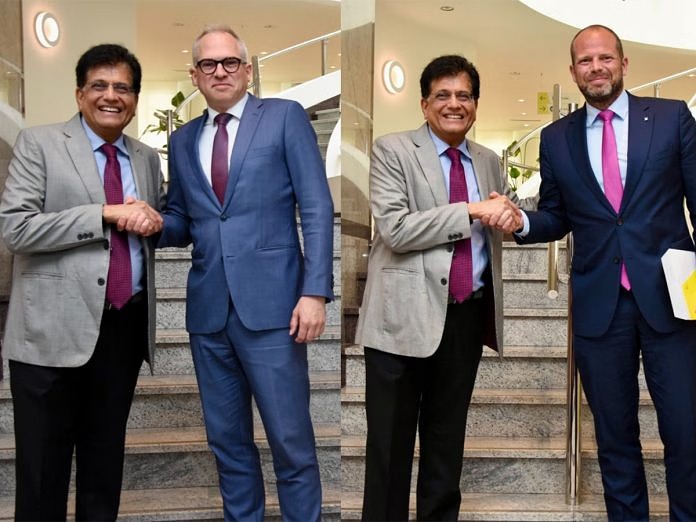
BURSSELS : Union Minister of Commerce and Industry, Shri Piyush Goyal, held a productive meeting in Brussels on 2nd May 2025 with Belgian Minister of Defence and Foreign Trade Mr. Theo Francken and Minister-President of the Flanders region Mr. Matthias Diependaele to strengthen the Indo-Belgianpartnership across trade, technology, investment, and innovation. This engagement follows the March 2025 visit of HRH Princess Astrid of Belgium to India, where her meeting with Prime Minister Shri Narendra Modi underscored the shared ambition to unlock new avenues for collaboration in trade, technology, defence, agriculture, life sciences, innovation, skilling and academic exchanges. The over 300-member Belgian Economic Mission, led by Princess Astrid, infused fresh momentum into this dynamic bilateral relationship. Both sides reaffirmed their commitment to building on this momentum to forge resilient, future-focused ties that enhance mutual growth and contribute to a more integrated global economic framework.
The discussions highlighted growing economic synergies and focused on scaling bilateral trade, fostering industrial collaboration, and deepening investments in strategic sectors such as semiconductors, clean energy, defence production, and pharmaceuticals.The Flanders region, recognized as Belgium’s economic engine, was highlighted as a critical partner with its advanced manufacturing ecosystem, R&D infrastructure, and its strategic role as a European gateway. With India already the world’s fastest-growing major economy and widely expected to remain so over the next two decades ahead—driven by a young, aspirational population and a dynamic reform-oriented environment—the growth story presents an unprecedented opportunity for India and Belgium.
The two sides reaffirmed their shared vision of mutual prosperity and resilient economic cooperation amidst evolving global challenges. Minister Goyal reflected on India’s transformative economic journey over the past decade, emphasizing reforms that have empowered citizens and entrepreneurs alike. “The last eleven years have not only been about economic upliftment, but about enabling aspirations,” he stated.
The meeting also reviewed progress in EU–India Free Trade Agreement (FTA) negotiations, with both parties recognizing the need to address tariff and non-tariff barriers to enhance market access. Minister Goyal reiterated India’s position as a trusted and long-term economic partner for Europe’s growth, remarking, “India is not just a market of the future—it is a collaborator of trust.”
Belgium remains one of India’s most significant economic partners in Europe. It is India’s 5th largest trading partner within the EU, with bilateral trade reaching USD 15.07 billion in 2023–24. Belgian FDI in India has totaled USD 3.94 billion from April 2000 to September 2024, including a remarkable 39% growth—USD 1.1 billion—in the past year alone. Bilateral cooperation spans a wide array of sectors including defence manufacturing, green hydrogen, nano-electronics, nuclear medicine, and pharmaceutical R&D, reflecting the expanding depth and strategic nature of the Indo-Belgian economic relationship. Both sides agreed to strengthen high-level engagements and facilitate regular visits by business delegations to accelerate trade and investment outcomes
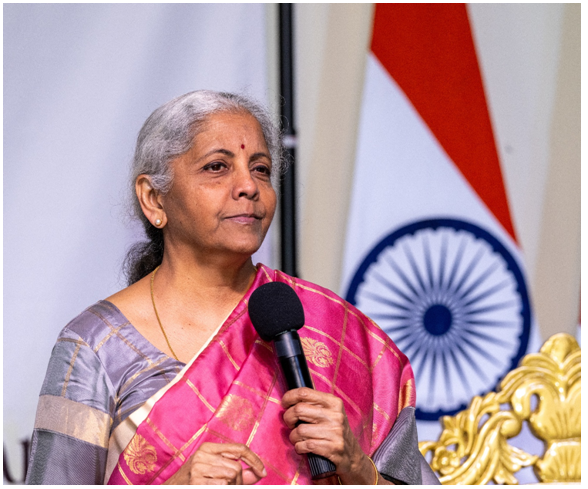
MILAN : Union Minister for Finance & Corporate Affairs Smt. Nirmala Sitharaman will lead the Indian delegation of officials from the Department of Economic Affairs, Ministry of Finance, to attend the 58th Annual Meeting of the Board of Governors of Asian Development Bank (ADB), scheduled to take place in Milan, Italy, from May 4 to 7, 2025.
The meetings will be attended by official delegations of Board of Governors of ADB, official delegations of ADB members and international financial institutions. The Union Finance Minister will participate in the Annual Meeting’s focal events like the Governors’ Business session, Governor’s Plenary Session and as a panelist in the ADB Governors’ Seminar on “Cross-Border Collaboration for Future Resilience”.
On the sidelines of the ADB’s 58th Annual Meeting, Smt. Sitharaman will also hold bilateral meetings with Finance Ministers of Italy, Japan, and Bhutan, in addition to meetings with President of ADB, the President of the International Fund for Agricultural Development (IFAD), and the Governor of the Japan Bank for International Cooperation (JBIC).
The Union Finance Minister will also interact with the Indian diaspora in Milan, besides meeting global think-tanks, business leaders and CEOs, and participating in a Plenary Session of the NEXT Milan Forum at the Bocconi University on “Balancing Economic and Climate Resilience”.